
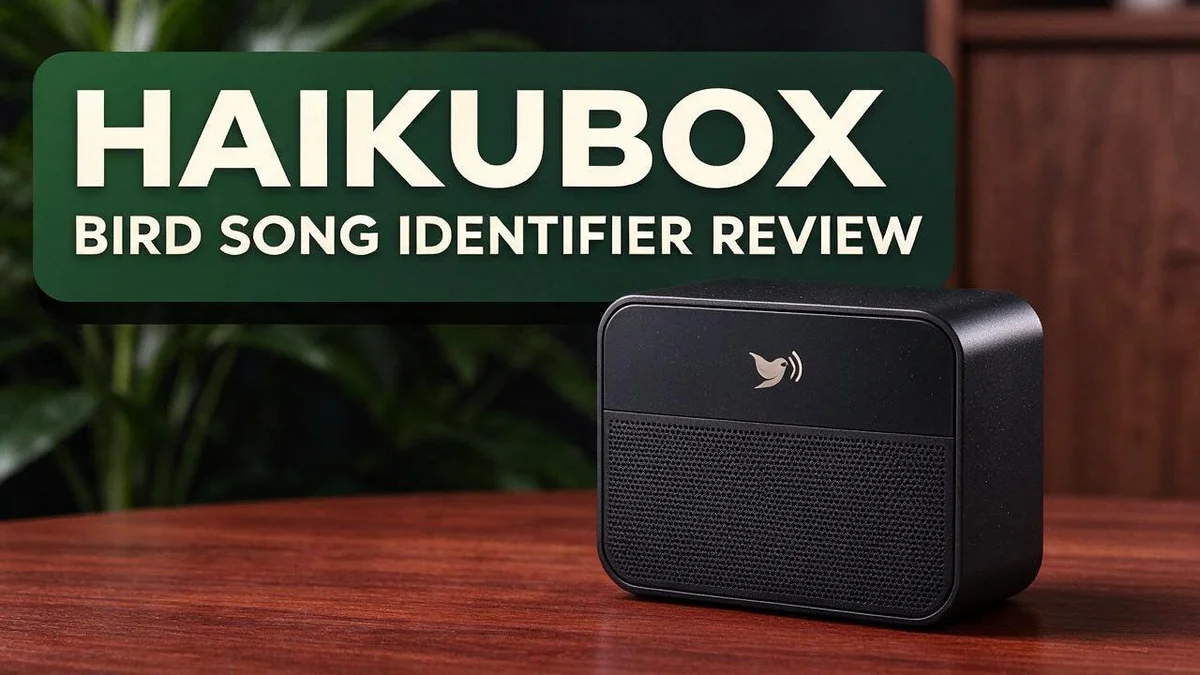
Haikubox Bird Song Identifier Review 2026: Buyer’s Guide
Have you ever heard a bird sing and wondered what it was? The Haikubox Bird Song Identifier can give you the answer. It is an AI enabled device that names bird species by their songs and calls.
Setup is easy. You plug the unit into an outdoor outlet, and it starts listening. It runs 24/7 and sends alerts as birds sing nearby.
Every detection comes with a call recording and a spectrogram. You can play back the sounds and see the patterns for yourself. Many owners also compare songs across years and across species.
The creator reports over 1.3 billion songs and calls identified and recorded. That number shows how much data the system has learned from. Still, some identifications can be quirky, so keep your ears open too.
In a Nutshell
-
Smart listening: This device uses artificial intelligence to name birds by their songs and calls. Its neural net learned from thousands of recordings. It can name many species without help from you.
-
Always on: It listens 24/7 without a break. You receive real time alerts when a bird sings nearby. You can also review the sounds later.
-
Simple outdoor power: This autonomous recording unit plugs into an outdoor outlet. You can place it in a garden, on a balcony, or near a window.
-
Compare over time: You can compare songs across years and across species. This helps you spot changes in local bird activity.
-
Some quirks: Identification is not always perfect. Some calls may get labeled incorrectly, so double check important results.
-
DIY option: BirdNET-Pi offers a hands on alternative for hobbyists. It takes more technical skill, but it gives you more control over the setup.
Key Features

- AI-Powered Bird Sound Identification: Bring nature inside your home, then get outside to experience it! Like the haiku poem, this little haiku box is a keen nature observer, harnessing AI to identify your birds using their songs and calls. It's a tireless bird sound identifier, gathering bird recordings day and night, and sharing them so you know when your favorite birds visit. Natural sounds have been found to improve health, increase a positive outlook, and lower stress. Haikubox is an addition to your existing cameras and feeders.
- Award-Winning Technology: TIME Best Invention of 2024 in Outdoors category and WIRED Review 9/10: "It's one of the rare pieces of technology that actually increases your connection to the world around you, rather than cutting you off." Audubon: "What distinguished Haikubox... is that it will detect all singing birds within range, not just those that visit feeders. It is especially suited for bird nerds."
Last update on 2026-09-13 / Affiliate links / Images from Amazon Product Advertising API Some of the links on this website are affiliate links, which means that at no additional cost to you, I earn a commission if you click through and make a purchase. I only recommend products and services that I believe will add value to my readers. Thank you for your support!
Instant alerts keep you in the loop. The device sends an alert as soon as it hears a bird. You can step outside and see your visitors while they still sing.
A neural net built from many recordings. The system uses BirdNET for Haikubox. This proprietary neural net learned from thousands of recordings. That training helps it pick out many species from short calls.
Your own growing sound library. Every detection adds to a collection you can revisit. Over time, you can use these clips to learn songs by ear.
Fun for the whole family. Kids often love guessing which bird is singing. The device turns a backyard into a small mystery. Everyone can join in.
Works well for beginners. New birders often struggle with similar songs. The device gives a name for each call, so you can learn faster. Practice becomes easier with clear results.
Sound before sight. Many species stay hidden in dense leaves. Their songs can reveal them first. A listening tool helps you find them without a long search.
Helpful for garden planning. Knowing which birds visit can guide your plants and feeders. You learn what your yard attracts throughout the year.
A smart choice for busy people. You do not need to sit and listen for hours. The device does the listening for you. You still get the results whenever you check your app.
A clear summary of your local birds. Over a season, the results show which species appear most often. This helps you notice new arrivals quickly.
Final thoughts for curious minds. This device suits anyone who loves nature sounds. It turns everyday noise into useful information. Many people find that rewarding.
Identification Accuracy
Accuracy matters most when you trust the name on screen. The Haikubox uses BirdNET for Haikubox, a neural net. It compares each sound with patterns learned from many recordings. The match is only as good as the sound it hears.
Wind, rain, and traffic can confuse the system. A noisy recording may hide the key notes of a song. Placement matters too. A spot near a busy road or a loud fountain can lower results.
Similar songs cause the most mix ups. Many sparrows, warblers, and finches sound alike to the human ear. The device may pick the closest match and miss the true bird. Listen to the recording yourself before you accept a name.
The spectrogram becomes your best check. This picture shows pitch and timing across each call. Compare the shape of the notes with a field guide or a trusted bird site. After a few weeks, you will spot differences fast.
Seasons also shape accuracy. Birds sing more in spring, so you get more detections to review. In fall and winter, many birds stay quiet. A short list does not always mean a bird left your yard.
Think of each detection as a clue, not a final answer. Over time, your sound library reveals patterns. You may notice one species always calls at dawn. Those patterns often prove more useful than any single result.
Research shows that the device has identification quirks, but detailed test data is hard to find. That makes careful checking even more important. Compare results with a second tool when you want extra confidence.
Your own ears still matter. Practice matching songs to birds you already know. Your skill grows with each visit. The device becomes easier to trust as you learn.
Setup and Outdoor Placement
Finding the right spot makes a big difference. A good location helps the microphone hear more birds clearly. Think about where birds already gather in your yard.
Pick a quiet corner first. Busy roads, lawn mowers, and loud neighbors can hide soft songs. Move the unit away from these sounds if you can.
Shelter matters too. Strong wind and heavy rain can add noise to every recording. Try to place the device under an eave or a covered porch. Keep it dry and secure.
Height helps as well. Mounting the unit at a moderate height lets it pick up birds in trees and shrubs. Avoid placing it low to the ground, where grass and plants may muffle sound.
Think about the birds you want to hear. Place the unit near a feeder, a bird bath, or a flowering shrub. Birds often sing near these spots. This gives you more detections each day.
Cable routing is another detail to plan. Run the power cord along a wall or fence line. Tuck loose cord out of reach of pets and kids. A tidy setup stays safe for years.
Mounting tips also help. Use sturdy brackets or a stable post so the unit does not sway. Check the fixings after storms. A loose mount may shift and change what it records.
Test before you commit. Place the device, then check the app for a few days. If the results look thin, move it a few feet. Small changes can bring a big boost in activity.
Keep seasons in mind. Summer brings lush leaves that can muffle calls, while winter may reveal more birds. Adjust your spot as the year changes, and watch how the bird list shifts.
Protect the unit from pests and damage. Check for spider webs and nests near the vents. Clean the housing gently with a dry cloth.
Good placement turns a simple gadget into a reliable garden partner. Take time with this step, and your bird log will show the rewards each week.
Top 3 Alternatives
Bird Buddy Smart Feeder

- AI-POWERED BIRDWATCHING APP: Premium Subscription required. The Bird Buddy app uses AI to identify bird species and individual birds, detect signs of illness, recognize other animal visitors, and provide real-time alerts when birds visit your feeder. Access advanced birdwatching features, personalized collections, and insights about your local wildlife through an active subscription.
- ADVANCED HD+ BIRD FEEDER CAMERA: The 2x larger sensor supports HDR for stunning contrasts and vibrant colors in 5MP photos and 2K video resolution. Unlock extra features and capture slow-motion videos of birds in flight, or enjoy a wider field of view.
Last update on 2026-07-01 / Affiliate links / Images from Amazon Product Advertising API Some of the links on this website are affiliate links, which means that at no additional cost to you, I earn a commission if you click through and make a purchase. I only recommend products and services that I believe will add value to my readers. Thank you for your support!
The Bird Buddy Smart Feeder suits people who love watching birds up close.
It has a built-in camera that takes high quality photos and videos of every visitor. When a bird lands on the perch, you get an alert on your phone.
The companion app helps you learn each species name. Kids and beginners often enjoy this feature most.
Birdfy Smart Feeder

- THE HEXA WARRIOR OF SMART BIRD FEEDERS. Unlike plastic bird feeders that fade, warp, or crack over time, Birdfy all-metal bird feeder with camera is built to thrive outdoors. It excels in design, performance, ease of use, intelligence, solar-powered endurance, and overall value—embodying perfect balance, much like a hexagon where every side is strong. With crystal-clear HD visuals and effortless setup right out of the box, it’s a long-lasting companion, proven over time and through experience
- REFINED DESIGN, NATURAL HARMONY. Birdfy is devoted to refining every detail of design, from functionality to the harmony of color. Birdfy camera bird feeder adds a refreshing touch of green to your outdoor space with its smooth, glossy metallic finish that complements your backyard’s changing beauty. Even in winter, when thick snow blankets the ground and branches stand bare, it becomes a vibrant hint of green that brings warmth and vitality back to your garden
Last update on 2026-06-17 / Affiliate links / Images from Amazon Product Advertising API Some of the links on this website are affiliate links, which means that at no additional cost to you, I earn a commission if you click through and make a purchase. I only recommend products and services that I believe will add value to my readers. Thank you for your support!
The Birdfy Smart Feeder offers a simple way to track backyard visitors. Its camera records clear footage and uses artificial intelligence to recognize bird species.
Setup takes only a few minutes. The feeder fits most outdoor spaces, so you can place it near a window or patio.
Many owners like how it sends short clips straight to their phones. You can also share favorite moments with friends and family.
Wingscapes BirdCam Pro
- AI-POWERED BIRDWATCHING APP: Premium Subscription required. The Bird Buddy app uses AI to identify bird species and individual birds, detect signs of illness, recognize other animal visitors, and provide real-time alerts when birds visit your feeder. Access advanced birdwatching features, personalized collections, and insights about your local wildlife through an active subscription.
- ADVANCED HD+ BIRD FEEDER CAMERA: The 2x larger sensor supports HDR for stunning contrasts and vibrant colors in 5MP photos and 2K video resolution. Unlock extra features and capture slow-motion videos of birds in flight, or enjoy a wider field of view.
Last update on 2026-07-01 / Affiliate links / Images from Amazon Product Advertising API Some of the links on this website are affiliate links, which means that at no additional cost to you, I earn a commission if you click through and make a purchase. I only recommend products and services that I believe will add value to my readers. Thank you for your support!
The Wingscapes BirdCam Pro suits people who want a rugged outdoor camera. It captures photos and short videos when motion triggers the sensor.
It runs on batteries, so you can place it almost anywhere. Many users mount it on a tree or fence post for a clear view.
This option works well for gardeners, hikers, and researchers. It keeps working through rain, wind, and cold nights.
Song Logs, Spectrograms and Year-Over-Year Comparisons
The song log is where the Haikubox really shines. Each detection gets saved with a timestamp, so you can see when a bird sang. Over days, the log shows a clear daily rhythm.
Listen to the actual call first. Recordings let you hear the exact song that the device caught. Play the clip more than once, and listen for repeated notes or rising trills.
Spectrograms add a visual layer. A spectrogram shows pitch and timing as a picture. Bright lines mark the high notes, and the pattern helps you match a song to a species.
Compare two clips side by side. A robin song and a thrush song may look similar at first. Their shapes on the spectrogram often differ in small ways.
Year to year comparisons add a new layer. Because the device keeps recordings, you can look back at the same month across several years. You may notice that a species arrives earlier in spring or stays later in autumn.
Save clips from key dates. Mark the first song of spring or the last call before winter. Over time, these saved clips build a personal archive of your garden’s seasons.
Use the comparisons with care. Weather, nesting activity, and background noise change each year. A quiet season may simply reflect a busy road or a windy spring rather than fewer birds.
Keep notes next to the logs. Write down unusual weather, new plants, or construction nearby. These notes help explain sudden changes in your data.
Patience pays off with logs. A few weeks of data gives a rough picture. A full year shows the true rhythm of your local birds.
Your logs also reveal patterns across species. You might see several birds singing at dawn, then fewer during the hottest hour of the day. Pattern spotting becomes a fun habit for the whole family.
Sort the entries by species to see who visits most often.
Pros and Cons
Pros
– Setup feels easy, and the device is fun to use.
– It listens all day and all night and sends alerts as birds sing.
– The recognition system learns from thousands of bird recordings.
– You can compare songs across years and across species.
– The maker reports over 1.3 billion songs and calls identified.
Cons
– Identification sometimes makes quirky mistakes.
– It needs a nearby outdoor power outlet to run.
– Independent test data on accuracy is hard to find.
– DIY options like BirdNET-Pi exist for people who enjoy tinkering.
Who Should Buy It
Not every bird lover needs this device. Some people will get more from it than others.
Beginners who want to learn birds by ear may find it helpful. Each alert gives a clear name to a song they hear.
The device suits people who cannot spend hours outside. It keeps listening while you work, cook, or sleep.
Parents and teachers can use it as a simple home or classroom project. Children can guess the bird before they check the name.
Retirees often enjoy this kind of steady, low effort hobby. They can enjoy birdsong from a favorite chair.
People with limited mobility can enjoy bird life without long walks. The calls reach a home office or living room window.
Renters and apartment dwellers should check their setup first. The unit needs a nearby outdoor outlet, so a balcony or patio may work best.
Rural and suburban homeowners often get the most from it. Quieter surroundings can bring clearer songs and a wider mix of species.
Night shift workers may enjoy the around the clock listening. They can check alerts after waking and see what sang overnight.
People who keep nature journals can use the daily alerts as prompts. A new species can become a short entry each week.
Researchers who need verified records should use it as a helper, not a final source. They can pair its results with their own field checks.
Readers who want a plug and play option will like it most. It asks for little time and gives steady rewards.
Sharing a favorite recording with friends can spark great conversations. Anyone who wants steady, quiet company at home may appreciate the songs filling the room without any screen time.
In short, this fits people who want easy, ongoing bird sounds. It suits the curious, the patient, and anyone who enjoys a daily nature moment.
Final Verdict
The short answer is that the Haikubox is worth a close look. It brings a steady stream of bird activity right to your home.
It listens around the clock, so you never miss early risers or night singers.
Its recognition engine learned from thousands of recordings. That training helps it name many common species with ease.
Its biggest strength is the steady pace of discovery. Each new species on the list invites a closer look at your yard.
The maker reports more than 1.3 billion detections. Keep in mind that this figure comes from the maker, not an outside audit.
Accuracy deserves a careful eye. Independent test data is hard to find, so treat each name as a strong hint rather than a final fact.
Reviewers note that identification has quirks. Confirm unusual names with a field guide or a local birding group before you log them.
Newer AI bird sound monitors keep appearing on the market. Compare features and listening coverage before you commit.
Placement shapes your results more than most shoppers expect. A spot with open air and varied plant life gives the widest range of songs.
Seasons change what you hear. Spring brings a burst of singing, while winter often brings quieter days.
Time also plays a role. Months of data reveal patterns that a few days never could.
Give the device a full season before you judge it. Early impressions can change once the seasons turn.
The Haikubox works best as part of a wider nature routine. Pair it with short walks or a bird feeder for a fuller picture.
Overall, the device earns a solid recommendation for curious homeowners.
For most people, its steady rhythm of sightings outweighs the occasional misfire.
The gadget opens the door, but you still do the learning. Stay curious, and let each new sound teach you something.
Frequently Asked Questions
What does a spectrogram show?
A spectrogram is a picture of a bird song. It shows pitch and timing as lines and shapes. You can compare a new call with a known one to learn the patterns of each species.
What should I do when a species name looks wrong?
Treat the name as a clue, not a final answer. Open the call recording and listen again. Then check the spectrogram before you trust the label.
What if I see no birds at first?
Give the device a few days. Birds sing more at dawn and dusk, so early and late hours often bring the most results. Also confirm that the outlet has power and that the unit sits where birds can be heard.
Where should I place the device?
Choose a spot near an outdoor outlet with trees or shrubs nearby. Keep it away from loud machines and busy noise sources. A quiet, clear spot helps the microphone catch cleaner songs.
Can I use the logs to spot seasonal patterns?
Yes, the logs work well for this. Review the species list each month to see which birds arrive, stay, or leave. Over time, these notes show how the seasons shape the birds in your yard.

Hello, I’m Amelia White, the founder of birdsfanatic.com. As a lifelong bird enthusiast and spiritual seeker, I’ve always been fascinated by the mystical connections between birds and the human experience. On this site, I share my knowledge and insights into the symbolic meanings and spiritual significance of various bird species, exploring their roles in mythology, folklore, and cultural traditions. Join me on this journey into the world of birds, where we’ll discover the hidden wisdom and guidance that these magnificent creatures have to offer.
