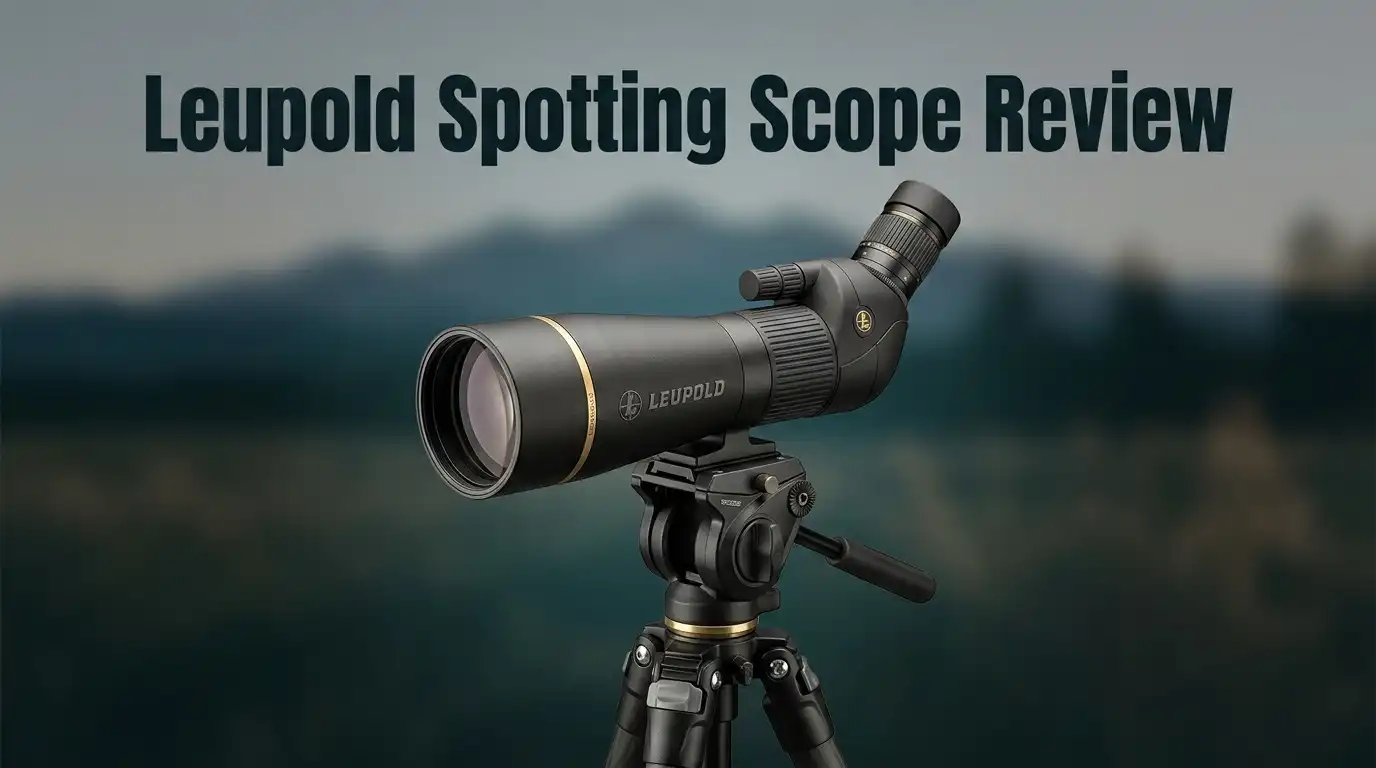
Leupold Spotting Scope Review 2026: Worth Buying?
Leupold has built spotting scopes in Oregon for decades, and the 2026 lineup is the strongest the brand has offered.
Three families matter right now: the budget friendly SX-2 Alpine HD Gen 2, the mid tier SX-4 Pro Guide HD Gen 2, and the flagship SX-5 Santiam HD. Each one promises bright glass, a lifetime guarantee, and a body that survives rain, snow, and truck beds.
This review covers real performance, honest weak points, unboxing details, and the price you actually pay in 2026. You will learn which model fits your hunt, your range day, or your birding hobby.
In a Nutshell:
- The SX-4 Pro Guide HD Gen 2 is the value winner. At $1,199.99 for the 20-60×85 angled model, it delivers most of the flagship image quality for roughly 60 percent of the price. The Arca Swiss base and Guard ion coatings are the biggest Gen 2 upgrades.
- The SX-5 Santiam HD is the sharpest Leupold spotter made. The 27-55×80 configuration trades zoom range for a wider, brighter, cleaner image at high power. It costs $1,999.99 and competes directly with the Vortex Razor HD.
- The SX-2 Alpine HD Gen 2 is an entry level tool, not a giant killer. Around $299 to $500 depending on objective size, it beats cheap no name glass easily but shows color fringing and image mush past 45x.
- Every Leupold spotter carries the Leupold Lifetime Guarantee. No receipt. No registration. They repair or replace the scope free, and the service reputation is genuinely excellent.
- None of these scopes are lightweight. The 85mm SX-4 weighs 78.2 ounces and measures 17.7 inches. Backcountry hunters counting grams should look at the 65mm models or a Maven instead.
- Top magnification is marketing on the budget models. Usable power on the SX-2 tops out near 40x in average air. Plan around that number, not the 60x printed on the box.
Why Leupold Still Matters in the 2026 Optics Market

- Model #185679 - SX-4 Pro Guide HD Gen2 20-60x85 Spotting Scope - Angled Eyepiece
Last update on 2026-09-20 / Affiliate links / Images from Amazon Product Advertising API Some of the links on this website are affiliate links, which means that at no additional cost to you, I earn a commission if you click through and make a purchase. I only recommend products and services that I believe will add value to my readers. Thank you for your support!
Leupold occupies an unusual spot. The company is American owned, assembles most optics in Beaverton, Oregon, and backs everything with a no questions asked guarantee. That combination keeps hunters loyal even when Asian built competitors undercut the price.
The 2026 lineup reflects a real shift. Leupold spent the last two product cycles fixing complaints instead of chasing higher magnification numbers. Arca Swiss bases replaced fiddly tripod plates. Interchangeable eyecups replaced the one size compromise. Lens coatings got tougher and more water repellent.
These are practical upgrades, not marketing fluff. Anyone who has fought a tripod plate with frozen fingers understands why the Arca Swiss foot matters more than another five power of zoom.
The brand still does not compete with Swarovski or Zeiss on pure resolution. Leupold does not pretend otherwise. What it offers is 85 percent of alpine European performance at 35 percent of the price, plus a warranty that outlives the owner. For most American hunters and shooters, that math works.
Leupold SX-4 Pro Guide HD Gen 2 20-60×85 Angled Review
This is the scope most people should buy. The SX-4 Pro Guide HD Gen 2 sits at $1,199.99 and covers 20x to 60x through an 85mm objective. Leupold rebuilt it around the Elite Optical System, which means better dawn and dusk light transmission and noticeably stronger glare control.
Real specs matter here. The scope stretches 17.7 inches and weighs 78.2 ounces. Field of view runs 91.7 feet at 1000 yards on 20x and drops to 50.6 feet at 60x. Eye relief measures 19mm low and 17.8mm high, which is generous enough for eyeglass wearers. Close focus sits at 35 feet.
In the field the image holds together impressively well. Edge sharpness stays clean to roughly 80 percent of the field. Color rendition leans slightly warm, which flatters tan hides against brown hillsides. Chromatic aberration appears only on high contrast edges above 50x, and even then it stays faint.
Pros
- Excellent brightness for the price class, especially in the last twenty minutes of legal light
- Built in Arca Swiss base mounts directly to modern tripods with no adapter plate
- Magnesium body with rubber armor survives real abuse and stays 100 percent waterproof
- Two sizes of FormFit eyecups let you block stray light or glass with glasses
- DiamondCoat 2 lens surfaces resist scratches better than any previous Leupold coating
Cons
- At nearly five pounds it punishes anyone hiking more than a few miles
- Image quality degrades visibly above 50x in heat shimmer
- No dual focus knob, so fine focusing at high power takes patience
- Tripod, case, and phone adapter cost extra
Unboxing the SX-4 Pro Guide HD Gen 2
The box is plain brown cardboard with a printed product photo. Nothing luxurious, which honestly suits the brand. Inside you find the scope wrapped in foam, a zippered neoprene stay on case, both sets of FormFit eyecups, a lens cloth, and the manual.
Lifting the scope out is the first real impression. It feels dense and cold. The magnesium chassis has heft that plastic bodied spotters never match. Rubber armor grips your palm even with damp hands.
The focus wheel is the standout detail. It runs the full length of the barrel, turns with light resistance, and shows zero backlash. Leupold clearly spent money here.
The stay on case is good but not great. It protects the body well and leaves the eyepiece and objective accessible. The zippers feel thin compared to the scope itself, and the shoulder strap is basic nylon.
Swapping eyecups takes about ten seconds. They twist off and snap on with a satisfying click. No tools required, which is exactly right.
Leupold SX-5 Santiam HD 27-55×80 Review

- Model #185605 - SX-5 Santiam HD 27-55x80 Spotting Scope - Angled Eyepiece
- Professional-Grade Optical System - offers unmatched light transmission that's designed to outperform in the most challenging lighting conditions, industry-leading glare reduction for a clear image in harsh, direct light, and the resolution and clarity in the field
Last update on 2026-09-20 / Affiliate links / Images from Amazon Product Advertising API Some of the links on this website are affiliate links, which means that at no additional cost to you, I earn a commission if you click through and make a purchase. I only recommend products and services that I believe will add value to my readers. Thank you for your support!
The SX-5 Santiam HD is the flagship, priced at $1,999.99. Leupold made a deliberate engineering choice here: instead of a 20x to 60x range, the Santiam runs 27x to 55x through an 80mm objective. That narrower range lets the designers optimize the entire zoom band instead of compromising at the extremes.
The result is obvious the moment you look through it. The image at 55x stays bright and resolved where the SX-4 at 55x begins to soften. Contrast is deeper. Colors read cooler and more neutral, which helps with judging antler tines and bullet holes at distance.
Independent testers consistently rank the Santiam near the top of the sub $2,000 class, matching or beating the Maven S1 and Vortex Razor HD on edge to edge clarity. Low light performance is where it truly separates itself. You gain roughly five to eight extra minutes of usable glassing at dusk compared to the SX-4.
Pros
- Best resolution and contrast in the Leupold catalog by a clear margin
- Twin power throw levers and a smooth focus system make adjustments fast
- Fully usable at maximum magnification, unlike most 60x spotters
- Weighs about 4.3 pounds, lighter than the 85mm SX-4
- Lifetime guarantee applies exactly the same as every other Leupold
Cons
- Starting magnification of 27x is too high for scanning wide basins quickly
- Two thousand dollars buys used Swarovski or Kowa glass on the secondhand market
- Narrow field of view makes finding animals harder than with a 20x scope
- Eyepiece is not interchangeable, so no reticle or wide angle options
Top 3 Alternative for Leupold SX-4 Pro Guide HD Gen 2

- Model #185684 - SX-4 Pro Guide HD Gen 2 20-60x80mm Spotting Scope - Angled Eyepiece
Last update on 2026-09-20 / Affiliate links / Images from Amazon Product Advertising API Some of the links on this website are affiliate links, which means that at no additional cost to you, I earn a commission if you click through and make a purchase. I only recommend products and services that I believe will add value to my readers. Thank you for your support!
Leupold SX-2 Alpine HD Gen 2 20-60×80 Angled Spotting Scope

- The Viper HD 20-60x85 Angled spotter is packed with features for incredible glassing and high end optical performance. A multi-position eyecup provides proper eye relief while a locking collar allows the scope to rotate into different viewing positions.
- The HD optical system comprised of premium components generates vivid high-definition images. XR anti-reflective coatings on exterior surfaces help obtain brighter views in low-light situations.
Last update on 2026-09-20 / Affiliate links / Images from Amazon Product Advertising API Some of the links on this website are affiliate links, which means that at no additional cost to you, I earn a commission if you click through and make a purchase. I only recommend products and services that I believe will add value to my readers. Thank you for your support!
Vortex Viper HD 20-60×85 Angled Spotting Scope

- The redesigned Diamondback HD spotting scope has all the optical horsepower the western hunter needs, and excels in low light. It features a streamlined exterior for a sleeker profile and a built-in helical focus wheel for fast and fine adjustments.
- HD optical system delivers exceptional resolution, cuts chromatic aberration and provides outstanding color fidelity, edge-to-edge sharpness and light transmission. Multiple anti-reflective coatings on all air-to-glass surfaces increase light transmission
Last update on 2026-09-17 / Affiliate links / Images from Amazon Product Advertising API Some of the links on this website are affiliate links, which means that at no additional cost to you, I earn a commission if you click through and make a purchase. I only recommend products and services that I believe will add value to my readers. Thank you for your support!
Vortex Diamondback HD 20-60×85 Angled Spotting Scope
Leupold SX-2 Alpine HD Gen 2 20-60×80 Review
The SX-2 Alpine HD Gen 2 is the entry point. Street prices land near $299 for the 20-60×60 version and around $492 for the 20-60×80 model. Both use calcium fluoride HD lenses, magnesium bodies, and the same Arca Swiss base found on pricier Leupolds.
This scope earns its place, but you must set expectations correctly. On a clear morning at 200 to 400 yards, the image is bright, flat, and completely usable. You can count points, spot .22 holes at 100 yards, and identify waterfowl comfortably.
Push past 45x and the picture washes out. Purple fringing shows up on backlit branches. The exit pupil shrinks to a pinhole, so any hand shake or cheap tripod ruins the view.
The Gen 2 refresh helped more than the price suggests. Glare control improved, the eyecups now adjust properly, and the tripod foot no longer needs an adapter. For a first spotting scope, or a truck scope you will not cry over, the SX-2 is a sensible buy.
Glass Quality and Image Clarity Compared
Leupold uses calcium fluoride lens elements across all three families, but the execution differs sharply. The SX-2 gets HD glass in fewer elements. The SX-4 adds more corrected elements plus DiamondCoat 2. The SX-5 uses the most refined stack in the catalog.
Side by side at 40x on a resolution chart, the ranking is unmistakable. The Santiam resolves fine detail the SX-4 blurs slightly. The SX-4 resolves detail the SX-2 turns into mush.
Edge performance tells the same story. The SX-5 stays sharp to roughly 90 percent of the field. The SX-4 manages about 80 percent. The SX-2 softens noticeably at 65 percent.
Color fidelity follows price too. The Santiam renders neutral whites and accurate greens. The SX-4 pushes warm. The SX-2 shifts slightly yellow in bright sun.
None of this makes the cheaper scopes bad. It means you should match the scope to the distance you actually glass.
Low Light Performance at Dawn and Dusk
Legal shooting light is when spotting scopes earn their keep. Exit pupil size drives most of this. The SX-4 at 20x offers a 4.1mm exit pupil, which gathers plenty of light for a dilated human eye. At 60x that shrinks to 1.4mm, and the image goes dim fast.
The practical lesson is simple: drop your magnification when light fades. Glassing at 25x in dusk beats glassing at 50x every single time.
The SX-5 Santiam handles the dim minutes best. Its coatings and prism design squeeze more light through the system, and testers regularly report five to eight extra usable minutes compared to mid tier competitors.
The SX-2 falls off first. Once the sun drops behind a ridge, the 80mm Alpine loses contrast quickly, and shadow detail disappears.
Weather matters as much as glass. Fog, dust, and heat shimmer flatten any scope. On a hot afternoon, even a $3,000 spotter cannot see through boiling air at 60x.
Build Quality and Weather Sealing
Leupold pioneered nitrogen sealing decades ago, and the current lineup shows it. All three scopes are 100 percent waterproof and fogproof. Leupold tests them through extreme temperature swings and elevation changes that mimic real hunts.
The magnesium chassis is the key structural piece. It resists dents better than aluminum at similar weight, and it does not flex when you torque the scope onto a tripod head.
Rubber armor wraps the whole body. It grips well when wet and absorbs minor impacts. After a season of use, expect scuffs but no cracking.
The lens coatings deserve specific mention. Guard ion sheds water and dirt, so raindrops bead off instead of smearing. DiamondCoat 2 resists abrasion better than any earlier Leupold treatment. You can wipe the objective with a shirt tail in an emergency without immediately scratching it.
The integrated sunshade slides out smoothly on the SX-4 and SX-5. It kills glare and keeps snow off the front element.
Tripod Mounting and Arca Swiss Convenience
This upgrade changes daily use more than any optical improvement. The Gen 2 SX-4 and the SX-2 Alpine Gen 2 both ship with integrated Arca Swiss dovetails machined into the tripod foot. You clamp the scope straight onto a compatible head.
No adapter plate. No lost screws. No tools in the dark.
The foot also keeps standard 1/4 20 threads, so older tripods and window mounts still work. The rotating collar lets you swing an angled eyepiece sideways for prone shooting or uphill glassing.
Do not cheap out on the tripod. An 85mm spotter weighing five pounds will shake on a $60 aluminum tripod, and shake destroys resolution faster than bad glass. Budget at least $150 to $300 for a stable head and legs rated well above your scope weight.
Carbon fiber legs help in wind and cold. A fluid pan head makes tracking moving animals far easier than a ball head. These accessories are not optional extras. They are part of the system.
Digiscoping with Your Phone
Phone photography through a spotting scope is popular, and Leupold scopes handle it reasonably well. The generous eye relief on the SX-4 gives you room to position a phone lens without heavy vignetting.
You will need a dedicated adapter. Leupold does not include one. Third party metal clamp adapters cost $25 to $60 and hold alignment far better than plastic models.
Results are decent, not spectacular. At 20x to 30x you get shareable images of animals and sharp video of impacts on steel. Above 40x, phone sensors struggle with the tiny exit pupil and images turn dark and noisy.
The SX-5 Santiam produces the cleanest digiscoped images thanks to its brighter high power view. The SX-2 produces the weakest, with visible edge softness and color fringing in photos.
One practical tip: turn off your phone’s digital zoom entirely. Let the scope do the magnifying. Digital zoom only multiplies the flaws already present in the image.
What Leupold Spotting Scopes Do Not Do Well
Honest reviews name the failures. Here are the real ones.
Weight is the biggest problem. The 85mm SX-4 at 78.2 ounces is genuinely heavy. Add a tripod and you carry seven or eight pounds. Backcountry hunters covering rough miles will resent it by day three.
Maximum magnification is optimistic on every model except the Santiam. The SX-4 gets soft above 50x. The SX-2 gets soft above 40x. Advertised 60x is a number, not a promise.
Accessories are sparse. No tripod. No phone adapter. The included stay on case feels cheaper than the scope.
Close focus of 35 feet on the SX-4 rules out butterfly and insect watching, a real limitation for naturalists.
Leupold also lacks interchangeable eyepieces across the line. Competitors offer reticle eyepieces and wide angle options. Leupold does not.
Finally, the SX-5 at $1,999.99 faces brutal competition. Used alpha glass sells in that range, and some buyers will prefer it.
Leupold vs Vortex vs Maven in 2026
Vortex is the most direct rival. The Viper HD 20-60×85 sells near $899 and undercuts the SX-4 by roughly $300. Optically the two trade blows, with the Leupold showing slightly better glare control and the Vortex offering a dual focus system many shooters prefer.
Warranty is a wash. Both companies replace damaged optics without receipts or questions, and both have excellent service records.
The Vortex Diamondback HD 20-60×85 competes with the SX-2 Alpine and generally wins on value, though the Leupold feels better built in hand.
Maven plays a different game. The direct to consumer model delivers very high glass quality per dollar, and the ultralight S.2 at 34 ounces solves the weight problem Leupold has not solved.
Choose Leupold for American assembly, service culture, and durability. Choose Vortex for price. Choose Maven for weight and pure optical value per dollar.
Who Should Buy Which Leupold Model
Match the scope to your actual use, not your ambition.
Buy the SX-2 Alpine HD Gen 2 if you shoot at a range under 300 yards, watch backyard wildlife, or need a first spotter under $500. It does that job honestly.
Buy the SX-4 Pro Guide HD Gen 2 20-60×85 if you hunt open country from a vehicle or a short hike, judge animals at 600 to 1200 yards, or want one scope that does everything reasonably well. This is the model I recommend to most readers.
Buy the SX-4 Pro Guide HD Gen 2 15-45×65 at $999.99 if you pack in on foot. You lose light gathering but save meaningful weight and bulk.
Buy the SX-5 Santiam HD if image quality is your top priority, you glass for hours daily, or you evaluate targets past 1000 yards. Guides, competitive shooters, and serious trophy hunters justify the cost.
Price, Warranty, and Long Term Value
Current 2026 pricing runs like this: SX-2 Alpine HD Gen 2 from roughly $299 to $500, SX-4 Pro Guide HD Gen 2 at $999.99 for the 65mm and $1,199.99 for the 85mm, and SX-5 Santiam HD at $1,999.99. Retailers discount these during late summer and around major holidays.
The Leupold Lifetime Guarantee is the hidden value. Leupold repairs or replaces defective optics free, forever, regardless of who owns the scope or whether you kept the receipt. Turnaround times are typically measured in weeks, not months.
Resale value holds up well. Used SX-4 and SX-5 scopes sell quickly on hunting forums because buyers know the warranty transfers automatically.
Factor accessories into your budget. A good tripod, a quality head, and a phone adapter add $200 to $400. Skipping the tripod to afford a better scope is a mistake most first time buyers make.
Buy the scope you can carry, on a tripod that holds it still.
Final Verdict
The Leupold SX-4 Pro Guide HD Gen 2 is the smartest buy in the 2026 lineup. It delivers bright, sharp, honest performance, mounts to modern tripods without hassle, and carries a warranty that removes all risk. The weight is the only serious complaint.
The SX-5 Santiam HD is the better optic and the harder purchase to justify. It rewards people who glass constantly. Casual users will not see the full benefit.
The SX-2 Alpine HD Gen 2 is a capable starter scope with clear limits. Respect those limits and you will like it.
None of these scopes beat alpine European glass, and Leupold does not claim they do. What they offer is durability, service, and performance that genuinely punches above the price tag.
If you want one recommendation: the SX-4 Pro Guide HD Gen 2 20-60×85 angled. It is the scope that fits the most hunters, the most shooters, and the most budgets.
Frequently Asked Questions
Is Leupold better than Vortex for spotting scopes?
Neither brand wins outright. Leupold builds slightly sturdier bodies and controls glare better. Vortex usually costs less at equivalent specs and offers dual focus on the Viper HD. Both warranties are excellent. Buy whichever gives you better glass for your budget after checking current prices.
Are Leupold spotting scopes made in America?
Leupold designs, machines, and assembles the majority of its optics in Beaverton, Oregon. Some components come from overseas suppliers, which is standard across the entire optics industry. Final assembly and quality control happen in the United States.
Should I choose an angled or straight spotting scope?
Choose angled if you glass uphill, share the scope with others, or use a shorter tripod. Choose straight if you glass downhill from ridges, scan quickly, or slide the scope into a pack. Straight models are easier for beginners to aim at a target.
What magnification do I actually need?
For 100 to 300 yard range work, 20x to 30x is plenty. For judging big game at 800 yards or more, you want 40x to 55x with quality glass. Very high magnification only helps in still, cool air with a stable tripod.
Does the Leupold lifetime warranty cover used scopes?
Yes. The Leupold Lifetime Guarantee follows the product, not the buyer. You do not need a receipt, a warranty card, or proof of purchase. This makes buying a used Leupold spotter unusually safe compared to other brands.
How much should I spend on a tripod?
Plan on $150 to $300 minimum for an 80mm or 85mm spotting scope. The tripod must handle at least double the scope weight without vibration. A fluid pan head beats a ball head for tracking animals and following shots.

Hello, I’m Amelia White, the founder of birdsfanatic.com. As a lifelong bird enthusiast and spiritual seeker, I’ve always been fascinated by the mystical connections between birds and the human experience. On this site, I share my knowledge and insights into the symbolic meanings and spiritual significance of various bird species, exploring their roles in mythology, folklore, and cultural traditions. Join me on this journey into the world of birds, where we’ll discover the hidden wisdom and guidance that these magnificent creatures have to offer.