
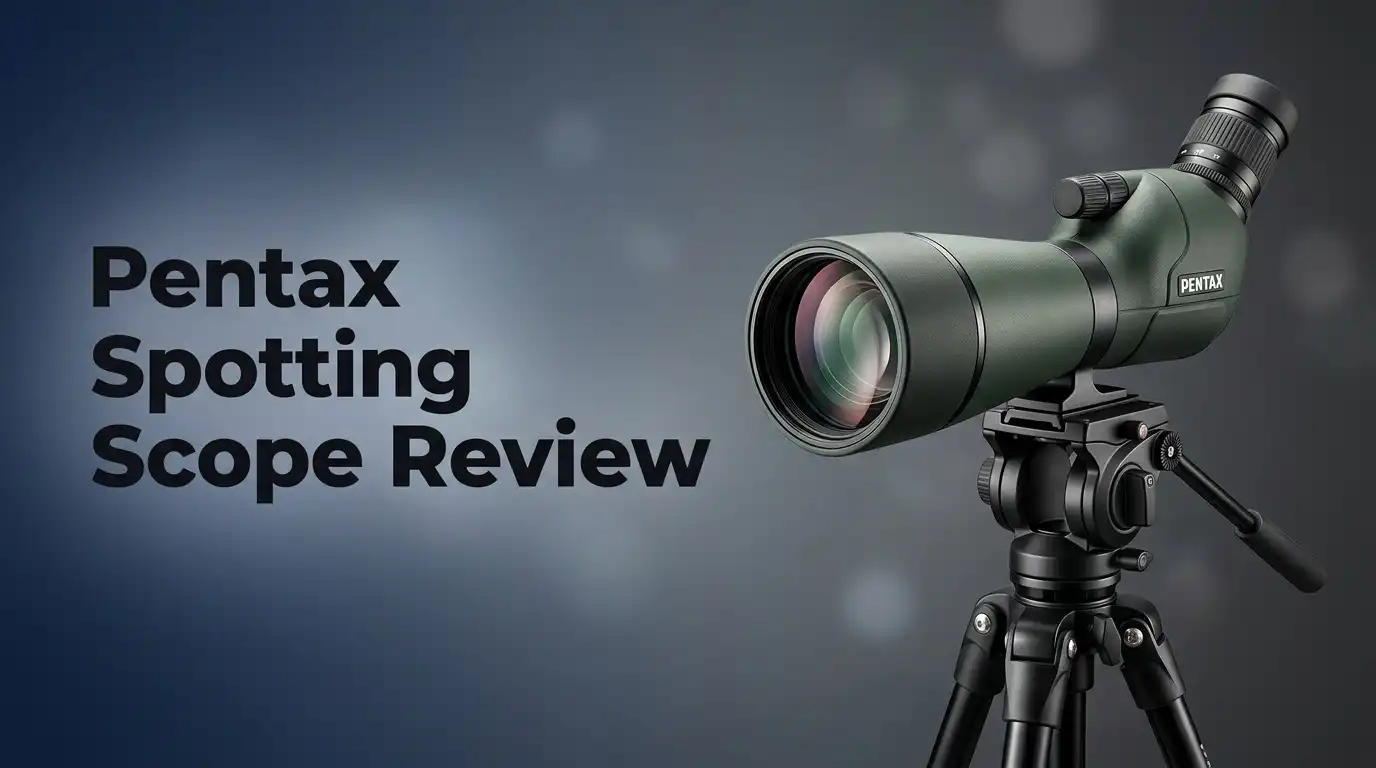
Pentax Spotting Scope Review 2026: Still Worth It?
Pentax has quietly built spotting scopes for decades while louder brands grabbed the headlines. The scopes rarely show up in flashy ads. They just keep showing up on tripods at hawk watches, shooting ranges, and shorebird flats. That says something.
In 2026 the Pentax sport optics range sits in an interesting spot. The newer PF-85EDA brings a modern roof prism design and a lighter body.
The older PF-80ED-A and PF-100ED still sell, and they still beat scopes costing far more. The compact PF-65ED II remains a favorite for hikers who count every ounce.
In A Nutshell:
- Pentax still delivers elite glass for mid tier money. Every current model uses extra low dispersion glass, and color fringing stays low in most daylight conditions. Owners regularly compare the 80mm and 85mm models against scopes priced two or three times higher and come away impressed.
- The PF-85EDA is the flagship for 2026 buyers. It uses a roof prism layout, weighs about 56.5 oz for the body, carries a JIS Class 7 waterproof rating, and launched around $1,299.95 for the body alone. The 8mm to 24mm zoom eyepiece kit pushes the price near $1,800.
- Eyepieces are sold separately on most models. That surprises first time buyers. Budget an extra few hundred dollars unless you buy a kit. The upside is real: the 31.7mm (1.25 inch) mount accepts almost any astronomy eyepiece you already own.
- The 65mm models win on portability. An angled PF-65EDA II with the XF zoom sits near 12 inches long and roughly 45 oz with eyepiece, which fits a daypack.
- Weak spots exist. Close focus is mediocre, accessory support is thin, the scopes are not sold everywhere, and no model includes a tripod or smartphone adapter.
The Pentax Spotting Scope Lineup In 2026

Last update on 2026-09-20 / Affiliate links / Images from Amazon Product Advertising API Some of the links on this website are affiliate links, which means that at no additional cost to you, I earn a commission if you click through and make a purchase. I only recommend products and services that I believe will add value to my readers. Thank you for your support!
Pentax keeps the catalog small and easy to follow. Four families cover almost every use case. The PF-65ED II and PF-65EDA II serve hikers and travelers who want a 65mm objective in a tiny shell. The PF-80ED and PF-80ED-A sit in the middle with an 80mm porro prism design that has barely changed in twenty years, mostly because it never needed changing.
The PF-85EDA arrived in 2024 as the modern option, using a roof prism and phase coating in a shorter body. The PF-100ED remains the giant, built for people who glass at extreme range and do not mind a heavy tripod.
Letters matter here. The letter A means angled, with the eyepiece tilted 45 degrees upward. Models without the A are straight barrel. Angled suits groups of mixed heights and long sitting sessions. Straight suits car window mounts and fast target acquisition at the range.
Pentax PF-85EDA Spotting Scope Review
The PF-85EDA is the model most buyers should look at first in 2026. Pentax swapped the classic porro prism for a roof prism with phase coating, which shortened the tube considerably. The body measures roughly 13.7 inches long and weighs about 56.5 oz on its own. Add the 8mm to 24mm zoom eyepiece and the pair lands near 76 oz.
Optically it punches hard. The 85mm objective uses five elements in four groups with extra low dispersion glass. With the zoom eyepiece you get 20x to 60x, a 4.3mm exit pupil at the wide end, and eye relief between 18mm and 22mm. Eyeglass wearers do fine here.
Waterproofing is rated JIS Class 7, so brief submersion to one meter will not kill it. Nitrogen fill blocks internal fogging. Users on optics forums describe the view as wide, bright, and almost addictive for the price. The main complaint is simple: the eyepiece costs extra unless you buy the kit.
Unboxing The PF-85EDA And First Impressions
The box is plain. Pentax spends money on glass, not cardboard. Inside you find the scope wrapped in a padded soft case, an objective lens cap, an eyepiece cap, and a thin printed manual. There is no tripod, no eyepiece in the base version, and no phone adapter. Plan for those purchases before the scope arrives.
Lifting the body out delivers the first surprise. It feels dense but short, closer to a chunky camera lens than a cannon. The rubber armor grips well in cold hands. The focus knob turns with a smooth, slightly stiff action that loosens after a week of use.
The eyepiece collar uses a collet lock. You drop the eyepiece in, twist the collar, and it seizes firmly. That lock matters more than it sounds. Expensive eyepieces slide out of friction mounts and hit rocks. The built in lens hood pulls out with a satisfying slide and stays where you leave it.
Pentax PF-80ED-A Spotting Scope Review

- 45° Angled Viewing
- Accepts All 1.25" Telescope Eyepieces

Last update on 2026-09-20 / Affiliate links / Images from Amazon Product Advertising API Some of the links on this website are affiliate links, which means that at no additional cost to you, I earn a commission if you click through and make a purchase. I only recommend products and services that I believe will add value to my readers. Thank you for your support!
The PF-80ED-A is the veteran. This porro prism scope has held its design for years and still earns praise from birders who own Swarovski and Leica gear. The body weighs roughly 3.5 pounds, uses a magnesium alloy frame under rubber armor, and carries a JIS Class 6 waterproof rating with nitrogen fill.
Paired with the 8mm to 24mm zoom eyepiece it delivers 21x to 63x. Apparent field of view runs 38 to 60 degrees. Close focus sits near 19 feet, which is the biggest weakness of this model for butterfly and dragonfly watchers.
Low light performance is the star. Under heavy tree cover at dawn the 80mm objective pulls in enough light to separate warbler face patterns. Chromatic aberration stays controlled until you point at bare branches against a bright sky, where a faint purple edge appears. Extending the lens hood cuts that noticeably.
The tripod collar rotates with click stops, so switching between horizontal and angled viewing takes one second.
Top 3 Alternative For Pentax PF-85EDA

- The redesigned Diamondback HD spotting scope has all the optical horsepower the western hunter needs, and excels in low light. It features a streamlined exterior for a sleeker profile and a built-in helical focus wheel for fast and fine adjustments.
- HD optical system delivers exceptional resolution, cuts chromatic aberration and provides outstanding color fidelity, edge-to-edge sharpness and light transmission. Multiple anti-reflective coatings on all air-to-glass surfaces increase light transmission
Last update on 2026-09-17 / Affiliate links / Images from Amazon Product Advertising API Some of the links on this website are affiliate links, which means that at no additional cost to you, I earn a commission if you click through and make a purchase. I only recommend products and services that I believe will add value to my readers. Thank you for your support!
Vortex Diamondback HD 20-60×85 Angled Spotting Scope

- QUALITY ED OBJECTIVE LENS: Extra-low dispersion optical glass with special dispersion properties to dramatically reduce chromatic aberration, rendering razor-sharp images with superb color correction. Enjoy true-to-life color with enhanced resolution and contrast.
- XLT LENS COATINGS: Fully multi-coated with Celestron’s proprietary XLT optical coatings – the same coatings used on observatory-class telescopes. This coating maximizes light transmission through the optical path for brighter images. A great addition to your field gear!
Last update on 2026-09-17 / Affiliate links / Images from Amazon Product Advertising API Some of the links on this website are affiliate links, which means that at no additional cost to you, I earn a commission if you click through and make a purchase. I only recommend products and services that I believe will add value to my readers. Thank you for your support!
Celestron Regal M2 80ED Spotting Scope

- Advanced Fully Multi-Coated lenses bring you better light transmission to bring optimum brightness and true color across the entire light spectrum.
- Phase Coated Porro prisms reflect great mount of lights to your eyes which will give you bright image.
Last update on 2026-09-13 / Affiliate links / Images from Amazon Product Advertising API Some of the links on this website are affiliate links, which means that at no additional cost to you, I earn a commission if you click through and make a purchase. I only recommend products and services that I believe will add value to my readers. Thank you for your support!
Athlon Optics Argos HD 20-60×85 Spotting Scope
Pentax PF-65ED II And PF-65EDA II For Light Packing
The 65mm pair solves a different problem. Size. An angled PF-65EDA II with the XF zoom eyepiece measures around 12 inches long and weighs roughly 45 oz complete. That combination rides in a daypack without a fight and works on a light carbon tripod that a big 85mm scope would wobble on.
With the XF 6.5mm to 19.5mm zoom you get 20x to 60x. Real field of view runs about 2.1 degrees down to 1 degree. Exit pupil shrinks to 1.1mm at full zoom, so the top of the zoom range gets dim fast in shade. Back off to 40x and the image tightens up nicely.
The 65mm models accept the XF 8.5mm and XF 12mm fixed eyepieces too. Those fixed options give brighter, sharper, wider views than any zoom. Many owners carry one fixed eyepiece and leave the zoom at home.
This is the Pentax to buy if you walk more than you sit.
Optical Performance In Real Field Conditions
Numbers on a spec sheet mean little until birds are moving. I tested Pentax glass across three light situations: bright midday, overcast afternoon, and last light before dusk.
Midday views are crisp and neutral in color. Whites stay white. Greens do not go yellow. Resolution holds well past 40x on the 80mm and 85mm bodies, which is where cheaper scopes usually turn to mush.
Overcast light is where extra low dispersion glass earns its cost. Contrast stays high, and subtle feather edges remain visible. A duck at 400 yards still shows head shape and bill color.
Last light exposes the limits of magnification. On the 85mm body at 60x the exit pupil drops to 1.4mm, and the image dims. Dial back to 25x or 30x and brightness returns immediately.
Heat shimmer beats every scope ever made, Pentax included. On hot afternoons over open ground, no amount of good glass fixes boiling air.
Eyepiece Choices Explained Simply
Pentax uses the American standard 31.7mm (1.25 inch) eyepiece sleeve. That single decision makes these scopes flexible in a way most rivals are not. Any 1.25 inch astronomy eyepiece fits.
The smc Pentax 8mm to 24mm zoom is the common pick for the 80mm, 85mm, and 100mm bodies. It gives 20x to 60x with good eye relief. The XF zoom 6.5mm to 19.5mm serves the 65mm scopes.
Fixed eyepieces change the experience. The XW series (7mm, 10mm, 14mm, 20mm) delivers a 70 degree apparent field, which feels like stepping closer to a window. On the 85mm body an XW14 gives 36x with a 2 degree true field. That combination is a joy for scanning flocks.
Third party eyepieces from astronomy brands work too, often at lower cost. Check weight though. A heavy two inch style eyepiece can unbalance an angled scope on a small tripod head.
Build Quality, Sealing, And Field Durability
Pentax builds these scopes like tools. The armor is thick rubber over metal, not plastic. Edges are rounded so the scope does not snag on pack straps. After a season of use the finish scuffs but nothing rattles loose.
Sealing is genuine. The eyepiece mount contains a dust proof glass element, which keeps the tube airtight even with no eyepiece installed. Nitrogen fill prevents internal fogging when you move from a cold car into humid morning air.
The PF-85EDA holds a JIS Class 7 rating. The older 80mm and 100mm bodies hold JIS Class 6. Neither rating means you can dunk the scope for fun, and the zoom eyepieces are not waterproof on their own.
Focus knobs are single speed on most models. That is the one build area where premium European brands pull ahead, since dual speed focus helps at high magnification. You learn to make small, patient movements with a Pentax knob.
Digiscoping With A Pentax Scope
Digiscoping means shooting photos through the scope. Pentax handles it reasonably well, though support is thinner than it should be in 2026.
Smartphone digiscoping works best with a third party clamp adapter. Line up the phone camera with the eyepiece, zoom the phone slightly to cut vignetting, and tap to focus. Results at 25x to 35x look sharp enough for identification photos and social posts.
The 80mm body accepts the PF-CA35 camera adapter, which turns the scope into roughly a 1000mm f/12.5 lens. That sounds exciting until you use it. Autofocus does not exist, depth of field is paper thin, and any breeze ruins the shot.
The honest summary is this. Pentax scopes digiscope fine for documentation, not for portfolio images. If photography is your main goal, a long telephoto lens serves you better. If you want a record shot of a rare bird at 300 yards, a phone on the eyepiece does the job.
Tripod And Head Pairing Tips
A spotting scope is only as steady as the legs under it. This is where new owners waste money.
For the 65mm models, a light aluminum or carbon travel tripod rated for 8 pounds handles the load. For the 80mm and 85mm bodies, step up to legs rated near 15 pounds. For the 100mm, use a serious video tripod and accept the weight penalty.
Head choice matters more than leg choice. A fluid video head gives smooth panning for tracking moving birds. A ball head is lighter but jerky at 60x. Many Pentax owners land on a compact fluid head as the best compromise.
Mount the scope with an Arca style plate long enough to balance the body. Shift the plate forward or back until the scope holds position with the head loose.
Set the tripod so the eyepiece meets your eye while you stand relaxed. Hunching over a short tripod ruins a long session faster than any optical flaw.
Pros And Cons Of Pentax Spotting Scopes
Here is the balanced summary after weeks of use across models.
Pros
- Extra low dispersion glass on every model delivers sharp, high contrast views that rival scopes costing far more
- The 31.7mm eyepiece mount accepts any 1.25 inch eyepiece, including astronomy glass you may already own
- Genuine waterproof sealing with nitrogen fill, rated JIS Class 6 or Class 7 depending on model
- Collet style eyepiece lock prevents costly eyepieces from sliding out and falling
- Rotating tripod collar with click stops makes angle changes fast and repeatable
- Built in retractable lens hood cuts stray light and protects the objective
- Long eye relief across the eyepiece range suits eyeglass wearers
- Padded field case included, with access openings for focus and tripod mount
Cons
- Most bodies ship without an eyepiece, which adds several hundred dollars
- Close focus around 16 to 19 feet limits insect and garden viewing
- Single speed focus knob feels slow next to dual speed premium rivals
- Limited retail availability compared with Vortex and Celestron
- No smartphone adapter or tripod included in the box
- Some color fringing appears when pointed near the sun
What Pentax Scopes Do Not Do Well
Every review should name the failures plainly. Here are the Pentax weak points.
Close focus is poor. The 80mm model needs roughly 19 feet, and the 85mm needs about 16 feet. Butterfly watchers and backyard observers will find that limiting.
Accessory ecosystem is thin. Swarovski and Kowa sell purpose built phone adapters, camera couplers, and stay on cases. Pentax offers a short list, and some adapters target old film camera mounts that almost nobody uses now.
Availability fluctuates. Stock comes and goes at major retailers, and some older models appear only through specialty dealers. Prices swing more than they should because of that.
Zoom eyepieces narrow the field at low power. The 8mm to 24mm zoom starts at a 38 degree apparent field, which feels tight compared with the 70 degree view of a fixed XW eyepiece.
No dual speed focus. At 60x, fine focus takes patience.
None of these flaws ruin the scopes. They do shape who should buy one.
Pentax Versus The Competition On Price And Value
Value is the whole Pentax argument, so the comparison matters.
At roughly $1,300 for the PF-85EDA body, you sit above budget scopes and well below alpha European glass. Vortex sells the Diamondback HD 20-60×85 complete with eyepiece for a few hundred dollars less, and it carries an unlimited lifetime warranty. Celestron’s Regal M2 80ED lands near $799 complete. Athlon’s Argos HD 20-60×85 undercuts both.
Those rivals are good scopes. Pentax wins on pure optical resolution and eyepiece flexibility. The rivals win on price, bundled eyepieces, and warranty terms.
Step upward and the picture flips. Swarovski, Zeiss, and Leica scopes start near $2,500 and climb past $4,000. They deliver better edge sharpness, dual speed focus, and stronger accessory support. The gap in view quality is real but smaller than the gap in price.
If you value glass over extras, Pentax offers the strongest value per dollar in the mid tier.
Who Should Buy A Pentax Spotting Scope In 2026
Buy a Pentax scope if you are a serious birder who already owns good eyepieces or plans to buy them. The eyepiece flexibility pays off over years.
Buy one if you watch wildlife at dawn and dusk. The extra low dispersion glass and large objectives handle dim light better than most scopes at similar prices.
Buy the 65mm version if you hike long distances and count grams. Buy the PF-85EDA if you want the best all around balance in the current lineup. Buy the PF-100ED only if you glass at extreme range from a fixed position.
Skip Pentax if you want a complete ready to use package at the lowest possible price. Skip it if you need close focus for insects. Skip it if you want strong smartphone photography support out of the box.
The right buyer here is someone who cares about the view first and convenience second. That describes plenty of people, though not everyone.
Final Verdict On Pentax Spotting Scopes
Pentax makes scopes for people who look through them, not people who photograph them for social media. The optics are excellent, the sealing is genuine, and the eyepiece system gives freedom that closed systems cannot match.
The PF-85EDA is the model I recommend to most buyers in 2026. It combines modern roof prism compactness with a large 85mm objective and strong weather sealing. Budget for the eyepiece kit and a proper tripod, then expect years of service.
The PF-80ED-A remains a bargain for anyone who finds one in stock. Its porro prism design still delivers views that embarrass newer scopes.
The 65mm models suit walkers, and the 100mm suits long range specialists.
Rating: 4.5 out of 5. Points come off for missing eyepieces, weak close focus, and thin accessory support. Everything else earns high marks. Pentax still deserves a spot on your shortlist.
Frequently Asked Questions
Is a Pentax spotting scope good for birding?
Yes. Pentax scopes rank among the better birding options in the mid price tier. The extra low dispersion glass produces sharp, high contrast views with low color fringing, which helps with feather detail and bill color. The angled models suit long sessions at a hawk watch or shoreline. The main limit is close focus, which sits around 16 to 19 feet depending on model.
Does the Pentax PF-85EDA come with an eyepiece?
The base PF-85EDA body ships without an eyepiece. Pentax sells a kit version that includes the smc 8mm to 24mm zoom eyepiece, giving 20x to 60x magnification. The base body launched near $1,299.95 while the kit runs closer to $1,800. Check current listings, since prices move.
Can I use astronomy eyepieces on a Pentax spotting scope?
Yes. Pentax uses a 31.7mm (1.25 inch) American standard eyepiece sleeve. Any 1.25 inch astronomy eyepiece fits, including third party brands. Watch the weight, since heavy eyepieces can unbalance an angled scope on a small tripod head.
Angled or straight, which Pentax model should I choose?
Choose angled if several people of different heights will share the scope, if you sit for long sessions, or if you want a lower tripod. Choose straight if you glass from a vehicle window, track fast moving targets at a range, or prefer pointing the scope like a rifle.
Are Pentax spotting scopes waterproof?
Yes. The PF-85EDA carries a JIS Class 7 rating, meaning it survives brief immersion to one meter. Older models like the PF-80ED-A carry JIS Class 6. All are nitrogen filled to stop internal fogging. Note that the zoom eyepieces are not waterproof on their own.
What tripod works best with a Pentax scope?
Match the tripod to the scope size. A light travel tripod handles the 65mm models. The 80mm and 85mm bodies need legs rated near 15 pounds. A fluid video head gives the smoothest panning at high magnification, while a ball head saves weight but feels jerky above 40x.

Hello, I’m Amelia White, the founder of birdsfanatic.com. As a lifelong bird enthusiast and spiritual seeker, I’ve always been fascinated by the mystical connections between birds and the human experience. On this site, I share my knowledge and insights into the symbolic meanings and spiritual significance of various bird species, exploring their roles in mythology, folklore, and cultural traditions. Join me on this journey into the world of birds, where we’ll discover the hidden wisdom and guidance that these magnificent creatures have to offer.