
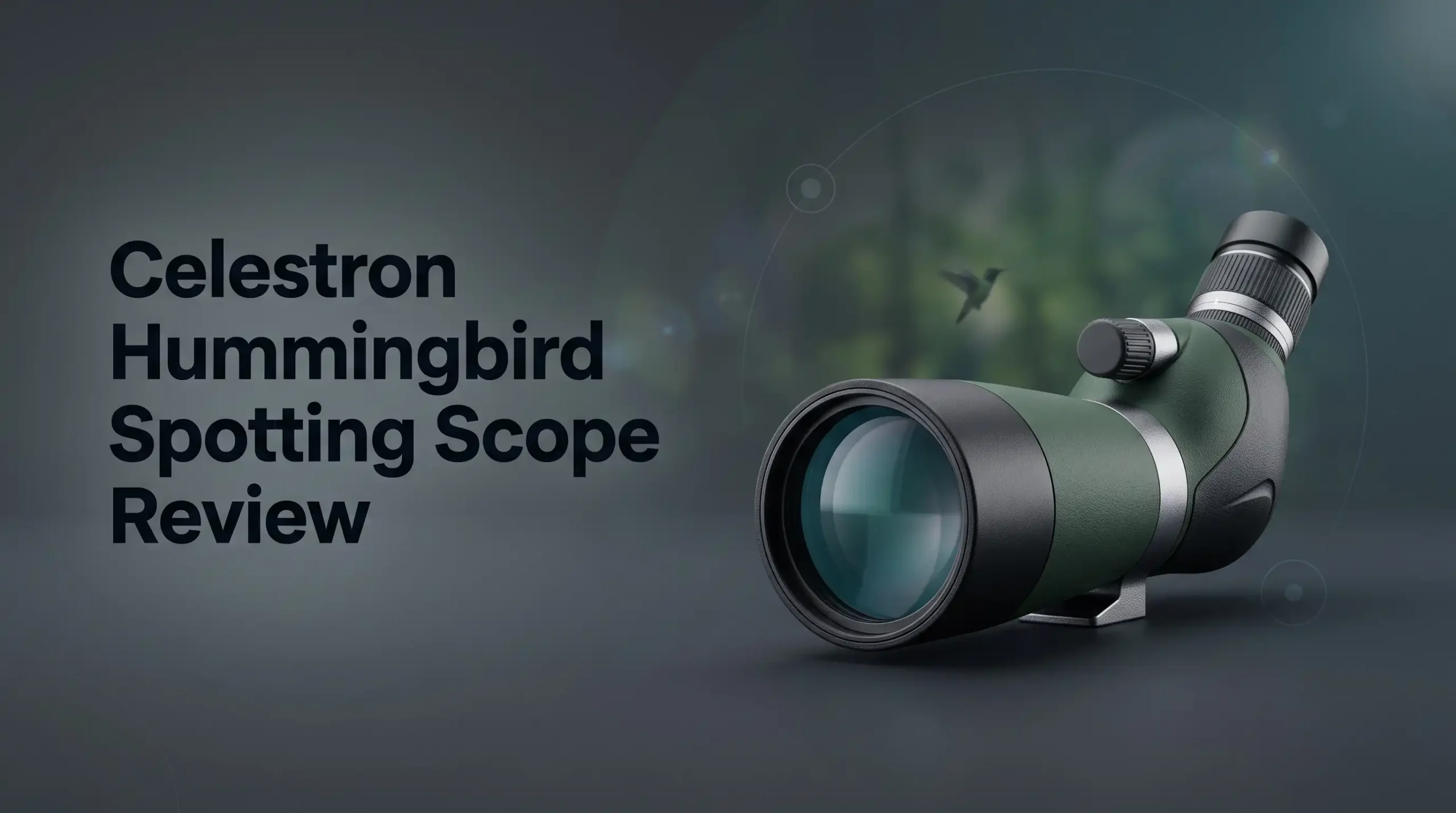
Celestron Hummingbird Spotting Scope Review 2026: Worth It?
Most spotting scopes ask you to carry a brick. The Celestron Hummingbird asks you to carry a sandwich. That single difference explains why this tiny scope keeps selling year after year, even though it launched back in 2016 and has never received a redesign.
I have used the Hummingbird on beach walks, in a car window mount, and on a lightweight carbon tripod during three travel trips. It surprised me in good ways and annoyed me in a few predictable ones.
This review covers the real optical performance, the unboxing, the weak points that marketing pages skip, and the alternatives worth comparing before you spend your money in 2026.
In a Nutshell:
- The Hummingbird is the smallest true ED spotting scope you can buy. The 56mm model weighs 20.8 ounces and measures roughly 8 inches long. It fits in a coat pocket, a camera bag, or carry on luggage without a second thought.
- Image quality punches above the price. The extra low dispersion glass controls color fringing well. Views stay bright and neutral in color through most of the zoom range, which is rare under $400.
- Magnification is the tradeoff. You get 9x to 27x on the 56mm model and 7x to 22x on the 50mm model. Full size scopes reach 60x. Celestron chose better glass over longer reach, and that choice will not suit everyone.
- Weatherproofing is genuine. The body is nitrogen filled, waterproof, and wrapped in rubber armor. It handled sea spray and light rain without fogging.
- Two real flaws exist. The focus wheel is stiff out of the box, and the included soft case is cut so tightly that the tripod plate must come off every time you pack it.
- Best for travelers, backyard birders, and hikers. Skip it if you scan open water, judge antler scores at 800 yards, or need serious digiscoping reach.
What Is the Celestron Hummingbird Micro Spotting Scope?

- Easily carried in vest or coat pocket, in belt pack, or shoulder bag
- ED lens optical system provides sharp, clear images with vivid, well-managed color

Last update on 2026-06-28 / Affiliate links / Images from Amazon Product Advertising API Some of the links on this website are affiliate links, which means that at no additional cost to you, I earn a commission if you click through and make a purchase. I only recommend products and services that I believe will add value to my readers. Thank you for your support!
The Hummingbird is Celestron’s micro class spotting scope. Celestron named it after the bird because both are small, mobile, and built for long distance travel. It comes in two versions. The 56mm model offers 9x to 27x zoom. The 50mm model offers 7x to 22x zoom and saves about two ounces.
Both use extra low dispersion glass, fully coated optics, a 45 degree angled eyepiece, and a nitrogen purged waterproof body. Close focus sits near 9.8 feet, which is short enough for butterflies and feeder birds.
This is not a toy scope. It is a genuine optical instrument that happens to be shrunk down. Think of it as the missing step between a good 10x binocular and a full size 80mm scope.
Unboxing Experience and First Impressions
The box is small enough that I assumed a shipping mistake. Inside you get the scope, a padded soft case with a shoulder strap, objective and eyepiece caps, a cleaning cloth, and the manual. There is no tripod in the box, and there is no quick release plate either.
Lifting the scope out is the moment that sells it. It sits in your palm like a large soda can. The rubber armor feels grippy and dense, and the orange accent ring looks sharp against the black body.
My honest first reaction was doubt. Something this light should not perform. Then I pointed it at a rooftop antenna 200 yards away and the doubt faded fast. Build quality feels tight, with no rattles and no creaking panels.
Key Specifications at a Glance
The 56mm version uses a 200mm focal length, measures roughly 208mm by 127mm by 68mm, and weighs 590 grams. The 50mm version uses a 170mm focal length and weighs 540 grams. Both accept standard 1.25 inch astronomy eyepieces, which is a genuinely useful bonus for stargazers.
The eyepiece is a zoom design with a twist up eyecup. Eye relief is adequate for glasses wearers at lower powers and tightens as you zoom in. The tripod foot uses a standard quarter inch thread, so any tripod, monopod, or window mount works.
Waterproof and nitrogen filled construction covers rain, humidity, and temperature swings. Celestron backs the scope with a limited lifetime warranty in the United States, which adds real peace of mind at this price.
Top 3 Alternative for Celestron Hummingbird Spotting Scope

- The redesigned Diamondback HD spotting scope has all the optical horsepower the western hunter needs, and excels in low light. It features a streamlined exterior for a sleeker profile and a built-in helical focus wheel for fast and fine adjustments.
- HD optical system delivers exceptional resolution, cuts chromatic aberration and provides outstanding color fidelity, edge-to-edge sharpness and light transmission. Multiple anti-reflective coatings on all air-to-glass surfaces increase light transmission
Last update on 2026-06-10 / Affiliate links / Images from Amazon Product Advertising API Some of the links on this website are affiliate links, which means that at no additional cost to you, I earn a commission if you click through and make a purchase. I only recommend products and services that I believe will add value to my readers. Thank you for your support!
Vortex Optics Diamondback HD 16x to 48x 65mm Spotting Scope

- QUALITY ED OBJECTIVE LENS: Extra-low dispersion optical glass with special dispersion properties to dramatically reduce chromatic aberration, rendering razor-sharp images with superb color correction. Enjoy true-to-life color with enhanced resolution and contrast.
- XLT LENS COATINGS: Fully multi-coated with Celestron’s proprietary XLT optical coatings – the same coatings used on observatory-class telescopes. This coating maximizes light transmission through the optical path for brighter images. A great addition to your field gear!
Last update on 2026-09-17 / Affiliate links / Images from Amazon Product Advertising API Some of the links on this website are affiliate links, which means that at no additional cost to you, I earn a commission if you click through and make a purchase. I only recommend products and services that I believe will add value to my readers. Thank you for your support!
Celestron Regal M2 65ED Spotting Scope

- Nitrogen Purging uses the inertia gas to purge moisture out of the tube giving you better waterproofing and thermal stability
- Fully Multi-Coated lenses gives you great light transmission and bring bright images to your eyes
Last update on 2026-09-17 / Affiliate links / Images from Amazon Product Advertising API Some of the links on this website are affiliate links, which means that at no additional cost to you, I earn a commission if you click through and make a purchase. I only recommend products and services that I believe will add value to my readers. Thank you for your support!
Athlon Optics Talos 20x to 60x 80mm Spotting Scope
Optical Performance in Daylight
In good light the Hummingbird delivers bright, clean, and pleasantly neutral images. Color correction is the standout. Look at a dark bird against bright sky, the classic chromatic aberration test, and fringing stays faint even near the frame edge.
The center sweet spot is generous. Sharpness tapers slightly in the outer twenty percent of the field, which is normal at this price and rarely noticed in practice. Contrast holds up well against backlighting.
One tip matters. Back off slightly from maximum zoom and the image snaps to its sharpest point. At a full 27x the view softens a touch, which is typical of compact zoom eyepieces.
At mid magnification I could separate leg color on small shorebirds at reasonable distance. That is a meaningful real world result for a scope this size.
Low Light Performance at Dawn and Dusk
A 56mm objective is small by scope standards, so physics sets limits here. At 9x the exit pupil is large and the view stays usable well into dusk. Zoom to 27x and the image dims noticeably.
I noticed a slight haze at the field edges in very low light, almost like a soft cataract effect. It never ruined a view, but it is there, and a premium 65mm scope would not show it.
For practical purposes, the Hummingbird gives you roughly twenty minutes less usable light than a mid range 65mm scope. Morning birders will be fine. Hunters glassing the last legal minutes of shooting light will want more glass.
Bottom line: good for its class, not a low light specialist.
Build Quality and Weatherproofing
Celestron did not cut corners on the shell. The rubber armor wraps every vulnerable edge and absorbs knocks. After being tossed into a daypack repeatedly, mine shows scuffs but no damage.
The nitrogen purge works. I moved the scope from an air conditioned car into humid Gulf Coast air and the internal optics stayed clear while my binoculars fogged.
Wind stability surprised me most. Common sense says a tiny scope will dance in a breeze, but the low profile actually reduces the sail area that catches wind. Mounted on a decent tripod, it stayed steadier than my full size scope in the same gusts.
The metal tripod foot is solid, not plastic, which matters for long term durability.
Focus Wheel and Zoom Ring Feel
Here is the first real complaint. The focus wheel is stiff. Straight from the box it takes deliberate pressure to turn, and one finger is not always enough.
There is an upside. The wheel never drifts and never slips, so your focus stays locked once set. Mine loosened slightly after a few months of use but remains firmer than average.
The stiffness has a consequence. A monopod is a poor pairing with this scope, because you need a stable counter force to turn the wheel without shaking the image. A tripod solves it completely.
The zoom ring turns more smoothly than the focus wheel. Travel from minimum to maximum magnification is short, and the detents are subtle rather than clicky.
Tripod, Monopod, and Window Mount Options
The Hummingbird is so light that your tripod choice becomes the main weight decision. Pair it with a heavy aluminum tripod and you lose the entire point of buying it.
A compact carbon fiber travel tripod with a small fluid head or a ball head is the right match. The whole rig can land under four pounds, which is less than many scopes alone.
Car window mounts work beautifully here. The low weight puts almost no strain on the clamp, and the angled eyepiece sits at a comfortable height from the driver seat.
Tabletop tripods also work for deck and patio use. This flexibility is one of the scope’s quiet strengths and a big reason owners keep it long term.
Digiscoping With a Smartphone
You can digiscope with the Hummingbird, and results at lower magnification look decent. Phone adapters that clamp to the eyepiece barrel fit without modification.
Expect limits. The small objective means less light reaching your phone sensor, so shutter speeds drop and noise climbs quickly in shade. Vignetting appears as you zoom the phone camera.
The stiff focus wheel becomes more annoying during digiscoping, because each adjustment nudges the whole rig and you must wait for vibration to settle.
My verdict: treat digiscoping as a bonus, not a reason to buy. If documenting rare sightings is your main goal, a larger 65mm or 80mm scope with a wider exit pupil will frustrate you far less and produce cleaner files.
Hummingbird 56mm or 50mm: Which One Fits You?
- Easily carried in vest or coat pocket, in belt pack, or shoulder bag
- ED lens optical system provides sharp, clear images with vivid, well-managed color
Last update on 2026-06-28 / Affiliate links / Images from Amazon Product Advertising API Some of the links on this website are affiliate links, which means that at no additional cost to you, I earn a commission if you click through and make a purchase. I only recommend products and services that I believe will add value to my readers. Thank you for your support!
The 56mm model costs a little more, reaches 27x, and gathers more light. The 50mm model saves two ounces, reaches 22x, and usually sells for less.
I recommend the 56mm version for most buyers. The extra reach genuinely helps with distant waterfowl and raptors, and two ounces is not a weight penalty anyone feels.
Choose the 50mm model if you plan to carry the scope on long backpacking trips where every gram counts, or if you mostly watch subjects inside 150 yards. Its wider field of view at the low end also makes finding birds faster.
Optical quality between the two is very close. Availability is the practical deciding factor, since the 50mm version often goes out of stock.
Who Should Buy the Celestron Hummingbird
This scope fits travelers first. If you have ever left a scope at home because of luggage weight, the Hummingbird solves that problem permanently.
Backyard birders benefit too. Leave it set up near a window on a small tripod and it becomes a feeder watching machine with a close focus under ten feet.
Hikers, kayakers, and cyclists gain a scope they will actually carry. A scope in your pack beats a better scope in your closet every single time.
Beginners with a modest budget also do well here, because Celestron prioritized image quality over inflated magnification numbers. Casual astronomers get a bonus, since the 1.25 inch eyepiece thread lets you swap in higher power eyepieces for lunar and planetary views.
What the Hummingbird Does Not Do Well
Honesty matters more than hype, so here are the genuine shortcomings.
Maximum reach is limited. At 27x you cannot separate distant scoters on open water, judge a buck at long range, or read targets at 200 yards. Anyone who needs 40x or more should look elsewhere immediately.
The case design is poor. The padded soft case fits so snugly that a tripod quick release plate cannot stay attached to the scope. You must remove the plate every time you pack up, then keep track of a small loose part in the field.
Eye relief tightens at high zoom, which frustrates glasses wearers. The focus wheel stiffness has already been covered. Finally, there is no included tripod, so budget extra for one.
Pros and Cons of the Celestron Hummingbird
Pros
- Extremely small and light. At around 20 ounces, it weighs less than many binoculars and fits in a coat pocket.
- Real ED glass. Color fringing stays minimal and images look natural rather than oversaturated or yellow.
- Fully waterproof and nitrogen filled with tough rubber armor that survives rough handling.
- Close focus near 9.8 feet makes it useful for butterflies, dragonflies, and feeder birds.
- Accepts 1.25 inch eyepieces, which adds astronomy flexibility that rivals do not offer.
- Stable in wind because of its low profile, provided your tripod is solid.
Cons
- Maximum 27x magnification falls far short of full size scopes for long distance work.
- Stiff focus wheel requires firm pressure and makes monopod use awkward.
- Undersized carrying case forces removal of the tripod plate before packing.
- Dimmer views at maximum zoom in dawn and dusk conditions.
- Edge sharpness softens slightly, and tight eye relief bothers glasses wearers at high power.
- No tripod included, adding cost to the total setup.
Price and Value in 2026
The Hummingbird typically sells between $350 and $420 depending on model and stock levels. Availability has become inconsistent, and the 50mm version disappears for long stretches.
At that price you can also buy a larger 65mm scope with 60x reach and lesser glass. That is the actual decision in front of you. Reach versus quality versus weight.
Value here depends entirely on how often the scope leaves your house. A cheaper 80mm scope that stays in the closet delivers zero value. A Hummingbird that rides in your bag every weekend delivers plenty.
For travelers, the value is excellent. For long range observers, the same money buys far more capability elsewhere.
Final Verdict: Is It Worth Buying?
The Celestron Hummingbird remains a niche product that serves its niche extremely well. Nearly a decade after launch, nothing else matches its combination of ED glass, waterproof construction, and pocket size at this price.
Buy it if portability drives your decision and you accept 27x as your ceiling. You will get sharp, honest images from a scope you barely notice carrying.
Skip it if you scan open water, hunt at long range, or want serious digiscoping results. Those needs demand a bigger objective and more magnification.
My rating sits at 4.2 out of 5. The optics earn high marks, while the stiff focus wheel and poorly sized case keep it from a perfect score.
Frequently Asked Questions
Is the Celestron Hummingbird good for birding?
Yes, for most birding situations. The 9x to 27x range covers feeder birds, woodland species, raptors, and shorebirds at moderate distance. Close focus near ten feet is a genuine birding advantage. Open water scanning is the main weakness.
Does the Hummingbird come with a tripod?
No. The box includes the scope, a soft case, lens caps, and a cleaning cloth. Plan to buy a lightweight carbon fiber travel tripod separately to keep the overall rig light.
Can I use the Hummingbird for astronomy?
Yes, within limits. It accepts standard 1.25 inch eyepieces, so you can swap in higher power options for moon craters, Jupiter’s moons, and bright star clusters. Deep sky performance stays modest because of the small objective.
Which Hummingbird model should I choose?
Most buyers should pick the 56mm version for its extra reach and light gathering. Choose the 50mm version only if you need the absolute lightest option or want a wider low power field of view.
Is the Hummingbird waterproof?
Yes. The body is nitrogen filled and sealed, so rain, humidity, and temperature changes will not fog the internal optics. Rubber armor protects against bumps during travel.
How does it compare to a full size 80mm scope?
An 80mm scope wins on magnification, brightness, and long range detail. The Hummingbird wins on weight, packability, and convenience. They serve different jobs rather than competing directly.

Hello, I’m Amelia White, the founder of birdsfanatic.com. As a lifelong bird enthusiast and spiritual seeker, I’ve always been fascinated by the mystical connections between birds and the human experience. On this site, I share my knowledge and insights into the symbolic meanings and spiritual significance of various bird species, exploring their roles in mythology, folklore, and cultural traditions. Join me on this journey into the world of birds, where we’ll discover the hidden wisdom and guidance that these magnificent creatures have to offer.