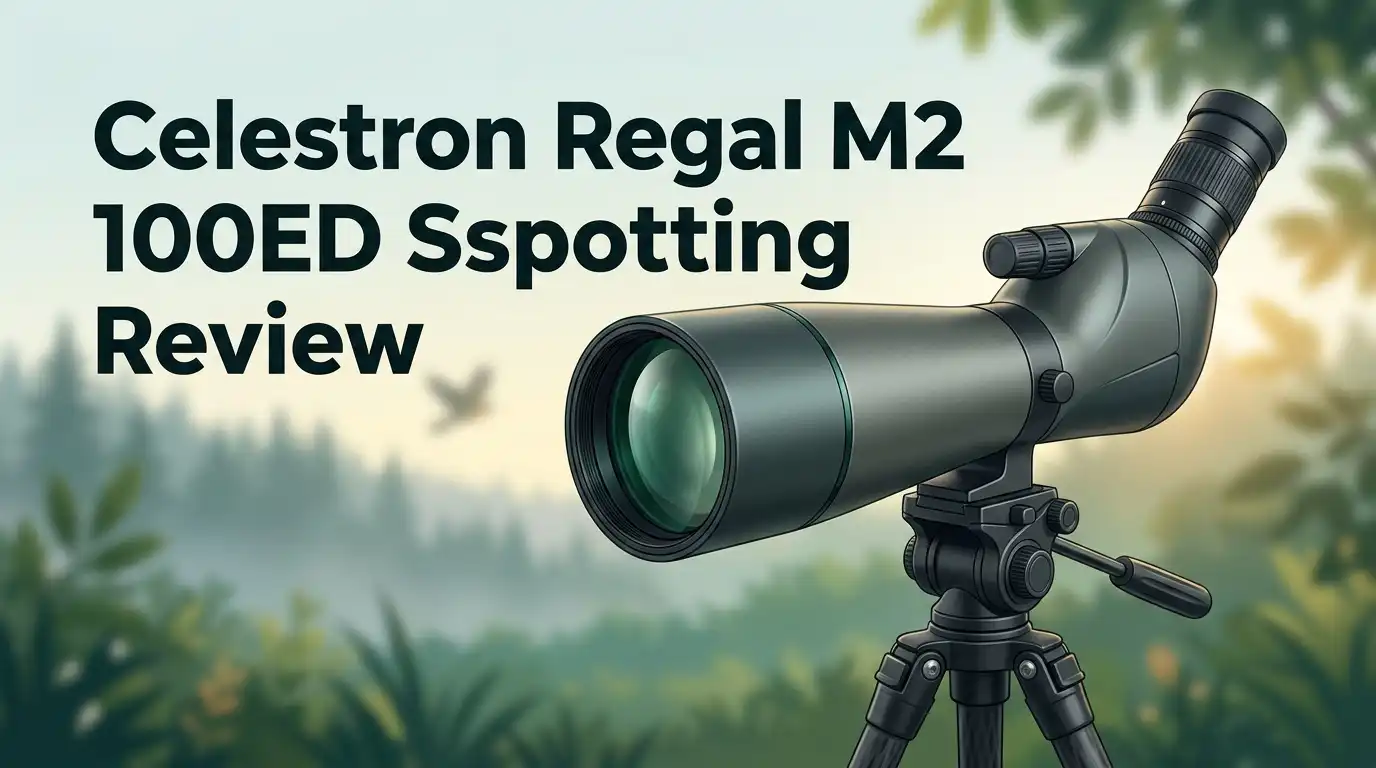
Celestron Regal M2 100ED Spotting Scope Review 2026: Still Worth It?
Big glass changes what you see. A 100mm objective pulls in light that smaller scopes simply cannot reach. The Celestron Regal M2 100ED sits in that large aperture class, and it does so at a price that undercuts most premium European brands by thousands of dollars.
So the real question is simple. Does this scope deliver premium views, or does it just look impressive on a tripod? I spent time with it on ducks at 600 yards, on Saturn after dark, and on a tripod that groaned under its weight.
This review covers the good, the frustrating, and the things Celestron does not advertise. If you are weighing a serious spotting scope purchase in 2026, read on before you spend.
In a Nutshell:
- Huge light gathering for the money. The 100mm ED objective produces bright, detailed images at dawn and dusk when 65mm and 80mm scopes start to fade. This is the scope’s single biggest strength.
- Real ED glass performance. Color fringing stays low through most of the zoom range. Edges soften past 55x, but the center holds sharp detail well.
- Dual focus is genuinely useful. A coarse knob gets you close fast. A fine knob nails the detail. Focusing feels about twice as quick as single knob designs.
- It accepts 1.25 inch astronomy eyepieces. This turns the scope into a small refractor telescope. Very few spotting scopes offer this flexibility.
- Weight is the deal breaker for some buyers. At roughly 5.3 pounds with the eyepiece, it demands a heavy tripod and a strong shoulder. Backpack hunters should look at the 80mm version instead.
- Value verdict: around $1,049 at Celestron, and it competes with scopes costing double. Best suited to fixed position birders, range shooters, and casual astronomers.
Celestron Regal M2 100ED Spotting Scope

- PREMIUM ED OBJECTIVE LENSES: Extra-Low Dispersion (ED) glass virtually eliminates chromatic aberration or color fringing, a visual defect common in binoculars. You'll enjoy razor-sharp images with outstanding, true-to-life color.
- XLT LENS COATINGS: All air-to-glass surfaces are multi-coated with Celestron’s proprietary XLT coatings – the same ones we use on our observatory-class telescopes. XLT maximizes light transmission through the optical path for brighter images.

Last update on 2026-09-18 / Affiliate links / Images from Amazon Product Advertising API Some of the links on this website are affiliate links, which means that at no additional cost to you, I earn a commission if you click through and make a purchase. I only recommend products and services that I believe will add value to my readers. Thank you for your support!
The Regal M2 100ED carries item number 52306. It uses a 100mm extra low dispersion objective lens, a magnesium alloy body, and a 540mm focal length. Celestron ships it with a 22 to 67x zoom eyepiece, which slides into a standard 1.25 inch eyepiece holder.
Magnification runs from 22x to 67x. Field of view measures 100 feet at 1000 yards on the low end and drops to 47 feet at full zoom. Close focus sits at about 26 feet, which is far for insect watching but normal for a scope this large.
The body is waterproof and nitrogen purged. XLT fully multicoated optics handle light transmission, and BaK4 prisms sit inside. Celestron backs it with a limited lifetime warranty, which adds real confidence at this price.
Unboxing Experience: What Actually Arrives
The box is plain cardboard with printed product shots. Nothing luxurious. Inside sits a green padded nylon case, and the scope lives inside that case rather than in foam.
The case is a view through design. That means you can leave the scope inside the case while you use it, with flaps opening for the objective and eyepiece. I liked this more than I expected. It protects the body from rain and knocks without adding a separate step.
The accessory pouch holds the zoom eyepiece, an objective lens cap, an eyepiece cover, an eyepiece mount cap, a balance rail, a T adapter ring, a lens cloth, and the manual. The included T adapter ring surprised me most. Most brands charge extra for camera adapters. Celestron includes it.
First impression when lifting it out: this thing is heavy and it feels solid.
Build Quality and Body Design
The magnesium alloy housing drops weight compared to aluminum. Celestron claims a 14 percent reduction versus the older Regal F ED series. The rubber armor covers most of the barrel and grips well with wet hands.
The sliding sunshade extends about two inches and includes a sighting line on top. That line helps you point the scope at a distant bird before you look through the eyepiece. It works, though it takes practice.
The rotating tripod collar has detents. You can click the eyepiece to different angles, which helps when you glass uphill or share the scope with someone shorter. Detents feel positive and do not slip under load.
One honest complaint. The eyepiece locking collar is a smooth ring rather than a knurled one. Cold fingers and gloves struggle with it.
Optical Performance in Daylight
This is where the Regal M2 100ED earns its keep. At 22x to 40x, the image looks bright, contrasty, and color accurate. Feather detail on a distant heron stayed crisp. Chromatic aberration shows up only on high contrast edges like dark branches against bright sky, and it stays faint.
Push to 50x and the view still holds. Past 55x, resolution softens and the image dims noticeably. This is normal behavior for a zoom eyepiece in this price class, not a defect.
Edge sharpness is average. The center 70 percent of the field looks excellent. The outer edge softens. Premium Austrian and Japanese scopes beat it here, and they should, given they cost two to four times more.
Atmospheric heat shimmer will limit you before the optics do on hot afternoons.
Top 3 Alternative for Celestron Regal M2 100ED

- Apochromatic lens system Helps in converging refracting colors into one focus point, producing greater contrast, sharpness, and color definition
- UHD glass Gives you an advantage with an image that has little or no chromatic fringe for the clearest and sharpest image
Last update on 2026-09-13 / Affiliate links / Images from Amazon Product Advertising API Some of the links on this website are affiliate links, which means that at no additional cost to you, I earn a commission if you click through and make a purchase. I only recommend products and services that I believe will add value to my readers. Thank you for your support!
Athlon Optics Cronus G2 20 to 60×86 Spotting Scope

- QUALITY ED OBJECTIVE LENS: Extra-low dispersion optical glass with special dispersion properties to dramatically reduce chromatic aberration, rendering razor-sharp images with superb color correction. Enjoy true-to-life color with enhanced resolution and contrast.
- XLT LENS COATINGS: Fully multi-coated with Celestron’s proprietary XLT optical coatings – the same coatings used on observatory-class telescopes. This coating maximizes light transmission through the optical path for brighter images. A great addition to your field gear!
Last update on 2026-09-17 / Affiliate links / Images from Amazon Product Advertising API Some of the links on this website are affiliate links, which means that at no additional cost to you, I earn a commission if you click through and make a purchase. I only recommend products and services that I believe will add value to my readers. Thank you for your support!
Celestron Regal M2 80ED Spotting Scope

- ULTIMA ANGLED ZOOM SPOTTING SCOPE: This versatile all-around spotting scope with a 100mm objective lens, 22-66x zoom, and a 45° viewing angle is the ideal choice for any outdoor enthusiast. It's perfect for observing nature and long-distance viewing.
- INCLUDES ESSENTIALS FOR BETTER VIEWING: The Celestron Ultima 100 comes complete with a soft carrying case, an extended tripod mounting plate, a zoom eyepiece with an integrated T-adapter for digiscoping, an eyepiece pouch, a lens cloth, and more.
Last update on 2026-09-17 / Affiliate links / Images from Amazon Product Advertising API Some of the links on this website are affiliate links, which means that at no additional cost to you, I earn a commission if you click through and make a purchase. I only recommend products and services that I believe will add value to my readers. Thank you for your support!
Celestron Ultima 22 to 66×100 Angled Spotting Scope
The Dual Focus System
Two knobs sit on top of the barrel. The larger one is coarse focus. The smaller one is fine focus. This arrangement sounds fussy on paper and works beautifully in practice.
Here is the workflow. Spin the coarse knob to land near focus in one quick motion. Then touch the fine knob to sharpen the image precisely. At 67x, the fine knob becomes essential, because a single knob design makes tiny adjustments almost impossible at that power.
Both knobs turn smoothly with light resistance. No grinding, no backlash worth mentioning on my sample.
The tradeoff is speed on moving subjects. A helical focus ring, like the one Vortex uses on the Viper HD, tracks a flying bird faster. Dual knobs favor patient, deliberate observation over quick reaction shooting.
Using Astronomy Eyepieces
The Regal M2 uses a standard 1.25 inch eyepiece mount. This single design choice separates it from almost every competitor.
Remove the zoom eyepiece and drop in any 1.25 inch telescope eyepiece. With a 540mm focal length, the math is easy. A 24mm eyepiece gives 22.5x. A 10mm gives 54x. A 5mm gives 108x, which is more than the atmosphere usually allows but fun on the Moon.
Wide angle eyepieces transform the experience. A 24mm with a 68 degree apparent field produces a far wider, sharper view than the stock zoom at similar power. Birders who want maximum field often add one for scanning.
Budget an extra $100 to $300 if you go this route. The stock zoom is fine, but it is not the scope’s ceiling.
Low Light and Astronomy Views
A 100mm aperture collects roughly 56 percent more light than an 80mm and more than double a 65mm. You feel that difference in the last 20 minutes of legal shooting light.
Exit pupil measures 4.5mm at 22x. That keeps the image bright for most eyes at low power. At 67x, exit pupil drops to 1.5mm and the view dims.
For astronomy, this scope performs like a decent 100mm refractor. Saturn’s rings resolve clearly. Jupiter shows belts and four moons. The Moon looks spectacular. Limiting stellar magnitude reaches about 12.5 under ideal skies.
Do not expect deep sky miracles. Galaxies look like faint smudges. Bright star clusters, double stars, and the Moon are where it shines.
Digiscoping and Camera Use
Celestron includes the T adapter ring. You supply a T ring matched to your camera mount, thread the two together, and your camera becomes the eyepiece. Effective focal length lands near 540mm at roughly f 5.4.
Image quality through the objective alone is respectable for casual documentation. Corners soften on full frame sensors. APS C and micro four thirds sensors crop into the sharper center and produce better results.
Phone digiscoping works too, though you will need a third party phone adapter that clamps to the eyepiece. The 20mm eye relief on the zoom eyepiece helps phone cameras find the exit pupil.
Focus becomes critical at this magnification. Use the fine knob, use live view, and use a sturdy tripod. Any vibration destroys the frame.
Tripod Requirements and Weight Reality
Let us be blunt about the weight. The scope alone runs 74.1 ounces, about 4.6 pounds. Add the eyepiece and you reach 85.3 ounces, roughly 5.3 pounds. Length with the eyepiece attached is nearly 22 inches.
This is not a scope you carry casually. A lightweight travel tripod will shake and drift under it. Plan on a carbon fiber or aluminum tripod rated for at least 15 pounds, paired with a fluid video head or a purpose built scope head.
Budget $200 to $500 for a tripod that does the optics justice. Cheaping out on the tripod wastes the scope entirely, and I have watched people do exactly that.
The included balance rail helps center the load on the head. Use it.
What the Regal M2 100ED Does Not Do Well
Honest reviews list failures. Here are this scope’s real weaknesses.
Edge sharpness falls off. The outer field softens more than premium alternatives. Stargazers using wide eyepieces notice it most.
The top zoom range disappoints. From 60x to 67x, you gain magnification but lose resolution and brightness. I rarely pushed past 55x in real use.
The eyepiece locking collar is smooth and hard to grip in cold or wet conditions. A knurled ring would cost Celestron pennies.
Close focus at 26 feet rules out butterflies and dragonflies nearby.
It is too heavy and too long for backcountry hunting. Full size, angled, and awkward in a pack.
Finally, eyecup twist up travel is modest for eyeglass wearers with thick frames.
Pros and Cons
Pros
- Exceptional light gathering from the 100mm ED objective, which beats 80mm scopes clearly in low light
- Real extra low dispersion glass keeps color fringing low and contrast high through the useful zoom range
- Dual focus knobs speed up focusing and make precise adjustment possible at high power
- Standard 1.25 inch eyepiece mount accepts astronomy eyepieces for far greater flexibility
- T adapter ring, view through case, and balance rail all included at no extra cost
- Magnesium alloy body is lighter than aluminum and feels genuinely durable
- Waterproof, nitrogen purged, and covered by a limited lifetime warranty
- Strong price to performance ratio near $1,049
Cons
- Heavy at 5.3 pounds with eyepiece, which demands a costly heavy duty tripod
- Image quality degrades noticeably above 55x, making the top zoom range less useful
- Edge of field softness trails premium alternatives
- Smooth eyepiece locking collar is awkward with gloves or wet hands
- Close focus of 26 feet limits nearby nature watching
- Not suitable for backpack hunting due to bulk and length
Who Should Buy This Scope
Buy the Regal M2 100ED if you observe from a fixed position. Wetland birders working from a car window or a hide will love the aperture. Shooting range users spotting holes at 600 yards and beyond get excellent resolution. Casual astronomers get a dual purpose instrument for far less than buying two separate products.
Skip it if you hike. Backcountry hunters and travel birders should choose the 80mm or 65mm Regal M2, or a helical focus scope built for fast tracking.
Skip it also if you already own premium glass. If you have used a top tier Austrian scope, the edge performance here will bother you.
Buy it if you want 90 percent of premium performance for roughly a third of the cost.
Price and Value in 2026
Celestron lists the Regal M2 100ED at $1,049.95. Street prices at authorized dealers sometimes dip lower during seasonal sales. Check current pricing before you buy, since optics prices moved around in 2025 and 2026 due to tariffs and supply shifts.
Compare that to the competition. An 85mm premium scope from a European maker starts near $2,500 and climbs past $4,000. The Athlon Cronus G2 86mm sits closer to $1,200 to $1,500 with excellent optics but a smaller objective.
No other 100mm ED spotting scope with a lifetime warranty sits near this price. That is the core argument.
Factor in the tripod cost. Total realistic spend lands between $1,300 and $1,600 for a complete setup that works.
Final Thoughts
The Celestron Regal M2 100ED is a specialist tool that does one thing extremely well. It gathers light. On a foggy morning at first light, when an 80mm scope shows a gray shape, this scope shows a bird with field marks you can identify.
It is not perfect. The weight is real, the top zoom range is soft, and the edges are not premium sharp. Celestron never claimed otherwise.
What you get is honest engineering at an honest price. The 1.25 inch eyepiece mount gives you an upgrade path most competitors block entirely. The included accessories save you money.
If you observe from one spot and value brightness above portability, this remains one of the smartest buys in spotting scopes in 2026.
FAQs
Is the Celestron Regal M2 100ED good for astronomy?
Yes, within limits. It functions as a 100mm f 5.4 refractor and shows Saturn’s rings, Jupiter’s belts and moons, lunar detail, double stars, and bright open clusters. Swap in 1.25 inch astronomy eyepieces for better performance than the stock zoom. Faint galaxies and nebulae will look dim because the aperture is modest by telescope standards.
How heavy is the Regal M2 100ED?
The scope body weighs 74.1 ounces, about 4.6 pounds. With the included 22 to 67x zoom eyepiece attached, total weight reaches 85.3 ounces, roughly 5.3 pounds. You need a tripod rated well above that figure for a stable image at high magnification.
Does the Regal M2 100ED come with a tripod?
No. Celestron sells it without a tripod. You must buy one separately, and a light travel tripod will not work. Budget for a heavy duty tripod with a fluid head, which typically costs $200 to $500.
Can I attach my camera to this scope?
Yes. Celestron includes a T adapter ring in the box. You add a T ring specific to your camera mount and thread them together. The result is a roughly 540mm f 5.4 lens. Crop sensor cameras produce sharper results than full frame bodies.
Is 100mm better than 80mm for birding?
For low light performance, yes. The 100mm gathers about 56 percent more light. For portability, no. The 80mm Regal M2 weighs significantly less and handles far better on a hike. Choose based on how you observe rather than on aperture numbers alone.
What is the warranty on the Regal M2 100ED?
Celestron covers the Regal M2 series with a limited lifetime warranty when purchased from an authorized dealer. Retailers sometimes list a shorter two year term, so confirm coverage with your seller before buying.

Hello, I’m Amelia White, the founder of birdsfanatic.com. As a lifelong bird enthusiast and spiritual seeker, I’ve always been fascinated by the mystical connections between birds and the human experience. On this site, I share my knowledge and insights into the symbolic meanings and spiritual significance of various bird species, exploring their roles in mythology, folklore, and cultural traditions. Join me on this journey into the world of birds, where we’ll discover the hidden wisdom and guidance that these magnificent creatures have to offer.