Tasco Spotting Scope 20-60×60 Review 2026: Still Worth It?
Buying your first spotting scope feels like a gamble. You want more reach than binoculars give you, but you do not want to spend a month of grocery money to get it. The Tasco 20-60×60 sits right in that gap. It costs less than most rifle scopes, it zooms to 60x, and it ships with a tripod and a case in the box.
So does it actually work? I spent time with this scope at the range, in the backyard, and under a clear night sky. I checked bullet holes at 100 yards. I watched hawks on a fence line. I pointed it at the moon. Some of what I found impressed me. Some of it annoyed me.
This review gives you the honest version. You will read about the unboxing, the glass, the tripod, the failures, and the fixes. You will also see three alternatives if this scope turns out to be wrong for you. Let us get into it.
In A Nutshell:
- The price is the main selling point. The Tasco 20-60×60 usually sells between $90 and $150. At that price you get a 60mm objective, a 45 degree angled eyepiece, fully coated glass, a soft case, and a small tripod. Very few kits include that much for the money.
- The glass performs well at 20x to 30x. Images look bright and reasonably sharp in the lower half of the zoom range. Colors stay natural and contrast holds up on sunny days. This is the sweet spot, and you should live there.
- The top end of the zoom disappoints. Past 40x the picture dims, softens, and loses contrast fast. The advertised 60x exists on the box more than in the field. Treat this as a 20x to 40x scope and you will enjoy it far more.
- The included tabletop tripod is the weakest part. It wobbles, it sits too low, and it fights you during small adjustments. Budget another $30 to $60 for a real camera tripod with a pan head.
- It suits casual users, not serious hunters. Backyard birding, range work at 100 yards, moon watching, and scouting all work fine. Long range antler judging and dawn glassing do not.
- Build quality feels better than the price suggests. The rubber armor grips well and the zoom ring turns smoothly, though the eyepiece can fog in humid or freezing weather.
Tasco Spotting Scope 20-60×60 Overview

- Bright, vivid color and high contrast viewing with fully coated optics
- Zoom in with maximum magnification utilizing the selectable power range. Optimal for birdwatching, nature viewing, hunting, target shooting, hiking camping, moon gazing and general observation.
Last update on 2026-09-20 / Affiliate links / Images from Amazon Product Advertising API Some of the links on this website are affiliate links, which means that at no additional cost to you, I earn a commission if you click through and make a purchase. I only recommend products and services that I believe will add value to my readers. Thank you for your support!
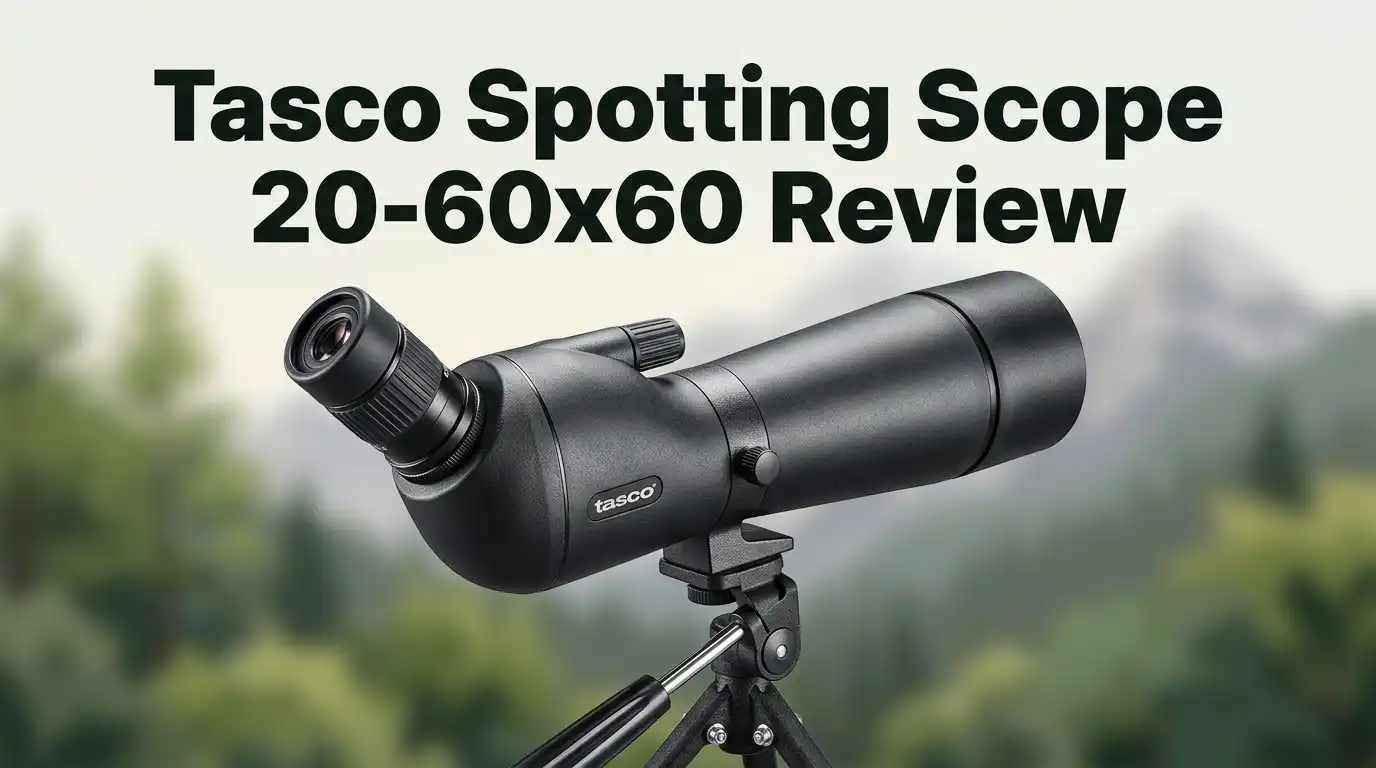
The Tasco 20-60×60 is an entry level angled spotting scope built for hunters, birders, and target shooters. The model number TS20606045 tells you the basics. You get 20x to 60x magnification, a 60mm objective lens, and a 45 degree eyepiece.
Inside sits a BK7 porro prism paired with fully coated lenses. That combination keeps the cost down. It also explains some of the limits we will discuss later. Fully coated is not the same as fully multi coated, and you notice that difference at dusk.
The scope measures roughly 13 to 14 inches long and weighs about 1.8 pounds. A standard 1/4 inch 20 thread sits on the base, so any camera tripod will accept it. A twist up eyecup and a sliding sunshade round out the package.
Tasco has sold optics since 1954, mostly at the value end of the market. This scope fits that history perfectly. It is a starter tool, priced like one, and honest about what it is.
Unboxing Experience: What Arrives At Your Door
The box is plain cardboard with a photo of the scope on the front. Nothing fancy. Open it and you find the scope wrapped in foam, a soft zippered carry case, a tabletop tripod, a lens cloth, and lens covers.
My first reaction was surprise at the weight. The scope feels denser in the hand than the photos suggest. The rubber armor has a slightly tacky texture that grips well even with damp fingers. That feels reassuring.
My second reaction was the opposite. The little tripod feels like a toy. The legs are thin, the pan head is stiff, and the whole thing stands only a few inches tall. You will use it on a bench, never on the ground.
The soft case works fine for storage. It has a shoulder strap and cutouts so you can glass without removing the scope, though the flaps flop around in wind. Setup took me under two minutes. Screw the scope onto the tripod, twist the eyecup, turn the focus knob, and you are watching.
Build Quality And Handling In The Field
The body holds up better than the price hints. Rubber armor covers most of the tube and absorbs bumps in a truck bed or a pack. The finish resists scuffs well after several months of normal use.
The zoom ring sits right behind the eyepiece and turns with firm, even resistance. I liked that. It does not drift on its own. The focus knob sits on top of the barrel with a ribbed, slip resistant surface that you can find by feel.
Focus travel feels a little long. Going from a close target to a distant one takes several turns of the wrist. At 20x this barely matters. At 60x it becomes a small chore because the depth of field shrinks and every tiny turn shifts the picture.
The sliding sunshade pulls out about two inches. It cuts glare on bright afternoons and keeps light rain off the front glass. Small feature, genuinely useful. The 45 degree eyepiece makes standing and prone viewing comfortable, which many straight scopes cannot claim.
Top 3 Alternatives For Tasco Spotting Scope 20-60×60

- 20-60x60 HD Optics: Designed for target shooting and outdoor observation with high-definition optical performance
- Ultra-Light Spotting Scope Kit for Effortless Travel: Weighing just 1.31lbs, this spotting scope with tripod comes with a soft shoulder-strap carrying case, easy to sling over your shoulder or compact storage in a backpack without taking space.
Last update on 2026-09-17 / Affiliate links / Images from Amazon Product Advertising API Some of the links on this website are affiliate links, which means that at no additional cost to you, I earn a commission if you click through and make a purchase. I only recommend products and services that I believe will add value to my readers. Thank you for your support!
Emarth 20-60×60 Angled Spotting Scope

- Gosky Updated Newest 20-60x80 Spotting Scope - Variable 20x to 60x magnification and dynamic lens focusing system brings better optics, more stable images and easier focusing power. It’s the best choice for target shooting, archery, hunting, bird watching, wildlife watching, hiking, camping, scenery, outdoor sporting, astronomical observation etc
Last update on 2026-09-13 / Affiliate links / Images from Amazon Product Advertising API Some of the links on this website are affiliate links, which means that at no additional cost to you, I earn a commission if you click through and make a purchase. I only recommend products and services that I believe will add value to my readers. Thank you for your support!
Gosky Updated 20-60×80 Spotting Scope with Tripod and Phone Adapter

- ULTIMA ANGLED ZOOM SPOTTING SCOPE: This versatile all-around spotting scope with a 65mm objective lens, 18-55x zoom, and a 45° viewing angle is the ideal choice for any outdoor enthusiast. It's perfect for observing nature and long-distance viewing.
- INCLUDES ESSENTIALS FOR BETTER VIEWING: The Celestron Ultima 65 comes complete with a soft carrying case, an extended tripod mounting plate, a zoom eyepiece with an integrated T-adapter for digiscoping, an eyepiece pouch, a lens cloth, and more.

Last update on 2026-09-17 / Affiliate links / Images from Amazon Product Advertising API Some of the links on this website are affiliate links, which means that at no additional cost to you, I earn a commission if you click through and make a purchase. I only recommend products and services that I believe will add value to my readers. Thank you for your support!
Celestron Ultima 18-55×65 Angled Spotting Scope
Optical Performance In Bright Daylight
Here is where the scope earns its keep. On a clear morning at 20x, the view looks bright and pleasantly wide. The field of view runs about 91 feet at 1000 yards at the low end, which helps you find your subject quickly.
Detail holds well from 20x through roughly 30x. I could read large lettering on a sign at 400 yards. Tree bark texture showed clearly. Colors look natural with only a mild warm cast.
Push past 35x and things change. The image softens, edge sharpness drops, and you see color fringing on high contrast edges like a dark branch against sky. At a full 60x the picture turns dim and mushy. You gain size but lose the detail that made the size useful.
Heat shimmer makes this worse on hot days. Every spotting scope suffers from mirage, but a cheaper one gives you less detail to start with. My habit became simple. Find at 20x, study at 30x, and only push higher when the air is cool and still.
How It Handles Low Light Conditions
Low light exposes budget glass faster than anything else. The Tasco 20-60×60 struggles here, and you should know that before you buy.
The math tells the story. At 20x with a 60mm objective, the exit pupil measures 3mm. At 60x it drops to just 1mm. A 1mm exit pupil delivers very little light to your eye. Add fully coated optics rather than fully multi coated, and the last thirty minutes of shooting light look grey and flat.
In practice, the scope works fine from mid morning to late afternoon. At sunrise and sunset the image dims noticeably, and details you saw an hour earlier disappear. Deer standing in shadow become dark shapes rather than identifiable animals.
This matters most to hunters. Legal shooting light often falls in the exact window where this scope fades. If your glassing happens at first and last light, spend more or choose an 80mm model. If you watch birds and targets during the day, you will rarely notice the limit.
The Included Tripod Is The Weak Link
I will be blunt. The tabletop tripod frustrated me more than any optical flaw.
The legs stand only a few inches high, so you need a bench, a tailgate, or a table. The pan head moves in jerky steps rather than smooth sweeps. Trying to center a bullet hole at 100 yards turned into a game of nudge, overshoot, nudge back.
Stability is the real problem. Any vibration travels straight into the image, and at 40x a light breeze makes the picture dance. Since the eye relief runs around 18 to 20mm with a rubber eyecup, your face often touches the scope, and that contact shakes the whole setup.
The fix costs less than you think. The base uses a standard 1/4 inch 20 thread, so almost any camera tripod fits. A basic $40 aluminum tripod with a fluid pan head transforms this scope. Images steady up, small adjustments become easy, and the higher magnifications suddenly look usable. Treat the bundled tripod as a spare and move on.
Range Day Testing At 100 And 200 Yards
Target shooters buy spotting scopes for one job. See the holes without walking downrange.
At 100 yards on a white paper target, the Tasco handles .30 caliber holes without complaint at 25x to 30x. Good light and a clean target make them obvious. Smaller .22 caliber holes need more magnification and good conditions, and they sometimes vanish into the paper texture.
At 200 yards the picture gets harder. Rifle holes in white paper stay findable when the sun cooperates, but you will push the zoom up and lose image quality doing it. On overcast days, or on brown cardboard, expect to walk downrange or use target pasters in bright colors.
One honest comparison stood out. A decent 10×40 rifle scope spotted holes nearly as well as the Tasco at 100 yards. That says something about the glass. For casual sight in work the Tasco still helps, especially when several shooters share one bench, but do not expect it to replace a premium spotter for load development.
Birdwatching And Backyard Wildlife Use
Birders will enjoy this scope more than hunters do, provided they keep their expectations sensible.
At 20x to 30x the view stays bright and wide enough to follow movement. Feeder birds at 50 to 100 feet look fantastic. Feather patterns on a cardinal or a woodpecker show clearly, and the 45 degree eyepiece lets you sit in a chair and watch comfortably for long stretches.
Waterfowl at 200 to 400 yards across a pond also work well. You can identify species, count birds, and pick out plumage differences. This is genuinely fun glass for a casual hobbyist.
Two limits show up. Small warblers flitting in dense brush move faster than the focus knob allows, so you lose them constantly. And shaded woodland edges turn dim, which hides the subtle color differences that identification depends on.
For a beginner building interest before buying premium optics, this scope does the job. For a serious lister chasing rare shorebirds at distance, the glass will hold you back.
Stargazing With The Tasco 20-60×60
This surprised me. The scope performs better on the night sky than its daytime reviews suggest.
The moon looks genuinely impressive. At 40x, craters along the terminator line show shadow and depth. Lunar brightness overwhelms the glass weaknesses because the subject throws so much light at you. Kids and guests love this view.
Jupiter shows as a small disc with the four Galilean moons lined up beside it. Saturn shows an oval shape where you can just make out the rings as an extension rather than a separate structure. Do not expect textbook photos, but the thrill of seeing them yourself still lands.
Star clusters like the Pleiades look pretty at 20x thanks to the wide field. Faint deep sky objects mostly do not appear. A 60mm objective simply gathers too little light for galaxies and nebulae.
A sturdy tripod is mandatory here. The tabletop model cannot aim upward with any stability. One bonus over a telescope: the image appears upright and correctly oriented, so the scope moves the same way your hands do.
Phone Digiscoping Results
Plenty of buyers want to shoot photos through the eyepiece. The Tasco 20-60×60 allows it, with effort.
No phone adapter comes in the box. You will buy one separately for around $15 to $25. Universal clamp style adapters fit the eyepiece diameter fine once you align them carefully.
Results look best at 20x. You get a round image circle with usable detail in the center. Push the zoom higher and vignetting, blur, and color fringing take over. Wind or a light tripod ruins shots instantly because your phone amplifies every shake.
Focus takes patience. You focus the scope first, then let the phone camera lock, then breathe and tap. My keeper rate hovered around one good shot in ten on the first outing, improving with practice.
Moon photos came out the best by far. Bright subject, high contrast, and no motion make it forgiving. Bird photos looked like proof of sighting images rather than portraits. Fine for a phone gallery, not for printing.
Weather Resistance And Long Term Durability
Tasco lists this model as weather resistant rather than fully waterproof and nitrogen purged. That distinction matters.
Light rain and morning dew cause no problems. The sunshade helps keep drops off the front lens. I would not submerge it, leave it in a downpour, or trust it on a soaking multi day hunt.
Fogging is the recurring complaint, and I experienced it. On humid days the eyepiece fogs from the warmth of your own face pressed against the eyecup. On freezing mornings, condensation can ice over the glass. Backing off slightly and using the twist up eyecup at full extension reduces the problem but does not remove it.
Internal fogging has been reported by some long term owners, which suggests the sealing varies between units. Store it in the soft case with the lens caps on and let it acclimate to temperature before use.
The mechanical parts have held up well for me. Zoom and focus still feel the same as day one, and the rubber armor shrugs off knocks.
What The Tasco 20-60×60 Does Not Do Well
Honest reviews list the failures plainly, so here they are.
It does not deliver usable 60x. The top third of the zoom range exists for marketing more than function. Treat 40x as your practical ceiling.
It does not perform at dawn and dusk. The narrow exit pupil and fully coated optics leave you with a dim, low contrast view exactly when hunters need clarity most.
It does not work out of the box for serious use. The tabletop tripod forces an extra purchase before the scope reaches its potential.
It does not spot small caliber holes reliably past 100 yards. .22 holes in white paper at 200 yards will frustrate you.
It does not resist fog perfectly. Humid and freezing conditions cause eyepiece condensation regularly.
It does not compete with $400 optics. That sounds obvious, yet plenty of buyers expect premium clarity from a budget porro prism scope and then feel cheated. Knowing these limits before you order is the difference between a happy purchase and a return label.
Pros And Cons
Pros
- Excellent price for a complete kit with case, tripod, and lens covers included
- Bright, sharp, enjoyable images across the 20x to 30x range in good light
- Comfortable 45 degree angled eyepiece that suits standing, sitting, and prone viewing
- Solid rubber armored body with a smooth zoom ring and grippy focus knob
- Standard 1/4 inch 20 mount accepts any camera tripod for an easy upgrade
- Wide 91 foot field of view at 1000 yards at 20x makes finding targets simple
- Genuinely fun on the moon and on bright planets with a steady tripod
- Lightweight at roughly 1.8 pounds, so it packs easily for scouting trips
Cons
- Image quality drops sharply above 40x and the advertised 60x is barely usable
- Poor low light performance because of fully coated rather than fully multi coated optics
- Included tabletop tripod is unstable, short, and awkward to adjust
- Eyepiece fogs in humid heat and can ice over in freezing weather
- Short eye relief with the eyecup forces face contact, which adds shake
- Struggles to show small caliber bullet holes beyond 100 yards
- Weather resistant only, not fully sealed or nitrogen purged
- No phone adapter included for digiscoping
Who Should Buy It And Who Should Skip It
Buy it if you want your first spotting scope and you are not sure how much you will use it. Spending $100 to find out beats spending $600 on a guess.
Buy it if you shoot at 100 yards and share a bench with friends. Buy it if you watch birds from a porch or a parked car. Buy it if you want a casual moon and planet viewer that also works in daylight. Buy it if you need something light for occasional scouting.
Skip it if you hunt seriously at dawn and dusk. The low light performance will cost you opportunities, and that frustration outlasts the savings.
Skip it if you shoot .22 caliber at 200 yards or run load development that depends on seeing exact hole placement. Skip it if you camp in wet weather for days. Skip it if you already own quality binoculars in the 10x to 15x range, because the jump in clarity may disappoint you.
Match the tool to the job and this scope looks smart. Mismatch it and it looks like wasted money.
Final Verdict: Is It Worth Buying In 2026?
- Bright, vivid color and high contrast viewing with fully coated optics
- Zoom in with maximum magnification utilizing the selectable power range. Optimal for birdwatching, nature viewing, hunting, target shooting, hiking camping, moon gazing and general observation.
Last update on 2026-09-20 / Affiliate links / Images from Amazon Product Advertising API Some of the links on this website are affiliate links, which means that at no additional cost to you, I earn a commission if you click through and make a purchase. I only recommend products and services that I believe will add value to my readers. Thank you for your support!
The Tasco 20-60×60 remains a reasonable buy in 2026 for one specific type of person. The casual user who wants reach without commitment.
Judge it against $400 spotters and it loses badly. Judge it against the $100 price tag and it makes sense. You get a comfortable angled eyepiece, honest daylight performance at moderate magnification, a durable body, and a complete starter kit. Very little else at this price includes a case and a mount.
The flaws are real and worth repeating. The high zoom range disappoints, low light viewing falls apart, and the bundled tripod needs replacing almost immediately. Plan for a $40 tripod purchase and think of your real total as $140.
My rating sits around 3.5 out of 5 for the price bracket and closer to 2.5 out of 5 against the wider market.
If your budget can stretch to $200, an 80mm model with fully multi coated glass will serve you better for years. If $100 is your limit, this scope gets you outside and looking, which is the whole point.
Frequently Asked Questions
Is the Tasco 20-60×60 waterproof?
No. Tasco describes it as weather resistant, not waterproof. It handles light rain, dew, and damp mornings without trouble, especially with the sunshade extended. It is not nitrogen purged, so internal fogging can happen in humid or rapidly changing temperatures. Do not submerge it or leave it exposed during heavy rain. Store it in the included soft case with the lens caps on when you finish, and let it warm up or cool down slowly before use in extreme conditions.
Can you see bullet holes at 100 yards with this scope?
Yes, with conditions in your favor. Larger rifle holes in white paper show clearly at 25x to 30x in good daylight. Smaller .22 caliber holes need higher magnification and can still hide in the paper texture. At 200 yards the job gets much harder. Bright target pasters, clean white backers, and a steady tripod all improve your odds significantly. On overcast days or with heat shimmer, expect to walk downrange and check by hand.
Do I need to buy a separate tripod?
Almost certainly yes. The included tabletop tripod stands only a few inches tall, wobbles under light pressure, and makes fine adjustments difficult. The scope uses a standard 1/4 inch 20 thread, so any camera tripod fits. A basic aluminum tripod with a fluid pan head, costing around $30 to $60, makes a dramatic difference. Images steady, aiming becomes intuitive, and higher magnifications finally become usable. Most owners describe this as the single best upgrade for the scope.
What is the highest useful magnification on this scope?
Around 35x to 40x in practice. The scope reaches 60x mechanically, but image brightness, sharpness, and contrast all decline sharply above 40x. At full zoom the exit pupil shrinks to 1mm, which starves your eye of light. Heat shimmer and tripod vibration also multiply at high power. Most users settle into 20x for scanning and 30x for detail. Think of 60x as an occasional peek rather than a working setting.
Is the Tasco 20-60×60 good for birdwatching?
It works well for casual birding in good light. Feeder birds, waterfowl across a pond, and perched raptors all look enjoyable at 20x to 30x. The 45 degree eyepiece keeps your neck comfortable during long sessions. Limits show with small fast birds in shaded brush, where the slow focus and dim view make identification hard. Beginners will get real value from it. Dedicated birders chasing difficult identifications should invest in fully multi coated glass instead.
How does it compare to the Emarth 20-60×60?
The two scopes compete directly and land close together. Both use similar 60mm porro prism designs at similar prices. The Emarth is Amazon’s top seller and typically ships with a slightly better tripod and a phone adapter. The Tasco offers a more reassuring body feel, a wider field of view at low power, and brand history. Optically, testers rate them within a hair of each other. Choose based on price on the day and whether you want the phone adapter included.
Can I use this scope for stargazing?
Yes, and it performs better at night than many reviews suggest. The moon looks excellent at 40x with visible crater detail. Jupiter shows its four bright moons and Saturn shows an oval ring shape. Bright star clusters look attractive at 20x. Faint galaxies and nebulae will not appear because a 60mm objective gathers too little light. You will need a full size tripod that can tilt upward, since the tabletop version cannot hold a steep angle steadily.

Hello, I’m Amelia White, the founder of birdsfanatic.com. As a lifelong bird enthusiast and spiritual seeker, I’ve always been fascinated by the mystical connections between birds and the human experience. On this site, I share my knowledge and insights into the symbolic meanings and spiritual significance of various bird species, exploring their roles in mythology, folklore, and cultural traditions. Join me on this journey into the world of birds, where we’ll discover the hidden wisdom and guidance that these magnificent creatures have to offer.