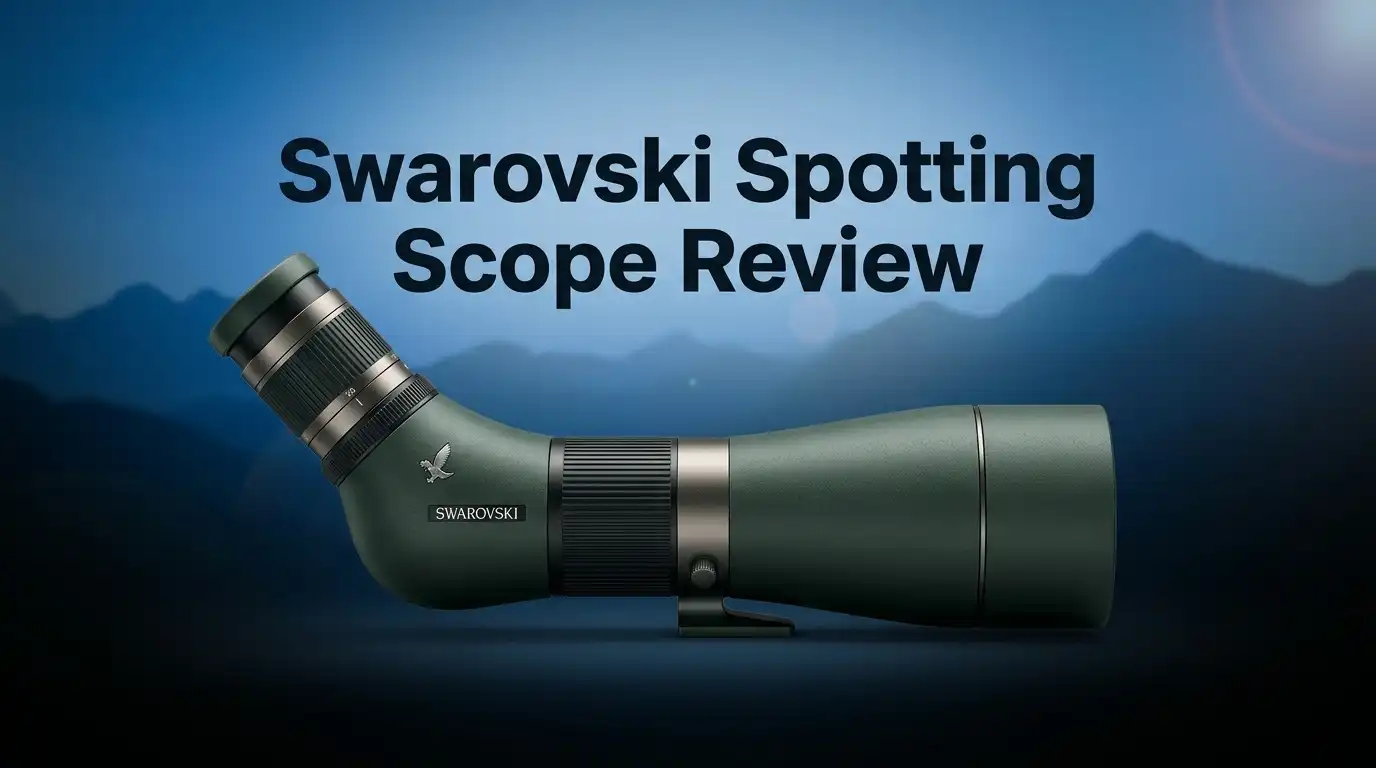
Swarovski Spotting Scope Review 2026: Still Worth It?
Swarovski spotting scopes carry a price tag that makes most people pause. You look at the number, you look at your bank account, and you wonder if any piece of glass can justify it. I wondered the same thing before I spent two seasons behind three different Swarovski spotters, glassing mule deer basins at dawn and shorebirds at dusk.
This review covers what Swarovski sells in 2026, how each model actually performs in the field, and where these scopes fall short. Yes, they fall short in places. No spotting scope is perfect, and a honest review should say so. You will find real weights, real prices, real frustrations, and clear guidance on which model fits your use.
If you are comparing Swarovski against Kowa, Zeiss, Vortex, or Maven, keep reading. By the end you will know whether the Austrian glass earns your money or whether a smarter buy sits one shelf down.
In a Nutshell:
- Swarovski makes three main spotting scope families in 2026. The ATC and STC compacts sit at 17 to 40×56. The ATS and STS 65 HD serve as midsize workhorses. The ATX, STX, and BTX modular system covers 65mm, 85mm, 95mm, and 115mm objectives with swappable eyepieces.
- Optical performance is genuinely elite. Color fringing stays near invisible in the center of the view. Contrast looks rich. Edge sharpness holds better than almost anything else on the market.
- The ATC 17-40×56 is the standout value inside the lineup. It weighs roughly 2.1 pounds, delivers a huge field of view, and offers 20mm of eye relief that glasses wearers love.
- Price remains the biggest barrier. Expect around $2,200 for the ATC, near $2,500 for the ATS 65 HD, and $4,000 to $5,000 for a full ATX 95 setup. Prices shift, so confirm before buying.
- The weaknesses are real. Focus rings can feel stiff near infinity. The ATC skips a rotating collar and a sunshade. The BTX is heavy and needs a serious tripod.
- Kowa, Maven, and Athlon deliver 85 to 90 percent of the image for half the cost. The last 10 percent is what you pay Swarovski for.

- SUPERIOR CLARITY - Experience unmatched image quality with the 56mm objective lens, capturing bright, clear images even in low-light conditions, enhancing every viewing experience with exceptional detail.
- VERSATILE MAGNIFICATION - Seamlessly adjust from 17x to 40x magnification, allowing you to zoom in on distant subjects with ease, perfect for detailed observation of wildlife or landscapes.
Last update on 2026-09-20 / Affiliate links / Images from Amazon Product Advertising API Some of the links on this website are affiliate links, which means that at no additional cost to you, I earn a commission if you click through and make a purchase. I only recommend products and services that I believe will add value to my readers. Thank you for your support!
Why Swarovski Still Leads the Spotting Scope Market in 2026
Swarovski Optik has built optics in Absam, Austria since 1949. That history shows in small details rather than marketing claims. The company grinds its own fluoride containing HD glass. It applies proprietary coatings that push light transmission above 90 percent across most of the visible spectrum.
What does that mean when you are behind the eyepiece? It means you see antler tines at 800 yards in fading light. It means you count primary feathers on a distant raptor. It means your eyes stay comfortable after three hours of glassing instead of aching after 30 minutes.
Competitors have closed the gap, and that matters. Kowa fluorite glass rivals Swarovski on pure resolution. Zeiss Harpia offers a wider zoom range. Still, Swarovski wins on the total package: mechanical smoothness, field of view, eye relief, warranty support, and resale value.
A used Swarovski scope holds value better than any other brand. That last point softens the sting of the purchase price more than most buyers expect.
Swarovski ATC 17-40×56 Compact Spotting Scope
The ATC is the scope I recommend most often. It measures about 10.2 inches long and weighs roughly 34 ounces with covers. You can slide it into a daypack without rearranging everything else.
The field of view is the headline feature. At 17x you see an enormous slice of hillside. Reviewers who tested the ATC against the Kowa 553 and the Swarovski ATS found the ATC at 40x showed nearly the same width of terrain as the ATS did at 20x. That number sounds wrong until you look through it yourself.
Eye relief measures 20mm, the most generous in this class. Chromatic aberration control beat both comparison scopes in side by side testing. The eyepiece design comes straight from the ATX family.
Pros
- Very compact and light for premium 56mm glass
- Massive field of view at every magnification
- 20mm eye relief suits eyeglass wearers
- Best in class for digiscoping with minimal vignetting
- Objective cap nests inside the eyepiece cover, so you never lose it
Cons
- No rotating collar for angled viewing adjustment
- No extending sunshade
- Some owners report a stiff focus ring near infinity
- Costs nearly $1,000 more than the Kowa 553
Swarovski ATS 65 HD Spotting Scope

- Aluminum spotting scope with 65mm objective lens diameter
- Fluoride-containing HD lenses minimize color fringing and produce high-contrast images
Last update on 2026-07-01 / Affiliate links / Images from Amazon Product Advertising API Some of the links on this website are affiliate links, which means that at no additional cost to you, I earn a commission if you click through and make a purchase. I only recommend products and services that I believe will add value to my readers. Thank you for your support!
The ATS 65 HD is the older design, and it still sells because it does everything competently. It uses a separate eyepiece, so you choose between the 20 to 60x zoom or the 25 to 50x wide angle. Weight runs close to 46 ounces, roughly a pound more than the ATC.
That extra glass buys you reach. In stable air and overcast light, the ATS resolved one full line more on a distant eye chart at 60x than the ATC managed at 40x. When the sun heats the ground and mirage builds, that advantage disappears fast. High magnification amplifies heat shimmer just as much as it amplifies detail.
The ATS includes a rotating collar and an extending sunshade. Both features matter more than spec sheets suggest. The collar shines on window mounts and uneven ground.
Pros
- Highest usable magnification in the compact Swarovski range
- Rotating collar and built in sunshade
- Two eyepiece options for different priorities
- Brighter image than the ATC at matched power
Cons
- A full pound heavier than the ATC
- Eyepiece sold separately on many listings, which raises the real cost
- Visible mustache distortion at high power
- An aging design compared to the modular ATX system
Top 3 Alternative for Swarovski ATC 17-40×56

- 88 mm. Angled Spotting Scope Kit
- PROMINAR Pure Fluorite Line of Products
Last update on 2026-09-20 / Affiliate links / Images from Amazon Product Advertising API Some of the links on this website are affiliate links, which means that at no additional cost to you, I earn a commission if you click through and make a purchase. I only recommend products and services that I believe will add value to my readers. Thank you for your support!
Kowa TSN-88A PROMINAR Pure Fluorite Angled Spotting Scope

- PREMIUM ED GLASS FOR CRYSTAL-CLEAR DETAIL – Extra-low dispersion (ED) glass delivers exceptional clarity, contrast, and color accuracy across the entire magnification range. Designed to reduce chromatic aberration, the Maven CS.1 spotting scope provides sharp, high-definition images for hunting, wildlife viewing, and long-range target spotting.
- VERSATILE 15-45X MAGNIFICATION RANGE – The 15-45x zoom eyepiece allows quick adjustment from wide-angle scanning to detailed long-distance observation. Ideal for spotting game, evaluating antlers, birdwatching, and identifying distant targets at the range.
Last update on 2026-06-28 / Affiliate links / Images from Amazon Product Advertising API Some of the links on this website are affiliate links, which means that at no additional cost to you, I earn a commission if you click through and make a purchase. I only recommend products and services that I believe will add value to my readers. Thank you for your support!
Maven CS.1 15-45x65mm Spotting Scope

- Apochromatic lens system Helps in converging refracting colors into one focus point, producing greater contrast, sharpness, and color definition
- UHD glass Gives you an advantage with an image that has little or no chromatic fringe for the clearest and sharpest image
Last update on 2026-09-13 / Affiliate links / Images from Amazon Product Advertising API Some of the links on this website are affiliate links, which means that at no additional cost to you, I earn a commission if you click through and make a purchase. I only recommend products and services that I believe will add value to my readers. Thank you for your support!
Athlon Optics Cronus G2 20-60×86 Spotting Scope
The Swarovski ATX, STX, and BTX Modular System Explained
The modular system splits a spotting scope into two parts. You buy one eyepiece module and one or more objective modules. They twist together in about two seconds.
ATX means angled. STX means straight. BTX means two eyes. The objective modules come in 65mm, 85mm, 95mm, and 115mm. The ATX and STX eyepieces zoom from 25 to 60x on the 65mm and 85mm, and 30 to 70x on the 95mm and 115mm.
The BTX changes the experience completely. Two eyepieces, one objective, fixed magnification. Long glassing sessions stop feeling like work because both eyes stay open and relaxed. Users describe the image as three dimensional and immersive.
The catch is weight and money. A BTX with a 95mm objective pushes past 5 pounds and past $5,000. Budget for a carbon fiber tripod and a fluid head too. Expect the eyepiece module alone to run above $2,200, with objectives from roughly $900 to over $2,000.
The Unboxing Experience
Swarovski packaging feels deliberate rather than flashy. The outer box uses recycled cardboard with a simple green print. Inside, the scope sits in molded foam or a fitted cloth bed depending on the model.
The first thing you notice is the smell of clean rubber armor. The second is the weight. Even the compact ATC feels denser than expected, the way a good tool does.
You get a stay on carrying case, a padded strap, lens covers, and a cleaning cloth. The ATC ships with its own soft case that many owners simply leave on permanently. Documentation is thin, which is fine because the controls are obvious.
My favorite touch stays the objective cap on the ATC. It clips inside the eyepiece cover, so it never ends up in the dirt. Small, thoughtful, and the kind of detail that explains part of the price.
First focus adjustment feels buttery. Then you point it at a tree 400 yards out and understand what you paid for.
Glass Quality and Image Performance
Swarovski uses fluoride containing HD lenses across the current range. The purpose is simple: bend different wavelengths of light back to the same focal point. When that works, purple and green fringes around dark branches vanish.
In controlled testing the ATC showed no visible fringing in the center of the field. Mild fringing appeared only at the extreme edge. The ATS and the Kowa 553 both showed a trace of fringing just off center.
Contrast is where Swarovski separates from midpriced glass. Shadows keep detail instead of flattening into gray mush. Brown fur against brown dirt still looks like two different browns.
Resolution testing at 535 yards showed something useful. At matched 40x magnification, the ATC, the ATS, and the Kowa 553 all resolved the same line on an eye chart. Premium glass does not out resolve good glass at equal power. It out performs in contrast, color accuracy, edge sharpness, and comfort. That distinction is worth understanding before you spend.
Low Light Performance
Physics rules this category. A bigger objective gathers more light, and no coating overcomes that.
The ATS 65 HD beats the ATC 56mm at matched magnification in the last 20 minutes of legal light. The gap is noticeable but not dramatic. Against the Kowa 553, the ATC held even right down to the final hints of daylight.
The ATX 95 and BTX 95 are the true low light champions. With a 95mm front element and 30x on the BTX, the exit pupil stays large enough to keep the image usable well past sunset. Hunters who spend the final hour glassing dark timber notice this immediately.
Here is the honest tradeoff. Each jump in objective size adds weight, length, and cost. A 95mm module weighs more than the entire ATC scope. Ask yourself how often you actually glass in the last ten minutes of light. If the answer is rarely, save the money and the back strain.
Field of View and Eye Relief
Field of view decides how quickly you find animals. Eye relief decides how long you can search comfortably.
The ATC leads both categories inside the Swarovski lineup. At 17x the view is so wide that digiscopers struggle to capture the field stop in a photo. Grid glassing across a large basin becomes fast instead of tedious.
Eye relief on the ATC measures 20mm. The ATS gives 17mm and the Kowa 553 gives 16mm. In practice, all three work for eyeglass wearers at low power. At maximum magnification the difference shows. The ATC needs only light contact between lens and eyecup. The Kowa needs firm pressure.
Narrow field of view creates what testers call the tube effect. You feel like you are looking down a pipe. The ATC eliminates that sensation entirely. After an hour behind it, going back to a narrower scope feels claustrophobic. This single factor changes how much glassing you actually do.
Build Quality and Weather Resistance
Every current Swarovski spotting scope is nitrogen filled and waterproof to 13 feet of submersion. That rating is overkill for rain, which is the point.
The rubber armor uses a light texture that grips well with wet hands and gloves. It stays warmer to the touch in cold weather than bare metal or painted finishes. The Kowa 553 skips armor entirely, and you feel that difference at 20 degrees.
Mechanical feel is the quiet strength here. Helical focus rings on the ATC and ATX turn without play or grinding. Zoom rings have consistent resistance across the range. Nothing rattles.
One documented complaint deserves attention. Some ATC owners on birding forums report focus that moves smoothly at close range but turns stiff and jerky when approaching infinity. A few describe the ring rubbing against the rubber armor. This is not universal, and Swarovski service resolves it, but it exists. Check your unit during the return window. Test the full focus travel before you commit.
Digiscoping Performance
Digiscoping means attaching a phone or camera to the eyepiece to photograph what you see. Swarovski built its reputation partly on this.
The ATC is exceptional here. It shares eyepiece construction with the ATX family. The wide field, the broad eyecup, and the short distance between camera lens and eyepiece lens combine to nearly eliminate vignetting. Mounting an adapter is repeatable, which saves frustration in the field.
Swarovski sells the VPA variable phone adapter and dedicated camera adapters. The system works, though the accessories cost more than third party options that perform nearly as well.
The ATX and BTX also digiscope well, with the 95mm modules producing the cleanest images at long range. Heavier setups need a solid tripod to prevent shake during exposure.
The limitation is magnification. Digiscoped images at 40x and beyond suffer badly from heat shimmer and air turbulence. Shoot in the first and last hours of the day for usable results.
Weight, Tripods, and Packability
Numbers matter here. The ATC runs about 34 ounces. The ATS 65 HD runs about 46 ounces. An ATX 95 setup approaches 90 ounces. A BTX 95 passes 5 pounds.
Your tripod must match the scope. A lightweight travel tripod handles the ATC fine. That same tripod turns a BTX into a vibrating mess. Plan on a carbon fiber tripod with a fluid or ball head for anything above the ATS.
Backpack hunters gain real advantages from the small scopes beyond weight. Compact bodies catch less wind, which reduces shake. They sit stable on lighter supports. They leave pack space for food and layers.
Here is where I push back on spec sheet shopping. One extra pound sounds trivial in your living room. At 10,000 feet on day four, that pound decides whether the scope comes along or stays at camp. A scope in your pack beats a better scope at home every single time.
What Swarovski Does Not Do Well
Honest reviews list the failures. Here are Swarovski’s.
Price is indefensible on pure performance grounds. The Kowa 553 saves nearly $1,000 and resolves the same detail at matched magnification. The Athlon Cronus G2 costs a quarter as much and satisfies most shooters completely.
The ATC omits two useful features. No rotating collar means awkward positioning on window mounts and side hills. No extending sunshade means glare when you glass toward the sun, though the deeply recessed objective helps.
The ATS design is aging. Mustache style distortion appears at high power. Eyepieces sell separately, which hides the true cost.
The modular system gets expensive fast. Buying an eyepiece plus two objectives costs more than most complete premium scopes.
Accessories are overpriced. Adapters, cases, and covers all carry a premium that is hard to justify.
None of these ruin the scopes. They simply mean Swarovski sells refinement, not miracles.
Price and Value in 2026
Expect roughly $2,200 for the ATC 17-40×56. The ATS 65 HD sits near $2,400 to $2,500 depending on eyepiece. The ATX or STX eyepiece module runs above $2,200 alone, with objectives from about $900 for the 65mm to over $2,000 for the 95mm. A BTX build lands between $4,500 and $6,000. Verify current pricing, because optics prices moved several times in the last two years.
Value depends entirely on how much you use it. Someone who glasses 200 days a year amortizes a Swarovski into pennies per hour. Someone who spots twice a season does not.
Resale protects you more than people realize. Used Swarovski scopes routinely sell for 65 to 75 percent of retail years later. Compare that to midtier brands that lose half their value in one season. Your real cost is the difference between purchase and eventual sale, not the sticker price.
Who Should Buy Which Swarovski Scope
Buy the ATC if you carry your scope. Backpack hunters, traveling birders, and anyone who values field of view over maximum magnification will be happiest here. It is the best ultracompact spotting scope available.
Buy the ATS 65 HD if you want one scope for everything. Truck glassing, range days, backyard birding, and occasional pack trips all work. The rotating collar and 60x ceiling add versatility.
Buy the ATX 85 if long range detail matters most. Competitive shooters and serious wildlife observers get the resolution they need without full 95mm weight.
Buy the BTX if comfort rules your decision. Stationary birders, waterfowl counters, and anyone glassing for hours will never go back to one eye.
Skip Swarovski entirely if budget is tight. The Maven CS.1 and Athlon Cronus G2 deliver satisfying performance at a fraction of the cost. There is no shame in that choice.
Final Verdict
Swarovski spotting scopes remain the reference standard in 2026. The glass is superb, the mechanics are smooth, and the field of view on the newer designs changes how you search terrain.
They are also expensive, occasionally quirky, and beatable on paper by cheaper rivals. The ATC 17-40×56 is the model I would buy with my own money. It balances size, optics, and usability better than anything else Swarovski makes.
Buy it if you will use it hard and often. Otherwise, put the savings toward a better tripod and more days in the field.
Frequently Asked Questions
Is a Swarovski spotting scope worth the money?
Yes for frequent users, no for occasional ones. The optical advantage over midtier scopes is real but modest, roughly 10 to 15 percent in contrast and edge sharpness. Strong resale value reduces the long term cost considerably.
Which Swarovski spotting scope is best for birding?
The ATC 17-40×56 suits mobile birders. The BTX with an 85mm or 95mm objective suits stationary observation and long sessions. Both digiscope well.
What is the difference between ATX and STX?
Only the viewing angle. ATX is angled, STX is straight. Both use identical objective modules and identical optics. Angled bodies suit shared viewing and steep terrain. Straight bodies suit quick target acquisition.
How much does a Swarovski ATC weigh?
About 34 ounces with lens covers attached, and roughly 31 ounces bare. It measures close to 10.2 inches long.
Does Swarovski offer a lifetime warranty?
Swarovski provides a limited warranty of 10 years with registration on most current optics, plus strong service support afterward. Terms vary by region, so check with Swarovski directly.
Is the Kowa TSN 883 better than a Swarovski ATX?
They are close. Kowa pure fluorite glass resolves detail beautifully and costs less. Swarovski offers a wider field of view, better eye relief, and the modular system. Most testers call it a tie on image quality.
Can I use a Swarovski spotting scope for astronomy?
Yes, for the moon, planets, and bright deep sky objects. The BTX performs especially well because binocular viewing reveals more detail. Dedicated telescopes gather far more light for serious astronomy.

Hello, I’m Amelia White, the founder of birdsfanatic.com. As a lifelong bird enthusiast and spiritual seeker, I’ve always been fascinated by the mystical connections between birds and the human experience. On this site, I share my knowledge and insights into the symbolic meanings and spiritual significance of various bird species, exploring their roles in mythology, folklore, and cultural traditions. Join me on this journey into the world of birds, where we’ll discover the hidden wisdom and guidance that these magnificent creatures have to offer.