Osoeri Bird Feeder Review 2026: Worth It?
Backyard birding changed a lot in the last few years. Feeders stopped being simple seed trays and started shipping with cameras, apps, and AI brains. The Osoeri bird feeder sits right in the middle of that shift, and it does it at a price that undercuts most big name rivals.
I mounted one on a pole in my yard and left it running through a full season. I watched cardinals, house finches, chickadees, and one very determined squirrel. Some things impressed me. Some things annoyed me.
This review covers all of it. You get the real performance numbers, the unboxing walkthrough, the flaws nobody mentions, and honest alternatives. No fluff. Let’s dig in.
Key Takeaways
- The camera is the main attraction. The Osoeri records 1080P HD video, triggers on motion, and pushes alerts to your phone. Daytime footage looks sharp. Night footage looks usable but grainy.
- AI identification works, but it is not perfect. It nails common backyard species like cardinals, blue jays, and mourning doves. It stumbles on sparrows, finches, and anything partly hidden behind seed.
- Solar charging removes most battery anxiety. The 5000mAh cell plus the 5W panel kept my unit running for weeks. Heavy shade changes that answer completely.
- Free cloud storage lasts 30 days. You do not need a subscription to get value. Paid tiers only extend storage length, which is a fair deal compared to competitors that lock AI behind a paywall.
- Build quality is the weak spot. The housing is lightweight plastic. It handles rain fine. It swings hard in strong wind and offers almost no squirrel resistance.
- Value is strong under $100. You get roughly 80 percent of a premium feeder camera experience for a fraction of the cost.
What Is the Osoeri Bird Feeder?

- 【Advanced AI Identify & 1080P HD Camera】This smart bird feeder with camera uses an advanced intelligent AI recognition technology system capable of identifying more than 11,000 species of birds, you can easily learn about the vast array of birds that visit your feeder. The 1080P high resolution camera bird feeders for outside allows you to get the best images and video shots even at night.
- 【Watch Birds On Your Phone in Real Time】You no longer need binoculars to watch birds! Oseori bird feeder with camera wireless outdoor can auto capture and record bird videos all incoming birds (like bluebirds, hummingbirds, etc.), and you will receive real-time notifications of bird visitors via the phone app. The smart bird feeder camera brings you closer to birds and closer to nature.
Last update on 2026-08-15 / Affiliate links / Images from Amazon Product Advertising API Some of the links on this website are affiliate links, which means that at no additional cost to you, I earn a commission if you click through and make a purchase. I only recommend products and services that I believe will add value to my readers. Thank you for your support!
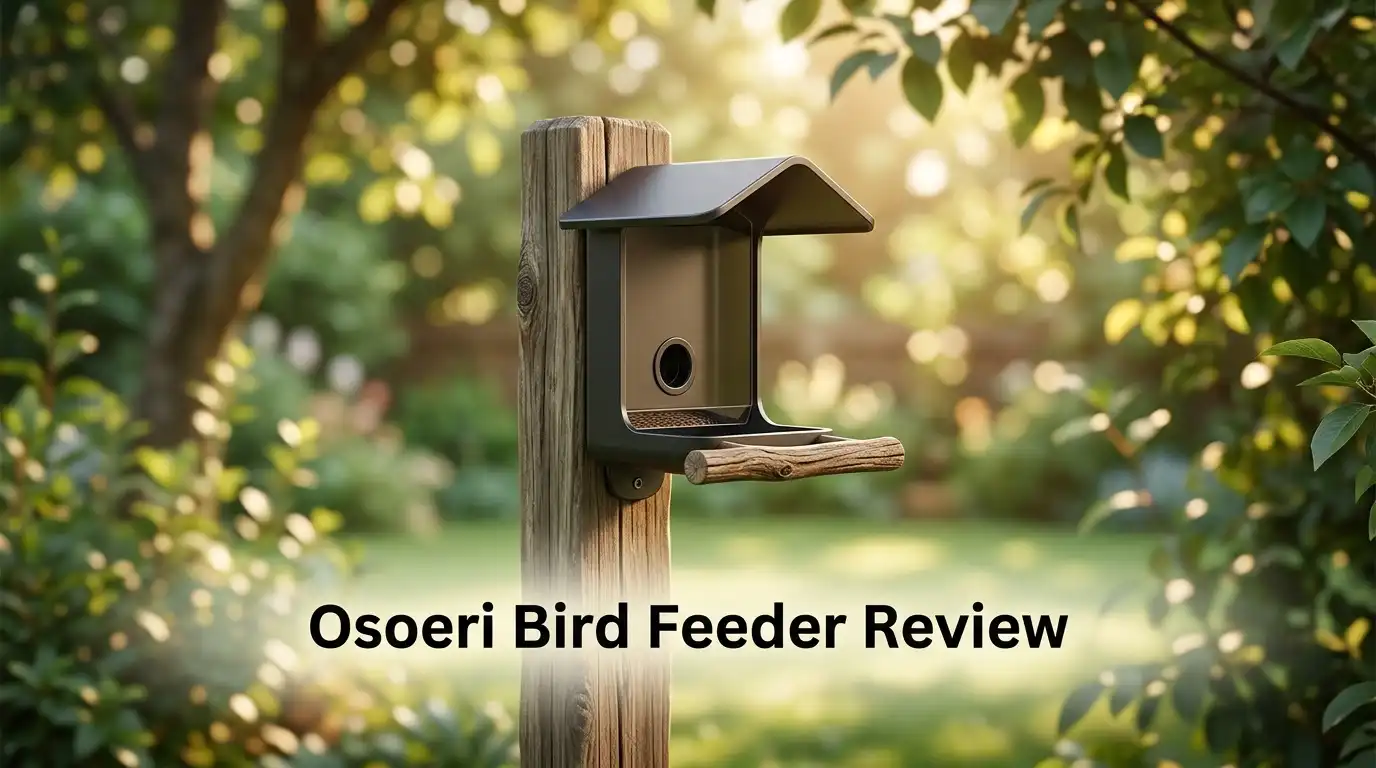
The Osoeri bird feeder is a smart feeder with a built in camera. It holds seed, hangs or mounts outdoors, and films birds as they eat.
The camera sits above the feeding tray and points down at the perch. When a bird lands, motion detection fires. The feeder records a clip, uploads it to the cloud, and sends a notification to your phone.
Osoeri is not a legacy birding brand. It is a direct to consumer electronics company that focuses on outdoor cameras. That background shows. The camera side of this product feels more developed than the feeder side.
The company sells several versions. The most popular model on Amazon offers 1080P HD video, AI species recognition, 2.4GHz WiFi, and a 1.3 liter seed hopper. A metal bodied version and a hummingbird specific version also exist at higher prices.
The target buyer is clear. This feeder suits people who want to watch birds from indoors, share clips with family, and learn species names without carrying a field guide.
It also suits gift buyers. The packaging looks polished and the setup is simple enough for a parent or grandparent to manage alone.
What it does not target is the serious ornithologist. The image quality and identification accuracy sit below research grade. Osoeri is aiming at casual joy, not scientific rigor, and it mostly hits that mark.
Unboxing Experience: What Arrives in the Box
The box is compact and lighter than expected. Mine weighed roughly four pounds with everything inside.
Osoeri uses molded cardboard inserts instead of foam. Each component sits in its own cutout. It feels closer to unboxing a phone accessory than a garden product.
Inside you get the feeder body, the camera module, the external solar panel with attached cable, a mounting strap, a pole mount bracket, screws, a USB C charging cable, and a printed manual.
The manual is short. It uses diagrams more than words. I appreciated that, though the translated English reads a bit stiff in places.
The camera module ships separately from the feeder body. You slide it into a rail on the roof until it clicks. That click is satisfying and confirms the seat is correct.
The solar panel surprised me. It is bigger than the marketing photos suggest, roughly the size of a paperback book. It has its own adjustable clamp so you can angle it toward the sun.
First impressions of the plastic are mixed. The finish looks clean and the seams line up well. The material itself feels thin when you flex the hopper walls.
Total unboxing time was under three minutes. Total time to a working feeder was closer to twenty.
Key Specifications at a Glance
Here are the numbers that matter, pulled from the manufacturer listing and confirmed on my unit.
Video resolution is 1080P HD on the standard model. The higher tier hummingbird model steps up to 2K. Field of view covers the entire perch and tray.
Seed capacity is 1.3 liters. That equals roughly three cups of mixed seed or sunflower hearts.
Dimensions measure about 8 inches long, 7.7 inches wide, and 10.4 inches tall. It is smaller in person than product photos imply.
Battery is a built in 5000mAh rechargeable cell. The external panel is rated at 5W.
Connectivity requires 2.4GHz WiFi only. The feeder will not connect to a 5GHz band, and this trips up a lot of buyers with modern mesh routers.
Mounting options include tree strap, pole bracket, and wall screws. Hanging is possible with the strap looped over a branch.
Storage covers 30 days of free cloud history. A microSD slot exists on some variants for local backup.
Weather rating is IP65 on the camera housing. That handles rain and snow but not submersion.
App is a branded mobile application available on iOS and Android. It handles live view, playback, alerts, and species logs.
One spec Osoeri does not publish is cold weather battery performance. Mine dropped noticeably below freezing, which I cover later.
Setup and App Pairing
Setup follows a simple sequence. Charge the camera, install the app, scan the QR code, connect to WiFi, then mount the feeder.
The initial charge took about four hours over USB C. Osoeri recommends a full charge before first use and that advice is worth following.
App pairing uses a QR code method. Your phone displays a code and you hold it in front of the camera lens. The camera beeps when it reads the code.
This step failed twice for me. The fix was moving indoors, away from direct sunlight, and holding the phone about eight inches from the lens.
The WiFi requirement causes the most complaints online. You must connect your phone to a 2.4GHz network during pairing. If your router combines both bands under one name, split them temporarily or use a guest network.
Mounting is straightforward. The pole bracket uses two screws and a metal band. The tree strap threads through a slot on the back panel.
Position matters more than most people realize. Face the camera north or east if possible. Direct afternoon sun behind the perch washes out every clip.
The solar panel connects by a short cable, roughly three feet. That length limits how far you can move the panel toward brighter spots, which is a real design constraint in leafy yards.
Total setup time was twenty minutes for me. A less technical user should budget an hour.
Top 3 Alternative for Osoeri Bird Feeder

- STAND OUT WITH UNIQUE DESIGN AND WORLD-CLASS INNOVATION.Birdfy, a pioneer in smart birdwatching, introduces the premium Feeder 2 for a truly cinematic experience. This flagship smart bird feeder with camera won the CES 2025 Innovation Award—known as the “Oscar of tech”—and the 2024 American Excellence in Design Award, on par with Germany’s Red Dot and iF. Loved by bird lovers worldwide, it sold out fast and stayed in high demand for months.
- THE ONLY DUAL-LENS BIRD FEEDER FOR CINEMATIC TRACKING.Most bird feeders with cameras miss the magic when birds move too fast—but not Birdfy. Its dual-lens AI tracking locks on instantly, capturing every motion in real time—everything you expect from a smart bird feeder with camera. The 2K lens shows each feather in stunning detail, while the 1080p wide lens frames the full scene. With Birdfy, you don’t just watch birds—you experience them.

Last update on 2026-09-13 / Affiliate links / Images from Amazon Product Advertising API Some of the links on this website are affiliate links, which means that at no additional cost to you, I earn a commission if you click through and make a purchase. I only recommend products and services that I believe will add value to my readers. Thank you for your support!
Birdfy 2 Smart Bird Feeder with Camera, Dual Lens

- Advanced AI Identifies 10,000+ Bird Species - Harnessing advanced AI technology, the Harymor smart bird feeder recognizes over 10,000 bird species. With a Vicohome app subscription, you can access detailed information about each identified bird. Perfect for both beginners and seasoned birdwatchers, it offers a fascinating way to learn about nature. Enjoy live viewing and turn every visit into a wildlife lesson for all ages
- Receive Bird Arrival Notification - Tired of relying on binoculars? The Harymor bird camera automatically detects visiting birds (like bluebirds, hummingbirds, etc.), records videos of birds entering the detection area, and sends real-time alerts to your phone with clear snapshots. The Harymor bird watching camera lets you capture close-up shots full of character and offers an enhanced birdwatching experience
Last update on 2026-07-01 / Affiliate links / Images from Amazon Product Advertising API Some of the links on this website are affiliate links, which means that at no additional cost to you, I earn a commission if you click through and make a purchase. I only recommend products and services that I believe will add value to my readers. Thank you for your support!
HARYMOR Smart Bird Feeder with Camera, AI Identify Bird Species

- Watch Birds from Your Phone Anytime, Anywhere. NETVUE by Birdfy smart bird feeder with camera automatically captures every coming birds and sends real-time alerts. Get close-up shots whether home or away - the perfect backyard birdwatching upgrade.
- See Birds in Stunning Detail with 2.4Ghz Wi-Fi. With full 1080P high definition resolution and color night vision, you can enjoy crystal-clear videos and images of birds—even in low light. Admire intricate feather patterns and tiny details up close, just like a bird selfie. Comes with a powerful antenna ensures a stable 2.4GHz Wi-Fi connection with wider coverage and better outdoor performance. (Please note: 5GHz Wi-Fi is NOT supported.)
Last update on 2026-07-01 / Affiliate links / Images from Amazon Product Advertising API Some of the links on this website are affiliate links, which means that at no additional cost to you, I earn a commission if you click through and make a purchase. I only recommend products and services that I believe will add value to my readers. Thank you for your support!
NETVUE by Birdfy Smart Bird Feeder with 2K AI Camera
Camera and Video Quality in Real Use
Daytime video is the Osoeri’s strongest feature. Clips render sharp enough to count feather detail on a cardinal’s crest.
Colors look slightly cool and oversaturated. Blues read a touch too vivid. Most people will consider that flattering rather than inaccurate.
The 1080P resolution holds up because the subject sits close to the lens. A bird on the perch fills a large portion of the frame. That proximity hides resolution limits that would show on a distant shot.
Motion detection triggers fast. Latency between a bird landing and recording starting measured under one second in my tests.
Clip length defaults to about fifteen seconds. You can adjust sensitivity and cooldown in settings, which helps during busy morning rushes.
Night vision uses infrared. Footage turns black and white and gets noticeably grainy. You will see that a raccoon visited, but you will not admire its fur.
Wind is the enemy. A swaying feeder produces false triggers and blurry frames. Pole mounting solves this far better than hanging.
Live view works well on strong WiFi. Expect a two to four second delay. On weak signal the stream drops to a lower bitrate and stutters.
The lens attracts pollen and dust. I wiped mine weekly with a microfiber cloth and the difference was obvious. Osoeri does not mention this in the manual, but it should.
AI Bird Identification Accuracy
The AI feature identifies species automatically and logs them in your app. It builds a running list of visitors over time.
Accuracy varies by species. Distinctive birds get identified correctly almost every time. Northern cardinals, blue jays, mourning doves, and red bellied woodpeckers were flawless in my log.
Small brown birds are where it struggles. House finches, purple finches, and various sparrows got mixed up repeatedly. That is a hard problem even for experienced birders, so the failure is understandable.
Partial views confuse it badly. A bird facing away or half hidden behind the hopper often returns a wrong guess or no guess at all.
I estimated roughly 75 to 80 percent accuracy across a season. That is respectable for the price but below what premium systems claim.
The app shows a confidence indicator on some identifications. Low confidence entries are worth checking yourself.
You can correct wrong identifications manually. The correction does not appear to train the model on your specific yard, which is a missed opportunity.
The species library skews toward North American birds. Users outside the United States report weaker results, especially in Europe and Australia.
One genuinely delightful touch is the collection view. It gamifies your yard. Watching the species count climb from six to nineteen over a summer kept me checking the app daily, and that engagement is the real product here.
Battery Life and Solar Charging Performance
Battery performance depends almost entirely on your sun exposure. This is the single biggest variable in owner satisfaction.
In full sun, my feeder never needed a manual charge. The panel replaced daily usage and the battery hovered between 85 and 100 percent.
In partial shade, the story changed. Battery dropped roughly 8 percent per day during a cloudy stretch in a spot that got three hours of morning light.
Heavy activity drains faster. A busy feeder recording fifty clips a day uses considerably more power than a quiet one recording ten.
Cold weather hurt performance noticeably. During a week below freezing, capacity felt reduced by about a third. Lithium cells behave this way universally, but Osoeri never warns buyers.
Recharging by USB C takes around four hours from empty. The camera module detaches easily, so you can bring it inside without dismantling the feeder.
The solar panel angle matters more than panel placement. Tilting it roughly 30 to 40 degrees toward the southern sky produced my best results.
Snow on the panel stops charging completely. So does a thick layer of pollen. Add the panel to your cleaning routine.
My practical advice is simple. Treat solar as a range extender, not a replacement for charging. Plan on plugging the camera in once every month or two, and you will never be caught with a dead feeder.
Seed Capacity and Refill Routine
The 1.3 liter hopper is the most common complaint in owner reviews, and the complaint is fair.
Three cups of seed sounds like plenty. It is not, once word spreads in your neighborhood.
My feeder emptied in about two days during peak spring activity. In winter with a resident flock of house sparrows, it emptied in one.
Filling requires lifting the roof panel. The opening is wide enough for a standard scoop. Seed spills easily if you rush.
Seed type affects both feeding and filming. Black oil sunflower seed works well and attracts a good variety.
Mixed seed with millet creates a problem. Ground feeding birds kick it out of the tray, which triggers endless motion alerts and drains the battery.
Sunflower hearts are my recommendation. No shells means no mess on the camera lens and no debris pile below.
Drainage is adequate but not excellent. Two small holes sit in the tray floor. Heavy rain still leaves seed damp for a few hours.
Wet seed molds fast in summer. I emptied and dried the hopper roughly every two weeks during humid stretches.
The tray is shallow. Larger birds like grackles and jays can perch but look cramped. Woodpeckers sometimes clung to the edge awkwardly.
If you want a feeder you fill weekly, this is not it. Buy it for the camera and accept the refill schedule as part of the deal.
Build Quality and Weather Resistance
The Osoeri housing is ABS plastic. It looks better than it feels.
Panel gaps are tight and the finish resists fading better than I expected after months of sun exposure.
Rain protection works. The IP65 rated camera stayed dry through repeated heavy storms and one ice event.
The roof overhangs the tray enough to keep most rain off the seed. Wind driven rain still gets in from the side.
Structural rigidity is the weak point. Press on the hopper walls and they flex. A hard impact would likely crack them.
Wind performance depends on mounting. Pole mounted, it stayed stable in 25 mile per hour gusts. Hanging from a branch, it spun and swung constantly.
The mounting bracket is the sturdiest part of the package. Metal band, solid screws, no complaints there.
The camera rail loosened slightly over time. A quarter turn of the retaining screw every couple of months fixed it.
UV degradation is my long term worry. Thin plastic in constant sun tends to grow brittle after two or three seasons. I cannot confirm that yet on my unit.
Osoeri offers a metal bodied version at a much higher price. If durability ranks above budget for you, that model addresses this exact concern.
For most buyers, the honest framing is this. This is a two to four year product, not a decade long investment. Price it accordingly in your decision.
Squirrel Resistance: The Weak Point
Let me be direct. The Osoeri bird feeder has essentially no squirrel resistance.
There is no weight activated closure. There is no cage. There is no baffle in the box.
A squirrel reached my feeder within four days of installation. It sat on the tray and ate steadily for eleven minutes while the camera filmed the whole thing.
The footage was genuinely funny the first time. It stopped being funny by the fourth day.
Squirrels also empty the hopper faster than birds do. A single visit can cost you a full cup of seed.
Worse, they knock the camera out of alignment. Twice I found the lens pointing at the ground.
The fix is external. A pole mounted baffle placed below the feeder solved the problem completely for me. Budget an extra twenty dollars for one.
Placement rules still apply. Keep the feeder at least ten feet from any branch, fence, or roof that a squirrel can jump from.
Raccoons are a separate issue. They visit at night, they are strong, and a baffle helps less against them. My only real defense was bringing the feeder in during heavy raccoon activity.
Larger birds also freeload. Grackles and starlings can dominate the tray and scare off smaller songbirds.
None of this is unique to Osoeri. Most camera feeders skip squirrel defenses because cages block the lens. Just go in knowing you will need to solve this yourself.
What the Osoeri Bird Feeder Does Not Do Well
Every review should name the failures plainly. Here are the ones that matter.
The app is inconsistent. It occasionally fails to load the live feed and requires a force close. Firmware updates improved this but did not eliminate it.
Notifications can overwhelm you. Default settings sent me forty alerts before breakfast. You will need to tune sensitivity within the first week.
The 5GHz limitation frustrates modern households. Splitting your router bands is not something every buyer knows how to do.
Night vision is weak. It documents visits but does not produce footage you want to save or share.
The hopper is too small for anyone who cannot refill every two days.
Wind causes false triggers and burns battery on empty clips of a swaying perch.
Customer support is slow. Email responses took several days in my experience, and phone support does not really exist.
The AI misses small brown birds at a rate that will disappoint anyone hoping to identify difficult species.
Long term durability is unproven. The plastic feels like it has a limited service life.
Cleaning is more work than expected. Lens wiping, panel wiping, and hopper drying all add up.
None of these are dealbreakers at this price. They would be at three times the price, which is exactly why the Osoeri makes sense as a budget pick and not as a premium one.
Pros and Cons
Here is the balanced scorecard after a full season of use.
Pros
- Excellent daytime video quality that makes close up bird watching genuinely enjoyable
- Strong price to feature ratio compared with premium feeder cameras costing three times as much
- 30 days of free cloud storage with no mandatory subscription to access core features
- Fast motion detection that rarely misses a visit during daylight hours
- Solar charging works well in sunny locations and removes most battery maintenance
- Simple physical setup with multiple mounting options included in the box
- AI species logging is fun and builds an engaging record of your yard over time
- Detachable camera module makes indoor charging and cleaning easy
Cons
- No squirrel protection at all, requiring a separate baffle purchase
- Small 1.3 liter hopper that empties in one to two days during busy seasons
- Lightweight plastic build that flexes and may not survive many seasons
- 2.4GHz WiFi only, which complicates setup on mesh and combined band routers
- Grainy night vision that documents rather than delights
- Occasional app instability requiring restarts
- AI accuracy drops sharply on sparrows, finches, and partially visible birds
- Battery capacity falls noticeably in freezing weather
Who Should Buy It and Who Should Skip It
Match the product to the person and satisfaction goes way up.
Buy the Osoeri if you are new to camera feeders. It is a low risk entry point. You learn what you actually want from the category without spending premium money.
Buy it as a gift. The unboxing feels nice, the setup is manageable, and the species collection feature delights people who never thought about birds much.
Buy it if you have a sunny yard. Solar performance is the difference between loving this feeder and resenting it.
Buy it if screen time with birds is the goal. Watching a live cardinal on your phone during a work break is a genuine mood lifter.
Skip it if your yard is heavily shaded. You will be charging the camera constantly and that friction kills enjoyment.
Skip it if squirrels dominate your yard and you will not install a baffle.
Skip it if you travel often. A two day hopper does not survive a week away.
Skip it if you want research quality identification. The AI is a fun assistant, not a reliable reference.
Skip it if you want a decade of service. Buy the metal version or a premium brand instead.
The honest summary is this. The Osoeri delivers roughly 80 percent of the premium experience for roughly 30 percent of the price. Whether that trade works depends entirely on which 20 percent you would miss.
Price and Value in 2026
Pricing shifts often, so treat these as ranges rather than fixed numbers.
The standard 1080P model typically sells under $100. Sale periods push it lower, sometimes near $50.
The 2K hummingbird model sits higher, usually in the $90 to $130 range. The metal bodied version climbs well past $200.
Compare that against the competition. Premium dual lens feeders from established brands routinely cost $300 to $450.
The value case is straightforward. You get camera hardware, AI software, solar charging, and mounting gear for the price of a single premium feeder accessory.
Subscription policy strengthens the case further. Core features stay free forever. You only pay if you want cloud history beyond 30 days.
Compare that against rivals that gate AI identification behind monthly fees. Over three years, subscription costs can exceed the Osoeri’s entire purchase price.
Factor in your extra costs honestly. A baffle runs about $20. Quality sunflower hearts cost more than cheap mixed seed.
Replacement risk is real. If the unit lasts three years and a premium feeder lasts eight, the yearly cost gap narrows considerably.
Even so, the math favors Osoeri for most buyers. Buying two Osoeri feeders over six years still costs less than one premium model. That is a compelling argument, and it explains why this brand keeps showing up in best of lists despite its flaws.
Final Verdict
- 【Advanced AI Identify & 1080P HD Camera】This smart bird feeder with camera uses an advanced intelligent AI recognition technology system capable of identifying more than 11,000 species of birds, you can easily learn about the vast array of birds that visit your feeder. The 1080P high resolution camera bird feeders for outside allows you to get the best images and video shots even at night.
- 【Watch Birds On Your Phone in Real Time】You no longer need binoculars to watch birds! Oseori bird feeder with camera wireless outdoor can auto capture and record bird videos all incoming birds (like bluebirds, hummingbirds, etc.), and you will receive real-time notifications of bird visitors via the phone app. The smart bird feeder camera brings you closer to birds and closer to nature.
Last update on 2026-08-15 / Affiliate links / Images from Amazon Product Advertising API Some of the links on this website are affiliate links, which means that at no additional cost to you, I earn a commission if you click through and make a purchase. I only recommend products and services that I believe will add value to my readers. Thank you for your support!
The Osoeri bird feeder earns a solid recommendation with clear conditions attached.
The camera performs above its price class. Daytime footage is genuinely good and motion detection is quick and reliable.
The AI identification adds real joy. It turns a passive feeder into an interactive log of your yard.
Solar charging works as advertised when you give it sun. That single condition determines most of the owner experience.
The failures are the feeder half, not the camera half. Small hopper, thin plastic, and zero squirrel defense are all real problems.
Every one of those problems has a cheap workaround. Refill more often, mount on a pole, add a baffle.
I would rate it 4 out of 5 for value and 3 out of 5 for durability.
If you have never owned a camera feeder, start here. You will learn what matters to you and you will not regret the spend.
If you already own one and want an upgrade, look at the premium dual lens options instead. The Osoeri will feel like a lateral move.
For everyone in between, the answer is yes. Buy it, add a baffle, mount it in the sun, and enjoy the show.
Frequently Asked Questions
Does the Osoeri bird feeder require a subscription?
No. Core features including live view, motion recording, notifications, and AI identification work without payment. You get 30 days of free cloud storage. Subscriptions only extend how long clips stay saved.
Will it connect to a 5GHz WiFi network?
No. The feeder supports 2.4GHz networks only. If your router broadcasts both bands under one name, temporarily separate them or create a 2.4GHz guest network during setup.
How long does the battery last without sun?
Expect roughly ten to fourteen days on a full charge with moderate activity and no solar input. Heavy recording or freezing temperatures shorten that significantly.
Can I use it in winter?
Yes. The camera handles cold and snow. Battery capacity drops in freezing weather, so check charge levels more often and clear snow off the solar panel.
What seed works best with this feeder?
Sunflower hearts give the best results. They attract a wide variety of birds, produce no shell debris, and keep the camera lens cleaner than mixed seed.
Does it keep squirrels away?
No. The feeder has no squirrel resistant mechanism. Add a pole baffle and place the feeder at least ten feet from any jumping point.
How accurate is the AI bird identification?
Accuracy runs around 75 to 80 percent in typical use. It performs very well on distinctive species and poorly on small brown birds like sparrows and finches.
Can multiple people view the same feeder?
Yes. The app supports sharing access with family members. Each person installs the app and receives an invitation from the primary account holder.
Is the camera removable for charging?
Yes. The camera module slides out of a rail on the roof. You can bring it indoors, charge by USB C, and reinstall without touching the mount.
How often do I need to clean it?
Wipe the lens weekly and the solar panel every two weeks. Empty and dry the hopper roughly every two weeks in humid conditions to prevent mold.

Hello, I’m Amelia White, the founder of birdsfanatic.com. As a lifelong bird enthusiast and spiritual seeker, I’ve always been fascinated by the mystical connections between birds and the human experience. On this site, I share my knowledge and insights into the symbolic meanings and spiritual significance of various bird species, exploring their roles in mythology, folklore, and cultural traditions. Join me on this journey into the world of birds, where we’ll discover the hidden wisdom and guidance that these magnificent creatures have to offer.