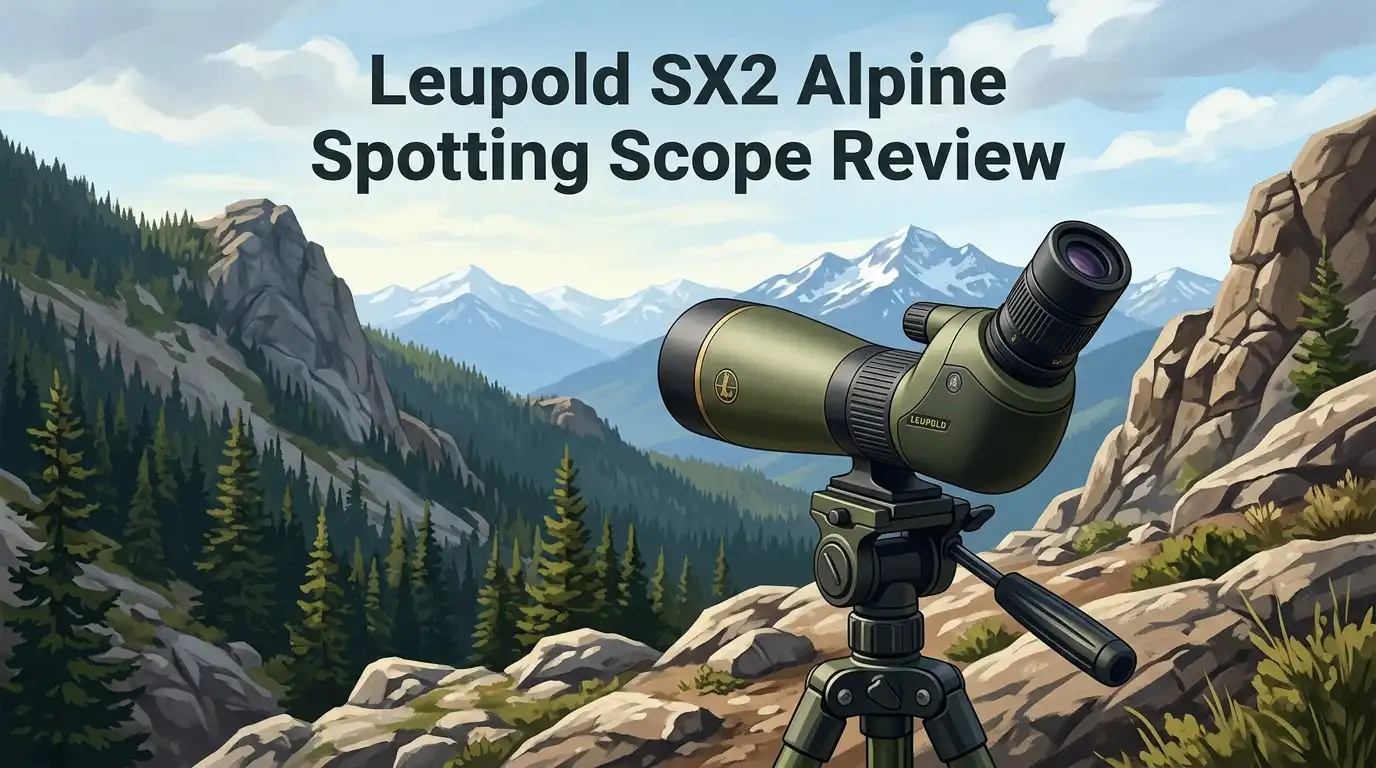
Leupold SX2 Alpine Spotting Scope Review 2026: Still Worth It?
Spotting scopes promise a lot. Most deliver about half of it. The Leupold SX2 Alpine HD sits in that crowded $350 to $500 window where every brand swears it has the sharpest glass on the shelf.
I spent several months with this scope at the range, on a ridge during elk season, and parked in a folding chair watching shorebirds.
This review covers what actually happened, including the parts Leupold would rather I skip. If you want to know whether this spotter earns a spot in your pack or your truck, keep reading.
In a Nutshell:
- Optical quality punches above the price. The calcium fluoride HD glass delivers genuinely sharp images from 20x to roughly 45x. Color is neutral. Contrast is strong. Chromatic aberration shows up at the edges past 50x, but it stays mild compared to similar scopes in this bracket.
- Build quality feels like a $700 scope. The rubber armor grips well in wet hands. The scope is 100% waterproof and fogproof. Leupold backs it with a lifetime guarantee that covers repair or replacement at no cost.
- Weight is the biggest complaint. The 60mm model weighs nearly 60 ounces. That is heavy for a 60mm spotter. Backcountry hunters counting grams will feel it on day three.
- The Gen 2 upgrades matter. You get an integrated Arca Swiss base, Guard ion lens coatings that shed water, and swappable FormFit eyecups. These are real improvements, not marketing filler.
- Magnification above 50x gets soft. Image quality degrades as you zoom past 50x, especially in heat mirage. Plan to live in the 20x to 40x range for most sessions.
- Best for range shooters, deer hunters, and casual birders. It is not the right pick for ultralight alpine hunts or for serious digiscoping work.
What Is the Leupold SX2 Alpine HD Spotting Scope?

- High Definition Optics: Experience incredible clarity at all magnification levels with high-definition, calcium-fluoride lenses
- Smooth Focusing: Make fine adjustments with an extremely smooth focusing system for precise viewing
Last update on 2026-09-13 / Affiliate links / Images from Amazon Product Advertising API Some of the links on this website are affiliate links, which means that at no additional cost to you, I earn a commission if you click through and make a purchase. I only recommend products and services that I believe will add value to my readers. Thank you for your support!
The Leupold SX2 Alpine HD is the brand’s entry level full size spotting scope. Leupold positions it below the SX4 Pro Guide and SX5 Santiam lines. It comes in two sizes. The 20x to 60x 60mm version retails around $399. The 20x to 60x 80mm version sits near $499.
Both models use calcium fluoride high definition lenses. Both are angled or straight depending on the model you choose. Leupold builds the SX2 Alpine around its Advanced Optical System, which manages light transmission and glare.
The Gen 2 refresh added Diamond Coat scratch resistant lens surfaces and the Guard ion water shedding coating. Leupold assembles and tests these scopes in Oregon, though some components are sourced overseas. The target buyer is clear: a hunter or shooter who wants reliable glass without spending $1,200.
The Unboxing Experience
The box is plain. Leupold ships the SX2 Alpine in a brown cardboard sleeve with a product photo on the front. Nothing fancy. Open it and you find the scope wrapped in foam, a soft neoprene case, and a thin manual.
The first thing I noticed was the heft. Pulling the 60mm model out of the foam, my hand dropped slightly. This scope is dense. The rubber armor feels thick and slightly tacky, which is good news for cold mornings.
The included neoprene cover zips around the body and stays on while you glass. It protects the barrel but adds bulk. The lens caps are tethered rubber, and they stay put better than the flimsy caps on cheaper scopes.
One mild letdown: no hard case, no tripod, no cleaning cloth. At this price, a microfiber cloth would have been a nice touch.
Key Specifications You Should Know
Here is the short version for the 20x to 60x 60mm Gen 2 angled model. Length measures 14.4 inches. Weight comes in at 59.9 ounces, which is just under four pounds. Field of view runs 106.8 feet at 1,000 yards on the low end and 50.8 feet at the high end.
Eye relief measures 19.5mm at 20x and 16.7mm at 60x. Exit pupil shifts from 3mm down to 1mm across the zoom range. Close focus distance is 32.8 feet.
The 80mm model is longer and heavier but gathers noticeably more light. It also holds image quality better at the top of the zoom range.
The 1mm exit pupil at 60x explains a lot. That tiny light cone is why the image dims and softens when you crank the magnification all the way up.
Top 3 Alternative for Leupold SX2 Alpine Spotting Scope

- Advanced Fully Multi-Coated lenses bring you better light transmission to bring optimum brightness and true color across the entire light spectrum.
- Phase Coated Porro prisms reflect great mount of lights to your eyes which will give you bright image.
Last update on 2026-09-13 / Affiliate links / Images from Amazon Product Advertising API Some of the links on this website are affiliate links, which means that at no additional cost to you, I earn a commission if you click through and make a purchase. I only recommend products and services that I believe will add value to my readers. Thank you for your support!
Athlon Optics Argos HD 20x to 60x 85mm Spotting Scope

- The redesigned Diamondback HD spotting scope has all the optical horsepower the western hunter needs, and excels in low light. It features a streamlined exterior for a sleeker profile and a built-in helical focus wheel for fast and fine adjustments.
- HD optical system delivers exceptional resolution, cuts chromatic aberration and provides outstanding color fidelity, edge-to-edge sharpness and light transmission. Multiple anti-reflective coatings on all air-to-glass surfaces increase light transmission
Last update on 2026-09-17 / Affiliate links / Images from Amazon Product Advertising API Some of the links on this website are affiliate links, which means that at no additional cost to you, I earn a commission if you click through and make a purchase. I only recommend products and services that I believe will add value to my readers. Thank you for your support!
Vortex Optics Diamondback HD 20x to 60x 85mm Angled Spotting Scope

- QUALITY ED OBJECTIVE LENS: Extra-low dispersion optical glass with special dispersion properties to dramatically reduce chromatic aberration, rendering razor-sharp images with superb color correction. Enjoy true-to-life color with enhanced resolution and contrast.
- XLT LENS COATINGS: Fully multi-coated with Celestron’s proprietary XLT optical coatings – the same coatings used on observatory-class telescopes. This coating maximizes light transmission through the optical path for brighter images. A great addition to your field gear!

Last update on 2026-09-17 / Affiliate links / Images from Amazon Product Advertising API Some of the links on this website are affiliate links, which means that at no additional cost to you, I earn a commission if you click through and make a purchase. I only recommend products and services that I believe will add value to my readers. Thank you for your support!
Celestron Regal M2 65ED Spotting Scope
Optical Performance in Daylight
This is where the SX2 Alpine earns its reputation. In full sun, the image snaps into focus with excellent center sharpness. At 20x, the view is crisp edge to edge. Colors look natural without the slight yellow cast that some budget scopes produce.
I compared it side by side against two competitors in the same price range. The Leupold showed the sharpest center resolution of the group. Chromatic aberration was moderate, sitting between the two others.
At 200 yards, I could count .22 caliber holes in paper with room to spare. At 400 yards, 6.5mm holes were visible on a clean white target under good light.
Glare control is a standout. Pointing the scope near the sun produced less washout than I expected. The Advanced Optical System does real work here.
Low Light and Dusk Performance
Low light is where small objective lenses get exposed. The 60mm model holds a usable image until roughly 15 minutes after sunset. After that, the picture gets muddy and detail collapses fast.
The 80mm version buys you another 10 to 15 minutes of workable glassing. If you hunt legal light edges, that extra 20mm of objective is worth the money and the extra weight.
One honest note: dropping the magnification helps enormously. At 20x, the exit pupil is 3mm and the image stays bright. At 60x, the 1mm exit pupil makes dusk viewing nearly pointless.
Compared to premium glass like Swarovski or Kowa, the Alpine falls behind at dusk. That is expected at this price. Against other scopes near $400, it holds its own comfortably.
Build Quality and Weatherproofing
Leupold built this thing tough. The body is sealed, nitrogen purged, and rated 100% waterproof and fogproof. I left mine out in steady rain for two hours. No fogging, no moisture intrusion, no issues.
The rubber armor covers nearly the entire barrel. It absorbs bumps and gives you a secure grip when your hands are cold or wet. The scope has survived two accidental tripod tips in my care without a scratch on the glass.
The Guard ion coating on the Gen 2 is genuinely useful. Water beads up and rolls off the objective instead of smearing. Fingerprints wipe away with a single pass.
Leupold’s lifetime guarantee removes most of the risk. If the scope fails, they repair or replace it at no charge, regardless of who owns it.
Focus System and Handling
The SX2 Alpine uses a single speed helical focus ring wrapped around the body. You grip the whole barrel and twist. It is simple and intuitive once your hands learn it.
The ring moves smoothly with light resistance. Going from close focus to infinity takes about a full turn. That is slower than a dual focus system but fine for static glassing.
Here is a real gripe: fine focus at 60x takes patience. Small ring movements produce large focus shifts. Dialing in a sharp image at high magnification can take several attempts.
The zoom ring sits at the eyepiece and turns with slightly more tension. Detents are absent, so you adjust by feel. Most users settle into a comfortable rhythm within a week.
Eye Relief, Eyecups, and Eyeglass Users
Eye relief measures 19.5mm at low power and drops to 16.7mm at 60x. That is generous for a spotting scope in this class. Eyeglass wearers get a full field of view at most magnifications.
The Gen 2 ships with FormFit interchangeable eyecups. You get a winged eyecup that blocks stray side light and a low profile cup for everyday glassing. Swapping takes about five seconds.
The winged cup is excellent for bright afternoon sessions. It kills reflections and cuts eye strain during long observation periods.
Some Gen 1 owners complained about short eye relief, and those complaints show up in older reviews. The Gen 2 eyecup system fixes most of that. If you wear glasses, buy the Gen 2 specifically.
Tripod Mounting and the Arca Swiss Base
This upgrade deserves its own section. The Gen 2 includes an integrated Arca Swiss dovetail machined into the foot. You slide it directly into any Arca compatible clamp. No plate, no adapter, no fumbling.
A standard 1/4 by 20 thread is also built in for traditional tripod heads. The mounting collar rotates, so you can shift the eyepiece angle for prone shooting or window mounting.
The rotation is smooth and locks firmly. I never had the scope creep under its own weight.
One caution: this scope is heavy, and it needs a real tripod. A $40 aluminum photo tripod will wobble badly at 60x. Budget at least $150 for a stable carbon fiber or heavy aluminum setup. The tripod matters as much as the glass.
Range Performance: Reading Bullet Holes
Target shooters want one answer. Can it read holes? Here is what I measured under good light with clean targets.
At 100 yards, .22 caliber holes are easy at 25x. At 200 yards, the same holes are readable at 35x to 40x. At 300 yards, .30 caliber holes show clearly at 45x. At 400 yards, you need near perfect conditions and 50x to spot 6.5mm holes.
Past 500 yards, forget about hole spotting and plan to use steel. Impact splash on steel plates is visible well past 800 yards.
Heat mirage ruins everything above 40x on warm afternoons. That is physics, not a scope flaw. Early morning sessions produce dramatically better results than noon sessions.
Birding and Wildlife Observation
Birders will find a lot to like and a couple of frustrations. The 32.8 foot close focus distance is mediocre. Dedicated birding scopes often focus down to 15 or 20 feet. You cannot study a warbler in a nearby bush.
At distance, the scope shines. Shorebirds at 300 yards show feather detail and leg band colors at 40x. Color reproduction is accurate, which matters for species identification.
The angled eyepiece is the right choice for birding. You can share views with shorter people without adjusting the tripod.
The weight is the real birding drawback. Carrying four pounds of scope plus a tripod on a long walk gets old. Birders who hike should seriously consider a lighter 65mm ED scope instead.
Digiscoping With a Phone
Leupold does not include a phone adapter in the box. You buy that separately, and the aftermarket options vary wildly in quality.
Once mounted, phone photos through the SX2 Alpine look decent at 20x to 30x. Image quality drops noticeably above 40x due to vignetting and softness.
The eyecup design works fine with universal clamp adapters. The twist up cups give the phone lens a stable surface to sit against.
Honest assessment: this is not a digiscoping specialist. Scopes with wider eyepieces and ED glass produce cleaner phone images. If photography is your main goal, look elsewhere.
For casual record shots of a buck or a rare bird, it does the job. Just do not expect gallery quality results.
What the Leupold SX2 Alpine Does Not Do Well
Authentic reviews name the flaws. Here are mine after extended use.
Weight is excessive for the objective size. Sixty ounces for a 60mm scope is hard to defend. Competitors deliver 80mm performance at similar weight.
The top of the zoom range disappoints. From 50x to 60x, the image softens, dims, and loses contrast. You will rarely use the last 10x.
No tripod or phone adapter included. At $400, some brands bundle accessories. Leupold does not.
Close focus is too far for serious birding. Thirty three feet rules out backyard and woodland use.
Chromatic aberration appears on high contrast edges. Look at a dark branch against bright sky at 50x and you will see purple fringing.
None of these are deal breakers for the right buyer. They are honest limits you should know before you spend the money.
Pros and Cons
Pros
- Sharp, high contrast center image with accurate color reproduction across most of the zoom range
- Excellent glare control, even when glassing near the sun
- Integrated Arca Swiss base on the Gen 2 saves time and removes a failure point
- Generous eye relief of 19.5mm at low power, friendly to eyeglass wearers
- Interchangeable FormFit eyecups let you adapt to bright or shaded conditions
- Fully waterproof and fogproof with proven performance in sustained rain
- Leupold lifetime guarantee covers free repair or replacement
- Grippy rubber armor handles well with wet or gloved hands
Cons
- Heavy at 59.9 ounces for the 60mm model, a real problem for backcountry use
- Image softens noticeably above 50x magnification
- Close focus distance of 32.8 feet limits birding versatility
- No tripod, phone adapter, or cleaning cloth included
- Single speed focus makes fine adjustment slow at high power
- Low light performance trails larger objective competitors
Price, Value, and the Warranty Question
The 60mm Gen 2 lists at $399.99. The 80mm Gen 2 lists at $499.99. Street prices drop during sales, and I have seen the 60mm hit $350 and the 80mm near $360 during promotional windows.
At full price, the SX2 Alpine competes hard but does not dominate. The Athlon Argos HD 85mm costs less and gathers more light. The Vortex Diamondback HD 85mm offers a bigger objective for similar money.
The Leupold wins on sharpness, glare control, and warranty service. Leupold’s repair turnaround has a strong reputation among hunters.
Value verdict: buy it on sale. At $350, it is a clear winner. At $400, it is a close call against the competition.
Who Should Buy It and Who Should Skip It
Buy the SX2 Alpine if you shoot at a fixed range, hunt from a truck or a stationary glassing point, want excellent sharpness under $400, or value a lifetime warranty from a company that actually honors it.
Skip it if you hike long distances with your gear, need close focus for backyard birding, want serious digiscoping capability, or plan to glass heavily in the last minutes of legal light.
The 80mm version is the better buy for most hunters. The extra light gathering matters more than the extra weight in practical use.
The 60mm version makes sense only if your tripod is small or your pack space is tight. Even then, lighter options exist at similar prices.
Final Verdict on the Leupold SX2 Alpine HD
- High Definition Optics: Experience incredible clarity at all magnification levels with high-definition, calcium-fluoride lenses
- Smooth Focusing: Make fine adjustments with an extremely smooth focusing system for precise viewing
Last update on 2026-09-13 / Affiliate links / Images from Amazon Product Advertising API Some of the links on this website are affiliate links, which means that at no additional cost to you, I earn a commission if you click through and make a purchase. I only recommend products and services that I believe will add value to my readers. Thank you for your support!
The Leupold SX2 Alpine HD is a good scope with one real flaw. The glass is sharp. The build is tough. The warranty is the best in the business. The weight is the price you pay.
I would recommend it without hesitation to a range shooter or a whitetail hunter who glasses from a stand or a vehicle. I would steer a backcountry sheep hunter toward something lighter.
Rating: 4.2 out of 5. The optics deserve a 4.5. The weight pulls the score down.
If you find the 80mm Gen 2 on sale near $400, buy it. You get optical performance that matches scopes costing twice as much, backed by a guarantee that outlives the product.
Frequently Asked Questions
Is the Leupold SX2 Alpine good for long range shooting?
Yes, within limits. You can read .30 caliber holes at 300 yards and spot steel impacts past 800 yards. Reading small holes beyond 400 yards requires ideal light and no mirage.
Should I buy the 60mm or the 80mm model?
Choose the 80mm unless weight is critical. The larger objective delivers better low light performance and holds image quality at higher magnification. The weight difference is modest relative to the optical gain.
Does the Leupold SX2 Alpine come with a tripod?
No. Leupold ships the scope with a neoprene cover, lens caps, and a manual only. Budget at least $150 for a tripod stable enough to support four pounds at 60x.
What is the difference between Gen 1 and Gen 2?
Gen 2 adds Diamond Coat scratch resistant lenses, Guard ion water shedding coating, an integrated Arca Swiss base, and interchangeable FormFit eyecups. Buy the Gen 2 if you have the choice.
Is the Leupold SX2 Alpine waterproof?
Yes. The scope is nitrogen purged, fully sealed, and rated 100% waterproof and fogproof. It handled two hours of steady rain in my testing without any internal moisture or fogging.
How does it compare to the Vortex Diamondback HD?
The Leupold shows slightly sharper center resolution and better glare control. The Vortex Diamondback HD 85mm offers a larger objective and brighter low light images. Both carry strong lifetime warranties.
Can I use the SX2 Alpine for bird watching?
Yes for distant birds, no for close ones. The 32.8 foot close focus distance rules out nearby subjects. Color accuracy and detail at 200 to 400 yards are very good.
Where is the Leupold SX2 Alpine made?
Leupold assembles and tests the scope at its Oregon facility. Some optical components are sourced from overseas suppliers, which is standard practice in this price category.

Hello, I’m Amelia White, the founder of birdsfanatic.com. As a lifelong bird enthusiast and spiritual seeker, I’ve always been fascinated by the mystical connections between birds and the human experience. On this site, I share my knowledge and insights into the symbolic meanings and spiritual significance of various bird species, exploring their roles in mythology, folklore, and cultural traditions. Join me on this journey into the world of birds, where we’ll discover the hidden wisdom and guidance that these magnificent creatures have to offer.