
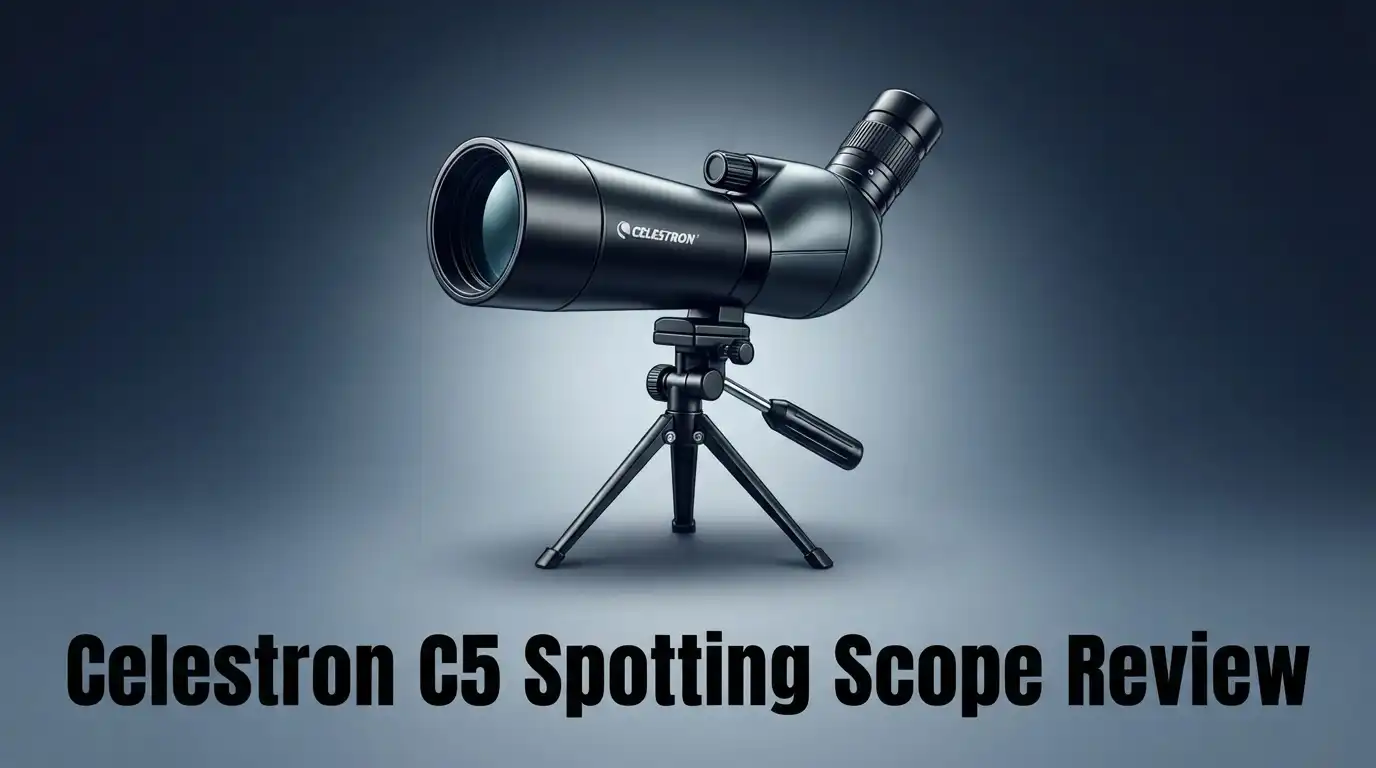
Celestron C5 Spotting Scope Review 2026: Worth It?
Most spotting scopes make you choose. You either get wide, easy views or you get serious magnification. The Celestron C5 refuses to play that game.
This little tube packs a 5 inch mirror into a body the size of a lunchbox. It pulls in distant ducks, license plates, lunar craters, and Saturn’s rings from the same tripod. Birders love it. Astronomers keep it in the trunk. Target shooters mount it at the range.
But the C5 is not perfect, and plenty of buyers get surprised by what it cannot do. I spent time with this scope, read through owner reports, and compared it against the usual rivals. Below is the honest picture, including the parts Celestron does not advertise. Keep reading before you spend your money.
In a Nutshell:
- Huge aperture in a tiny body. The C5 uses a 127mm Schmidt Cassegrain design with a 1250mm focal length folded into an 11 inch tube. It gathers 2.5 times more light than an 80mm spotting scope and about 4.5 times more than a 60mm scope.
- Daytime sharpness is genuinely excellent. Views stay crisp past 100x with no color fringing on high contrast targets like white birds against dark water.
- The field of view is narrow. Expect roughly 1 degree maximum. Finding fast moving birds takes practice, and wide landscape scanning is not this scope’s job.
- It needs a serious tripod. At six pounds with a back heavy balance, a flimsy photo tripod will ruin your experience. Budget extra for a solid mount.
- Poor seeing hurts it more than most scopes. The 38 percent central obstruction makes the image go mushy when the air is turbulent. Planets can disappoint on average nights.
- Best value for patient viewers. If you observe from a fixed position and want maximum reach for the size, the C5 is outstanding. If you want grab and scan simplicity, look elsewhere.
What Is the Celestron C5 Spotting Scope?

- 5" SCHMIDT-CASSEGRAIN SPOTTING SCOPE: This scope's optical excellence is the reason it was chosen by NASA to travel into orbit on several Space Shuttle missions. It's ideal for bird watching, nature observation, target shooting, and digiscoping.
- BRIGHT, SHARP VIEWS OF DISTANT TARGETS: With 1250mm of focal length and an f/10 focal ratio, the C5 can help you spot small targets at great distances.

Last update on 2026-09-28 / Affiliate links / Images from Amazon Product Advertising API Some of the links on this website are affiliate links, which means that at no additional cost to you, I earn a commission if you click through and make a purchase. I only recommend products and services that I believe will add value to my readers. Thank you for your support!
The C5 is a telescope wearing spotting scope clothing. Celestron built it around a Schmidt Cassegrain optical system, the same folded light path used in big observatory style instruments.
Light enters through a corrector plate, bounces off a 127mm primary mirror, reflects off a secondary mirror, then exits through the rear. That folding trick compresses 1250mm of focal length into an 11 inch tube.
The scope carries StarBright XLT coatings, which push light transmission to around 83.5 percent. It ships with a 25mm Plossl eyepiece for 50x magnification, a 6×30 finderscope, an erect image diagonal, and a padded soft case.
Close focus sits at 20 feet. The design earned enough respect that a version of it flew on a NASA space shuttle mission.
The Unboxing Experience
Opening the C5 box feels different from opening a typical spotting scope. There is no rubber armored tube waiting inside.
Instead you find a well padded soft carry case, and the scope lives inside that. Celestron used dense ethafoam for the padding, so the case genuinely protects the optics during travel. It measures roughly 39 by 29 by 20 centimeters, small enough for carry on luggage.
Lift the tube out and the weight surprises you. Six pounds in such a short body feels dense, almost like holding a small dumbbell.
The orange and black finish looks classic. The corrector plate sits behind a plastic push fit dew cap. Accessories come bagged separately: the diagonal, the finder bracket, the eyepiece, and the manual.
Setup takes about five minutes. Thread the finder on, slide in the diagonal, drop in the eyepiece, and you are ready.
Build Quality and Design Details
The C5 uses solid metal castings at the front and rear with an aluminum tube between them. It feels sturdy in hand, though not luxurious.
Honest note: build quality sits a step below Celestron’s larger C8. The tube is held together with screws, and some owners report those screws are not seated perfectly. The dew cap is plain plastic and pushes on rather than threading.
A Vixen style dovetail bar runs along the bottom. That bar includes two quarter 20 threads for photo tripod mounting, which is a smart touch. You can move the scope between an astronomy mount and a camera tripod in seconds.
One real weakness: the C5 is not waterproof or nitrogen purged. Most dedicated birding scopes are. Leave this one out in heavy rain at your own risk.
Optical Performance During Daylight
This is where the C5 earns its reputation. Daytime images are sharp, bright, and neutral in color.
Because the design uses mirrors rather than lenses for the heavy lifting, there is zero chromatic aberration. White egrets against dark reeds show no purple fringe. Black and white plumage stays black and white.
Center field sharpness holds up beautifully all the way past 100x. You can read small signage at distances where an 80mm scope turns to soup.
The focuser deserves praise. It moves the primary mirror internally, and on modern C5 units the action is smooth with almost no image shift. Focus returns to the same spot whether you approach from near or far.
Edge sharpness does soften. Roughly the outer 20 percent of the field loses crispness, which matters less for spotting than it does for photography.
Top 3 Alternatives for Celestron C5 Spotting Scope

- 90MM MAKSUTOV-CASSEGRAIN SPOTTING SCOPE: Compact and lightweight, the C90 is an ideal choice for bird watching, nature observation, target shooting, and digiscoping.
- BRIGHT, SHARP VIEWS OF DISTANT TARGETS: Ideal for spotting small land-based targets at great distances or viewing astronomical objects at night.
Last update on 2026-09-28 / Affiliate links / Images from Amazon Product Advertising API Some of the links on this website are affiliate links, which means that at no additional cost to you, I earn a commission if you click through and make a purchase. I only recommend products and services that I believe will add value to my readers. Thank you for your support!
Celestron C90 Mak Spotting Scope

- ULTIMA ANGLED ZOOM SPOTTING SCOPE: This versatile all-around spotting scope with an 80mm objective lens, 20-60x zoom, and a 45° viewing angle is the ideal choice for any outdoor enthusiast. It's perfect for observing nature and long-distance viewing.
- INCLUDES ESSENTIALS FOR BETTER VIEWING: The Celestron Ultima 80 comes complete with a soft carrying case, an extended tripod mounting plate, a zoom eyepiece with an integrated T-adapter for digiscoping, an eyepiece pouch, a lens cloth, and more.
Last update on 2026-09-13 / Affiliate links / Images from Amazon Product Advertising API Some of the links on this website are affiliate links, which means that at no additional cost to you, I earn a commission if you click through and make a purchase. I only recommend products and services that I believe will add value to my readers. Thank you for your support!
Celestron Ultima 20 to 60×80 Angled Spotting Scope

- QUALITY ED OBJECTIVE LENS: Extra-low dispersion optical glass with special dispersion properties to dramatically reduce chromatic aberration, rendering razor-sharp images with superb color correction. Enjoy true-to-life color with enhanced resolution and contrast.
- XLT LENS COATINGS: Fully multi-coated with Celestron’s proprietary XLT optical coatings – the same coatings used on observatory-class telescopes. This coating maximizes light transmission through the optical path for brighter images. A great addition to your field gear!
Last update on 2026-09-17 / Affiliate links / Images from Amazon Product Advertising API Some of the links on this website are affiliate links, which means that at no additional cost to you, I earn a commission if you click through and make a purchase. I only recommend products and services that I believe will add value to my readers. Thank you for your support!
Celestron Regal M2 65ED Spotting Scope
Night Sky and Astronomy Performance
Plenty of buyers pick the C5 for double duty. Here the results split.
Deep sky viewing is the C5’s surprise strength. Open clusters like M35, M36, M37, and M38 fill the field with pinpoint stars. Globular clusters such as M15 begin resolving at higher powers. The Ring Nebula shows its shape clearly even at low magnification.
The Moon looks good when air conditions cooperate. Craterlets inside Mare Crisium become visible around 114x.
Planets are the weak spot. Jupiter shows its main cloud belts and the Great Red Spot in steady air, but average seeing turns the planet into a mushy ball. The large central obstruction amplifies atmospheric turbulence.
Cool down takes longer than a refractor but less time than a Maksutov. Give it 20 to 30 minutes outside.
Birding and Wildlife Observation
Birders get a mixed but mostly positive deal. The reach is unmatched at this size and price.
Shorebirds, ducks, raptors on distant snags, and seabirds all come in close. At 50x with the included eyepiece, a duck 400 yards out shows bill shape and feather pattern.
The 20 foot close focus is excellent. You can study butterflies, dragonflies, and garden birds without backing up.
Now the honest caution. Finding a moving bird through a 1 degree field takes skill. Warblers flitting through branches will frustrate you. The 6×30 finderscope helps, though a red dot finder helps more.
This scope rewards patient, seated observation from a hide or a shoreline. It punishes fast walking and quick scanning.
Digiscoping and Camera Use
The C5 doubles as a 1250mm telephoto lens, which is remarkable for the money.
Remove the diagonal, thread on a T adapter and T ring, and your DSLR or mirrorless body attaches directly to the rear cell. Smartphone adapters clamp onto the eyepiece for casual shots.
Daylight results are strong. Perched birds at 50 meters come out crisp and detailed. Lunar photos look decent straight out of camera.
Deep sky imaging is harder. The C5 shows field curvature and coma toward the edges, so stars stretch outward on larger sensors. Bright stars just outside the frame can throw arcing reflections into the image.
A focal reducer and field flattener fix much of this. Budget for those accessories if astrophotography is your goal.
Tripod Requirements You Cannot Ignore
This section saves people money, so read it carefully.
The C5 weighs six pounds and sits back heavy. At 50x and above, vibration becomes the enemy. A lightweight travel tripod will shake for several seconds after every touch.
You want a tripod rated for at least 15 pounds with a fluid video head or a sturdy pan head. Aluminum works. Carbon fiber works better and weighs less.
Budget between 150 and 400 dollars for a tripod that actually matches this scope. That is not an upsell, that is reality.
Celestron sells heavy duty options, and third party video tripods from established brands work well too. A great scope on a bad tripod performs worse than an average scope on a great tripod.
What the Celestron C5 Does Not Do Well
Authentic reviews name the flaws. Here they are plainly.
The C5 is not weather sealed. Rain, fog, and humidity can reach the optics.
The field of view is narrow, roughly 1 degree at best. Scanning wide landscapes feels like looking through a straw.
Planetary views suffer in ordinary seeing conditions because of the 38 percent central obstruction.
There is no zoom eyepiece included, so changing magnification means swapping eyepieces by hand.
Edge of field sharpness drops noticeably.
Bright objects outside the field can cause reflection arcs.
The scope needs cool down time before night use.
And finally, it is heavier than most 80mm birding scopes, which matters on long hikes.
Pros and Cons
Pros
- Massive light gathering for its size, with 127mm of aperture in an 11 inch tube
- Zero chromatic aberration thanks to the mirror based optical design
- Excellent daytime sharpness that holds past 100x magnification
- Smooth internal focuser with very little image shift
- Close focus of 20 feet for insects and nearby wildlife
- Standard 1.25 inch eyepiece holder accepts hundreds of aftermarket eyepieces
- Included soft case is genuinely travel friendly and well padded
- Doubles as a 1250mm camera lens with simple adapters
- Vixen dovetail plus quarter 20 threads give flexible mounting
Cons
- Narrow field of view makes target finding slower
- Not waterproof or fogproof, unlike most birding scopes
- Needs a heavy, stable tripod that costs real money
- Planetary views degrade badly in average seeing
- Requires cool down time before night observing
- No zoom eyepiece in the box
- Off axis coma and field curvature limit astrophotography without extra optics
- Heavier than comparable 80mm refractor style scopes
Who Should Buy the Celestron C5
The C5 fits specific people extremely well.
Buy it if you observe from one spot, want maximum magnification per pound, and value reach over convenience. Shore birders, hawk watchers, range shooters, and casual astronomers all fit this profile.
Buy it if you already own a telescope and want a portable companion for travel or quick sessions.
Buy it if digiscoping interests you and you want long focal length without spending thousands on a camera lens.
Skip it if you hike long distances and need light weight. Skip it if you bird in rainy climates and need sealed optics. Skip it if planets are your main target, since a 127mm Maksutov gives better results there.
Match the tool to the job and you will be very happy.
Price and Value in 2026
The C5 typically lists around 680 dollars, with street prices often landing lower during sales.
That number looks steep next to an 80mm zoom spotting scope costing 300 dollars. The comparison is not fair though. You are buying 2.5 times the light gathering area and more than double the usable magnification ceiling.
Compared to premium ED birding scopes from Swarovski, Zeiss, or Kowa, the C5 costs a fraction and delivers more raw reach. Those scopes beat it on field of view, weather sealing, and ease of use.
Value verdict: strong, with conditions. You must accept the tripod cost and the handling quirks.
Used C5 units appear regularly on astronomy forums for 300 to 450 dollars, which is excellent value if the optics check out.
Care and Maintenance Tips
Good habits keep this scope performing for decades.
Never clean the corrector plate unless it is genuinely dirty. Dust affects image quality far less than scratches do. When cleaning is needed, use a blower bulb first, then a proper optical cleaning solution with lens tissue.
Store the scope with caps on and let it reach room temperature before sealing it in the case. Sealing a cold scope traps moisture.
Keep the dew cap attached during evening sessions. It slows dew formation and blocks stray light.
Check collimation once a year using a defocused star. The C5 rarely drifts, but a quick check costs nothing.
Store the case in a dry room rather than a garage or basement. Humidity is the real enemy of uncoated internal surfaces.
Final Verdict
The Celestron C5 is a specialist that pretends to be a generalist. Understand that and you will love it.
Its daytime optical performance is genuinely excellent, with sharpness and color accuracy that embarrass many pricier refractor style scopes. The portability to aperture ratio remains hard to beat in 2026.
The compromises are real. Narrow field, no weather sealing, tripod demands, and soft planetary views in mediocre air all count against it.
Rating: 4.3 out of 5 for spotting use, 3.8 out of 5 for all around astronomy.
If you want reach, sharpness, and a scope you can actually carry, the C5 delivers. If you want convenience above all, spend your money on an 80mm zoom scope instead and enjoy the easier ride.
Frequently Asked Questions
Is the Celestron C5 waterproof?
No. The C5 is not waterproof, fogproof, or nitrogen purged. Light drizzle under cover is survivable, but heavy rain risks internal moisture. Use a rain cover or keep it sheltered.
What magnification does the Celestron C5 reach?
The included 25mm eyepiece gives 50x. Swapping eyepieces takes you from about 39x with a 32mm to roughly 250x with a 5mm. Useful daytime magnification tops out near 100x to 120x in most air conditions.
Does the Celestron C5 come with a tripod?
No. The scope ships with a soft case, eyepiece, diagonal, and finderscope only. You must buy a tripod separately, and it should be rated for at least 15 pounds.
Can I use the C5 for astrophotography?
Yes, with limitations. Lunar and planetary imaging works well. Deep sky imaging needs a focal reducer and field flattener to control coma and field curvature at the edges.
How does the C5 compare to the Celestron C90?
The C90 is smaller, lighter, and cheaper with a 90mm aperture. The C5 gathers roughly twice the light and resolves more detail. Choose the C90 for portability and the C5 for performance.
Is the C5 good for birdwatching?
Yes for stationary birds at long range, such as waterfowl, raptors, and shorebirds. It is less suited to fast moving woodland birds because the field of view is narrow.

Hello, I’m Amelia White, the founder of birdsfanatic.com. As a lifelong bird enthusiast and spiritual seeker, I’ve always been fascinated by the mystical connections between birds and the human experience. On this site, I share my knowledge and insights into the symbolic meanings and spiritual significance of various bird species, exploring their roles in mythology, folklore, and cultural traditions. Join me on this journey into the world of birds, where we’ll discover the hidden wisdom and guidance that these magnificent creatures have to offer.
