
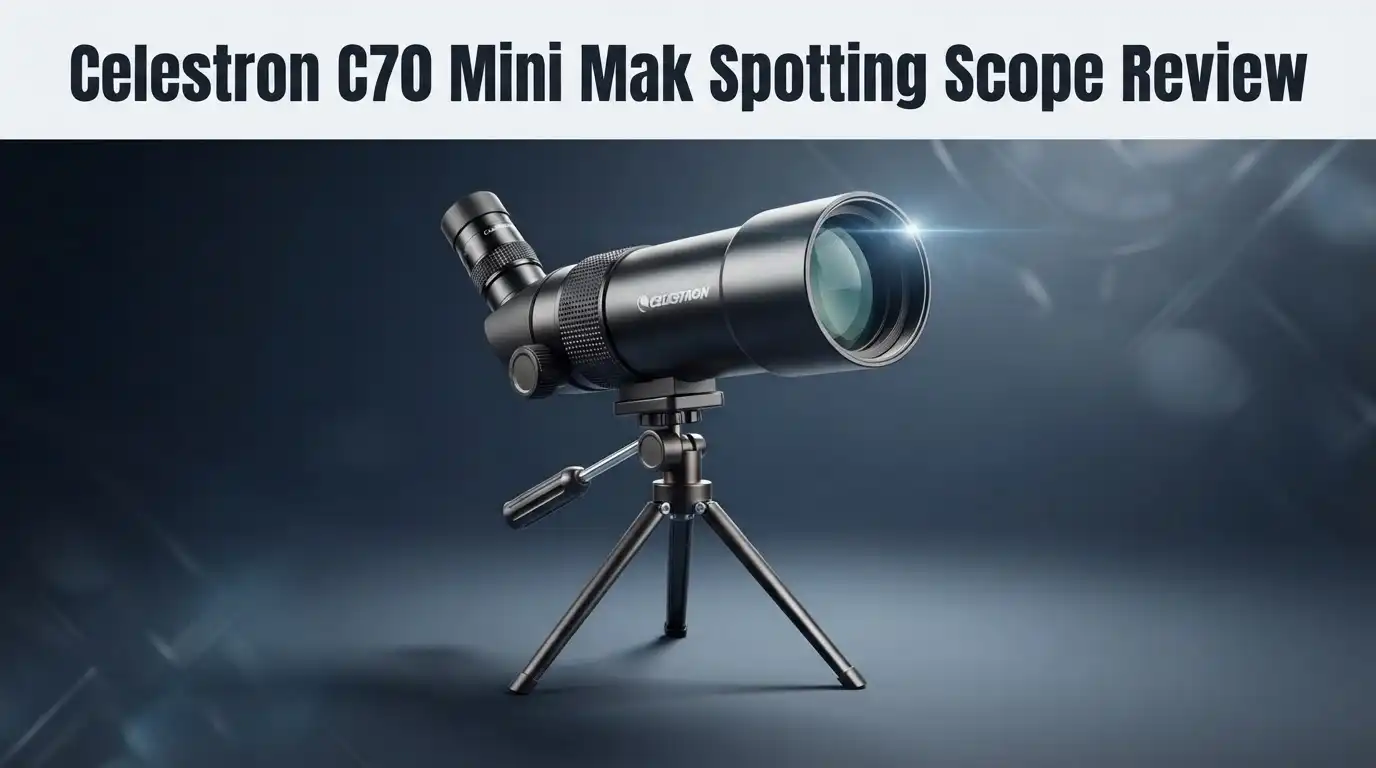
Celestron C70 Mini Mak Spotting Scope Review 2026: Worth It?
Small scopes create big arguments. The Celestron C70 Mini Mak has sat in that argument for years. Some owners love the pocket sized shape and the sharp lunar views.
Others call it dim and fussy. I wanted to know which side is right in 2026, so I spent weeks with this little Maksutov on a deck rail, a hillside, and a dark backyard.
This review covers the real experience, not the box copy. You will read about the unboxing, the zoom eyepiece, the tabletop tripod, and the honest weak spots. You will also see three alternatives if the C70 turns out to be the wrong fit for your eyes and your budget.
In a Nutshell:
- The C70 Mini Mak is a 70mm Maksutov Cassegrain spotting scope with a 750mm focal length and a built in zoom eyepiece that runs from 25x to 75x. It weighs about 2 pounds and measures roughly 11 inches long.
- Portability is the headline feature. The scope fits in a daypack with room to spare. You can carry it all day and forget it is there. That alone wins over many birders and hikers.
- The image is sharp at low power and soft at high power. Views at 25x to 40x look clean and pleasing. Push toward 75x and brightness drops fast because a 70mm mirror system simply cannot feed that much magnification.
- The included tabletop tripod helps but limits you. It has slow motion controls, which is a nice touch. A proper photo tripod transforms the experience. Budget for one.
- This scope is a strong daytime and lunar performer, not a deep sky tool. The Moon looks crisp. Saturn shows rings. Faint galaxies do not show much at all.
- Value depends on your expectations. At its usual street price, the C70 offers a lot of reach per dollar. It does not match an ED glass refractor spotter for color and brightness.
Celestron C70 Mini Mak Spotting Scope Overview

- 70MM MINI MAKSUTOV-CASSEGRAIN SPOTTING SCOPE: Compact and lightweight, the C70 Mini Mak is an ideal choice for bird watching, nature observation, target shooting, and digiscoping.
- BRIGHT, SHARP VIEWS OF DISTANT TARGETS: With 700mm of focal length and an f/10 focal ratio, the C70 can help you spot small targets at great distances.

Last update on 2026-09-28 / Affiliate links / Images from Amazon Product Advertising API Some of the links on this website are affiliate links, which means that at no additional cost to you, I earn a commission if you click through and make a purchase. I only recommend products and services that I believe will add value to my readers. Thank you for your support!
The C70 Mini Mak is Celestron’s smallest catadioptric spotting scope. Catadioptric means the optical path uses both a lens and a mirror. Light enters through a corrector plate, bounces off the primary mirror, reflects off a secondary spot, and then reaches the eyepiece. This folded design packs a 750mm focal length into a tube barely longer than a water bottle.
The scope ships with a 25x to 75x zoom eyepiece, a 45 degree erect image viewing angle, a tabletop tripod with slow motion controls, and a soft carry case. Celestron sells it under model number 52238.
The target buyer is clear. This is for someone who wants high magnification in a very small package and accepts the tradeoffs that come with a small mirror.
Unboxing Experience and First Impressions
The box is small and plain. Inside you find the scope wrapped in foam, the soft case, the tabletop tripod in a separate cardboard tray, and a thin manual. Nothing feels luxurious. Nothing feels broken either.
The first surprise is weight. The C70 feels denser than it looks. Two pounds in an 11 inch body reads as solid in the hand. The rubber armor grips well and has a slightly tacky finish.
The second surprise is the zoom collar. It turns with a smooth, damped motion that feels better than the price suggests. The focus wheel sits on the side and moves with very fine sensitivity, which is normal for Maksutov designs.
Setup takes under two minutes. Screw the scope to the tripod, remove the caps, and look.
Key Specifications at a Glance
The numbers explain a lot about how this scope behaves. Aperture is 70mm. Focal length is 750mm, which gives a focal ratio near f/10.7. Magnification runs from 25x to 75x through the built in zoom.
Angular field of view measures about 1.3 degrees at the low end and 0.7 degrees at the high end. In practical terms that is roughly 68 feet at 1000 yards at 25x. Eye relief sits around 22mm at 25x, which glasses wearers appreciate. Near focus lands close to 16 feet.
Weight is 2 pounds. Length is about 11 inches. The viewing angle is 45 degrees, which suits both standing birders and seated observers.
The small aperture paired with long focal length tells you the story: high power, narrow field, and modest brightness.
Build Quality and Design
Let me be direct here. The C70 is mostly plastic under the rubber armor. The corrector cell and eyepiece mount use aluminum. The focuser mechanism and primary mirror mount use metal. The main tube body does not.
This is not automatically bad. The plastic keeps weight down and survives knocks well. But it does mean the scope feels less premium than the heft suggests.
Some owners report slop in the focuser on arrival. In most cases two loose internal bolts cause it. A few also report slight collimation error out of the box, which is unusual for a Maksutov since the design normally holds alignment.
The scope is not waterproof or nitrogen purged. Treat it as a fair weather instrument. Light drizzle is survivable. A soaking is not.
Top 3 Alternative for Celestron C70 Mini Mak

- ULTIMA ANGLED ZOOM SPOTTING SCOPE: This versatile all-around spotting scope with an 80mm objective lens, 20-60x zoom, and a 45° viewing angle is the ideal choice for any outdoor enthusiast. It's perfect for observing nature and long-distance viewing.
- INCLUDES ESSENTIALS FOR BETTER VIEWING: The Celestron Ultima 80 comes complete with a soft carrying case, an extended tripod mounting plate, a zoom eyepiece with an integrated T-adapter for digiscoping, an eyepiece pouch, a lens cloth, and more.
Last update on 2026-09-13 / Affiliate links / Images from Amazon Product Advertising API Some of the links on this website are affiliate links, which means that at no additional cost to you, I earn a commission if you click through and make a purchase. I only recommend products and services that I believe will add value to my readers. Thank you for your support!
Celestron Ultima 20x to 60x 80mm Angled Spotting Scope

- Easily carried in vest or coat pocket, in belt pack, or shoulder bag
- ED lens optical system provides sharp, clear images with vivid, well-managed color
Last update on 2026-06-28 / Affiliate links / Images from Amazon Product Advertising API Some of the links on this website are affiliate links, which means that at no additional cost to you, I earn a commission if you click through and make a purchase. I only recommend products and services that I believe will add value to my readers. Thank you for your support!
Celestron Hummingbird ED 56mm Angled Micro Spotting Scope

- QUALITY ED OBJECTIVE LENS: Extra-low dispersion optical glass with special dispersion properties to dramatically reduce chromatic aberration, rendering razor-sharp images with superb color correction. Enjoy true-to-life color with enhanced resolution and contrast.
- XLT LENS COATINGS: Fully multi-coated with Celestron’s proprietary XLT optical coatings – the same coatings used on observatory-class telescopes. This coating maximizes light transmission through the optical path for brighter images. A great addition to your field gear!
Last update on 2026-09-17 / Affiliate links / Images from Amazon Product Advertising API Some of the links on this website are affiliate links, which means that at no additional cost to you, I earn a commission if you click through and make a purchase. I only recommend products and services that I believe will add value to my readers. Thank you for your support!
Celestron Regal M2 65ED Spotting Scope with ED Glass
Optical Performance in Daylight
Daytime use is where the C70 earns its keep. At 25x the image looks bright, contrasty, and pleasantly sharp across most of the field. Color correction is excellent. The Maksutov design produces almost no false color fringing, so dark branches against bright sky stay clean.
Push to 40x and the view still holds together well. Detail on bark, feathers, and distant signage remains readable in good light.
Beyond 50x the picture changes. Brightness drops noticeably and contrast softens. The central obstruction from the secondary spot costs you some punch, and 70mm of aperture cannot compensate.
Compared against a quality 60mm refractor spotter, the C70 lands in similar territory for resolution while giving up a little brightness. Against an 80mm ED spotter, it loses clearly.
Zoom Eyepiece Performance from 25x to 75x
The built in zoom is better than I expected at this price. It performs on par with decent budget plossl eyepieces when tested in other telescopes. The zoom action stays smooth and does not shift focus badly as you change power.
Eye relief of about 22mm at the low end is generous. Glasses wearers can see most of the field. At the high end eye relief tightens and the exit pupil shrinks to under 1mm, which makes eye placement fussy.
The sweet spot sits between 25x and 45x. That is where the image stays bright enough to enjoy and sharp enough to reward.
The 75x setting exists more as a marketing number than a practical one. Use it only on very steady, bright targets.
Using the C70 for Birding and Wildlife
Birders will like the size and hate the field of view. A 1.3 degree field at 25x is narrow for finding small moving birds. There is no finder scope, so target acquisition takes practice.
My routine became simple. Spot the bird with binoculars, note a landmark, then swing the scope to that landmark. Once you catch the subject, the view rewards you.
Close focus near 16 feet is genuinely useful for backyard feeders and butterflies. Few compact spotters focus that close.
For hunters and target shooters, the C70 reads bullet holes at moderate distance in good light. In low light at dawn or dusk, the small aperture struggles. Plan around bright conditions.
Astronomy Performance: Moon, Planets and More
This is the C70’s happiest role. The Moon looks superb. Crater walls, ridges, and terminator shadows show crisp detail at 50x to 75x, and the lack of false color makes the view clean and natural.
Saturn shows its rings clearly. Jupiter shows cloud belts and the four Galilean moons. Venus shows phases. Mars stays small and mostly featureless.
Deep sky is a different story. A 70mm mirror gathers limited light. Bright open clusters, the Orion Nebula, and the Andromeda smudge are visible under dark skies. Galaxies and faint nebulae are not realistic targets.
One practical note: the thick corrector plate needs cooling time. Give the scope fifteen to twenty minutes outside before critical viewing.
Tabletop Tripod and Mounting Options
The included tabletop tripod surprises people. It has built in slow motion controls, which makes tracking at high power far easier than a simple pan head would allow.
The catch is height. You need a table, a car hood, a wall, or a very patient back. For standing birding it is useless on its own.
The scope has a standard photo tripod thread, so any decent full size tripod works. A sturdy tripod is the single best upgrade you can make. At 75x, even a light breeze turns a flimsy tripod into a vibration machine.
Budget around the price of the scope itself for a tripod that genuinely steadies it. That cost changes the value equation, so factor it in early.
Digiscoping with a Phone
Celestron markets the C70 for digiscoping, and it works within limits. The long focal length gives dramatic reach for lunar phone shots. Moon images come out sharp and detailed with a basic phone adapter.
Daytime digiscoping is harder. The narrow exit pupil at higher zoom settings creates heavy vignetting, and the image dims quickly. Keep the zoom near 25x to 30x for the best phone results.
You will need a separate smartphone adapter since none is included. Alignment takes patience because the eyepiece is small.
Serious wildlife photographers should look elsewhere. Casual sharers who want a decent Moon photo for social media will be pleased with what this scope produces.
What the C70 Mini Mak Does Not Do Well
Honest reviews list the failures. Here they are plainly.
Low light performance is weak. A 70mm obstructed aperture simply does not gather enough light for dawn, dusk, or deep shade.
The field of view is tight. Finding moving subjects without a finder takes real practice and often takes binoculars as a spotting aid.
The internal prism is the weak link. It is very small, and small prisms are hard to make well. Some units show a faint line or reduced contrast because of it.
High power is mostly unusable. The 75x claim oversells what the optics deliver.
No weather sealing. Rain is a genuine risk. Add mediocre plastic construction and a tripod you will probably replace, and the real cost climbs.
Pros and Cons of the Celestron C70 Mini Mak
Pros
- Extremely compact at 11 inches and 2 pounds, so it travels anywhere without complaint.
- Excellent color correction with virtually no false color fringing on high contrast targets.
- Long 750mm focal length delivers serious magnification from a tiny body.
- Smooth zoom eyepiece with generous 22mm eye relief at low power.
- Close focus near 16 feet suits backyard and garden observation.
- Tabletop tripod includes slow motion controls, which is rare at this price.
- Outstanding lunar views for the money.
Cons
- Dim and soft above roughly 50x magnification.
- Narrow field of view with no finder scope for aiming.
- Mostly plastic tube construction under the rubber armor.
- Not waterproof or fog proof, so weather limits use.
- Tiny internal prism caps the achievable contrast.
- Included tripod is too short for standing use.
- Corrector plate needs cooling time before sharp night views.
Who Should Buy the Celestron C70 Mini Mak
Buy this scope if portability ranks above raw image quality for you. Backpackers, travelers, and apartment dwellers with balcony views get real value here.
It also suits the curious beginner who wants one instrument for daytime scenery and casual Moon watching. The dual purpose nature is genuine, not marketing fluff.
Skip it if you bird seriously at dawn or dusk. Skip it if you need a wide field for scanning. Skip it if you want to chase galaxies.
Skip it also if you already own good 10x or 12x binoculars and expect a dramatic jump. The jump is real at 25x, but the narrow field means you will still reach for binoculars first.
Price and Value in 2026
The C70 typically sells in the lower budget bracket for spotting scopes. At that level, you are choosing between reach and brightness.
The C70 gives you reach. An 80mm refractor spotter in the same price range gives you brightness and a wider field, but it will be twice the size and weight.
Prices shift often, so check current listings before deciding. Value here is conditional, not absolute.
If you can stretch your budget, an ED glass spotter delivers a visible upgrade in sharpness and color. If your budget is fixed and your pack space is tight, the C70 remains a sensible pick in 2026.
Final Verdict
- 70MM MINI MAKSUTOV-CASSEGRAIN SPOTTING SCOPE: Compact and lightweight, the C70 Mini Mak is an ideal choice for bird watching, nature observation, target shooting, and digiscoping.
- BRIGHT, SHARP VIEWS OF DISTANT TARGETS: With 700mm of focal length and an f/10 focal ratio, the C70 can help you spot small targets at great distances.
Last update on 2026-09-28 / Affiliate links / Images from Amazon Product Advertising API Some of the links on this website are affiliate links, which means that at no additional cost to you, I earn a commission if you click through and make a purchase. I only recommend products and services that I believe will add value to my readers. Thank you for your support!
The Celestron C70 Mini Mak is a specialist pretending to be a generalist. As a compact travel scope for bright daylight and Moon watching, it performs well above its price. As an all purpose spotting scope, it falls short.
My honest score sits around 7 out of 10. The portability, color correction, and lunar views earn genuine praise. The dim high power, narrow field, plastic build, and small prism keep it from scoring higher.
Buy it for what it is, not for what the 75x number promises. Pair it with a sturdy tripod, use it mostly between 25x and 45x, and you will enjoy it for years.
Frequently Asked Questions
Is the Celestron C70 Mini Mak good for astronomy?
Yes, within limits. The Moon looks excellent, and Saturn, Jupiter, and Venus all show recognizable detail. Deep sky objects are mostly out of reach because 70mm gathers limited light. Treat it as a lunar and planetary scope with daytime versatility.
Does the C70 Mini Mak need collimation?
Maksutov designs normally hold alignment for years. Most units never need adjustment. A small number arrive slightly out of collimation, and the adjustment screws sit on the rear plate. Contact Celestron support rather than attempting it yourself if you are new to this.
Can I use the C70 Mini Mak without a tripod?
Not practically. At 25x and above, handheld shake makes the image unusable. The included tabletop tripod works on a flat surface. A full size photo tripod is strongly recommended for standing use and for steady high power views.
How does the C70 compare to the C90 Mak?
The C90 has a 90mm aperture and gathers noticeably more light. It shows brighter, higher contrast images and handles higher magnification better. The C70 wins only on size and weight. If pack space allows, the C90 is the better optical choice.
Is the Celestron C70 Mini Mak waterproof?
No. The scope is not waterproof and is not nitrogen purged against fogging. Light moisture will not destroy it, but sustained rain can allow water inside. Carry the soft case and pack the scope away in wet weather.

Hello, I’m Amelia White, the founder of birdsfanatic.com. As a lifelong bird enthusiast and spiritual seeker, I’ve always been fascinated by the mystical connections between birds and the human experience. On this site, I share my knowledge and insights into the symbolic meanings and spiritual significance of various bird species, exploring their roles in mythology, folklore, and cultural traditions. Join me on this journey into the world of birds, where we’ll discover the hidden wisdom and guidance that these magnificent creatures have to offer.