
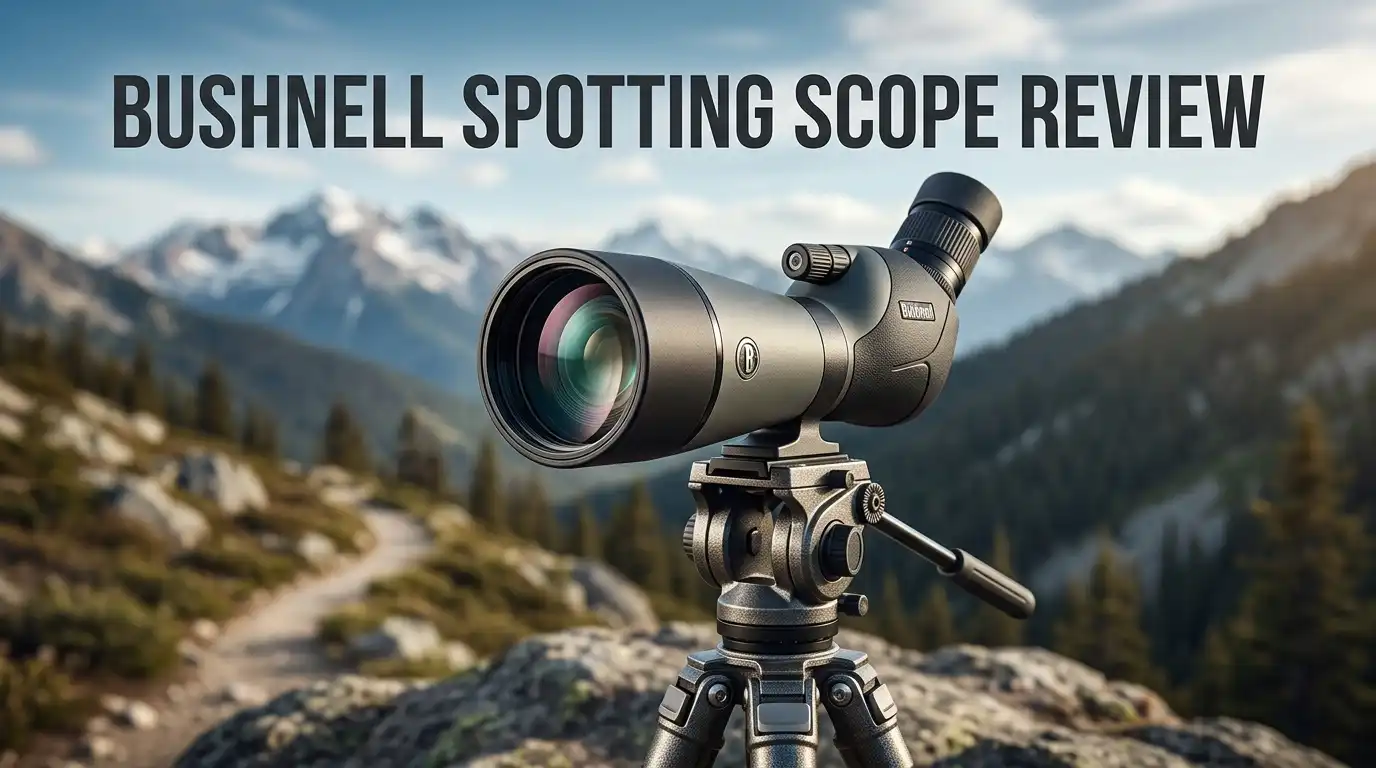
Bushnell Spotting Scope Review 2026: Still Worth It?
Distance ruins good glass. A deer at 800 yards turns into a brown smudge through binoculars. A bird on a far mudflat becomes a gray dot. A spotting scope fixes that problem, and Bushnell has sold more of them to American hunters than almost anyone else.
But 2026 is a crowded year for optics. Vortex, Athlon, and Celestron all fight for the same shelf space. Bushnell no longer wins by default. So the real question is simple. Does Bushnell still deliver honest value, or are you paying for a familiar name?
I spent time behind three Bushnell spotters at the range, on a ridge, and off my back porch. This review covers what the glass actually shows you, what the focus wheels feel like after an hour, and where these scopes fall short. No sugar coating. You will read the weak points too.
In a Nutshell:
- Bushnell sits in the value lane, not the premium lane. The Prime and Trophy Xtreme models cost under $300 and behave like it. You get usable images to roughly 40x, then quality drops. That is normal at this price, and buyers should expect it rather than feel cheated.
- The 80mm models are the sweet spot. The Engage DX and the Forge both use an 80mm objective. That extra glass gathers more light, so dawn and dusk viewing improves in a clear, measurable way over the 65mm bodies.
- Waterproofing is genuinely good. Every current model carries IPX7 sealing with argon or nitrogen purging. Rain, fog, and humidity have not caused internal fogging in my testing or in most owner reports.
- Eye relief varies wildly between models. Glasses wearers should stick to the 18mm eye relief options. Some older Bushnell spotters have cramped eyeboxes that frustrate anyone with lenses on their face.
- Top magnification is marketing. Every 60x setting in this price range looks soft and dim. Plan to shoot and glass at 30x to 40x for the sharpest view.
- Warranty support improved. Bushnell now backs most spotting scopes with a lifetime limited warranty, though it falls short of the no questions asked policies from Vortex.
Why Bushnell Still Matters in Optics

- Hunting scopes spotting
- Versatile top of the line
Last update on 2026-09-17 / Affiliate links / Images from Amazon Product Advertising API Some of the links on this website are affiliate links, which means that at no additional cost to you, I earn a commission if you click through and make a purchase. I only recommend products and services that I believe will add value to my readers. Thank you for your support!
Bushnell started in 1948 and built its reputation on affordable field glass. That history means something practical. Dealers stock parts, accessories fit, and used models hold steady resale value.
The brand covers a wide price ladder. You can spend $200 on a Sentry or $1,100 on a Forge. Few competitors stretch that far under one badge.
Bushnell also understands American hunting culture. Their spotters ship with rubber armor, sun shades, and simple controls that work with cold fingers or gloves on. Fancy features stay off the list.
The trade is obvious. Bushnell rarely wins optical shootouts against Swarovski or Kowa. Testers at major outdoor publications place Bushnell in the middle of the pack for resolution while ranking it near the top for value.
That middle ground suits most buyers. A weekend hunter who glasses for two hours per season does not need $3,000 glass. A reliable $400 spotter that survives a truck bed serves them better. Bushnell has built its 2026 lineup around exactly that customer, and the pricing reflects it.
Bushnell Prime 20 to 60×65 Angled Spotting Scope
The Prime is the entry point that most buyers land on. It pairs a 65mm objective with a 20x to 60x zoom and sells around $299 at list price, often less on Amazon.
Specs stay modest. You get fully multi coated lenses, BaK 4 porro prisms, argon purging, and IPX7 waterproofing. Eye relief measures 18mm, which is generous and friendly to eyeglass wearers. Close focus sits at 20 feet. Weight lands at 38.1 ounces.
Image quality holds up well through 50x. One verified owner noted sharp focus at 20x, 40x, and 50x, with clear softening at 60x. My experience matched that exactly.
The Prime does not use ED glass. You will see purple and green color fringing on high contrast edges, like a dark branch against bright sky. At 400 yards on a paper target, that fringing hides fine bullet holes.
Pros
- Very affordable for a full size angled spotter
- Generous 18mm eye relief for glasses wearers
- Argon purged and IPX7 waterproof housing
- Lightweight enough for tripod travel
Cons
- No ED glass, so chromatic aberration shows
- Soft and dim at the 60x setting
- Plastic focus wheel feels cheap
- Tripod not included in most listings
Bushnell Trophy Xtreme 20 to 60×65 Spotting Scope

- Same Trusted Design: This Trophy Xtreme 20-60x65 is built on the same great platform as our previous model, but now comes in black rubber armor. This model provides a cheaper option for those not needing a tabletop tripod.
- Black Rubber Armor: Engineered for extreme conditions, the Trophy Xtreme spotting scope features a durable rubber-armored housing and 100% waterproof construction—ideal for trophy hunting, wildlife observation, and birding in any environment.

Last update on 2026-09-17 / Affiliate links / Images from Amazon Product Advertising API Some of the links on this website are affiliate links, which means that at no additional cost to you, I earn a commission if you click through and make a purchase. I only recommend products and services that I believe will add value to my readers. Thank you for your support!
The Trophy Xtreme shares the Prime’s 65mm objective but targets hunters who want a tougher shell. Black rubber armor wraps the whole body. Bushnell prices it at $229.95, which makes it one of the cheapest 65mm spotters from a major brand.
The build inspires confidence. The armor absorbs knocks, the housing resists water at IPX7, and the porro prism layout keeps the price down. A hunter can toss this in a pack without a hard case.
Honesty matters here. This model draws the most mixed owner feedback in the Bushnell line. One long term shooter on a rimfire forum complained that eye relief felt poor and the field of view stayed narrow even at 20x. Those criticisms are fair and worth weighing.
Field of view is the real limitation. Scanning a hillside feels like looking through a tube. You will find animals slower than you would with a wider scope.
Pros
- Lowest price in the current Bushnell full size range
- Heavy rubber armor handles rough transport
- Simple zoom and focus controls work with gloves
- Waterproof and fog resistant construction
Cons
- Narrow field of view slows target searching
- Short eye relief bothers glasses wearers
- Edge sharpness falls off noticeably
- Included accessories feel basic
Bushnell Engage DX 20 to 60×80 Spotting Scope
The Engage DX steps up to an 80mm objective and lists near $599.95. That larger lens is the single most useful upgrade in this lineup. More aperture means a brighter image when light fades.
Bushnell adds its EXO Barrier coating here. The treatment bonds to the exterior glass and repels water, oil, dust, and fingerprints. In drizzle, water beads and rolls off instead of smearing.
Weight stays reasonable at roughly 3.75 pounds. That surprised me for an 80mm body. Gear testers at a major hunting publication found the Engage DX performed better than expected in optical resolution, calling out clear visuals on their benchmark target groupings.
The catch appears beyond resolution. Those same testers noted the scope did not lead in other categories, particularly low light and color fidelity. Competing 85mm scopes near this price show slightly better contrast.
Focus travel also runs long. Moving from 100 yards to infinity takes several turns of the wheel, which costs you seconds when an animal moves.
Pros
- Bright 80mm objective helps at dawn and dusk
- EXO Barrier coating sheds rain and fingerprints
- Light for an 80mm scope at 3.75 pounds
- Solid resolution scores in independent testing
Cons
- Long focus travel slows quick target acquisition
- Contrast trails similarly priced rivals
- Tripod capable of holding it steady costs extra
- Angled body takes practice to aim
Top 3 Alternative for Bushnell Engage DX 20 to 60×80

- The redesigned Diamondback HD spotting scope has all the optical horsepower the western hunter needs, and excels in low light. It features a streamlined exterior for a sleeker profile and a built-in helical focus wheel for fast and fine adjustments.
- HD optical system delivers exceptional resolution, cuts chromatic aberration and provides outstanding color fidelity, edge-to-edge sharpness and light transmission. Multiple anti-reflective coatings on all air-to-glass surfaces increase light transmission
Last update on 2026-06-28 / Affiliate links / Images from Amazon Product Advertising API Some of the links on this website are affiliate links, which means that at no additional cost to you, I earn a commission if you click through and make a purchase. I only recommend products and services that I believe will add value to my readers. Thank you for your support!
Vortex Diamondback HD Spotting Scope

- ULTIMA ANGLED SPOTTING SCOPE: The outdoor enthusiast’s choice is our great all-around spotting scope with an 80mm objective lens and a 45° viewing angle. Perfect for observing nature and long-distance viewing.
- INCLUDES ESSENTIALS FOR BETTER VIEWING – PLUS DIGISCOPING: Celestron Ultima 80 includes an extended tripod mounting plate, a zoom eyepiece with an integrated T-adapter for digiscoping, a carrying case, an eyepiece lens cap, an eyepiece port cover, a soft carrying case, an eyepiece pouch, a lens cloth, instruction manual, and a smartphone adapter so you can quickly and easily capture images and video through the scope with your smartphone.
Last update on 2026-06-09 / Affiliate links / Images from Amazon Product Advertising API Some of the links on this website are affiliate links, which means that at no additional cost to you, I earn a commission if you click through and make a purchase. I only recommend products and services that I believe will add value to my readers. Thank you for your support!
Celestron Ultima 20 to 60×80 Angled Spotting Scope

- Nitrogen Purging uses the inertia gas to purge moisture out of the tube giving you better waterproofing and thermal stability
- Fully Multi-Coated lenses gives you great light transmission and bring bright images to your eyes
Last update on 2026-09-17 / Affiliate links / Images from Amazon Product Advertising API Some of the links on this website are affiliate links, which means that at no additional cost to you, I earn a commission if you click through and make a purchase. I only recommend products and services that I believe will add value to my readers. Thank you for your support!
Athlon Optics Talos 20 to 60×80 Spotting Scope
The Unboxing Experience
Bushnell keeps packaging plain. My Prime arrived in a printed cardboard box with molded foam inserts. No premium touches, no magnetic flaps, no branded tissue paper. The money went into the optic, not the wrapper.
Inside you find the scope, a soft carry case, objective and eyepiece covers, a lens cloth, and a folded manual. Some Prime listings include a compact travel tripod, which is handy but genuinely flimsy.
First impressions of the body are better than the box suggests. The rubber armor grips well. The zoom ring turns with even resistance. Nothing rattles.
The lens covers are the weak spot. They are tethered rubber caps that pop off too easily in a pack. I lost one within a month.
The soft case deserves credit. It has a zip top, a shoulder strap, and enough padding to survive normal handling. It will not protect against a serious drop.
Setup takes about two minutes. Thread the scope onto a tripod head, twist the eyecup, and start glassing.
Optical Performance in Real Light
Numbers on a box mean little. Actual viewing tells the story. I tested at three times of day across two weeks.
Midday performance is strong. At 30x, a Bushnell Prime resolved individual feathers on a hawk at 250 yards. Colors looked slightly warm but natural.
Low light is where price shows. Thirty minutes before sunset, the 65mm models dimmed noticeably. The 80mm Engage DX stayed usable for another fifteen minutes past the point where the Prime became guesswork.
Exit pupil explains this. The Prime measures 1.2mm to 3.3mm. At full 60x zoom, a 1.2mm exit pupil delivers a dark, narrow view that your eye struggles to use.
Heat shimmer affects every scope at long range, and no amount of money fixes it. A reviewer spotted vapor trails from bullets at 450 meters through a Bushnell Prime, which shows the glass can do serious work in good conditions.
My practical advice stays consistent. Set the zoom to 30x or 35x and leave it there.
Build Quality and Weather Sealing
Bushnell earns real praise here. Every current spotting scope in the line carries IPX7 waterproof certification. That rating means the sealed body survives immersion in three feet of water for thirty minutes.
Argon or nitrogen purging removes internal moisture. Air cannot get in, so temperature swings do not create interior fog. I moved a Prime from a cold truck into humid morning air with no fogging.
Rubber armor covers all major surfaces. It dampens sound if you bump the scope against rock, which matters when animals are close.
The chassis feels more durable than the controls. Focus wheels and zoom rings use polymer parts that develop slight play over time. Owners who have used the same scope for years report loosening, though rarely outright failure.
Tripod threads are standard quarter inch. Mounting collars rotate so you can shift the eyepiece position, and the detent holds firmly.
One Engage DX owner described pairing it with a Bushnell tripod and said both felt built like a tank.
What Bushnell Spotting Scopes Do Not Do Well
Real reviews name the flaws. Here are mine after extended use.
Top end magnification disappoints on every model under $600. The 60x setting produces a dim, mushy image that no one should rely on for judging antlers or reading bullet holes.
Chromatic aberration is unavoidable without ED glass. The Prime and Trophy Xtreme both show color fringing. Only the Forge and Nitro use ED Prime glass.
Field of view runs narrow across the value models. Wildlife watchers who scan large areas will notice this immediately and may prefer a wider 65mm competitor.
Focus mechanisms are the weakest engineered part. Single wheel designs make fine adjustment fussy at high power. The Forge adds dual focus, which helps enormously.
Included tripods, when present, cannot support an 80mm scope steadily. Budget $100 to $200 extra for a proper aluminum or carbon tripod.
Warranty terms lag behind Vortex. Bushnell offers a lifetime limited warranty with conditions, not unconditional replacement.
Bushnell Forge 20 to 60×80 for Serious Users
The Forge sits at the top of the line near $1,099. It exists for people who glass for hours and need their eyes to last.
ED Prime glass changes the picture. Color fringing nearly disappears. Edges look clean. Independent testers found the Forge performed admirably in clarity and low light relative to its price, tying scopes that cost considerably more.
The dual focus system is the standout feature. A coarse wheel gets you close and a fine wheel locks in detail. This single feature justifies a large part of the price jump.
Build touches improve too. A sliding sun shade cuts glare. The twist up eyecup moves smoothly. The zoom ring feels damped rather than gritty.
Weight is the cost of quality. The Forge tips the scale at roughly 61 ounces, close to four pounds. That demands a serious tripod and a willingness to carry weight.
Backcountry hunters counting ounces should think twice. Truck and blind hunters will love it.
Digiscoping With Your Phone
Phone photography through a spotter has become a major reason people buy. Bushnell supports it, though not as smoothly as some rivals.
No current Bushnell spotting scope ships with a phone adapter in the box. You buy one separately, typically for $30 to $60.
Universal clamp adapters work fine. Center your phone camera over the eyepiece, tighten the clamp, and shoot. Expect vignetting at low magnification and a dark ring around the frame.
The 18mm eye relief on the Prime actually helps here. More relief gives the adapter room to sit without cutting the image circle.
Results are honest rather than spectacular. You will capture identifiable photos of birds and game at distance. You will not capture magazine quality images without ED glass.
Video shakes badly at high zoom. Use 20x to 30x, a heavy tripod, and a timer or voice trigger to avoid touching the phone.
Who Should Buy a Bushnell Spotting Scope
Match the model to your actual use. That decision matters more than brand loyalty.
Target shooters at 100 to 300 yards should buy the Prime or Trophy Xtreme. Both resolve bullet holes in paper at those ranges for under $300.
Western hunters who glass long ridges need the Engage DX or Forge. The 80mm objective and better coatings pay off during the first and last hour of legal light.
Birders should think carefully. Narrow field of view and no ED glass on the cheap models make bird identification harder than it should be. Serious birders will prefer a wider 65mm ED scope from another brand.
Backyard astronomers can use any of these for moon craters and Jupiter’s moons at 40x. Deep sky work needs a telescope instead.
Anyone on a strict budget under $250 gets real capability from the Trophy Xtreme or Sentry. Accept the compromises and you will still see far more than binoculars allow.
Frequently Asked Questions
Are Bushnell spotting scopes good in 2026?
Yes, within their price bracket. Bushnell delivers reliable waterproof construction and acceptable image quality for $200 to $600. Premium brands beat them on resolution and low light performance, but at three to five times the cost.
Which Bushnell spotting scope is best for hunting?
The Engage DX 80mm model offers the best balance for most hunters. It combines a bright objective, EXO Barrier coating, and a manageable 3.75 pound weight. Hunters wanting top optical quality should choose the Forge with ED Prime glass.
Do I need ED glass in a spotting scope?
ED glass reduces color fringing and improves sharpness at high magnification. If you glass for hours or judge fine detail like antler points, it is worth the extra money. Casual users at moderate ranges can live without it.
What magnification should I actually use?
Set your zoom between 30x and 40x for the sharpest, brightest view. Higher settings amplify heat shimmer, tripod shake, and optical weakness. The 60x setting is useful only in perfect midday conditions.
Does Bushnell include a tripod?
Some Prime listings include a compact travel tripod, but most models ship without one. Any included tripod will be too light for an 80mm scope. Budget separately for a sturdy tripod rated above five pounds.
How long does the warranty last?
Bushnell covers most current spotting scopes with a lifetime limited warranty against defects in materials and workmanship. It does not cover accidental damage the way Vortex’s unconditional policy does. Register your purchase to simplify future claims.
Can I use a Bushnell spotting scope for stargazing?
Yes, for the moon, planets, and bright star clusters at 30x to 40x. The image will be upright and correctly oriented, which helps beginners. Faint galaxies and nebulae need a dedicated telescope with far more aperture.

Hello, I’m Amelia White, the founder of birdsfanatic.com. As a lifelong bird enthusiast and spiritual seeker, I’ve always been fascinated by the mystical connections between birds and the human experience. On this site, I share my knowledge and insights into the symbolic meanings and spiritual significance of various bird species, exploring their roles in mythology, folklore, and cultural traditions. Join me on this journey into the world of birds, where we’ll discover the hidden wisdom and guidance that these magnificent creatures have to offer.