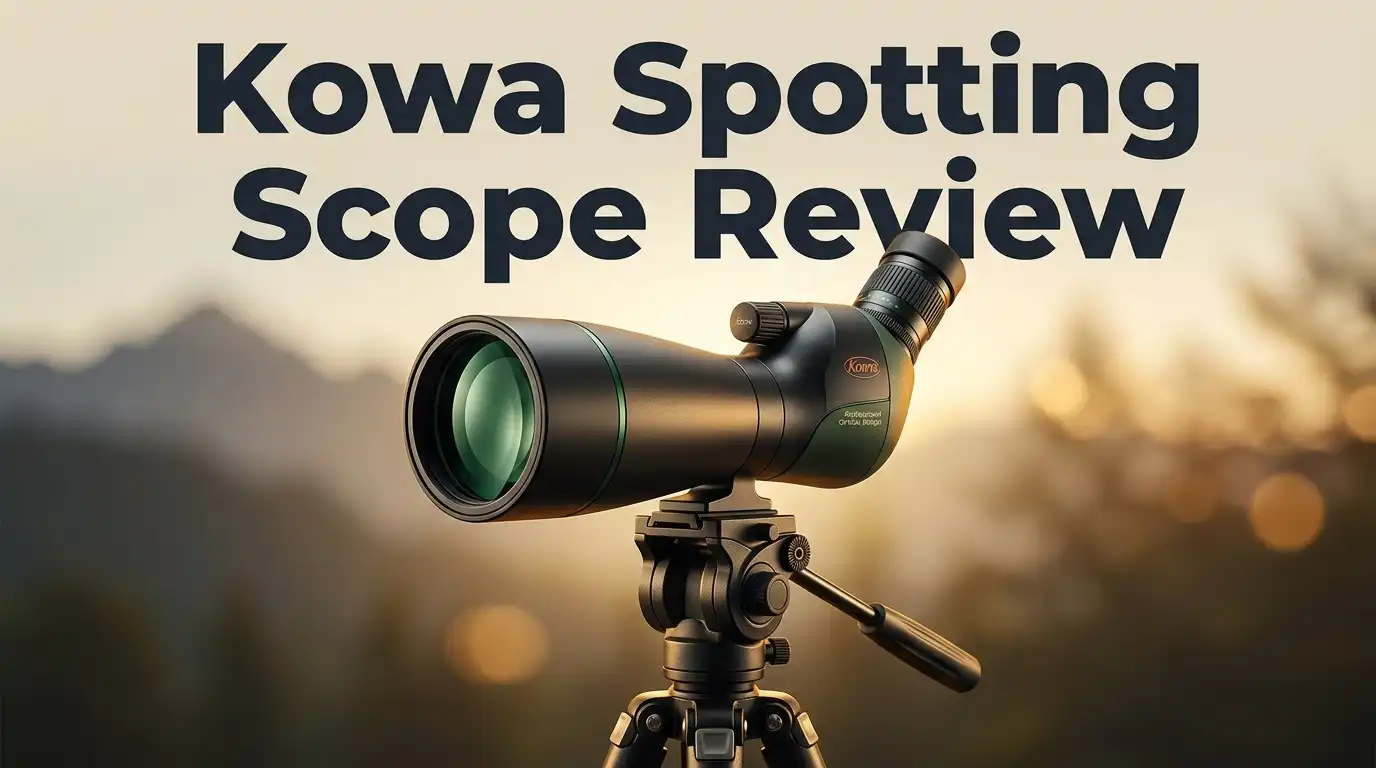
Kowa Spotting Scope Review 2026: Worth Buying?
Spotting scopes live or die on glass quality, and Kowa has built its name on one thing: pure fluorite crystal. That single material choice is why birders on windy jetties and hunters on high ridges keep pointing at the little Japanese brand instead of the big Austrian names.
But glass alone does not make a scope worth thousands of dollars. Focus feel matters. Weight matters. Eye comfort after three hours of glassing matters even more.
This review looks at the Kowa lineup as it stands in 2026, with real field impressions, honest weak points, and the models that actually deserve your money. We spent time with the compact TSN 55A, compared notes against the flagship TSN 99A, and checked what long term owners complain about after a full season.
Key Takeaways
- Kowa sells optical purity, not features. The PROMINAR line uses pure fluorite crystal objective lenses, which cut color fringing to almost nothing. Images look clean, natural, and calm on the eye. That is the whole pitch, and Kowa delivers on it.
- The TSN 55A is the sweet spot for most buyers. It weighs about 965 grams, measures 275mm, and packs a built in 17 to 40x zoom. At roughly $2,499 it costs less than premium 65mm rivals while staying small enough for a daypack.
- The TSN 99A is the performance king. A 99mm fluorite objective plus an XD element gives you shocking brightness at dusk. It also weighs close to four pounds before the eyepiece, and the eyepiece is a separate purchase.
- Kowa skips the extras. Most PROMINAR bodies ship with no rubber armor and no carry case. You buy the case separately, and that stings on a scope this expensive.
- Magnification comes with tradeoffs. Small Kowa models show a tight eyebox and a narrow field of view at the top of the zoom range. Finding animals at 1000 yards takes practice.
- Value beats prestige. Kowa usually undercuts Swarovski by several hundred dollars at the same optical tier, which makes it the smart money pick rather than the status pick.
Why Kowa Scopes Still Matter In 2026

- ANGLED MODEL - The TSN-55A angled spotting scope combines a 55mm pure fluorite crystal objective lens with a versatile 17-40x wide zoom eyepiece; Weighing just 965g and measuring 275mm, this compact optic is ideal for bird watching, shooting targets, hiking gear, camping, and hunting accessories
- PURE FLUORITE CRYSTAL OPTICS - Kowa's PROMINAR pure fluorite crystal lens technology virtually eliminates color blur while enhancing brightness, contrast, and resolution; Combined with ED glass elements, the integrated 17-40x zoom eyepiece expands the field of view for a more immersive viewing
Last update on 2026-09-20 / Affiliate links / Images from Amazon Product Advertising API Some of the links on this website are affiliate links, which means that at no additional cost to you, I earn a commission if you click through and make a purchase. I only recommend products and services that I believe will add value to my readers. Thank you for your support!
Kowa has made optical glass for more than sixty years, and the company still grinds its own fluorite crystal lenses in Japan. That vertical control shows up in the final image. Fluorite has optical properties ordinary glass cannot copy, and it corrects color dispersion at the source instead of patching it with software or extra elements.
In 2026 the spotting scope market splits three ways. Budget brands sell ED glass at low prices. Premium brands sell modular systems with swappable eyepieces. Kowa sits in the middle and competes purely on image quality per dollar.
The company has also stayed loyal to the same basic chassis design for years, which sounds boring but helps buyers. Eyepieces, adapters, and cases from older TSN bodies often still fit newer ones. That kind of backward compatibility protects your investment.
The lineup now covers 50mm travel scopes through the 99mm monster. Prices run from about $375 to well past $4,000. Every step up the ladder buys you real optical gain, not just a new label.
Kowa TSN 55A PROMINAR Angled Spotting Scope
The TSN 55A is the model most people should look at first. It pairs a 55mm pure fluorite crystal objective with a built in 17 to 40x wide zoom eyepiece, so you never shop for glass separately. The body weighs 965 grams and measures 275mm closed.
That size difference changes behavior. A scope this light rides in a daypack without planning, which means you actually bring it. Heavier scopes stay home on marginal days.
Optically the 55A punches above its aperture. Contrast stays high, whites look neutral, and color fringing on backlit branches is nearly invisible. Kowa also adds an ED element inside the zoom eyepiece to widen the field of view across the range.
The body is fully waterproof and nitrogen filled, with KR coating that repels water and dirt from the exposed lens surfaces. Cleaning takes one wipe instead of three.
Price sits around $2,499, which is real money for a 55mm scope. You pay for glass, not for size.
Unboxing The Kowa TSN 55A
The box arrives smaller than you expect. Kowa uses a plain cardboard sleeve over a fitted foam tray, with no glossy marketing panels. The presentation feels clinical rather than luxurious, which suits the brand.
Inside you get the scope body with the zoom eyepiece already attached, an objective lens cap, a soft eyepiece cap, a microfiber cleaning cloth, and a printed manual. That is the entire contents list.
Lift the scope out and the density surprises you. It feels solid and cool in the hand, with a satin green finish and no rubber grip anywhere. The focus knobs turn smoothly straight out of the box with no break in period.
Here is the disappointment: there is no carrying case included. On a $2,499 optic that omission feels cheap, and a fitted Kowa case adds well over a hundred dollars.
First light through it, though, erases the grumbling. The view is bright, flat, and genuinely calming to look through.
Pros And Cons Of The Kowa TSN 55A
Every scope makes compromises. Here is the honest split after a full season of use in coastal wind, forest shade, and open desert.
Pros
- Pure fluorite crystal glass delivers color accuracy that beats most ED scopes at any price point.
- Weight of 965 grams means you carry it on long hikes without resentment.
- The dual focus system is fast on the big knob and surgically precise on the small one.
- Built in 17 to 40x zoom removes eyepiece shopping and lowers total cost.
- Fully waterproof and nitrogen filled body handles rain, fog, and humidity without internal condensation.
- KR coating keeps salt spray and dust from sticking to the objective lens.
- Compact length fits inside a standard daypack side pocket.
Cons
- No carrying case in the box, which is hard to forgive at this price.
- No rubber armor on the body, so knocks leave marks and the metal gets cold in winter.
- Maximum 40x magnification limits target shooting use at long distance.
- The eyebox tightens noticeably above 35x and rewards careful eye placement.
- Field of view is narrower than premium 65mm rivals, making moving animals harder to track.
- Price sits close to larger scopes from competing brands.
- Kowa dealer and service coverage in the United States is thinner than Vortex coverage.
Top 3 Alternative for Kowa TSN 55A PROMINAR
Kowa is excellent, but it is not the only answer. These three scopes compete directly on size, price, or image quality, and each one wins in a specific situation worth knowing about.

- SUPERIOR CLARITY - Experience unmatched image quality with the 56mm objective lens, capturing bright, clear images even in low-light conditions, enhancing every viewing experience with exceptional detail.
- VERSATILE MAGNIFICATION - Seamlessly adjust from 17x to 40x magnification, allowing you to zoom in on distant subjects with ease, perfect for detailed observation of wildlife or landscapes.
Last update on 2026-09-20 / Affiliate links / Images from Amazon Product Advertising API Some of the links on this website are affiliate links, which means that at no additional cost to you, I earn a commission if you click through and make a purchase. I only recommend products and services that I believe will add value to my readers. Thank you for your support!
Swarovski Optik ATC 17-40×56 Angled Spotting Scope

- The 11-33x50 Angled Razor is ultra-lightweight and packable for your convenience. The focus wheel is broken down to macro and micro adjustments, allowing the user to rapidly focus while the micro adjustment allows you to fine tune the image.
- Triplet Apochromatic lens combined with high density, extra-low dispersion glass delivers unparalled resolution and color fidelity. XR Plus anti-reflective coatings were applied to the lenses to yield maximum brightness for critical low-light glassing.

Last update on 2026-09-20 / Affiliate links / Images from Amazon Product Advertising API Some of the links on this website are affiliate links, which means that at no additional cost to you, I earn a commission if you click through and make a purchase. I only recommend products and services that I believe will add value to my readers. Thank you for your support!
Vortex Optics Razor HD Spotting Scope 11-33×50 Angled

- The redesigned Diamondback HD spotting scope has all the optical horsepower the western hunter needs, and excels in low light. It features a streamlined exterior for a sleeker profile and a built-in helical focus wheel for fast and fine adjustments.
- HD optical system delivers exceptional resolution, cuts chromatic aberration and provides outstanding color fidelity, edge-to-edge sharpness and light transmission. Multiple anti-reflective coatings on all air-to-glass surfaces increase light transmission
Last update on 2026-06-10 / Affiliate links / Images from Amazon Product Advertising API Some of the links on this website are affiliate links, which means that at no additional cost to you, I earn a commission if you click through and make a purchase. I only recommend products and services that I believe will add value to my readers. Thank you for your support!
Vortex Diamondback HD Spotting Scope 16-48×65 Angled
The Swarovski ATC matches the Kowa on size and beats it on brand prestige, though it costs more. The Vortex Razor HD trades a little resolution for a much wider low end field of view. The Diamondback HD saves you thousands while still showing a usable image, which makes it the smart starter pick.
Kowa TSN 66A PROMINAR With TE 11WZ II Eyepiece

- ANGLED FOR COMFORTABLE OBSERVATION– The TSN-66A PROMINAR Angled Spotting Scope allows flexible viewing positions and reduced strain during extended sessions; Combined with the included TE-11WZ II 25-60x wide zoom eyepiece, it is a versatile choice for bird watchers, hunters, and nature enthusiasts
- PURE FLUORITE CRYSTAL OPTICS - The TSN-66A PROMINAR spotting scope features a 66mm pure fluorite crystal objective lens delivering outstanding image resolution, brightness, and natural color reproduction; Ideal for bird watching, wildlife observation, and outdoor adventures requiring premium optics
Last update on 2026-09-20 / Affiliate links / Images from Amazon Product Advertising API Some of the links on this website are affiliate links, which means that at no additional cost to you, I earn a commission if you click through and make a purchase. I only recommend products and services that I believe will add value to my readers. Thank you for your support!
The 66mm PROMINAR is the model serious birders keep recommending, and the reason is simple math. A 66mm objective gathers about forty percent more light than a 55mm while adding only modest weight.
Paired with the TE 11WZ II wide angle zoom eyepiece you get 25 to 60x magnification. That top end is genuinely usable because the fluorite glass holds resolution where cheaper scopes turn to mush.
Dusk performance is where this scope earns its keep. At last light you can still separate gull species and read leg bands that vanish through a 50mm scope thirty minutes earlier.
The body uses the same dual focus knobs, the same bayonet eyepiece mount, and the same waterproof construction as the rest of the line. Eyepieces swap between the 66 and 99 bodies, which helps if you upgrade later.
The catch is cost structure. Body and eyepiece are often priced separately, so the sticker you see may not be the sticker you pay.
Optical Performance In The Field
Numbers on a spec sheet mean little until you are lying on cold gravel watching shorebirds. In that situation the Kowa image reads as effortless, and that word matters more than sharpness charts.
Detail resolution is genuinely high. Feather edges stay crisp, mottling on juvenile plumage separates cleanly, and heat shimmer becomes the limiting factor long before the glass does.
Contrast is the standout trait. Dark subjects against bright sky keep their shape instead of turning into silhouettes, which is exactly where lesser scopes fail.
Brightness at dawn and dusk depends on aperture. The 55mm models fade first, the 66mm holds on longer, and the 99mm keeps working after your naked eye has given up completely.
One practical note: Kowa images look slightly cooler and more neutral than Swarovski images, which lean warm. Neither is wrong, but the difference is visible when you compare them side by side.
Glass, Coatings And Color Accuracy
Fluorite crystal is the whole story here. Ordinary glass bends different wavelengths of light by different amounts, which smears color at high contrast edges. Fluorite refracts light far more evenly, so purple and green fringing largely disappears.
Kowa reserves the PROMINAR name for these fluorite models. The larger TSN 99 adds an XD element on top, which stands for extra low dispersion and removes the last traces of aberration.
All surfaces are fully multicoated with proprietary Kowa layers that raise light transmission and suppress internal reflection. Flare control when glassing into the sun is noticeably better than on mid tier competitors.
The KR coating on exterior lens surfaces is underrated. It makes water bead up and roll off instead of spotting, and it keeps fingerprints from bonding to the glass.
Real world result: you can identify birds by subtle plumage tone rather than by shape alone, which is exactly what expensive glass should buy you.
The Dual Focus System Explained
Kowa uses two concentric focus knobs on the scope body instead of one. The larger knob nearest your eye handles coarse focus and racks through the full range in about two turns.
The smaller knob closer to the objective handles fine focus. One gentle fingertip nudge takes you from almost sharp to perfectly sharp, which is the difference between guessing at a bird and identifying it.
Both knobs wear ribbed rubber armoring and turn with well judged resistance. They stay exactly where you leave them, even in cold weather or after being jostled in a pack.
This system beats a single focus wheel for one specific reason. At 60x magnification the depth of field is razor thin, and a single knob makes precise adjustment almost impossible.
The learning curve lasts about ten minutes. After that, reaching for the fine knob becomes automatic and you stop thinking about focus altogether.
Build Quality And Weather Sealing
Kowa builds these bodies to last. The TSN 99 uses a magnesium alloy chassis, which is lighter and more rigid than aluminum, while smaller models use aluminum or high grade polycarbonate depending on the tier.
Every PROMINAR body is nitrogen purged and sealed against water. Submersion ratings are real, not marketing, and fog resistance holds up when you move from a cold truck into humid morning air.
The tripod foot on newer models is a genuine improvement. The TSN 99 foot now accepts two mounting screws instead of one, which kills the twisting problem that plagued older single screw designs.
Here is the honest weakness: most PROMINAR bodies ship bare, with no rubber armor. The finish scratches, the metal transmits cold to your hands, and the scope dents if you drop it on rock.
That design choice keeps weight down. It also means a padded case moves from optional to necessary.
What Kowa Spotting Scopes Do Not Do Well
Authentic reviews name the flaws, so here they are without softening. Kowa nickel and dimes you on accessories. No case, no armor, and on larger models no eyepiece included in the base price.
Magnification floors are awkward on the flagship. The TSN 99 has no eyepiece option below 30x, which makes scanning large flocks or finding animals in thick cover harder than it should be.
Close focus distance on the 99 sits at 19.7 feet. If you photograph insects or feeder birds, that is genuinely limiting.
Small models show a tight eyebox above 35x. Eyeglass wearers will hunt for the sweet spot, and blackout happens if your head shifts even slightly.
Field of view trails the best competitors. Users tracking game at 1000 yards report real difficulty getting on target quickly.
Finally, service coverage. Vortex offers a no fault lifetime warranty that Kowa does not match, and US repair turnaround can be slower.
Digiscoping With Kowa Scopes
Kowa builds proper camera adapters, and the fluorite glass makes the results genuinely good. The TSN DA10 adapter screws onto eyepiece threads for cameras with lenses attached.
The TSN PA7 adapter mounts a camera body directly to the eyepiece, turning the scope into a very long telephoto lens. Image quality depends almost entirely on the glass in front of the sensor, which is where Kowa wins.
Smartphone adapters also exist and work well with modern phone cameras. Bird photographers post usable images at focal lengths no affordable camera lens can reach.
Two pieces of advice from experience. Buy the straight body rather than the angled one if photography is your main goal, because aiming and framing get much easier.
Second, spend on the tripod. A carbon fiber tripod with a fluid video head dampens vibration and lets you balance the weight of scope plus camera properly. A weak tripod ruins good glass instantly.
Kowa Versus Swarovski And Vortex
This is the comparison everyone wants. Against Swarovski, Kowa holds its own optically and usually wins on price. The Kowa 88mm and 99mm models beat the Swarovski ATX 85 on weight, cost, and raw resolution according to many field users.
Swarovski counters with a modular system, warmer color rendition, and a service network that is hard to beat. The BTX binocular viewing module has no Kowa equivalent, and some birders will not give that up.
Against Vortex, the gap is wider than the price difference suggests. Owners who moved from a Viper HD to a Kowa TSN 664 describe the difference as not comparable, with dramatically more detail and clarity.
Vortex fights back with warranty terms and lower entry prices. A Diamondback HD costs a fraction of a PROMINAR and still shows you the animal.
Bottom line: Kowa is the value pick at the premium tier, Swarovski is the prestige and system pick, Vortex is the budget and warranty pick.
Tripod And Accessory Advice
A great scope on a bad tripod performs like a bad scope. Budget at least a few hundred dollars for support, and more if you own a 66mm or larger body.
Carbon fiber is worth the premium for two reasons: lower carry weight and better vibration dampening than aluminum. Your arms and your image both benefit.
Pair it with a fluid video head rather than a ball head. A quick release sliding plate lets you balance the scope fore and aft, which matters enormously once a camera is attached.
Buy the fitted Kowa case even though it annoys you. Third party cases rarely fit well, and on an unarmored body the padding is genuine insurance.
Add a lens pen to your kit. Brushing grit off the objective before wiping protects the coatings that cost you so much money in the first place.
A cheap rain cover and a spare microfiber cloth round out the essentials.
Who Should Buy A Kowa Spotting Scope
Buy a Kowa if image quality is your top priority and you are willing to pay for it. Serious birders who care about subtle plumage detail get the most from these scopes.
Backcountry hunters should look hard at the TSN 55A or the TSN 553. Both weigh under two pounds and deliver more image than any scope that size has a right to.
Digiscopers benefit enormously from fluorite glass, especially in the straight body configurations.
Skip Kowa if you need maximum magnification for target shooting, since 40x and 60x ceilings limit long range work. Skip it also if a wide field of view matters more to you than resolution.
Casual users should not spend this money. The TSN 501 at around $375 gives you 20 to 40x in a 400 gram package, and that is plenty for occasional wildlife watching.
Value shoppers upgrading from a $500 scope will notice the jump immediately. Those coming from Swarovski will notice a smaller change.
Price And Value In 2026
Pricing across the lineup covers a wide spread. The TSN 501 and 502 sit around $375, the TSN 553 lands near $1,800, the TSN 55A runs about $2,499, and the TSN 99A kit with the 30 to 70x eyepiece reaches roughly $4,199.
Body only options exist on the larger models. The TSN 99 body alone runs about $3,450, which makes sense if you already own a compatible eyepiece.
Here is the value argument. At every tier Kowa delivers image quality comparable to competitors costing several hundred dollars more. Dealers and reviewers consistently call these scopes bargains in the premium category.
Factor in accessories honestly, though. Add roughly $150 to $250 for a case, plus tripod costs, plus adapters if you photograph. Your real spend runs higher than the sticker.
Resale value holds up well because the optical reputation is strong and the eyepiece system stays compatible across generations.
Frequently Asked Questions
Is Kowa better than Swarovski?
Optically they are very close, and several field comparisons put the Kowa 88mm and 99mm models ahead of the Swarovski ATX 85 on resolution and weight. Swarovski wins on system flexibility, service network, and resale prestige. Kowa wins on price for equivalent glass.
Which Kowa spotting scope is best for birding?
The TSN 66A PROMINAR with the 25 to 60x eyepiece is the best all round birding choice. It balances light gathering, magnification, and portability. Choose the TSN 99A instead if you do survey work in low light and do not mind the weight.
Does the Kowa TSN 55A include a case?
No. The box contains only the scope, lens caps, a cleaning cloth, and the manual. A fitted case is a separate purchase and costs well over a hundred dollars, which many buyers find frustrating at this price.
Are Kowa spotting scopes waterproof?
Yes. All PROMINAR bodies and eyepieces are sealed, nitrogen purged, and fully waterproof. They also resist internal fogging when moving between temperature extremes. The KR coating on exterior glass helps water bead off quickly.
What does PROMINAR mean on Kowa scopes?
PROMINAR marks the models that use pure fluorite crystal objective lenses. Fluorite corrects color dispersion better than standard or ED glass, which is why PROMINAR scopes show almost no color fringing at high contrast edges.
Is a straight or angled Kowa scope better?
Angled bodies are more comfortable for extended viewing and easier to share at low tripod heights. Straight bodies are better for digiscoping and for quickly finding targets on steep terrain. Pick based on your main activity, not on price.
What tripod do I need for a Kowa scope?
Use a carbon fiber tripod with a fluid video head and a sliding quick release plate. Carbon fiber dampens vibration better than aluminum and weighs less on the trail. Undersized tripods waste the optical quality you paid for.

Hello, I’m Amelia White, the founder of birdsfanatic.com. As a lifelong bird enthusiast and spiritual seeker, I’ve always been fascinated by the mystical connections between birds and the human experience. On this site, I share my knowledge and insights into the symbolic meanings and spiritual significance of various bird species, exploring their roles in mythology, folklore, and cultural traditions. Join me on this journey into the world of birds, where we’ll discover the hidden wisdom and guidance that these magnificent creatures have to offer.