
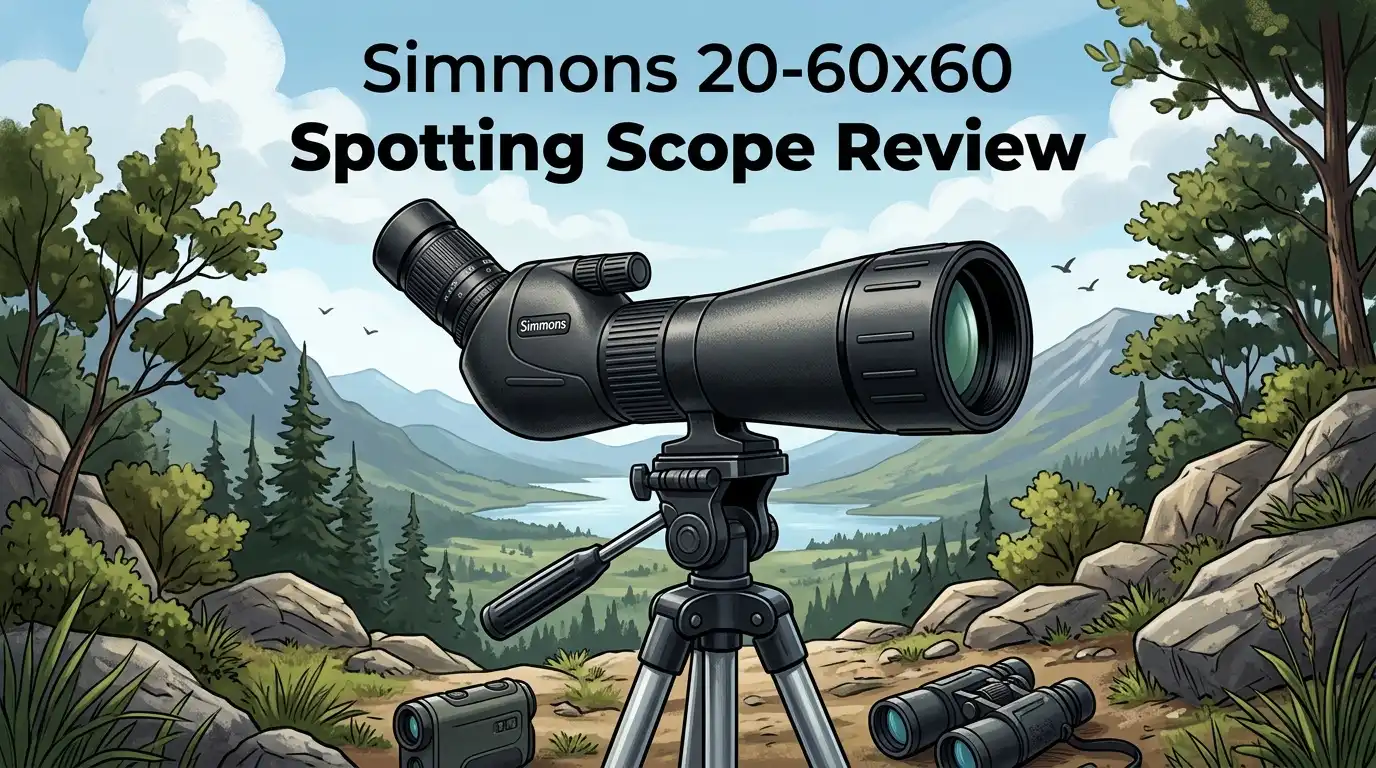
Simmons 20-60×60 Spotting Scope Review 2026: Worth Buying?
Spotting scopes cost anywhere from eighty dollars to three thousand dollars. That gap confuses buyers. You stand at the range, you squint through your rifle scope, and you still cannot tell if you hit the nine ring or the ten ring. A spotting scope solves that problem. But does a budget scope solve it well?
The Simmons 20-60×60 sits near the bottom of the price ladder. It promises 60x magnification, a 60mm objective lens, a tripod, and a carry case. That package sounds generous for the money. Generous packages often hide compromises.
I spent time with this scope at a 100 yard range, in a backyard, and on a cold morning watching hawks. This review covers what the scope actually delivers, where it falls apart, and who should spend money on it. No marketing language. Just honest observations from real use.
In a Nutshell:
- The price is the main selling point. The Simmons 20-60×60 usually sells between eighty and one hundred forty dollars depending on the version and bundle. You get a scope, a tripod, a hard case, and a soft case. Few competitors match that bundle at this price.
- Usable magnification stops around 30x. The scope zooms to 60x on paper. In practice the image softens badly past 30x. Brightness drops. Contrast fades. Most users settle between 20x and 30x and stay there.
- It spots .30 caliber holes at 100 yards in good light. That is the realistic performance ceiling. Do not expect to see .22 holes at 200 yards. Heat shimmer and glass quality both work against you.
- The included tripod is the weakest part. It wobbles. It sits too low for bench use. Plan to replace it with a better tripod within the first month.
- Build quality feels better than the price suggests. The body is solid. The rubber armor grips well. The focus wheel turns smoothly after a short break in period.
- This is a starter scope, not a lifetime scope. Buy it to learn what you need. Serious birders and long range shooters will outgrow it quickly.
Simmons 20-60×60 Spotting Scope Overview

Last update on 2026-09-20 / Affiliate links / Images from Amazon Product Advertising API Some of the links on this website are affiliate links, which means that at no additional cost to you, I earn a commission if you click through and make a purchase. I only recommend products and services that I believe will add value to my readers. Thank you for your support!
Simmons has sold budget optics since 1983. The brand now lives under the Bushnell umbrella. That history matters because Simmons never chased the premium market. The company builds entry level gear for casual users.
The 20-60×60 follows that pattern. It uses a 60mm objective lens and a zoom eyepiece that runs from 20x to 60x. The body is nitrogen purged and sealed against water. The current Venture version carries fully multi coated optics, which is a genuine upgrade over older Simmons models that used simple coatings.
The scope weighs roughly 2 pounds without the tripod. That makes it light enough to carry in a daypack. Length sits near 15 inches with the sunshade retracted.
Simmons ships both straight and angled eyepiece versions. The angled model works better for bench shooting and sky viewing. The straight model feels more natural for quick target acquisition.
Unboxing Experience and First Impressions
The box arrives smaller than expected. Mine came in a plain cardboard sleeve with a product photo on the front. Inside, the hard case takes up most of the space.
Opening the hard case feels satisfying. The scope sits in molded foam. The tabletop tripod rests beside it in its own cutout. A soft carry bag, a lens cloth, and a thin instruction sheet fill the remaining gaps.
First handling impression: the scope feels denser than its price tag suggests. The rubber armor has real texture. It does not feel like thin plastic wrap. The zoom collar turns with firm resistance, almost too firm when brand new.
The tripod is where the mood drops. It is small, light, and made mostly of plastic with thin aluminum legs. Lifting it tells you immediately that it will not hold a steady image at 60x.
Mounting the scope takes about thirty seconds. The threaded foot accepts any standard tripod screw. Setup is genuinely simple.
Build Quality and Everyday Durability
The Simmons body holds up to normal handling. I knocked it against a bench leg, dropped it from about two feet onto grass, and carried it loose in a truck bed. Nothing broke. Nothing shifted.
The rubber armor does real work here. It absorbs small impacts and gives you grip with cold or wet hands. The eyepiece ring stays attached firmly. The retractable sunshade slides out and holds position without rattling.
The focus wheel is the part I watched most closely. Budget scopes often develop sloppy focus within a season. Mine stayed consistent. The wheel is large and knurled, which helps when wearing gloves.
Weak points exist. The lens caps fit loosely and fall off easily. Mine disappeared within two outings. The eyecup is a simple rubber fold down style that cracks over time in sun exposure.
For a scope under one hundred fifty dollars, the durability is reasonable. It will survive casual use for several years.
Top 3 Alternatives for Simmons 20-60×60 Spotting Scope

- POWERFUL MAGNIFICATION: Adjustable powerful 20-60x zoom magnification allows you to lock onto your target and zoom in for more detail. Perfect for target shooting, hunting, bird watching, hiking, star gazing, travel, sport etc.
- FULLY MULTI-COATED LENS: Fully multi-coated 60mm green film objective lens. The quality BAK4 Porro prism optics increases light transmission, delivers bright, clear, high-contrast images even in low-light conditions. 45 degree eyepiece provides more comfortable viewing.

Last update on 2026-10-05 / Affiliate links / Images from Amazon Product Advertising API Some of the links on this website are affiliate links, which means that at no additional cost to you, I earn a commission if you click through and make a purchase. I only recommend products and services that I believe will add value to my readers. Thank you for your support!
Gosky OptiRange 20-60×60 Spotting Scope

- 20-60x60 HD Optics: Designed for target shooting and outdoor observation with high-definition optical performance
- Ultra-Light Spotting Scope Kit for Effortless Travel: Weighing just 1.31lbs, this spotting scope with tripod comes with a soft shoulder-strap carrying case, easy to sling over your shoulder or compact storage in a backpack without taking space.
Last update on 2026-09-17 / Affiliate links / Images from Amazon Product Advertising API Some of the links on this website are affiliate links, which means that at no additional cost to you, I earn a commission if you click through and make a purchase. I only recommend products and services that I believe will add value to my readers. Thank you for your support!
Emarth 20-60×60 Angled Spotting Scope

- ULTIMA ANGLED SPOTTING SCOPE: The outdoor enthusiast’s choice is our great all-around spotting scope with an 80mm objective lens and a 45° viewing angle. Perfect for observing nature and long-distance viewing.
- INCLUDES ESSENTIALS FOR BETTER VIEWING – PLUS DIGISCOPING: Celestron Ultima 80 includes an extended tripod mounting plate, a zoom eyepiece with an integrated T-adapter for digiscoping, a carrying case, an eyepiece lens cap, an eyepiece port cover, a soft carrying case, an eyepiece pouch, a lens cloth, instruction manual, and a smartphone adapter so you can quickly and easily capture images and video through the scope with your smartphone.
Last update on 2026-06-09 / Affiliate links / Images from Amazon Product Advertising API Some of the links on this website are affiliate links, which means that at no additional cost to you, I earn a commission if you click through and make a purchase. I only recommend products and services that I believe will add value to my readers. Thank you for your support!
Celestron Ultima 80 Angled Spotting Scope
Optical Performance From 20x to 30x
This is the range where the Simmons earns its keep. At 20x the image looks bright and reasonably sharp across the center of the field. Colors stay natural. Edge sharpness drops off, but the center stays clean.
At 25x to 30x the scope still performs honestly. I could read range flag lettering at 100 yards. I could count feathers on a robin at 40 yards. Detail at this magnification is genuinely useful.
Chromatic aberration appears around high contrast edges. You will see faint purple fringing on a black target against white paper. It does not ruin the view. It simply reminds you that this is not premium glass.
Light transmission feels adequate in daylight. The fully multi coated lenses on the Venture model help noticeably compared to older Simmons scopes.
Dawn and dusk performance is limited. The 60mm objective gathers less light than an 80mm scope, and the coatings are average. Plan your viewing for good light.
What Happens When You Push Past 30x
Here is the honest part that marketing copy skips. The top half of the zoom range is mostly decorative.
At 40x the image dims. Contrast flattens. Fine detail that you saw clearly at 30x starts to blur into mush. At 50x the exit pupil shrinks to 1.2mm, which is smaller than your eye can comfortably use in most light.
At 60x the view becomes genuinely frustrating. The image is dark, soft, and extremely sensitive to vibration. A light breeze on the tripod makes the picture dance. Finding focus becomes guesswork.
This is not a Simmons specific flaw. Every 60mm scope struggles at 60x. Physics limits what a small objective lens can resolve. Cheaper glass makes the problem worse.
My practical advice: treat this as a 20x to 30x scope with a 35x emergency setting. Set your expectations there and you will enjoy it.
Tripod Performance and Why You Should Upgrade
The included tabletop tripod measures about seven inches tall. It works on a shooting bench if you sit low. It does not work anywhere else.
The legs flex under the scope’s weight. The pan head has noticeable play. Touching the focus wheel introduces wobble that takes two or three seconds to settle. At 30x that wobble is annoying. At 50x it makes viewing impossible.
A forty dollar aluminum tripod transforms this scope. I mounted mine on a standard photo tripod with a fluid pan head. Image stability improved dramatically. Perceived sharpness improved too, because a steady image always looks sharper.
Budget for this upgrade from day one. Look for a tripod rated to at least six pounds with a proper pan and tilt head.
The scope’s mounting foot is standard, so almost any tripod works. The foot also rotates, which lets you switch between horizontal and angled viewing without remounting.
Field of View and Eye Relief Explained
The Simmons 20-60×60 delivers roughly 115 feet of field of view at 1,000 yards at the 20x setting. That narrows to around 50 feet at 60x.
Wide field of view matters more than most buyers realize. A wide view helps you find your target fast. It helps you track moving birds. It makes scanning a hillside practical instead of exhausting.
At 20x the Simmons view feels comfortable. You can locate a target on a 100 yard range without hunting around.
Eye relief is the bigger complaint. The scope offers limited eye relief, and eyeglass wearers will struggle to see the full field. You must press your eye close to the eyepiece. Users who wear glasses often report dark edges and a cramped view.
If you wear glasses full time, test this scope before committing. The eye relief issue affects comfort more than image quality does.
Real World Use for Target Shooting
Target shooting is the most common use case for this scope. Here is what it actually does.
At 100 yards in bright light, the Simmons shows .30 caliber holes clearly at 25x to 30x. It shows .22 caliber holes at 100 yards only on clean white paper in direct light. Dark targets hide small holes.
At 200 yards, .30 caliber holes become difficult. You will see them on fresh white targets under perfect conditions. Add heat shimmer and the holes vanish.
Beyond 200 yards, plan on walking downrange or using target cameras. This scope cannot deliver reliable hole spotting at distance.
For sight in sessions, load development, and casual range days, the performance is adequate. You save walks downrange. You correct your zero faster.
Competitive shooters checking small groups at distance need better glass. That is simply the truth.
Birding and Wildlife Viewing Results
Birders ask more from optics than shooters do. They need color accuracy, brightness at dawn, and comfortable extended viewing.
The Simmons handles backyard and feeder birding well. At 20x to 25x you see plumage detail, eye color, and beak shape clearly. Identifying common species at 50 to 100 yards is easy.
Waterfowl viewing across a pond works at 30x in good light. Shorebird identification at long distance becomes harder because fine detail softens.
Early morning birding is where the scope disappoints. The 60mm objective and average coatings limit low light brightness. Serious birders view at dawn, and that is exactly when this scope struggles most.
The limited eye relief also matters here. Birders spend long sessions at the eyepiece. A cramped view causes eye strain faster than shooters experience in short bursts.
Casual birders will enjoy it. Dedicated birders should save for an 80mm scope.
Digiscoping With Your Phone
Digiscoping means shooting photos through the scope with a phone camera. Many buyers want this feature.
The Simmons does not include a phone adapter in most bundles. You will buy one separately for around twenty dollars.
Results are mixed. At 20x with good light, you can capture recognizable photos of birds and targets. Image quality is acceptable for identification and record keeping. It is not acceptable for printing or serious photography.
Vignetting is the main problem. A dark circle frames most shots, and you must crop heavily. Aligning the phone camera with the eyepiece takes patience.
The limited eye relief makes alignment harder than on scopes with longer eye relief. Expect several minutes of fiddling per session.
Phone video through this scope shakes badly on the stock tripod. Upgrade the tripod first if video matters to you.
What This Scope Does Not Do Well
Honest reviews list failures. Here are the Simmons 20-60×60 shortcomings in plain language.
It does not deliver usable 60x magnification. The top of the zoom range exists on the label more than in the field.
It does not perform in low light. Dawn, dusk, and overcast days all reduce the image to something dull and flat.
It does not include a tripod worth using. The bundled tripod undermines the scope’s real potential.
It does not suit eyeglass wearers. Short eye relief creates a cramped and uncomfortable view.
It does not resolve small bullet holes past 150 yards reliably. It does not control chromatic aberration well. It does not hold its lens caps securely.
The sealing holds against rain, but several long term users report internal fogging after a few years. The nitrogen purge quality varies between units.
Knowing these limits before you buy prevents disappointment later.
Pros and Cons
Pros
- Excellent price for a complete bundle that includes two cases and a tripod
- Solid build quality with effective rubber armor and a smooth focus wheel
- Genuinely sharp image from 20x to 30x in good daylight
- Light weight at roughly 2 pounds, easy to pack and carry
- Fully multi coated optics on the Venture version improve brightness over older models
- Standard tripod thread accepts any aftermarket tripod
- Waterproof and nitrogen filled body handles rain and humidity
- Available in both straight and angled eyepiece versions
Cons
- Image quality collapses above 30x magnification
- Included tripod is too small and too unstable for real use
- Short eye relief frustrates eyeglass wearers
- Weak low light performance at dawn and dusk
- Visible purple fringing on high contrast edges
- Lens caps fall off easily and get lost
- Cannot reliably spot .22 caliber holes past 100 yards
- Some units report internal fogging after extended ownership
Who Should Buy the Simmons 20-60×60
This scope fits specific people well. It fits other people poorly.
Buy it if you are new to spotting scopes. You will learn what magnification you actually use, how much stability you need, and whether you want an angled or straight eyepiece. That knowledge guides your next purchase.
Buy it for casual range use at 100 yards. Sight in sessions, plinking, and recreational shooting all suit this scope.
Buy it as a backup or truck scope. It costs little enough that damage or theft does not hurt.
Skip it if you shoot competitively at distance. Skip it if you are a serious birder. Skip it if you view primarily at dawn or dusk. Skip it if you wear glasses and cannot remove them.
The buyers who regret this purchase almost always expected premium performance. The buyers who love it expected a capable starter tool.
Price and Value in 2026
Spotting scope prices shifted in recent years. Entry level Chinese manufactured scopes improved while prices stayed flat. That competition pressures Simmons.
In 2026 the Simmons 20-60×60 typically sells between eighty and one hundred forty dollars depending on the model and retailer. The Venture bundle with the hard case sits at the higher end.
Value depends entirely on your expectations. At one hundred dollars with a tripod and two cases, the package is fair. At one hundred fifty dollars, competitors offer more.
The Gosky and Emarth alternatives now match or beat the Simmons on included accessories. Both ship with phone adapters that Simmons omits.
The Simmons advantage is brand reliability and warranty support through Bushnell. That counts for something when a product fails.
Compare current prices before buying. Spotting scope discounts appear frequently, and a twenty dollar swing changes the recommendation.
Final Verdict on the Simmons 20-60×60
Last update on 2026-09-20 / Affiliate links / Images from Amazon Product Advertising API Some of the links on this website are affiliate links, which means that at no additional cost to you, I earn a commission if you click through and make a purchase. I only recommend products and services that I believe will add value to my readers. Thank you for your support!
The Simmons 20-60×60 is an honest budget spotting scope with dishonest specifications. The 60x number sells units. The 30x performance is what you actually use.
I would recommend it to a first time buyer who shoots at 100 yards and wants to stop walking downrange. For that person, the scope delivers real value and real convenience.
I would not recommend it to anyone who already owns decent binoculars and expects a meaningful upgrade. Good 10x binoculars often beat this scope at 40x for comfort and image quality.
The build quality deserves praise. The optics deserve measured praise within their range. The tripod deserves replacement.
Buy it with clear eyes. Budget another forty dollars for a proper tripod. Set the zoom to 25x and leave it there. Do those three things and you will be satisfied with your purchase.
Rating: a solid choice for beginners, a poor choice for anyone demanding more.
Frequently Asked Questions
Is the Simmons 20-60×60 good for 200 yard shooting?
It works at 200 yards for larger calibers on clean white targets in bright light. You will see .30 caliber holes under those conditions. Add heat shimmer, dark targets, or smaller calibers and the scope fails. For reliable 200 yard spotting, you need better glass and a larger objective lens. Most users find 100 yards is the comfortable working distance.
Can you see bullet holes with a Simmons spotting scope?
Yes, within limits. The scope shows .30 caliber holes clearly at 100 yards around 25x to 30x magnification. It shows .22 caliber holes at 100 yards only in good light on white paper. Beyond those conditions, hole spotting becomes unreliable. Target color matters enormously. Bright white targets with black centers give the best results.
Is Simmons a good optics brand?
Simmons builds entry level optics and has done so since 1983. The brand operates under Bushnell ownership today. Simmons products deliver acceptable quality at low prices. They do not compete with Vortex, Leupold, or Nikon on optical performance. Think of Simmons as a budget brand that keeps its promises at the price point where it operates.
Do I need a better tripod for this scope?
Yes. The included tabletop tripod sits too low and flexes under the scope’s weight. A forty to sixty dollar aluminum tripod with a pan head improves the viewing experience more than any other change. Image stability directly affects perceived sharpness. A steady 30x image looks better than a shaky 40x image every single time.
Is the angled or straight version better?
Angled eyepieces work better for bench shooting, sky viewing, and sharing the scope between people of different heights. Straight eyepieces work better for quick target acquisition and viewing from a seated position at a fixed bench. Most shooters prefer straight. Most birders prefer angled. Choose based on how you will actually use it.
Is the Simmons 20-60×60 waterproof?
The scope is nitrogen purged and sealed against water intrusion. It handles rain and humidity in normal use. Some long term owners report internal fogging after several years, which suggests seal quality varies between units. Do not submerge it. Store it dry in the included case and the seals should hold for years of normal outdoor use.

Hello, I’m Amelia White, the founder of birdsfanatic.com. As a lifelong bird enthusiast and spiritual seeker, I’ve always been fascinated by the mystical connections between birds and the human experience. On this site, I share my knowledge and insights into the symbolic meanings and spiritual significance of various bird species, exploring their roles in mythology, folklore, and cultural traditions. Join me on this journey into the world of birds, where we’ll discover the hidden wisdom and guidance that these magnificent creatures have to offer.