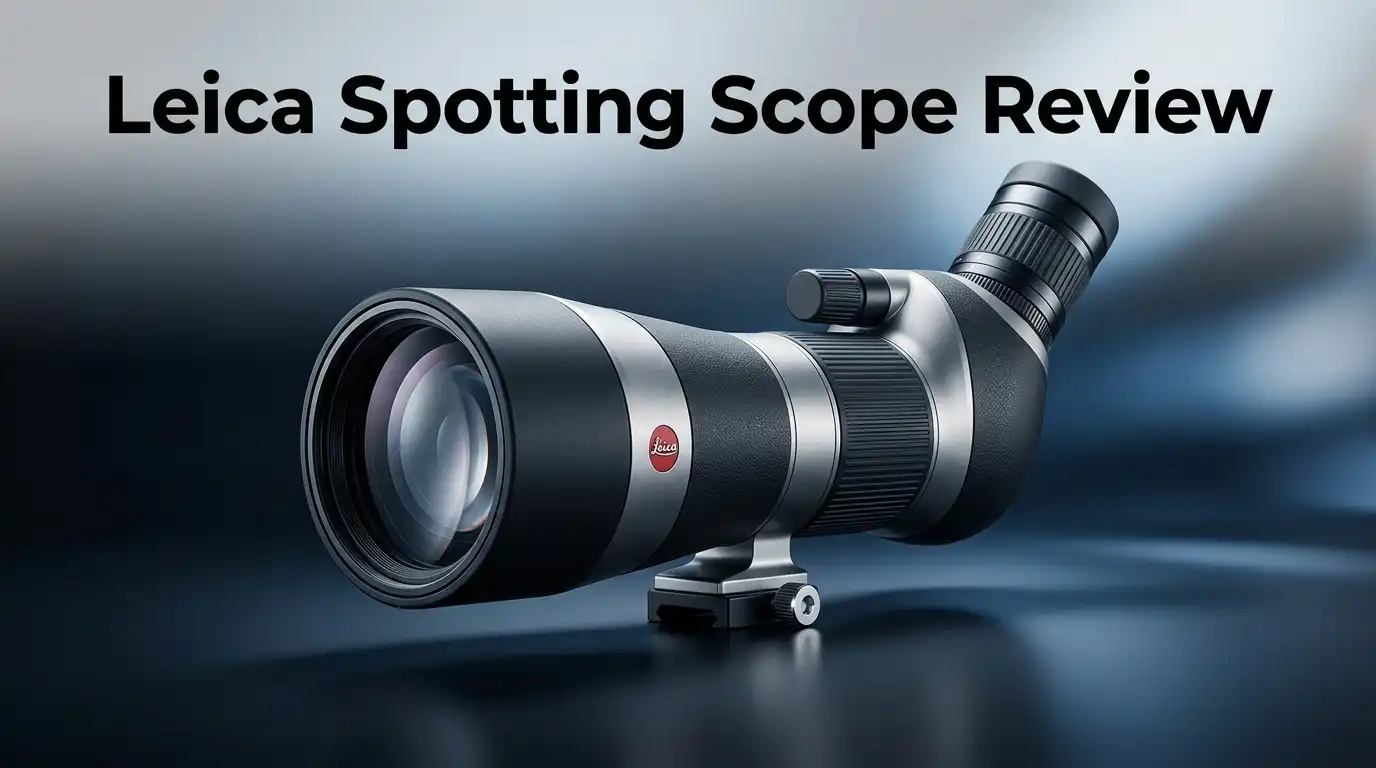
Leica Spotting Scope Review 2026: Worth It?
Leica scopes carry a serious price tag. So the real question is simple. Does the glass justify the cost in 2026?
I spent weeks with the new Leica Televid family, watching shorebirds at dawn, counting rams across a canyon, and squinting at license plates far down a valley road just to test resolution.
Leica rebuilt this line for 2026, and the changes are bigger than a fresh coat of rubber armor. New lens systems, new eyepieces, a new mounting base, and a new lower priced HD model all arrived at once.
In a Nutshell:
- Optical performance sits at the very top tier. The new APO Televid models claim 88 percent light transmission, and the view backs that number up. Colors look neutral, contrast stays high, and color fringing barely registers even on a white egret against dark water.
- Two families now exist. The APO Televid range uses apochromatic and fluoride glass for maximum correction. The newer Televid HD range trades some of that correction for a friendlier price, roughly $2,999 for the 82mm kit versus around $4,199 for the APO kit.
- The dual focus system is the standout handling feature. A large coarse wheel finds focus fast. A smaller front wheel nails the final sharpness. Once you use it, single wheel scopes feel clumsy.
- Build quality is genuinely excellent. Rubber armored magnesium housing, nitrogen filling, waterproofing to 5 meters, and an integrated Arca Swiss compatible base mean fewer accessories to buy.
- The weaknesses are real. Eyepieces cost extra, the 82mm body is heavy for backpack hunting, and the warranty only transfers when you buy from an authorized dealer.
- Value depends entirely on use. Daily birders and digiscopers will love it. Casual weekend users will not see $4,000 worth of difference.
Leica APO Televid 82: The Flagship Reviewed

Last update on 2026-09-20 / Affiliate links / Images from Amazon Product Advertising API Some of the links on this website are affiliate links, which means that at no additional cost to you, I earn a commission if you click through and make a purchase. I only recommend products and services that I believe will add value to my readers. Thank you for your support!
The APO Televid 82 is the scope Leica wants you to judge the brand by. The 82mm objective pulls in serious light, and paired with the wide angle zoom eyepiece it produces one of the cleanest images I have looked through.
Sharpness holds across almost the entire field. At the low end of the zoom, the image is sharp edge to edge. Push to maximum magnification and the outer five percent softens slightly, which is normal and easy to ignore.
Color rendering leans neutral and slightly cool. Warblers look like warblers. Grays stay gray. Birders doing plumage identification will appreciate that honesty more than a warm, flattering tint.
The magnesium body feels dense and solid without feeling like a brick. Focus wheels turn with even resistance and no backlash. The bayonet eyepiece mount clicks in confidently and locks automatically.
Downsides exist. The body flares near the objective, so it does not slide into slim scope cases. And at roughly 1,550 grams with an eyepiece, you feel it on a long hike.
Leica APO Televid 65: The Lighter Alternative

- 25-50x WW ASPH zoom eyepiece offers a wide viewing angle throughout the zoom range for immersive viewing experiences.
- Apochromatic color-corrected optical system with fluoride glass elements for superior contrast and resolution.
Last update on 2026-09-20 / Affiliate links / Images from Amazon Product Advertising API Some of the links on this website are affiliate links, which means that at no additional cost to you, I earn a commission if you click through and make a purchase. I only recommend products and services that I believe will add value to my readers. Thank you for your support!
The 65mm version is the scope I would personally carry. It uses the same glass technology and the same dual focus system in a smaller shell, and the weight drops to around 1,200 grams with the wide angle eyepiece.
That difference matters more than the spec sheet suggests. A lighter scope works on a lighter tripod, and a lighter tripod actually leaves the house. Many birders own a big scope that lives in a closet.
Image quality stays remarkably close to the 82. In good light, I struggled to call a winner between the two at moderate magnification. The gap only opens in dim conditions or at the top of the zoom range, where the bigger objective delivers a brighter, steadier image.
The 65 also focuses closer, which butterfly and dragonfly watchers will love. Travelers gain another advantage, since the shorter barrel fits carry on bags without a fight.
Skip the 65 if you scan long distances at maximum power in poor light. Buy it if you walk more than you drive.
Unboxing a New Leica Televid
The packaging is restrained, which suits the brand. My kit arrived in a firm cardboard box with the Leica script on the lid, no glossy hunting photography, no shouting.
Inside, a molded insert holds the scope body, and the eyepiece sits in its own compartment. Lift the flap and you find the objective cover, the eyepiece caps, a cleaning cloth, the warranty paperwork, and the passport registration card.
The first thing you notice is the smell of new rubber armor and the weight in your palm. It feels engineered rather than assembled. Nothing rattles. Nothing flexes.
Mounting the eyepiece is the satisfying part. You line up the bayonet, twist, and it snaps into place with an audible lock. No threading, no cross threading, no fumbling with cold fingers.
One small gripe about the box contents. A padded field case is sold separately on most kits. For this money, I expected one included.
Top 3 Alternative for Leica APO Televid 82

- Includes Swarovski ATX 25-60x85mm Spotting Scope with 85mm objective lens for superior light transmission (86%) and clarity.
- Elegant wooden tripod with walnut and ash finish, compatible for indoor use and complements any decor.
Last update on 2026-09-20 / Affiliate links / Images from Amazon Product Advertising API Some of the links on this website are affiliate links, which means that at no additional cost to you, I earn a commission if you click through and make a purchase. I only recommend products and services that I believe will add value to my readers. Thank you for your support!
Swarovski ATX Interior 25-60x85mm Spotting Scope

- 88 mm. Angled Spotting Scope Kit
- PROMINAR Pure Fluorite Line of Products
Last update on 2026-09-20 / Affiliate links / Images from Amazon Product Advertising API Some of the links on this website are affiliate links, which means that at no additional cost to you, I earn a commission if you click through and make a purchase. I only recommend products and services that I believe will add value to my readers. Thank you for your support!
Kowa TSN-88A PROMINAR Pure Fluorite Angled Spotting Scope

- The Razor HD 27-60x85 Angled Spotting Scope employs high-end optical technology, precision craftsmanship, and ultra-sleek functionality to make the Razor one of the finest spotting scopes on the market. A built-in sunshade pulls out to reduce glare.
- Triplet Apochromatic lens combined with high density, extra-low dispersion glass delivers unparalled resolution and color fidelity. XR Plus anti-reflective coatings were applied to the lenses to yield maximum brightness for critical low-light glassing.
Last update on 2026-09-13 / Affiliate links / Images from Amazon Product Advertising API Some of the links on this website are affiliate links, which means that at no additional cost to you, I earn a commission if you click through and make a purchase. I only recommend products and services that I believe will add value to my readers. Thank you for your support!
Vortex Razor HD Spotting Scope 27-60×85 Angled
Leica Televid HD 82: The Sensible Money Choice
Leica added the Televid HD line in 2026 for buyers who want the handling and the build without the apochromatic premium. The HD 82 kit with the 20x to 60x zoom eyepiece lands near $2,999, roughly $1,200 below the APO kit.
You still get the High Lux Pro lens system, the dual focus wheels, and the magnesium housing. Leica claims class leading brightness for the HD 82, and in side by side viewing the difference against the APO version is subtle rather than obvious.
Where does the APO pull ahead? Chromatic aberration control at high magnification. Point both scopes at a dark branch against bright sky, zoom past 45x, and the APO shows cleaner edges.
For most birding, hunting, and target spotting, the HD is enough. For digiscoping and hardcore plumage work, the APO earns its extra cost.
My honest advice for many buyers: take the HD body and put the savings into a better tripod head.
The Optics Explained Without Jargon
Leica stacks several technologies here, and the names sound like alphabet soup. Here is what they actually do.
High Lux Pro, or HLP, is the new lens system. It raises light transmission and improves contrast, which is why the APO models reach that 88 percent figure. More light means usable views earlier at dawn and later at dusk.
Apochromatic design plus fluoride glass attacks color fringing. Standard glass bends different colors to slightly different focus points. Fluoride elements pull those colors back together, so high contrast edges look clean instead of purple.
AquaDura coating is the outer layer on the exposed lenses. Water beads and rolls off. Dust and fingerprints wipe away with less pressure, which protects the coating over years of use.
HDC multicoating handles internal reflections and stray light. That is the difference between a hazy image when the sun sits low and a crisp one.
Together these features explain the price. Whether you can see all of them depends on your eyes and your conditions.
Eyepiece Options and Why They Matter
Leica sells the bodies and the eyepieces separately on many configurations, and the eyepiece choice changes the scope more than most buyers expect.
The Vario 20x to 60x zoom gives the widest magnification range. It is the better pick for long distance work, western hunting, and anyone who wants maximum reach from one piece of glass.
The Vario Wide Angle 25x to 50x ASPH is the birder’s eyepiece. It uses aspherical elements and delivers an apparent field of view reaching about 74 degrees, which feels like looking through a window instead of a tube.
I preferred the wide angle version for nearly everything. Finding a moving bird is faster. Scanning a mudflat is less tiring. Losing the top 10x of magnification bothered me far less than I expected.
Both eyepieces are nitrogen filled and waterproof, and both fit the APO and HD bodies. Budget accordingly, because the wide angle unit alone costs as much as a complete midrange scope.
Build Quality and Handling in the Field
Leica develops these scopes in Germany and builds them in its own factory in Portugal. The finish reflects that.
The rubber armor grips well in rain and does not feel sticky in heat. Controls are rubberized, so gloved hands still work the focus wheels. Eyecups twist up and down smoothly and hold their position.
The integrated mounting base is the quiet hero of this redesign. It accepts Arca Swiss clamps and Manfrotto plates directly. No extra plate to lose, no wobble from a stacked adapter, no thread to strip.
Waterproofing runs to 5 meters, which is far beyond anything a birder needs and exactly what you want when you drop a scope into a creek.
One handling criticism stands out. The 82mm body is long and front heavy, so balance on a lightweight travel tripod is poor. Plan on a solid tripod and a fluid head, which adds several hundred dollars to the real cost.
Field Test: Low Light and Long Range
I ran the APO Televid 82 through two situations that separate good scopes from great ones.
Dawn on a marsh, roughly 25 minutes before sunrise. The scope held usable detail on distant ducks while a friend’s midrange 80mm scope had already gone muddy. Bill shape and flank pattern remained readable, which is exactly what identification needs.
Late afternoon heat shimmer across a canyon, about 900 yards. Here no scope wins outright, because the air itself is the limiting factor. The Leica handled it gracefully, showing shimmer as smooth movement rather than a smeared mess.
Resolution testing on a distant sign confirmed the impression. The APO read text cleanly at magnifications where cheaper scopes turned letters into gray blobs.
Honest caveat. The gap between this scope and a good $1,500 scope is smaller in bright midday light than the price difference suggests. You pay for the edges of the day and the edges of the field.
What the Leica Scopes Do Not Do Well
Authentic reviews name the flaws, so here are mine after extended use.
The price is brutal. A complete APO Televid 82 setup with the wide angle eyepiece, a proper tripod, and a case can pass $6,000. That buys a very good used car.
Accessories are expensive and often necessary. Cases, extenders, and digiscoping adapters all cost real money, and several are sold separately from the headline kit.
Weight remains an issue for backcountry hunters. Lighter 80mm class scopes exist, and some hunters will happily trade a small amount of optical quality for a kilogram saved.
Availability and dealer support vary. The 10 year Passport Protection Plan only applies when you buy from an authorized North American dealer. Gray market bargains void that safety net.
Finally, the maximum magnification on the wide angle eyepiece caps at 50x. Long range target shooters who want 60x or more must choose the other eyepiece or another brand.
Digiscoping Performance with Phones and Cameras
Leica clearly built these scopes with digiscoping in mind, and the 2026 accessory range reflects that focus.
The optical qualities that help digiscoping are exactly Leica’s strengths. High contrast, neutral color, and flat field sharpness all translate directly into better photographs. Sensors are far less forgiving of color fringing than human eyes.
The dual focus system helps enormously here. Fine focus by phone screen is frustrating with a single coarse wheel. With the small front wheel, you can creep into perfect focus without shaking the rig.
Leica offers a dedicated digiscoping adapter and a 1.8x extender that nearly doubles the eyepiece magnification range, which opens up tighter framing on distant subjects.
The honest limitation is vibration. Any digiscoping setup amplifies tripod shake, and even this scope cannot fix a flimsy support. Use the carbon tripod with a fluid head, use a timer or remote, and expect a learning curve of several outings.
Leica vs Swarovski vs Kowa in 2026
These three brands sit at the summit, and choosing between them is a matter of preference rather than quality.
Swarovski ATX wins on modularity. One eyepiece module works with 65mm, 85mm, and 95mm objectives, so you can change objective size without buying a whole new scope. Its ergonomics are superb.
Kowa TSN-88 uses pure fluorite crystal and delivers stunning resolution, often at a slightly lower price than the European rivals. Kowa also tends to feel a little lighter in hand.
Leica’s edge is field of view and focusing feel. The wide angle eyepiece gives a notably generous view, and the dual focus wheels are the best focusing arrangement of the three in my opinion.
My blunt summary: you cannot make a bad choice here. Look through all three before spending. Eye comfort is personal, and the scope that suits your eyes beats the one that wins spec comparisons.
Price, Warranty, and Long Term Value
Current pricing puts the APO Televid 82 kit near $4,199, the Televid HD 82 kit near $2,999, and premium eyepieces anywhere from roughly $759 to well over $3,000 depending on the model. Prices shift, so verify before buying.
The warranty package softens the sting. Leica offers a 30 year manufacturer warranty plus a 10 year Passport Protection Plan that covers accidental damage, and that plan transfers to a new owner.
That transferability matters for resale. Leica scopes hold value well on the used market, partly because buyers know the warranty travels with the product.
Think about cost per year rather than cost today. A scope you keep for two decades at $4,000 costs about $200 a year. A $900 scope you replace twice is not the bargain it appears.
Still, that math only works if you actually use the scope regularly. Occasional users should buy less scope and more tripod.
Who Should Buy a Leica Spotting Scope in 2026
Buy the APO Televid 82 if you are a serious birder or digiscoper who spends dawn and dusk behind glass, and if you want the last few percent of optical performance regardless of cost.
Buy the APO Televid 65 if you travel, hike, or hate carrying weight. It is the smarter everyday scope for most people, and the optical compromise is smaller than the size difference suggests.
Buy the Televid HD 82 if you want Leica handling and durability at a more rational price. It is the best value in the lineup.
Skip Leica entirely if you use a scope a few times a year. A Vortex Razor HD or Athlon Cronus delivers 85 percent of the experience for a fraction of the money, and nobody will judge you for it.
Long range target shooters wanting maximum magnification should also compare carefully, since the wide angle eyepiece tops out at 50x.
Final Verdict: Is It Worth It?
Yes, with conditions.
Leica delivered a genuine upgrade in 2026. The new lens systems, the improved eyepieces, the integrated mounting base, and the addition of a lower priced HD tier all make the range stronger than the previous generation.
The optics are exceptional. The build should outlast you. The dual focus system is the best in the business, and the warranty coverage is unusually generous.
But worth is relative to use. If a scope lives on your tripod most weekends, this is money well spent. If it lives in a closet, the value collapses immediately.
My personal pick from the lineup is the APO Televid 65 with the wide angle eyepiece. It balances quality, weight, and usability better than anything else Leica sells.
My value pick is the Televid HD 82. It gives you the Leica experience while leaving budget for the tripod that actually determines how good your views will be.
Frequently Asked Questions
Is the Leica APO Televid better than the Televid HD?
Yes, slightly. The APO version uses apochromatic and fluoride glass for better color correction, which shows at high magnification against bright backgrounds. The HD version keeps the same body, focus system, and coatings, and costs roughly $1,200 less. Most users will be very happy with the HD.
How much does a Leica spotting scope cost in 2026?
Kits generally run from about $2,999 for the Televid HD 82 with eyepiece to around $4,199 for the APO Televid 82 kit. Bodies and eyepieces sold separately vary widely. Always check current dealer pricing, since these figures change.
Should I choose the 65mm or 82mm objective?
Choose 65mm for travel, hiking, and close focus work. Choose 82mm for maximum brightness in low light and better performance at the top of the zoom range. The 65mm suits more people than they expect.
Which eyepiece should I buy?
Birders should take the Vario Wide Angle 25x to 50x ASPH for its very wide field of view. Hunters and long distance spotters should take the Vario 20x to 60x for extra reach.
Are Leica spotting scopes waterproof?
Yes. The housings are nitrogen filled and waterproof to a depth of 5 meters. The eyepieces are also sealed and nitrogen filled to prevent internal fogging.
Can I use a Leica scope for digiscoping?
Absolutely. Leica sells a digiscoping adapter and a 1.8x extender, and the high contrast, color neutral image suits camera sensors well. A stable tripod with a fluid head is essential for good results.
Where are Leica spotting scopes made?
They are developed in Germany and manufactured at Leica’s own factory in Portugal. Both facilities operate under Leica quality control.
Does the warranty transfer if I sell the scope?
The 10 year Passport Protection Plan is fully transferable, but only when the scope was originally purchased from an authorized North American Leica dealer. Gray market purchases do not qualify.

Hello, I’m Amelia White, the founder of birdsfanatic.com. As a lifelong bird enthusiast and spiritual seeker, I’ve always been fascinated by the mystical connections between birds and the human experience. On this site, I share my knowledge and insights into the symbolic meanings and spiritual significance of various bird species, exploring their roles in mythology, folklore, and cultural traditions. Join me on this journey into the world of birds, where we’ll discover the hidden wisdom and guidance that these magnificent creatures have to offer.