Burris Spotting Scope Review 2026: Worth Buying?
Long range glassing punishes cheap glass. You sit behind a scope for three hours, your eye starts to water, the image goes soft at full zoom, and you still cannot tell if that buck carries four points or five.
Burris built the Signature HD line to fix that problem without charging alpha European money. In 2026 this spotter sits in a strange and interesting place. It costs more than budget glass, yet it costs far less than the Swarovski and Zeiss crowd.
So does it earn the money? I spent time behind one at the range and on public land, and this review covers what I saw, what annoyed me, and who should skip it.
In a Nutshell:
- The Burris Signature HD 20x to 60x 85mm is the flagship. It uses apochromatic triplet objective glass and index matched lens coatings. Image quality stays sharp from 20x through roughly 50x, and only softens slightly at the top of the zoom range.
- Build quality feels premium. The body uses die cast magnesium with rubber armor, argon purging, and full waterproof sealing. It weighs about 70 ounces, so this is a truck and treestand scope more than a backpack scope.
- The interchangeable eyepiece system is the standout feature. Few spotters under two thousand dollars let you swap in a fixed 30x reticle eyepiece with SCR Mil or SCR MOA hash marks. Competition shooters love this.
- Eye relief runs about 18mm to 19.7mm. Eyeglass wearers get a usable image, though the sweet spot is tight at maximum power.
- It is not perfect. The weight, the price of extra eyepieces, and the tight exit pupil at 60x are real drawbacks. Budget hunters may prefer the cheaper Burris Landmark or a Vortex Diamondback HD.
- Best for: range shooters, Western hunters who glass from vehicles or spike camps, and birders who want reticle options.
Why Burris Still Matters in 2026

Last update on 2026-09-25 / Affiliate links / Images from Amazon Product Advertising API Some of the links on this website are affiliate links, which means that at no additional cost to you, I earn a commission if you click through and make a purchase. I only recommend products and services that I believe will add value to my readers. Thank you for your support!
Burris has sold optics since 1971 out of Greeley, Colorado. The company spent decades known mostly for riflescopes and the FastFire red dot line. Observation optics took a back seat for years. Loyal customers pushed for a return, and Burris answered with the Signature HD spotting scope.
What makes the brand interesting today is positioning. Burris sells at prices that undercut Leica, Swarovski, and Zeiss, while offering features those brands reserve for higher tiers.
The Forever Warranty covers the product for life with no receipt required and no registration needed. That warranty alone removes a lot of buying anxiety. You are not gambling on a no name import that vanishes in two years. You are buying from a company with a real service department in Colorado.
Burris Signature HD Spotting Scope 20x to 60x 85mm
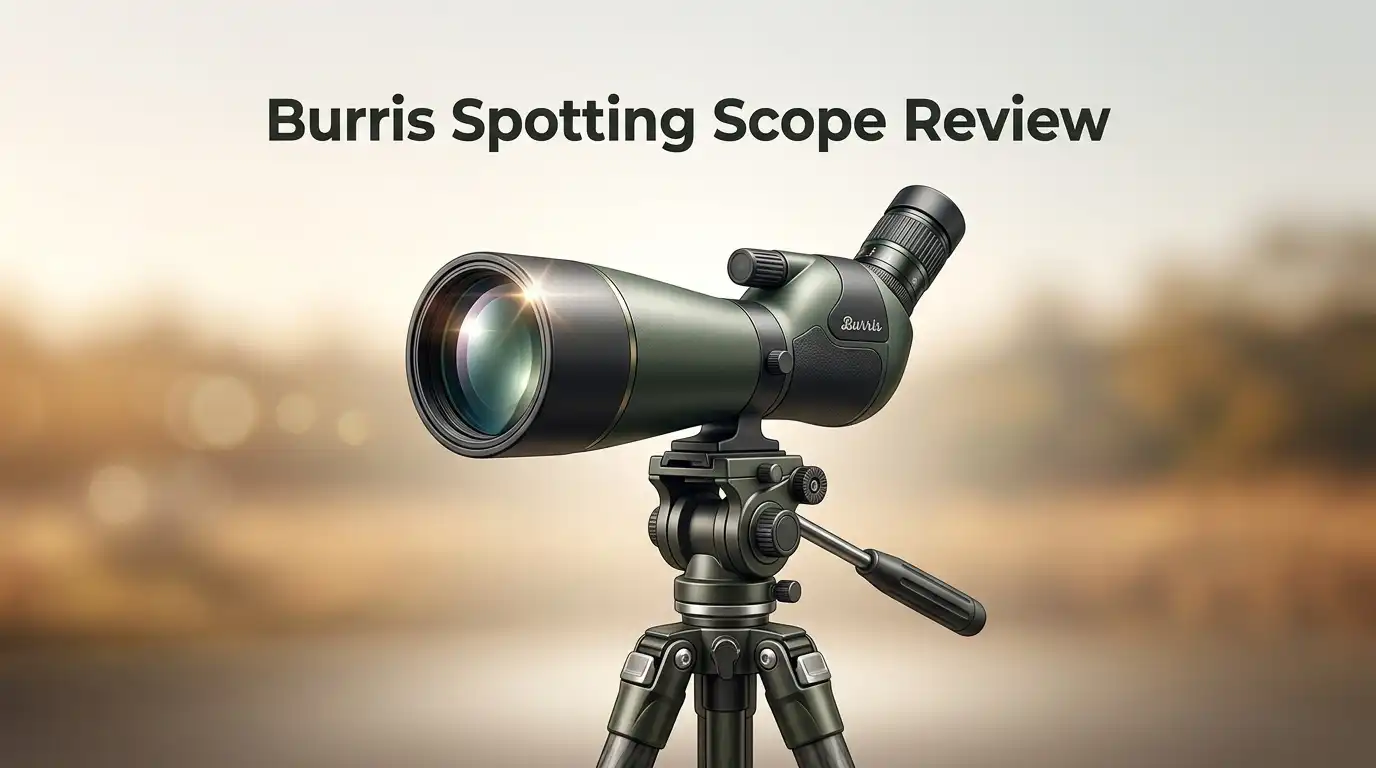
This is the model most buyers mean when they search for a Burris spotter. The 85mm objective pulls in serious light. Magnification runs from 20x to 60x through a variable eyepiece that comes in the box. Field of view measures roughly 110 feet at 20x and 55 feet at 60x, measured at 1000 yards. Length sits at 16.25 inches with the sunshade retracted.
The angled body is the common configuration, and it works well for shared glassing and for tripod use at low height. A straight body version exists and suits people who glass from prone or from a vehicle window.
The tripod foot rotates through a collar, so you can flip the eyepiece to any comfortable angle without moving the legs. Burris finishes the scope in either black with green accents or a sand color. Both finishes resist scuffing better than painted aluminum bodies.
The Unboxing Experience
The box arrives heavier than you expect. Inside, the scope sits in molded foam with the objective cover already fitted. Burris includes a neoprene stay on case, an eyepiece cap, an objective cap, a lens cloth, and a manual. Some retail bundles add a small tripod and a phone adapter, though the included tripod is a travel grade unit rather than a serious platform.
First impressions run strongly positive. The rubber armor has a textured grip that feels tacky rather than slick, which helps in rain. The focus wheel turns smoothly with no gritty spots.
The zoom collar has firm resistance, enough that it will not drift on its own. The neoprene case deserves a mention because it stays on the scope during use, with flaps that fold back off the lenses. You can glass all day without ever removing it, and that saves the finish on rock and truck beds.
Top 3 Alternative for Burris Signature HD Spotting Scope

- The redesigned Diamondback HD spotting scope has all the optical horsepower the western hunter needs, and excels in low light. It features a streamlined exterior for a sleeker profile and a built-in helical focus wheel for fast and fine adjustments.
- HD optical system delivers exceptional resolution, cuts chromatic aberration and provides outstanding color fidelity, edge-to-edge sharpness and light transmission. Multiple anti-reflective coatings on all air-to-glass surfaces increase light transmission
Last update on 2026-09-17 / Affiliate links / Images from Amazon Product Advertising API Some of the links on this website are affiliate links, which means that at no additional cost to you, I earn a commission if you click through and make a purchase. I only recommend products and services that I believe will add value to my readers. Thank you for your support!
Vortex Diamondback HD Spotting Scope 20x to 60x 85mm Angled

- Advanced Fully Multi-Coated lenses bring you better light transmission to bring optimum brightness and true color across the entire light spectrum.
- Phase Coated Porro prisms reflect great mount of lights to your eyes which will give you bright image.
Last update on 2026-09-13 / Affiliate links / Images from Amazon Product Advertising API Some of the links on this website are affiliate links, which means that at no additional cost to you, I earn a commission if you click through and make a purchase. I only recommend products and services that I believe will add value to my readers. Thank you for your support!
Athlon Optics Argos HD 20x to 60x 85mm Spotting Scope

- QUALITY ED OBJECTIVE LENS: Extra-low dispersion optical glass with special dispersion properties to dramatically reduce chromatic aberration, rendering razor-sharp images with superb color correction. Enjoy true-to-life color with enhanced resolution and contrast.
- XLT LENS COATINGS: Fully multi-coated with Celestron’s proprietary XLT optical coatings – the same coatings used on observatory-class telescopes. This coating maximizes light transmission through the optical path for brighter images. A great addition to your field gear!

Last update on 2026-09-17 / Affiliate links / Images from Amazon Product Advertising API Some of the links on this website are affiliate links, which means that at no additional cost to you, I earn a commission if you click through and make a purchase. I only recommend products and services that I believe will add value to my readers. Thank you for your support!
Celestron Regal M2 80ED Spotting Scope
Optical Performance in the Field
Glass quality decides everything in a spotter. The Signature HD uses an apochromatic triplet objective, which means three lens elements work together to bring red, green, and blue light to the same focal point. The practical result is very low color fringing. On a dark branch against bright sky, the classic purple halo stays faint even at high power.
Resolution impressed me most between 20x and 45x. At those settings I could count rings on a paper target at 300 yards and read bullet holes in .22 caliber at 200 yards under good light.
Push to 60x and the image dims and softens, which happens with nearly every 85mm spotter because the exit pupil shrinks to about 1.4mm. Low light performance at dawn stays strong through about 40x. Compared to a budget 80mm scope, the Burris holds usable detail ten to fifteen minutes longer at last light.
Build Quality and Weather Protection
The chassis uses die cast magnesium rather than polymer or plain aluminum. Magnesium gives strength at lower weight, and the rubber armor over it absorbs knocks. Burris seals the scope with O rings and purges it with argon gas. Argon molecules are larger than nitrogen, so the purge holds longer over years of temperature cycling.
I left the scope out in steady rain for an hour with the case on. No fogging appeared inside, and water beaded off the exterior coatings. The built in retractable sunshade earns its keep here. It blocks glare and keeps drizzle off the objective lens, which means less wiping and fewer smears.
Storage temperature range runs from about 5 degrees below zero Fahrenheit to 150 degrees. That covers almost any hunting condition in North America. The tripod mount uses a standard 1/4 inch by 20 thread with a rotating collar.
Focus System and Ergonomics
Burris uses a centrally located focus ring rather than a knob near the eyepiece. The ring circles the body about midway down, and it offers both coarse and fine adjustment through the same control. Some shooters love a dual knob setup with separate fine focus. This design trades that for simplicity.
In practice the placement works well. Your left hand rests naturally on the ring when the scope sits on a tripod. Focus travel is short enough to jump from 60 yards to infinity in less than a full turn.
Fine tuning takes a small nudge, and the ring holds position once set. The eyecup twists up and down with click stops. Glasses wearers should twist it fully down and expect a slightly tight eye box at maximum zoom. The zoom collar sits at the rear and turns with light pressure, marked clearly at 20x, 30x, 40x, 50x, and 60x.
The Interchangeable Eyepiece System
This feature separates Burris from nearly every competitor at this price. Most spotting scopes under two thousand dollars use a permanently attached eyepiece. Burris lets you unscrew the 20x to 60x zoom and install a fixed 30x eyepiece instead.
Two reticle versions exist. The SCR Mil eyepiece carries half mil holdover lines, two tenths mil and one mil windage marks, and one tenth mil ranging brackets. The SCR MOA version uses one MOA holdover lines and quarter MOA ranging brackets.
Both reticles sit in the first focal plane, so subtensions stay true. For a spotter calling wind and impacts for a shooter, this is a genuine advantage. A plain 30x eyepiece without a reticle is also sold separately. Keep in mind that each extra eyepiece costs real money, often three hundred dollars or more.
Digiscoping and Phone Use
Phone photography through a spotter has become a standard use case. Hunters send photos of animals to friends. Birders log sightings. Competitive shooters record target faces.
The Burris pairs reasonably well with phone adapters because the eyecup diameter is standard and the eye relief is generous enough to seat a lens flat. Many retail bundles include a basic clamp adapter. Image quality through the phone looks best between 20x and 35x.
Above 40x, any vibration in the tripod shows up as a shaking video. Use a heavy tripod and a remote shutter for best results. One small complaint: the twist up eyecup can loosen under the pressure of a tight adapter clamp, which shifts your phone alignment. Mark your eyecup position with a piece of tape and the problem mostly disappears.
The Burris Landmark: The Budget Option
Not everyone needs an 85mm apochromatic spotter. Burris also sells the Landmark series, typically a 20x to 60x 80mm scope at a fraction of the Signature HD price. The Landmark uses fully multicoated glass and BaK4 prisms, with a rubber armored body and waterproof construction.
Honest assessment: the Landmark delivers real value near the three hundred dollar mark. Users consistently report clear images at 300 yards, enough to see .223 groups on paper. The weaknesses are equally consistent.
Eye relief is short, which frustrates eyeglass wearers, and image quality drops noticeably past 40x. Color fringing appears on high contrast edges. Low light performance falls well behind the Signature HD. Buy the Landmark for occasional range trips and casual wildlife watching. Buy the Signature HD if you glass seriously and often.
What the Burris Does Not Do Well
Every honest review lists the failures. Here are the real ones.
Weight is the biggest issue. At roughly 70 ounces, or 4.4 pounds, this scope punishes backpack hunters. Add a tripod and head and you carry close to eight pounds of glassing kit. Lighter 65mm spotters exist for that job.
The top end of the zoom disappoints slightly. Detail at 60x does not match what the price suggests, and heat shimmer makes that setting unusable on warm afternoons anyway. Treat 60x as an occasional tool, not a working magnification.
Accessory pricing stings. The reticle eyepieces cost enough to push your total investment well past the base price. The included travel tripod in some bundles is not strong enough for the scope. Finally, availability has been uneven, with certain colors and configurations going out of stock for months.
Pros and Cons
Pros
- Apochromatic triplet glass controls color fringing better than most scopes near this price
- Interchangeable eyepieces, including first focal plane SCR Mil and SCR MOA reticle options
- Die cast magnesium body with rubber armor, argon purged and fully waterproof
- Retractable sunshade reduces glare and protects the objective in rain
- FastFire mounting points on both sides help you aim the scope quickly
- Burris Forever Warranty with no receipt and no registration required
- Neoprene stay on case protects the scope during active use
- Strong low light performance from the 85mm objective
Cons
- Heavy at about 70 ounces, which limits backcountry packing
- Image softens and dims noticeably at 60x
- Eye relief feels tight at maximum magnification for eyeglass wearers
- Reticle eyepieces cost extra and add substantially to total price
- Single focus ring rather than separate coarse and fine knobs
- Bundled tripods in some packages are too light for the scope
- Stock availability has been inconsistent through 2025 and 2026
Tripod Pairing and Field Setup
A great spotter on a weak tripod gives you a bad experience. This scope needs support rated for at least ten pounds. Aluminum tripods with a fluid head work well and cost less. Carbon fiber saves about a pound and dampens vibration faster.
Set the eyepiece at seated eye height when glassing from a hillside. The rotating collar lets you tilt the eyepiece sideways so two people can share the scope without touching the legs. Start every session at 20x. Find your subject in the wide field, center it, then zoom in.
Beginners waste time by starting at high power and hunting blindly. Refocus every time you change magnification, because the scope is not fully parfocal. In wind, hang your pack from the tripod center column to add stability.
Price and Value in 2026

- Product 1: Built-in sun shade reduces glare and protects the objective lens from rain and snow
- Product 1: Both coarse and fine focusing adjustment are possible with the forward mounted focus knob
Last update on 2026-09-25 / Affiliate links / Images from Amazon Product Advertising API Some of the links on this website are affiliate links, which means that at no additional cost to you, I earn a commission if you click through and make a purchase. I only recommend products and services that I believe will add value to my readers. Thank you for your support!
List pricing on the Signature HD 85mm sits above two thousand dollars, though street prices have regularly landed between fourteen hundred and eighteen hundred dollars. At that range the competition includes the Vortex Viper HD, the Leupold SX4 Pro Guide, and the Maven S series.
Value depends on what you need. If you want the absolute lightest scope, look elsewhere. If you want an interchangeable reticle eyepiece under two thousand dollars, the Burris has almost no direct competitor.
If you glass mostly at 20x to 40x from a stable position, the optical quality here competes with scopes costing several hundred dollars more. The Forever Warranty adds real long term value because repair costs stay at zero for the life of the product. Prices shift often, so check current listings before you decide.
Who Should Buy It and Who Should Skip It
Buy the Signature HD if you shoot precision rifle at distance and want a spotter that reads impacts and calls wind with a reticle. Buy it if you hunt the West from glassing points you reach by truck, horse, or short hike. Buy it if you want one scope that handles hunting, target work, birding, and casual moon viewing.
Skip it if you backpack deep and count every ounce. A 65mm spotter at half the weight serves you better. Skip it if your budget stops near five hundred dollars, because the Landmark or a Vortex Diamondback HD makes more sense there.
Skip it also if you need the sharpest possible image at maximum magnification, since alpha European glass still wins that contest by a clear margin at three times the cost.
Final Verdict
The Burris Signature HD spotting scope earns a strong recommendation with honest limits. Optical quality is excellent through the practical magnification range. Construction feels built to last decades. The interchangeable eyepiece system gives it a feature set that competitors at this price simply do not offer. The Forever Warranty removes long term risk.
The weight is real. The softness at 60x is real. The accessory costs are real. None of those flaws break the scope, but they should shape your expectations before you buy.
This is a serious optic for people who spend real hours behind glass. If that describes you, and if you can live with carrying four and a half pounds, the Burris delivers a great deal of performance for the money in 2026.
Frequently Asked Questions
Is the Burris Signature HD good for birding?
Yes. The 85mm objective and apochromatic glass give bright, color accurate images that birders appreciate. Field of view at 20x is adequate for tracking movement. The weight makes it better for hides, decks, and short walks than for long trail days.
Can you use the Burris spotting scope for astronomy?
Casual astronomy works well. The moon shows crisp crater detail at 40x. Jupiter’s moons and Saturn’s rings appear as small but visible shapes. A dedicated telescope still performs far better for deep sky objects.
What tripod does the Burris Signature HD need?
Choose a tripod rated for at least ten pounds with a fluid pan head. Aluminum works fine. Carbon fiber reduces weight and vibration. The scope uses a standard 1/4 inch by 20 mounting thread.
How much does the Burris Signature HD weigh?
About 70.4 ounces, which equals roughly 4.4 pounds. Length measures 16.25 inches at zero diopter with the sunshade retracted.
Does Burris make a straight body spotting scope?
Yes. Burris offers both angled and straight configurations in the Signature HD line. Straight bodies suit prone shooting and vehicle window mounts. Angled bodies suit tripod glassing and sharing.
Is the Burris warranty really lifetime?
Burris offers the Forever Warranty on its optics. It requires no receipt and no registration, and it transfers to future owners. Check the current terms on the Burris website since policies can change.
Is the Burris better than a Vortex Diamondback HD?
The Burris offers better glass, stronger construction, and the interchangeable eyepiece system. The Vortex Diamondback HD costs far less and weighs less. Choose based on budget and how often you glass.

Hello, I’m Amelia White, the founder of birdsfanatic.com. As a lifelong bird enthusiast and spiritual seeker, I’ve always been fascinated by the mystical connections between birds and the human experience. On this site, I share my knowledge and insights into the symbolic meanings and spiritual significance of various bird species, exploring their roles in mythology, folklore, and cultural traditions. Join me on this journey into the world of birds, where we’ll discover the hidden wisdom and guidance that these magnificent creatures have to offer.