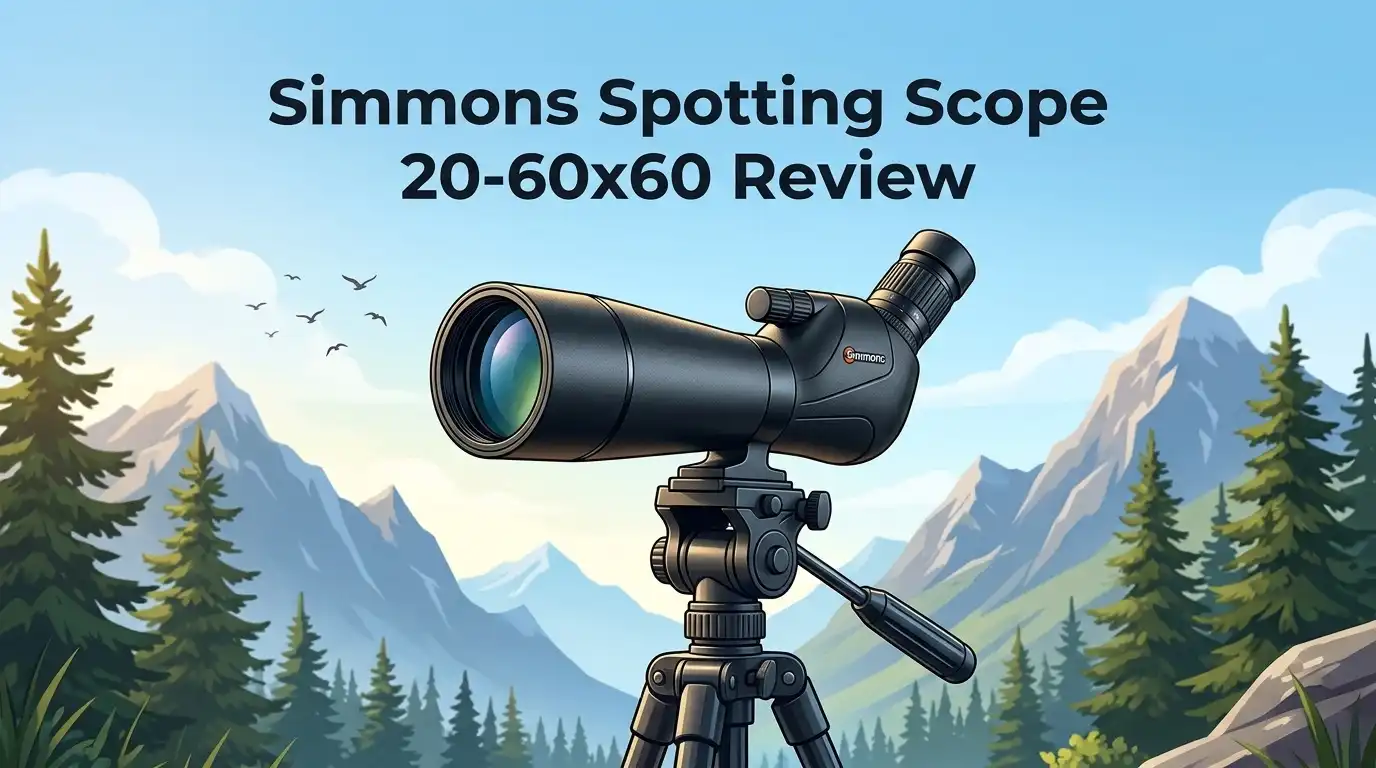
Simmons Spotting Scope 20-60×60 Review 2026: Worth Buying?
Most shooters hit the same wall. You punch a group at 200 yards, then walk downrange three times to check it. Binoculars do not cut it. A premium spotting scope costs more than the rifle. So you start looking at budget glass, and the Simmons 20-60×60 keeps showing up in every search.
This scope has sat on discount shelves and online carts for years. It promises 60x magnification, a 60mm objective, fully multicoated optics, waterproof housing, and a tripod, all for the price of a decent range bag. That sounds too generous. It partly is.
I spent time with this scope at the range, in the backyard, and on a cold morning field walk. This review covers what arrived in the box, what the glass actually shows at distance, and the honest points where it disappoints. No marketing copy. Just what you see through the eyepiece.
Key Takeaways:
- The price is the main selling point. This scope usually sits near or under the fifty dollar mark, which puts it far below almost every other spotting scope with a 60mm objective and a zoom eyepiece.
- Usable magnification stops well before 60x. The image stays sharp and bright through roughly 20x to 30x. Push past that and the view dims, softens, and loses contrast quickly. Treat the 60x number as marketing, not a working setting.
- It works for 100 to 200 yard target shooting. You can see .22 and .223 holes on white paper at 100 yards in good light. Past 250 yards on a grey day, holes start to vanish.
- The included tripod is the weakest part. It is a small tabletop unit with thin legs and a loose head. Any wind or bench bump shakes the image. Budget for a better tripod immediately.
- Build quality beats expectations for the price. Rubber armor, waterproof sealing, and a twist eyecup feel more solid than the cost suggests.
- Serious birders and long range shooters should skip it. Color fidelity, edge sharpness, and low light performance fall short of what those users need.
What Is the Simmons Spotting Scope 20-60×60?

Last update on 2026-09-20 / Affiliate links / Images from Amazon Product Advertising API Some of the links on this website are affiliate links, which means that at no additional cost to you, I earn a commission if you click through and make a purchase. I only recommend products and services that I believe will add value to my readers. Thank you for your support!
The Simmons 20-60×60 is an entry level spotting scope built around a 60mm objective lens and a variable eyepiece that zooms from 20x to 60x. Simmons sells it under names like Venture and ProSport, with model codes such as SP206060B. The optical layout stays the same across those labels.
Inside, the scope uses a porro prism system with BK7 glass. Simmons lists the optics as fully multicoated, which means every air to glass surface receives a coating layer. That coating helps brightness and cuts glare. BK7 glass, however, sits a tier below the BAK4 glass found in mid range scopes.
The body wears rubber armor and carries waterproof and fogproof sealing. Simmons aims this product squarely at casual users. Think weekend range trips, backyard wildlife, deer camp glassing, and the occasional look at the moon.
It is not a professional instrument. It is a starter tool that lets you stop walking downrange after every string of shots.
Unboxing Experience: What Actually Arrives
The box is plain cardboard with a product photo on the front. Nothing premium. You open it and find the scope wrapped in a soft foam sleeve inside a black hard case.
The hard case surprised me. It uses a zipper closure with molded foam that holds the scope body firmly. A separate soft case with a shoulder strap also ships in the box, along with a small tabletop tripod, lens caps, and a folded instruction sheet.
First impressions of the scope body are positive. The rubber armor has real texture and grip. The scope weighs a little over a pound and a half, so it feels light but not hollow. The zoom collar turns with moderate resistance.
The tripod tells a different story. It arrives folded, weighs almost nothing, and the legs flex under light finger pressure. Setup takes about a minute. Mounting the scope is one thumb screw.
Total unboxing time runs under five minutes. No tools needed.
Key Specifications Explained in Plain English
Specifications only matter if you know what they change in the field. Here is the translation.
The 60mm objective lens is the front glass that gathers light. Larger objectives collect more light and produce brighter images. 60mm is modest. Serious scopes run 80mm or larger.
The 20x to 60x zoom sets how much closer the target appears. At 20x, a target 200 yards away looks like it sits 10 yards away. More power always means less brightness and a narrower view.
The field of view narrows sharply as you zoom. At 20x you can scan a wide section of a target board. At 60x you see a small circle and lose your place easily.
Eye relief measures how far your eye sits from the eyepiece. This scope offers short eye relief, which matters if you wear glasses.
Nitrogen purging prevents internal fogging during temperature swings. The scope holds up in rain and humidity.
Build Quality and Weather Sealing
The chassis feels better than the price tag suggests. Simmons wraps the metal barrel in thick rubber armor that absorbs knocks and adds grip in wet weather. I dropped the scope from bench height onto grass with no damage or loss of alignment.
The twist up eyecup rotates smoothly and holds its position. Lens caps fit snugly, although the objective cap can pop loose inside a pack. The rear eyepiece cap is the piece most owners lose first.
Waterproofing works as advertised. I ran the scope under a garden tap for thirty seconds and saw no internal moisture. Nitrogen filling kept the interior clear when I moved it from a warm car into freezing morning air.
The zoom collar is the one weak mechanical point. On some units it feels gritty, and turning it can nudge the scope on a light tripod. The focus knob, by contrast, moves smoothly with just enough tension.
For a scope in this bracket, the physical build earns genuine respect.
Top 3 Alternative for Simmons Spotting Scope 20-60×60

- 20-60x60 HD Optics: Designed for target shooting and outdoor observation with high-definition optical performance
- Ultra-Light Spotting Scope Kit for Effortless Travel: Weighing just 1.31lbs, this spotting scope with tripod comes with a soft shoulder-strap carrying case, easy to sling over your shoulder or compact storage in a backpack without taking space.
Last update on 2026-09-17 / Affiliate links / Images from Amazon Product Advertising API Some of the links on this website are affiliate links, which means that at no additional cost to you, I earn a commission if you click through and make a purchase. I only recommend products and services that I believe will add value to my readers. Thank you for your support!
Emarth 20-60x60AE Angled Spotting Scope

- Gosky Updated Newest 20-60x80 Spotting Scope - Variable 20x to 60x magnification and dynamic lens focusing system brings better optics, more stable images and easier focusing power. It’s the best choice for target shooting, archery, hunting, bird watching, wildlife watching, hiking, camping, scenery, outdoor sporting, astronomical observation etc
Last update on 2026-09-13 / Affiliate links / Images from Amazon Product Advertising API Some of the links on this website are affiliate links, which means that at no additional cost to you, I earn a commission if you click through and make a purchase. I only recommend products and services that I believe will add value to my readers. Thank you for your support!
Gosky Updated 20-60×80 Spotting Scope with Tripod and Phone Adapter

- ULTIMA ANGLED ZOOM SPOTTING SCOPE: This versatile all-around spotting scope with a 65mm objective lens, 18-55x zoom, and a 45° viewing angle is the ideal choice for any outdoor enthusiast. It's perfect for observing nature and long-distance viewing.
- INCLUDES ESSENTIALS FOR BETTER VIEWING: The Celestron Ultima 65 comes complete with a soft carrying case, an extended tripod mounting plate, a zoom eyepiece with an integrated T-adapter for digiscoping, an eyepiece pouch, a lens cloth, and more.

Last update on 2026-09-17 / Affiliate links / Images from Amazon Product Advertising API Some of the links on this website are affiliate links, which means that at no additional cost to you, I earn a commission if you click through and make a purchase. I only recommend products and services that I believe will add value to my readers. Thank you for your support!
Celestron Ultima 18-55×65 Angled Spotting Scope
Optical Performance in Bright Daylight
Good light is where this scope earns its keep. On a clear afternoon at 100 yards, the view at 20x is bright, flat, and genuinely sharp in the center. Black bullet holes on a white target stand out clearly. You can call .22 shots without guessing.
Push to 25x and 30x and the image holds. Contrast drops slightly. Sharpness stays acceptable across the middle two thirds of the view. This is the sweet spot of the scope.
Edge softness appears at every power setting. The outer ring of the image blurs, which is normal for budget porro prism designs. You learn to center your target and ignore the edges.
Color reproduction leans slightly cool and washed. Greens look flatter than reality. A faint purple fringe shows up on high contrast edges, such as a dark branch against bright sky. That is chromatic aberration, and it is expected at this price.
Low Light Performance at Dawn and Dusk
This is where budget glass shows its limits. A 60mm objective simply cannot gather much light, and the coatings can only do so much with BK7 prisms.
At 20x during the golden hour, the image stays workable. You can identify deer shapes and movement at 200 yards. Detail fades, but you still see enough to make a judgment call.
Twenty minutes after sunset, the scope goes dark. The exit pupil at higher magnification shrinks to a pinhole, and your eye receives almost no light. At 60x in dim conditions, the view turns into a grey blur with no usable detail.
If your hunting or wildlife watching happens mainly in low light, this scope will frustrate you. An 80mm scope costs more but delivers a visibly brighter picture during those crucial first and last minutes of legal light.
Plan your expectations around bright and moderate light only.
Zoom Range Honesty: Where the Image Falls Apart
Every budget spotting scope advertises a big number. Very few deliver it. This one is no exception.
Between 20x and 30x, the Simmons behaves well. The image stays bright enough, sharp enough, and steady enough to be useful. Most of my shooting sessions lived at 25x.
Between 30x and 45x, quality declines steadily. Brightness drops, contrast softens, and heat shimmer from the ground becomes very obvious. Focus gets fussy and needs constant adjustment.
Past 45x, the view becomes mostly decorative. At full 60x the image is dim, soft, and shaky. Any breeze on the tripod turns the picture into jelly. You will rarely use the top third of the zoom range, and that is fine.
Here is the practical takeaway. Judge this scope as a solid 20x to 30x instrument with extra numbers printed on the collar. Under that framing, it performs honestly for the money.
The Included Tripod and Carry Cases
Let me be direct. The tabletop tripod included in the box is the single biggest limitation of this package.
It stands roughly a foot tall with thin aluminum legs and a simple pan head. The head has noticeable play. When you touch the focus knob, the image jumps. At 40x or higher, that jump makes precise viewing nearly impossible.
On a solid concrete bench in still air it just about works. On grass, dirt, or a wobbly range table, it does not. Wind makes things worse.
My advice is simple. Spend an extra twenty to forty dollars on a basic full size photo tripod. The improvement in image stability is dramatic and instant. The scope suddenly feels like a different product.
The cases fare better. The hard case protects the scope well during transport. The soft case with shoulder strap works fine for short walks, though the material is thin and offers little impact protection.
Focus Wheel, Eye Relief and Viewing Comfort
The focus knob sits on top of the barrel and turns smoothly through its range. Travel from close focus to infinity takes about two full rotations. That pace suits target shooting well, because small corrections stay easy.
Eye relief is short. Your eye needs to sit close to the eyepiece to see the full field. With the eyecup twisted up, non spectacle users get a comfortable position.
Eyeglass wearers face a real problem. Even with the eyecup twisted down, you lose part of the field and fight with blackout rings at the edge of the image. Contact lens users will have a much better time.
Extended viewing sessions cause eye strain faster than with better glass. After fifteen minutes at high power, I noticed fatigue. Dropping back to 20x relieved it immediately.
The angled eyepiece option helps neck comfort during long bench sessions. Straight eyepiece versions suit prone shooting better.
Range Day Performance for Target Shooters
This is the scope’s core job, so it deserves specifics.
At 100 yards in daylight, you can see .22 caliber holes on a clean white target at 20x to 25x. Holes in black bullseye rings are much harder to spot. Use light colored targets and the scope performs noticeably better.
At 200 yards, .223 and larger holes remain visible in good light. You may need to zoom to 30x and accept a dimmer view. Splatter style reactive targets make this far easier.
At 300 yards, individual bullet holes largely disappear. You can see the target frame and hits on steel, but paper scoring becomes guesswork.
Mirage is a real factor. On hot days, rising heat distorts the image badly at higher power. Dropping back to 20x cuts the shimmer significantly.
For a shooter checking groups at 100 and 200 yards, this scope saves plenty of walking. For precision rifle work at longer distance, it falls short.
Birding, Wildlife and Digiscoping Results
Casual birders will find this scope useful in a backyard or park setting. At 20x, you can identify common species on a feeder or a nearby branch. Shape, size, and basic markings come through clearly.
Serious identification work is harder. Subtle plumage color separates similar species, and the slightly cool, flat color rendition here makes those calls unreliable. Warblers in shaded canopy remain a challenge.
For deer and larger mammals, performance improves. Big animals at 200 to 400 yards read clearly at moderate power in daylight. You can judge body size and general antler shape, though fine tine detail stays fuzzy.
Digiscoping is possible but frustrating. No phone adapter ships in the box, so you must buy one or hold your phone freehand. Combined with the shaky tripod, capturing a sharp image takes patience and a lot of failed attempts.
Treat photography as a bonus, not a feature.
What This Scope Does Not Do Well
Honest reviews list the failures. Here are mine after real use.
The advertised 60x magnification is not usable. Image quality collapses past roughly 30x to 35x. Buyers expecting sharp 60x views will feel misled.
The tripod is inadequate. It undermines the entire package and forces an extra purchase.
Low light performance is poor. The 60mm objective and BK7 prisms cannot deliver a bright dusk image.
Eyeglass wearers will struggle because eye relief is short and blackout at the field edge is common.
Quality control varies between units. Some owners report gritty zoom collars, stiff focus, or slight image misalignment. Others receive perfect samples. That inconsistency is part of buying at this price.
Long range shooting beyond 250 yards is out of reach for paper target scoring.
None of these flaws are hidden secrets. They are the predictable trade offs of a very cheap spotting scope, and you should accept them before buying.
Pros and Cons of the Simmons 20-60×60
Pros
- Excellent price. Few spotting scopes with a 60mm objective and zoom eyepiece cost this little.
- Genuinely bright and sharp between 20x and 30x in good daylight conditions.
- Waterproof and fogproof sealing works. Nitrogen purging prevents internal condensation during temperature changes.
- Rubber armored body feels durable and survives normal range and field handling.
- Complete starter package includes a hard case, a soft case, a tripod, and lens caps.
- Light weight near one and a half pounds makes it easy to carry in a pack.
- Smooth focus knob allows fine adjustments without overshooting.
Cons
- Top half of the zoom range is essentially unusable due to dimness and softness.
- Included tabletop tripod is too flimsy for steady viewing at any real magnification.
- Poor performance in low light at dawn and dusk.
- Short eye relief creates problems for eyeglass wearers.
- Noticeable chromatic aberration and soft image edges.
- Colors appear flat, which limits fine bird identification.
- Inconsistent quality control between individual units.
Who Should Buy It and Who Should Skip It
Last update on 2026-09-20 / Affiliate links / Images from Amazon Product Advertising API Some of the links on this website are affiliate links, which means that at no additional cost to you, I earn a commission if you click through and make a purchase. I only recommend products and services that I believe will add value to my readers. Thank you for your support!
Buy this scope if you shoot at 100 to 200 yards and want to stop walking downrange. It pays for itself in saved time and hot brass avoided. It also suits beginners who want to test whether spotting scopes fit their hobby before spending real money.
Buy it if you need a knockaround scope for a truck, a deer camp, or a range bag where damage or theft would not hurt much. The low price makes it disposable in the best sense.
Skip this scope if you hunt in low light, glass at long range, or identify birds seriously. The optical limits will annoy you within one outing.
Skip it if you wear glasses and cannot switch to contacts. The short eye relief will ruin the experience.
Buyers with a budget near two hundred dollars should stretch for a larger objective and better glass. The jump in image quality is significant and immediately visible.
Final Verdict: Is It Worth It in 2026?
The Simmons 20-60×60 is a scope that makes sense only when you judge it against its price. At roughly fifty dollars, it delivers real value. At double that price, it would deserve criticism.
You get a waterproof, rubber armored scope with usable 20x to 30x performance, a hard case, and a soft case. For a weekend shooter checking groups at 100 yards on a sunny Saturday, that combination does the job.
The advertised 60x figure is fiction, and the tripod belongs in the recycling bin. Accept both facts before you order, add a proper tripod, and your satisfaction will rise sharply.
I would recommend it to beginners, casual shooters, and anyone who wants an inexpensive second scope. I would steer hunters, birders, and precision shooters toward something larger and better.
Rating: 3.5 out of 5 for value. 2.5 out of 5 for pure optical quality. Buy with clear eyes and you will not regret it.
Frequently Asked Questions
Can you see bullet holes at 200 yards with this scope?
Yes, in good light with larger calibers such as .223 and above on light colored targets. You will need roughly 30x magnification and a stable tripod. Smaller .22 holes at 200 yards are difficult to see reliably. At 100 yards, .22 holes show clearly on white paper.
Is the Simmons 20-60×60 waterproof?
Yes. The scope carries waterproof and fogproof sealing with nitrogen purging inside the body. It handles rain, snow, and humid conditions without internal fogging. You should still avoid submerging it, and you should dry the external lenses carefully with a proper lens cloth after wet use.
Does the included tripod work well enough?
No. The tabletop tripod is too light and too flexible for steady viewing above 25x. Vibration from touching the focus knob shakes the image. Replacing it with a basic full size photo tripod costs little and improves the viewing experience more than any other change you can make.
Can you use this scope for stargazing?
Partly. You can see craters on the moon and the four large moons of Jupiter on a clear night. Saturn appears as a small oval shape rather than a clear ringed planet. Deep sky objects remain out of reach. Treat astronomy as an occasional bonus, not a main purpose.
Is there a phone adapter included for photos?
No. The box contains the scope, two cases, lens caps, and a tripod only. You must buy a universal smartphone adapter separately. Even with an adapter, image quality stays limited by the glass and the shaky included tripod, so expect modest results.
How does it compare to an 80mm spotting scope?
An 80mm scope gathers substantially more light, which produces a brighter image at dawn, dusk, and high magnification. Detail and color also improve. The trade offs are more weight, larger size, and a higher price. If low light performance matters to you, the larger objective is worth the extra cost.

Hello, I’m Amelia White, the founder of birdsfanatic.com. As a lifelong bird enthusiast and spiritual seeker, I’ve always been fascinated by the mystical connections between birds and the human experience. On this site, I share my knowledge and insights into the symbolic meanings and spiritual significance of various bird species, exploring their roles in mythology, folklore, and cultural traditions. Join me on this journey into the world of birds, where we’ll discover the hidden wisdom and guidance that these magnificent creatures have to offer.