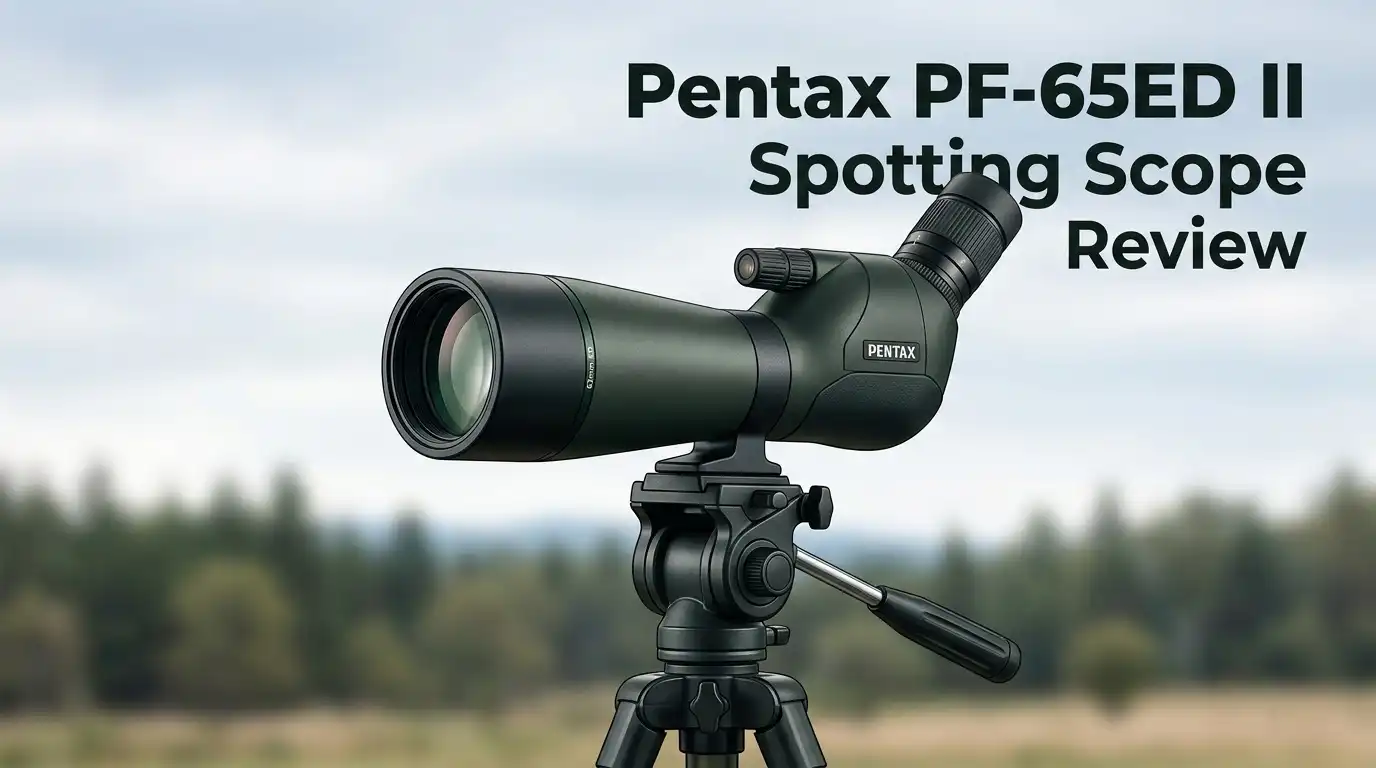
Pentax PF-65ED II Spotting Scope Review 2026: Worth Buying?
The Pentax PF-65ED II has quietly held its place in the spotting scope market for years. It is small, it is sharp, and it carries real ED glass at a price that undercuts most rivals. Birders love it.
Target shooters respect it. Yet plenty of buyers still hesitate, because the scope ships in confusing configurations and the eyepiece is often sold separately.
This review walks through the unboxing, the glass, the handling, and the honest weak spots. By the end you will know whether this compact Japanese scope deserves your money in 2026, or whether a newer midrange option suits you better.
In A Nutshell:
- The optics punch above the price. The 65mm objective uses ED glass elements. Colors stay neutral, white objects look truly white, and chromatic aberration stays low across most of the field. Reviewers have found it brighter at 20x than some 80mm scopes they tested beside it.
- Portability is the headline feature. The body weighs about 37.7 ounces and measures roughly 10.6 inches long. Add the zoom eyepiece and you sit near 45 ounces at 12 inches. It slides into a daypack without a fight.
- Eyepieces use the 1.25 inch astronomy standard. You can fit Pentax XF and XW eyepieces, plus almost any telescope eyepiece in that size. This single design choice gives the scope a long upgrade path.
- The zoom tops out early in practice. Useful sharpness runs from 20x to around 55x. Past that, the image softens and dims. That is normal for a 65mm scope, but worth knowing.
- Buying it is the confusing part. Separate listings exist for the body alone, the body with a case, the straight model, and the angled model. Read the listing twice before checkout.
- It is made in Japan and sealed to JIS Class 6. Nitrogen filling stops internal fogging, and the rubber armor shrugs off knocks.
Pentax PF-65ED II Spotting Scope Overview

- 65mm Objective Lens: The PF-65ED II features a compact yet capable 65mm diameter objective lens.
- ED Glass: This spotting scope incorporates Extra-low Dispersion (ED) glass elements in its optical design.
Last update on 2026-10-05 / Affiliate links / Images from Amazon Product Advertising API Some of the links on this website are affiliate links, which means that at no additional cost to you, I earn a commission if you click through and make a purchase. I only recommend products and services that I believe will add value to my readers. Thank you for your support!
The PF-65ED II is the straight barrel version of Pentax’s compact fieldscope. Pentax redesigned the older 65mm line with better glass and better coatings, then kept the price low. The lens group uses five elements in three groups with a 390mm focal length. The front objective measures 65mm and includes an extra low dispersion element.
The scope uses a porro prism layout rather than a roof prism. That keeps the optical path efficient and the cost down. Focus arrives through a single knob on top of the barrel, reachable with either hand. The lens hood extends forward and carries a raised sight line for quick target acquisition.
What you get is a traditional, no nonsense fieldscope. There is no electronic anything. There is no reticle. There is just good glass in a tough shell.
Unboxing Experience
The box is plain cardboard with modest Pentax branding. Nothing about it feels premium, and that sets an honest tone for the whole product. Inside you find the scope body nested in foam, the cordura carrying case, the objective cap, and the eyepiece cap if your configuration includes an eyepiece.
The first thing most people notice is the weight. It feels denser than it looks. The rubber armor has a slightly grippy texture that warms quickly in the hand. The objective cap uses a double spring design that snaps on firmly and rarely falls off by accident.
The cordura case fits snugly over the body and includes a Velcro flap over the focus knob. That flap opens from either side, which left handed users will appreciate. Padding is thin, so treat the case as dust protection rather than crash protection.
Build Quality And Design
Pentax built this scope in Japan, and the fit quality shows. Seams line up. The rubber armor wraps the prism housing without gaps. The collet style eyepiece receptacle locks an eyepiece with a quarter turn, and the action stays smooth after years of use.
The body carries JIS Class 6 waterproof rating with a dust shielding glass element inside the eyepiece receptacle. That means you can swap eyepieces in light rain without flooding the barrel. Nitrogen filling prevents internal condensation during sudden temperature swings.
The angled model adds a click stop rotating tripod collar. Detents sit at 45 and 90 degrees off vertical, so you can tilt the eyepiece for prone or seated viewing. Rotation stops at 90 degrees in either direction because the prism housing meets the collar. It is a small limit, rarely a problem in practice.
Top 3 Alternative for Pentax PF-65ED II

- QUALITY ED OBJECTIVE LENS: Extra-low dispersion optical glass with special dispersion properties to dramatically reduce chromatic aberration, rendering razor-sharp images with superb color correction. Enjoy true-to-life color with enhanced resolution and contrast.
- XLT LENS COATINGS: Fully multi-coated with Celestron’s proprietary XLT optical coatings – the same coatings used on observatory-class telescopes. This coating maximizes light transmission through the optical path for brighter images. A great addition to your field gear!

Last update on 2026-09-17 / Affiliate links / Images from Amazon Product Advertising API Some of the links on this website are affiliate links, which means that at no additional cost to you, I earn a commission if you click through and make a purchase. I only recommend products and services that I believe will add value to my readers. Thank you for your support!
Celestron Regal M2 65ED Spotting Scope

- The redesigned Diamondback HD spotting scope has all the optical horsepower the western hunter needs, and excels in low light. It features a streamlined exterior for a sleeker profile and a built-in helical focus wheel for fast and fine adjustments.
- HD optical system delivers exceptional resolution, cuts chromatic aberration and provides outstanding color fidelity, edge-to-edge sharpness and light transmission. Multiple anti-reflective coatings on all air-to-glass surfaces increase light transmission
Last update on 2026-06-10 / Affiliate links / Images from Amazon Product Advertising API Some of the links on this website are affiliate links, which means that at no additional cost to you, I earn a commission if you click through and make a purchase. I only recommend products and services that I believe will add value to my readers. Thank you for your support!
Vortex Optics Diamondback HD Spotting Scope

- Nitrogen Purging uses the inertia gas to purge moisture out of the tube giving you better waterproofing and thermal stability
- Fully Multi-Coated lenses gives you great light transmission and bring bright images to your eyes
Last update on 2026-09-17 / Affiliate links / Images from Amazon Product Advertising API Some of the links on this website are affiliate links, which means that at no additional cost to you, I earn a commission if you click through and make a purchase. I only recommend products and services that I believe will add value to my readers. Thank you for your support!
Athlon Optics Talos 20-60×80 Spotting Scope
Pentax PF-65EDA II Angled Version

- Package Dimensions: 29.4 H x 15.7 L x 18.7 W (centimeters)
- Package Weight: 1.61 kilograms
Last update on 2026-10-05 / Affiliate links / Images from Amazon Product Advertising API Some of the links on this website are affiliate links, which means that at no additional cost to you, I earn a commission if you click through and make a purchase. I only recommend products and services that I believe will add value to my readers. Thank you for your support!
The PF-65EDA II shares identical optics with the straight model. The letter A marks the angled barrel, which tilts the eyepiece 45 degrees upward. Birders usually prefer this layout. It lets you look at treetops or soaring raptors without crouching, and it lets two people of different heights share one tripod setting.
Hunters and target shooters often pick the straight model instead, because straight scopes point more intuitively at ground level targets and work better from a prone position. Neither version is optically superior.
The angled model also includes the rotating tripod collar described earlier. Its carrying case fits a little differently and takes slightly more effort to use with the hood deployed. Pick the angle based on how you sit, kneel, or stand while observing. That single habit matters more than any specification on the box.
Optical Performance In The Field
The field of view runs from 117 feet down to 51 feet at 1000 yards across the 20x to 60x range. That upper figure is generously wide for any scope size, and it makes finding small birds far easier than the numbers suggest.
Brightness surprises most first time users. At 20x the view looks punchy and open. Reviewers have compared it directly with 80mm ED scopes and found the little Pentax matching or beating them at low power. Color neutrality is the standout trait. Snow looks white. Gray feathers look gray.
Edge sharpness holds up well across the frame rather than collapsing in the outer third. Contrast dips slightly in flat overcast light, as you would expect from a 65mm aperture. Resolution at 40x on a clear morning is genuinely impressive for the money.
Eyepiece Options And The 1.25 Inch Mount
This is the feature that keeps the PF-65ED II relevant. The eyepiece receptacle uses the 31.7mm, or 1.25 inch, American astronomical standard. Almost any telescope eyepiece in that size will thread into place.
Pentax offers the XF Zoom 6.5mm to 19.5mm for 20x to 60x, the XF8.5 for 46x, and the XF12 for 32.5x. The XF fixed eyepieces deliver 18mm eye relief and a 60 degree apparent field, which eyeglass wearers will notice immediately.
Step up to the XW series and things get better still. The XW10 gives 39x with 20mm eye relief and a 70 degree apparent field. The XW20 gives 19.5x with a 3.3mm exit pupil, which is the brightest configuration available. Buying a quality fixed eyepiece transforms this scope more than any accessory.
Focus System And Close Focus
The PF-65ED II uses a single focus knob about an inch long, positioned on top of the barrel. There is no dual speed mechanism here, and some buyers expect one at this price.
In use, the single knob works well. The action feels comfortably stiff, which stops accidental focus shifts when you brush against it. Precision is excellent, letting you settle onto fine feather detail without hunting back and forth.
The tradeoff is travel. The focus throw is shallow, meaning many turns separate the minimum focus distance from infinity. Tracking a bird that flies from 20 feet to 200 feet takes noticeable cranking.
Close focus sits at roughly 16.4 feet, or about 5 meters. That figure suits butterflies, dragonflies, and feeder watching nicely. Pentax chose reliability over speed, and the choice mostly pays off.
Weather Sealing And Durability
Pentax rates the body to JIS Class 6, which covers heavy rain and spraying water. The scope is not designed for submersion, and Pentax says so plainly. Do not drop it in a creek.
Nitrogen purging keeps the interior dry and stops fogging when you move from a cold car into humid air. The dust shielding element inside the eyepiece mount protects the prisms during eyepiece changes.
Shock resistant rubber armor covers the prism housing and barrel. It absorbs bumps against car doors, fence posts, and rocks. Owners regularly report decade long service with no mechanical faults, which reflects the Japanese assembly.
The extendable lens hood does double duty, shielding the objective from rain and low sun while reducing flare. Keep the hood deployed as your default, because it also holds the case flap out of your view.
Digiscoping With The PF-65ED II
Digiscoping works surprisingly well here. Unscrew the rubber eyecup on the XF zoom eyepiece and you reveal a 43mm filter thread. Cameras with filter threads attach directly, and step rings handle other diameters.
Direct threading keeps the camera lens aligned with the eyepiece axis. That alignment prevents positional vignetting, those dark shadows that creep around the frame when the optical centers drift apart. It is also the only workable method for a DSLR or mirrorless body.
For compact cameras without filter threads, Pentax sells the UA 1 Universal Camera Adapter. It clamps around the eyepiece collet and holds the camera on a swing away platform. The platform lets you check the view by eye between shots.
One flaw stands out. The camera mounting screw slides freely once you remove the camera, so you lose your alignment every battery change.
What The Pentax PF-65ED II Does Not Do Well
Honest criticism matters, so here are the real shortcomings. The zoom eyepiece loses sharpness and brightness above roughly 55x. Treat 60x as a marketing number rather than a working magnification.
The eyepiece situation frustrates buyers. Several listings sell the objective module alone with no eyepiece included, and the low price makes people assume they are getting a bargain. Then the box arrives with no way to look through it.
Eye relief on the XF zoom runs 11mm to 15mm, which is tight for eyeglass wearers. The fixed XF and XW eyepieces fix this, but they cost extra.
The design is also dated. There is no helical focus, no dual focus, and no Arca Swiss foot. Newer rivals offer modern conveniences that Pentax simply never added.
Pros And Cons
Pros
- Excellent ED glass delivers neutral color and high resolution for a 65mm aperture
- Very compact and light at 37.7 ounces for the body, easy to pack and easy to stabilize
- Standard 1.25 inch eyepiece mount accepts Pentax XF, Pentax XW, and third party telescope eyepieces
- Wide field of view, up to 117 feet at 1000 yards, which speeds target finding
- Made in Japan with JIS Class 6 sealing, nitrogen filling, and shock resistant armor
- Strong digiscoping support through the hidden 43mm filter thread
Cons
- Usable zoom range stops near 55x, not the advertised 60x
- Confusing product listings mean the eyepiece may not be included
- Short eye relief on the zoom eyepiece bothers eyeglass wearers
- Single speed focus with a shallow throw requires many turns
- No dual focus and no Arca Swiss mounting foot
- Thin case padding offers little impact protection
Who Should Buy This Spotting Scope
Backpacking birders are the natural audience. The low weight lets you carry a carbon tripod and a scope together without wrecking your shoulders, and the wide field makes handheld scanning practical.
Travelers benefit too. The scope fits into carry on luggage and the sealed body handles humid coastal air and mountain cold without complaint.
Amateur astronomers get unexpected value. Because the mount accepts XW eyepieces and other 1.25 inch optics, the scope doubles as a small refractor for lunar and planetary views.
Target shooters who need to resolve bullet holes at 600 yards or more should think harder. A 65mm aperture limits useful magnification. An 80mm or larger scope serves long range shooters better. Likewise, anyone who wants modern features like fast helical focus should look at current Vortex or Celestron models instead.
Tripod Pairing Tips
A light scope deserves a sensible tripod. Because the whole package sits near 45 ounces with an eyepiece, you do not need a heavy video tripod. A midsize aluminum or carbon tripod carries it comfortably.
Match it with a fluid pan head rather than a ball head. Fluid heads track moving birds smoothly and hold position without creep at high magnification. A small two way head keeps total weight low.
Extend the center column only as a last resort, since the column is the weakest link for vibration. Set eyepiece height by adjusting the legs instead.
Finally, hang your pack from the tripod hook in wind. That extra mass steadies the image more than any expensive upgrade. These small habits give you sharper views than buying a bigger scope would.
How It Compares To 80mm Scopes
An 80mm scope gathers roughly 50 percent more light than a 65mm scope. That advantage shows up at dawn, at dusk, and above 50x magnification. If you watch shorebirds in fading light, the bigger aperture earns its keep.
The PF-65ED II answers with weight and size. An 80mm ED scope typically weighs 60 to 72 ounces and demands a sturdier tripod, which compounds the load. Many owners end up leaving the big scope at home.
Optically, the Pentax holds its own at lower powers. Several reviewers found it brighter at 20x than larger scopes with lesser glass.
The practical answer is simple. Choose 80mm for stationary long range work, and choose this 65mm Pentax for anything involving walking. The scope you actually carry always outperforms the one in your closet.
Final Verdict
The Pentax PF-65ED II remains a smart buy in 2026, with conditions. The glass is genuinely good, the build quality is Japanese, and the 1.25 inch eyepiece mount gives it a flexibility that sealed eyepiece rivals cannot match.
You must accept its age. There is no dual focus, no helical focus, and no modern tripod foot. The zoom eyepiece runs out of usable sharpness before 60x, and eyeglass wearers will want a fixed XF or XW eyepiece.
If you value optical honesty, portability, and long term upgrade options, this scope rewards you for years. If you want convenience features and a bundled tripod, a newer Vortex or Celestron suits you better.
For backpacking birders and traveling naturalists, it still ranks among the best value ED scopes available.
FAQs
Does the Pentax PF-65ED II include an eyepiece?
It depends entirely on the listing. Pentax sells the objective module alone under one model number and bundles it with the 20x to 60x XF zoom eyepiece under another. The low price on body only listings catches many buyers out. Read the title and the specification table carefully before you order.
What is the difference between the PF-65ED II and the PF-65EDA II?
The letter A marks the angled version, which tilts the eyepiece 45 degrees. Optics and dimensions are identical. The angled model adds a click stop rotating tripod collar. Birders usually prefer angled, while shooters usually prefer straight.
Can I use telescope eyepieces on this scope?
Yes. The receptacle uses the 31.7mm, or 1.25 inch, American astronomical standard. Pentax XF and XW eyepieces fit, and so do most third party telescope eyepieces in that size. Field of view and eye relief will vary by eyepiece.
Is the Pentax PF-65ED II waterproof?
It carries JIS Class 6 waterproof construction and a nitrogen filled body. Heavy rain poses no problem. Pentax states clearly that the scope is not designed for submersion, so do not dunk it.
What magnification does it reach in real use?
The zoom eyepiece is marked 20x to 60x. Sharpness and brightness hold well up to roughly 55x, then fall off noticeably. Fixed eyepieces like the XW7 deliver a cleaner 55.5x view if you need that power regularly.
How heavy is the complete setup?
The body weighs 37.7 ounces. With the XF zoom eyepiece attached, the total sits near 45 ounces at about 12 inches long. Add a light tripod and fluid head for a comfortable all day carry.

Hello, I’m Amelia White, the founder of birdsfanatic.com. As a lifelong bird enthusiast and spiritual seeker, I’ve always been fascinated by the mystical connections between birds and the human experience. On this site, I share my knowledge and insights into the symbolic meanings and spiritual significance of various bird species, exploring their roles in mythology, folklore, and cultural traditions. Join me on this journey into the world of birds, where we’ll discover the hidden wisdom and guidance that these magnificent creatures have to offer.