
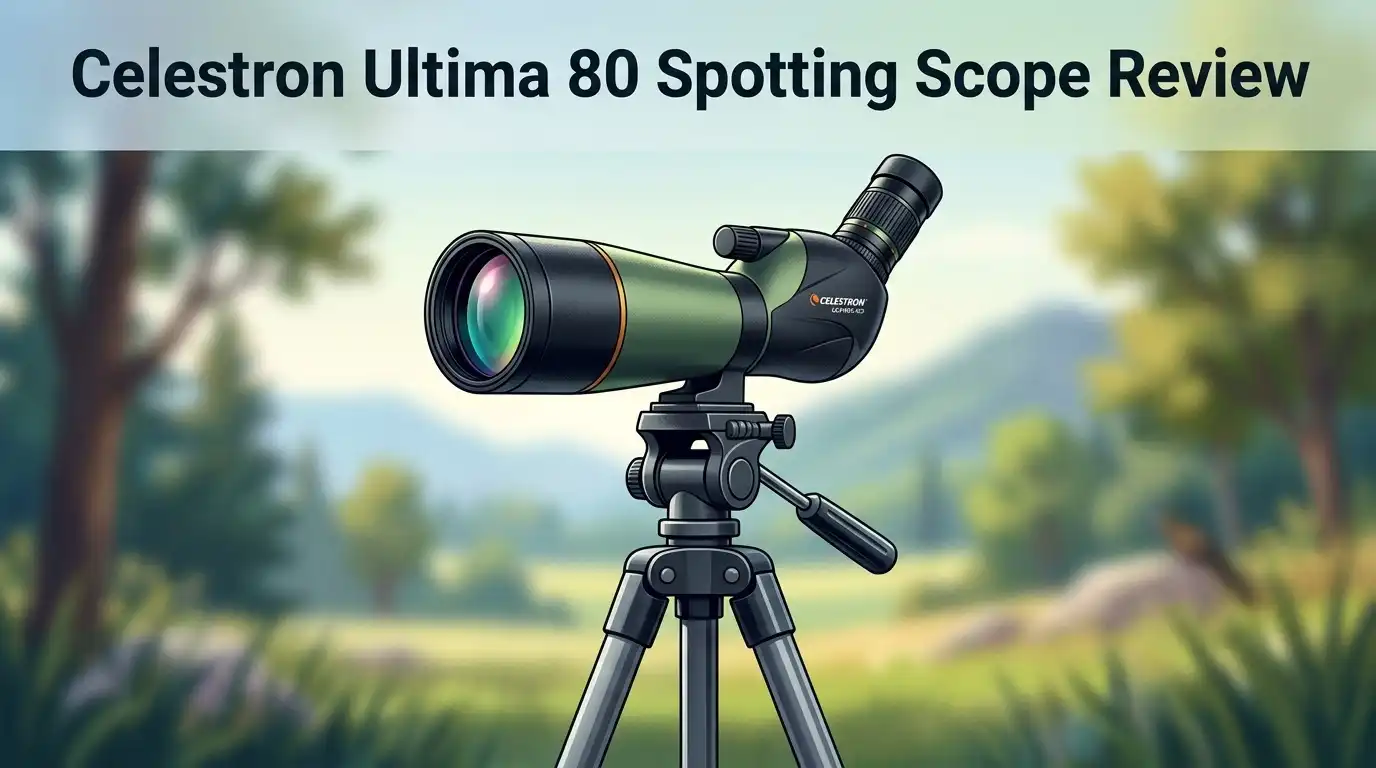
Celestron Ultima 80 Spotting Scope Review 2026: Still Worth It?
Spotting scopes sit in a strange middle ground. They cost more than binoculars but less than a good telescope. You want one that earns its shelf space. The Celestron Ultima 80 has been that scope for a lot of people, and it keeps selling year after year.
This review looks at the Ultima 20x to 60x 80mm spotting scope with fresh eyes in 2026. I cover the optics, the zoom eyepiece, the tripod situation, the digiscoping quirks, and the flaws nobody mentions in the marketing copy. No fluff. Just what happens when you take this scope outside and point it at something far away.
In a Nutshell:
- The 80mm objective is the main selling point. It pulls in roughly 50% more light than a 65mm scope. That extra brightness shows up most at dawn, at dusk, and at high magnification where cheaper scopes go dim and mushy.
- Image quality peaks around 20x to 40x. Below 40x the view looks bright, sharp, and pleasantly neutral in color. Push to 60x and contrast drops while purple fringing appears on bright edges. This is normal for a non ED scope at this price.
- Build quality feels genuinely outdoor ready. The tube is waterproof, nitrogen purged, and wrapped in green rubber armor. It shrugs off rain, fog, and the occasional knock against a truck door.
- It weighs 57 ounces, so about 3.5 pounds. That is fine for a car, a blind, or a back porch. It is heavy for a long hike, and it demands a sturdy tripod rather than the flimsy one often bundled with it.
- Digiscoping works but takes patience. A T thread lives inside the eyepiece housing, and phone adapters mount easily. Results look decent for documentation, not for gallery prints.
- Best value sits in the birding, range, and casual astronomy crowd. Serious hunters who count hair on an animal at 800 yards will eventually want ED glass.
Celestron Ultima 80 Spotting Scope: Quick Overview

- ULTIMA ANGLED ZOOM SPOTTING SCOPE: This versatile all-around spotting scope with an 80mm objective lens, 20-60x zoom, and a 45° viewing angle is the ideal choice for any outdoor enthusiast. It's perfect for observing nature and long-distance viewing.
- INCLUDES ESSENTIALS FOR BETTER VIEWING: The Celestron Ultima 80 comes complete with a soft carrying case, an extended tripod mounting plate, a zoom eyepiece with an integrated T-adapter for digiscoping, an eyepiece pouch, a lens cloth, and more.

Last update on 2026-09-13 / Affiliate links / Images from Amazon Product Advertising API Some of the links on this website are affiliate links, which means that at no additional cost to you, I earn a commission if you click through and make a purchase. I only recommend products and services that I believe will add value to my readers. Thank you for your support!
The Celestron Ultima 80 is an 80mm refractor spotting scope with a 480mm focal length. It ships with a zoom eyepiece that covers 20x to 60x, which comes from an 8mm to 24mm variable design. The angled model uses a 45° eyepiece, and Celestron also sells a straight version for people who prefer looking through it like a rifle scope.
Field of view runs about 105 feet at 1000 yards at the low end and drops to roughly 52 feet at full power. Eye relief measures 18mm, which is generous enough for most eyeglass wearers. Close focus sits near 26 feet, so it is not a butterfly scope.
The whole tube is sealed, nitrogen filled, and rubber armored in dark green. A sliding sunshade with a built in sight tube helps you find your target fast. Celestron includes a soft carrying case. The scope has lived in the catalog for years with a street price hovering near the $250 to $280 range, which tells you the market keeps buying it.
Unboxing the Ultima 80: What Arrives in the Box
The box is plain brown cardboard with a printed label. Nothing fancy. Inside you find the scope nested in molded foam, the soft case folded flat beside it, an eyepiece cap, an objective cap, and a short manual.
Lifting the scope out is the first real moment. It feels denser than the photos suggest. The rubber armor has a slightly tacky texture that grips well in cold hands. Metal focus knob, metal tripod collar, plastic sunshade ring. The zoom collar turns with a firm click of resistance right out of the box.
The soft case deserves a mention because it surprises people. It is a stay on style case with zippered flaps, not a padded hard box. You can leave the scope inside and still use it. Some owners love this. Others find the flaps flop around in wind.
If you buy a bundle version, a small aluminum tripod and a phone adapter show up too. The tripod is the weak link, and I will come back to that. First light takes about two minutes from opening the box.
Top 3 Alternative for Celestron Ultima 80

- Nitrogen Purging uses the inertia gas to purge moisture out of the tube giving you better waterproofing and thermal stability
- Fully Multi-Coated lenses gives you great light transmission and bring bright images to your eyes
Last update on 2026-09-17 / Affiliate links / Images from Amazon Product Advertising API Some of the links on this website are affiliate links, which means that at no additional cost to you, I earn a commission if you click through and make a purchase. I only recommend products and services that I believe will add value to my readers. Thank you for your support!
Athlon Optics Talos 20 to 60×80 Spotting Scope

- Gosky Updated Newest 20-60x80 Spotting Scope - Variable 20x to 60x magnification and dynamic lens focusing system brings better optics, more stable images and easier focusing power. It’s the best choice for target shooting, archery, hunting, bird watching, wildlife watching, hiking, camping, scenery, outdoor sporting, astronomical observation etc
- Fully multi-coated 80mm green film objective lens provides a field of view at 82.9-48ft/1000yards. The quality BAK4 Porro prism optics increases light transmission and make your view brighter, clearer and delivers crisp images
Last update on 2026-09-18 / Affiliate links / Images from Amazon Product Advertising API Some of the links on this website are affiliate links, which means that at no additional cost to you, I earn a commission if you click through and make a purchase. I only recommend products and services that I believe will add value to my readers. Thank you for your support!
Gosky 20 to 60×80 HD Spotting Scope with Tripod and Carrying Bag

- QUALITY ED OBJECTIVE LENS: Extra-low dispersion optical glass with special dispersion properties to dramatically reduce chromatic aberration, rendering razor-sharp images with superb color correction. Enjoy true-to-life color with enhanced resolution and contrast.
- XLT LENS COATINGS: Fully multi-coated with Celestron’s proprietary XLT optical coatings – the same coatings used on observatory-class telescopes. This coating maximizes light transmission through the optical path for brighter images. A great addition to your field gear!
Last update on 2026-09-17 / Affiliate links / Images from Amazon Product Advertising API Some of the links on this website are affiliate links, which means that at no additional cost to you, I earn a commission if you click through and make a purchase. I only recommend products and services that I believe will add value to my readers. Thank you for your support!
Celestron Regal M2 80ED Spotting Scope with ED Glass and Zoom Eyepiece
Optical Performance in Real Daylight
Point this scope at a tree line 300 yards away on a clear morning. At 20x the image looks bright, flat across most of the field, and clean. Bark texture resolves well. Colors stay honest without the yellow cast some budget scopes add.
Center sharpness holds strong from 20x through roughly 40x. This is the sweet spot and where you will spend most of your viewing time. Feather detail on a hawk, lettering on a distant sign, bullet holes in paper at 100 yards. All easy.
Then things change. From 45x upward the view softens. Brightness falls off. Chromatic aberration shows as a faint purple or yellow halo on high contrast edges like a white gull against dark water or a black branch against bright sky.
Edge of field sharpness is average. The outer 15% of the view goes slightly soft at any power. Honestly, most users never notice because eyes track to the center anyway.
Multi coated optics do their job on glare. Shooting into a low sun still causes some washout, and pulling out the sunshade helps a lot.
Build Quality and Weatherproofing
Celestron sealed this tube properly. It is fully waterproof and nitrogen purged, which means internal fogging does not happen when you carry it from a warm cabin into freezing air. That single feature separates it from the cheap scopes that fog and never recover.
The green rubber armor covers almost the entire body. It absorbs shock and dampens noise, which matters if you are trying to stay quiet near wildlife. Field scratches buff out instead of showing as white gouges.
The rotating tripod collar loosens with a large thumb screw and lets you tilt the eyepiece sideways. This helps when you sit awkwardly or share the scope with a shorter person. The mechanism holds position without creep.
The sunshade slides smoothly and stays put. The sight tube etched into it works better than expected for finding targets fast at 60x.
One honest complaint. The eyepiece cap is a loose friction fit and falls off easily in a bag. Several owners lose it in the first season. A rubber band fixes it, but that should not be necessary.
The 20x to 60x Zoom Eyepiece Explained
The bundled zoom eyepiece is the heart of this scope, and it is a mixed bag. On the good side, it stays parfocal enough that a target stays roughly in focus while you zoom. Small touch ups to the focus knob finish the job.
Zoom action feels stiff when new. A few dozen cycles loosen it into something smooth. The stiffness actually helps in the field because the setting does not drift.
Eye relief of 18mm gives glasses wearers a usable full field at low power. At maximum zoom the exit pupil shrinks to about 1.3mm, and eye placement becomes fussy. Move your head slightly and the image blacks out.
This eyepiece is not removable in favor of fixed focal length oculars, which is the biggest design limit. Premium scopes let you swap in a wide angle fixed eyepiece for the sharpest possible view. Here you get what you get.
For the money the eyepiece is fair. It is not the reason to buy this scope, though. The 80mm objective is.
Focusing Feel and Close Focus Range
A single large focus knob sits on top of the tube near the eyepiece. It is coarse focus only. No dual speed fine knob like you find on the Regal M2 series.
The knob turns with moderate resistance and no backlash. Full travel takes roughly one and a half turns, which makes racking from near to infinity quick. At 20x this feels perfect. At 60x, coarse focus becomes a real irritation because tiny movements cause visible focus shifts.
You learn a technique. Approach focus from one direction, slow down, and use fingertip pressure instead of a grip. It becomes muscle memory after a week.
Close focus sits at about 26 feet. That rules out watching insects or a feeder on your deck rail. Birders who want close range detail should look at a 65mm scope with a shorter minimum distance.
Cold weather stiffens the grease slightly but the knob never seizes. Warm it in your hands for a minute and it returns to normal feel.
Low Light and Dusk Performance
This is where the 80mm aperture pays you back. At 20x the exit pupil measures 4mm, which is bright enough to keep working well after the sun drops below the horizon.
Compare it directly against a 65mm scope in the last thirty minutes of legal light. The Ultima 80 shows more color, more contrast, and more usable detail. That gap is the whole argument for the larger objective.
At 60x in dim light the picture gets dark and grainy fast. Drop back to 30x and the image brightens noticeably while still showing plenty of detail. Experienced users treat 60x as an occasional tool, not a default.
Twilight birding, dawn glassing, and evening range sessions all work fine here. The scope stays useful about 15 to 20 minutes longer than smaller scopes.
Fully multi coated glass, not ED glass, means contrast in flat gray conditions looks slightly milky compared with premium scopes. It is a visible difference when you compare side by side, and it is invisible when you do not.
Digiscoping with a Phone or Camera
Celestron built a T thread into the eyepiece housing. Unscrew the rubber eyecup and the thread appears. Add a T ring for your camera brand and you can mount a DSLR or mirrorless body directly.
Results are honest rather than impressive. You get roughly 480mm of focal length at f/6, with vignetting and soft corners. Good enough to document a rare bird. Not good enough for a magazine cover. Set your expectations accordingly.
Phone digiscoping works better for most people. A clamp style adapter holds the phone over the eyepiece. Alignment takes fiddling, and the phone camera must be centered precisely or you get a dark tunnel image.
Some kit versions include a smartphone adapter, which saves a separate purchase. Video looks surprisingly decent because phone stabilization smooths small vibrations.
The biggest limit is shutter speed. At effective focal lengths beyond 1000mm, any breeze causes visible shake. A heavy tripod and a delayed shutter make a real difference.
Using the Ultima 80 for Astronomy
Plenty of owners buy this scope for birds and then discover the night sky. It performs better than you would guess.
The Moon looks excellent. Craters, rilles, and terminator shadows show crisp detail at 40x to 60x. Saturn shows its rings as a distinct separation. Jupiter shows two cloud belts and all four Galilean moons. Seeing those for the first time through a spotting scope is a genuine thrill.
Star clusters like the Pleiades and the Double Cluster look gorgeous at 20x thanks to the wide field. Brighter deep sky objects such as the Orion Nebula and Andromeda appear as soft glows.
Limits show up quickly. Bright stars display noticeable purple halos from chromatic aberration. The 45° angle is awkward for objects high overhead. Maximum useful magnification caps out around 60x, so planetary detail stays modest.
Treat it as a capable travel telescope that happens to work in daylight. As a dual purpose instrument, the value is hard to beat.
Tripod Needs and Setup Tips
The bundled tripod in kit versions is the weakest part of the package. It is a lightweight aluminum photo tripod with thin legs and a pan head. At 20x it holds acceptably. At 60x the image wobbles for two full seconds after you touch the focus knob.
Budget an extra amount for a proper support. Look for a tripod rated for at least 8 pounds with a fluid video head. A fluid head makes tracking a moving animal smooth instead of jerky.
Spread the legs wide, keep the center column retracted, and hang your pack from the hook if there is one. These three habits eliminate most vibration.
Window mounts and car door mounts work well with this scope because the collar is solid. Range shooters often use a short tabletop tripod on the bench.
Height matters for comfort. With an angled eyepiece you can sit and look down into the scope, which means a shorter tripod works fine and saves weight. Straight eyepiece users need the tripod at full standing eye height.
What the Ultima 80 Does Not Do Well
Every honest review needs this section. Here is where the scope disappoints.
Sixty power is mostly marketing. Real usable detail tops out around 45x on average days. Heat shimmer and atmospheric turbulence limit you further in summer.
No ED glass means visible color fringing. If you have sharp eyes and you have looked through a Swarovski or a Kowa, you will see it immediately and it will bother you.
Single speed focus frustrates at high power. Fine tuning takes more patience than it should.
Close focus of 26 feet is poor for backyard birding and useless for insects.
Weight of 3.5 pounds plus a real tripod adds up to roughly 8 pounds of kit. That is a lot for a long hike.
The included accessories feel cheap. The eyepiece cap falls off, and kit tripods are not adequate.
None of these are deal breakers at this price. They are the trade offs you accept to get an 80mm sealed scope for under $300.
Pros and Cons
Pros
- Large 80mm objective gathers far more light than 60mm or 65mm rivals, which helps at dawn and dusk
- Fully waterproof and nitrogen purged body handles rain, snow, and temperature swings without internal fogging
- Sharp, bright, neutral images from 20x to about 40x
- Generous 18mm eye relief works well for eyeglass wearers
- Built in T thread makes camera and phone digiscoping straightforward
- Rotating tripod collar improves comfort and sharing
- Sunshade with integrated sight tube speeds up target finding
- Doubles as a capable beginner telescope for Moon and planets
- Green rubber armor resists scratches and stays quiet near wildlife
- Long standing model with strong parts and service support from Celestron
- Stay on soft case lets you use the scope while it stays protected
Cons
- Visible chromatic aberration on high contrast edges because there is no ED glass
- Image quality drops clearly above roughly 45x magnification
- Single speed coarse focus knob makes precise focusing tedious at high power
- Close focus distance of about 26 feet limits nearby subjects
- Eyepiece is not interchangeable with fixed focal length oculars
- Bundled tripod in kit versions is too light for stable 60x viewing
- At 3.5 pounds it is heavy for backpack hunting
- Eyepiece cap fits loosely and gets lost easily
- Edge of field softness is average rather than excellent
Who Should Buy the Celestron Ultima 80
This scope fits specific people very well. Birders who watch from cars, blinds, hides, or porches get the most from it. The aperture handles poor light, and weight does not matter when the scope sits on a fixed mount.
Target shooters love it. Spotting holes at 100 to 300 yards is easy, and the sealed body survives range dust and weather. Price leaves room in the budget for ammunition.
Beginner astronomers get a genuine bonus instrument. Moon and planet views justify the purchase on their own.
Anyone buying their first spotting scope should consider this one because it teaches you what you actually need. After a season you will know whether you want ED glass, lighter weight, or better close focus.
Skip it if you hike miles with your gear, if you need to judge trophy animals at extreme range, or if you already own good ED optics. In those cases the jump to a Regal M2 80ED or better makes real sense.
Final Verdict on the Celestron Ultima 80

- ULTIMA ANGLED SPOTTING SCOPE: The outdoor enthusiast’s choice is our great all-around spotting scope with an 80mm objective lens and a 45° viewing angle. Perfect for observing nature and long-distance viewing.
- INCLUDES ESSENTIALS FOR BETTER VIEWING – PLUS DIGISCOPING: Celestron Ultima 80 includes an extended tripod mounting plate, a zoom eyepiece with an integrated T-adapter for digiscoping, a carrying case, an eyepiece lens cap, an eyepiece port cover, a soft carrying case, an eyepiece pouch, a lens cloth, instruction manual, and a smartphone adapter so you can quickly and easily capture images and video through the scope with your smartphone.
Last update on 2026-06-09 / Affiliate links / Images from Amazon Product Advertising API Some of the links on this website are affiliate links, which means that at no additional cost to you, I earn a commission if you click through and make a purchase. I only recommend products and services that I believe will add value to my readers. Thank you for your support!
The Celestron Ultima 80 remains one of the smartest optical purchases available in 2026. It is not the sharpest scope. It is not the lightest. It does not have ED glass. What it has is a big sealed 80mm objective, honest daylight performance, and a price that stays reasonable.
Value is the whole story here. You pay roughly a quarter of what a premium 80mm scope costs and you get maybe 70% of the performance in the magnification range you actually use. That math works for most people.
Buy it, spend another chunk on a solid tripod with a fluid head, and treat 60x as an emergency setting. Do those three things and this scope will satisfy you for years.
If you upgrade later, keep it anyway. It makes an excellent loaner, a second scope for the truck, and a grab and go telescope for dark nights.
Frequently Asked Questions
Is the Celestron Ultima 80 waterproof?
Yes. The tube is fully sealed and purged with dry nitrogen. Rain, snow, and humidity do not get inside, and internal lens surfaces do not fog when you move between temperatures. Wipe the exterior dry after wet outings and keep caps on during storage.
Does the Celestron Ultima 80 come with a tripod?
Some retail bundles include a lightweight aluminum tripod, while the standard package includes only the scope and a soft carrying case. The bundled tripod handles low magnification but shakes at 60x. Plan on a sturdier tripod with a fluid video head for serious use.
Can I use the Ultima 80 for stargazing?
Yes, and it performs well. The Moon looks sharp and detailed, Saturn shows its rings, and Jupiter reveals cloud belts plus four moons. Bright star clusters look excellent at 20x. Expect purple halos around bright stars because the scope does not use ED glass.
What is the difference between the angled and straight models?
The angled model uses a 45° eyepiece, which suits seated viewing, shorter tripods, and objects high in the sky. The straight model points in line with the tube, which feels natural for shooters and for quickly finding targets. Optics are identical between both versions.
Is the Celestron Ultima 80 good for hunting?
It works well for general glassing at moderate ranges and for range work. Weight of about 3.5 pounds makes it better suited to truck hunting, stands, and short walks than to long backcountry trips. Hunters judging fine detail at extreme distance will want ED glass instead.
Can I attach my phone to this spotting scope?
Yes. A clamp style smartphone adapter mounts over the eyepiece, and some kit versions include one. The eyepiece also hides a T thread for camera T rings. Alignment takes practice, and results look good for documentation rather than professional photography.

Hello, I’m Amelia White, the founder of birdsfanatic.com. As a lifelong bird enthusiast and spiritual seeker, I’ve always been fascinated by the mystical connections between birds and the human experience. On this site, I share my knowledge and insights into the symbolic meanings and spiritual significance of various bird species, exploring their roles in mythology, folklore, and cultural traditions. Join me on this journey into the world of birds, where we’ll discover the hidden wisdom and guidance that these magnificent creatures have to offer.
