
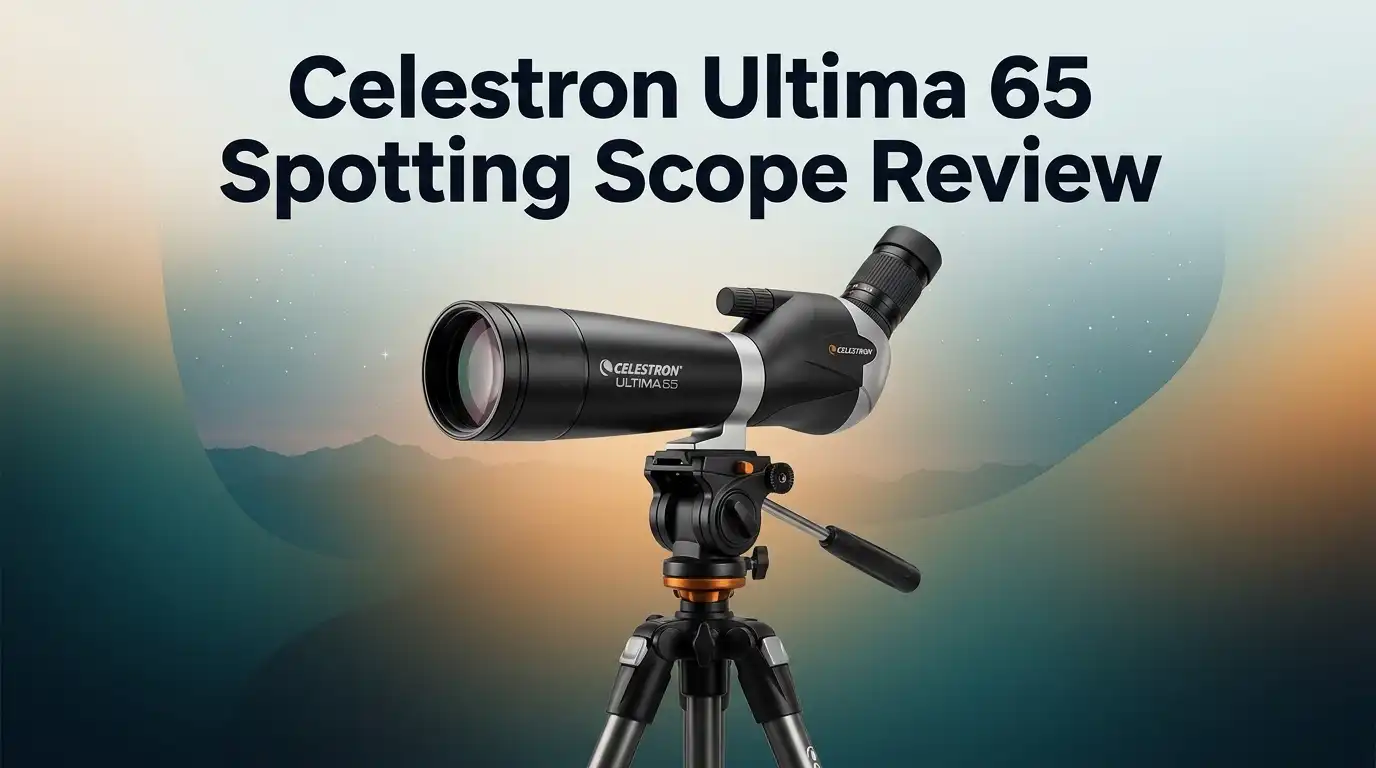
Celestron Ultima 65 Spotting Scope Review 2026: Still Worth It?
Spotting scopes can cost more than a used car. The Celestron Ultima 65 does not. It sits near the bottom of the price ladder, yet it keeps showing up in the field bags of birders, target shooters, and weekend hikers who care about weight.
I spent months with this scope. I watched herons at a marsh at sunrise. I checked bullet holes at 200 yards. I glassed ridgelines while my legs burned. This review covers what the Ultima 65 does well, what it fumbles, and whether it still earns a spot in 2026 against newer glass.
No marketing fluff here. Just what you see through the eyepiece.
Key Takeaways
- Great value for the money. The Ultima 65 delivers sharp daylight images at a price most beginner scopes cannot match. You get fully multicoated optics, BaK 4 porro prisms, and a lifetime warranty from Celestron.
- Compact and light at 37 ounces. This scope fits in a daypack. The 65mm objective keeps the body short, so you can carry it on long hikes without hating your choices by mile three.
- Waterproof and fogproof. Nitrogen purging and sealed construction mean rain, fog, and humidity will not kill it. The green rubber armor also blends into brush.
- Image quality drops past 40x. This is the honest weak spot. The top of the zoom range gets dim and soft. Most users park it between 18x and 35x.
- You need a real tripod. The scope ships without one. A flimsy tripod will ruin the experience faster than bad glass.
- Best for birders, range shooters, and casual wildlife watchers. Serious long range hunters and astronomy fans should look at the 80mm or 100mm models instead.
What Is the Celestron Ultima 65 Spotting Scope?

- ULTIMA ANGLED ZOOM SPOTTING SCOPE: This versatile all-around spotting scope with a 65mm objective lens, 18-55x zoom, and a 45° viewing angle is the ideal choice for any outdoor enthusiast. It's perfect for observing nature and long-distance viewing.
- INCLUDES ESSENTIALS FOR BETTER VIEWING: The Celestron Ultima 65 comes complete with a soft carrying case, an extended tripod mounting plate, a zoom eyepiece with an integrated T-adapter for digiscoping, an eyepiece pouch, a lens cloth, and more.

Last update on 2026-09-17 / Affiliate links / Images from Amazon Product Advertising API Some of the links on this website are affiliate links, which means that at no additional cost to you, I earn a commission if you click through and make a purchase. I only recommend products and services that I believe will add value to my readers. Thank you for your support!
The Celestron Ultima 65 is the smallest scope in the Ultima spotting scope line. It uses a 65mm objective lens and comes with an 18 to 55x zoom eyepiece. You can buy it in a straight body or a 45 degree angled body. The angled version stays the more popular pick.
The optical design is a porro prism refractor with BaK 4 prisms and fully multicoated lenses. Celestron built the tube from aluminum and wrapped it in green rubber armor. The scope is waterproof and nitrogen filled.
Here is the part people forget. That 65mm aperture pulls in roughly 17 percent more light than a standard 60mm scope. It also resolves about 8 percent more detail. Those numbers sound small on paper. In the field, at dusk, you notice them.
The Ultima 65 weighs 37 ounces. Close focus sits near 20 feet. Field of view runs from 89 feet down to 38 feet at 1000 yards. This is an entry level scope with midrange manners.
Unboxing the Ultima 65: What Arrives in the Box
The box is plain. Celestron does not spend money on presentation, and honestly, I prefer that. The savings went into the glass.
Inside you find the scope already tucked into a soft carrying case. The case zips around the body and leaves the eyepiece and objective accessible through flaps. Celestron calls it a stay on case. You can mount the scope and glass without removing it.
Under the scope sits a small accessory tray. You get objective and eyepiece caps, a lens cloth, a basic manual, and an eyepiece adapter for digiscoping. The eyepiece is already attached, so setup takes about thirty seconds.
My first impression was weight. The scope feels denser than the size suggests. That heft comes from real metal, not plastic pretending to be metal. The rubber armor has a slightly tacky grip that holds well in wet hands.
The one letdown is the case. The fabric feels thin and the zippers run rough. It protects against dust and light bumps. It will not survive a rough truck bed for years.
Build Quality and Design in the Field
The Ultima 65 handles like a tool built to be used rather than displayed. The rubber armor covers almost every surface. It absorbs knocks and keeps the scope quiet against a tripod leg or rock.
The rotating tripod collar is the highlight. You loosen a single knurled ring and spin the body. Angled scope users switch from horizontal scanning to overhead viewing in a second. This feature alone saves you neck pain during a long birding session.
The scope includes a built in sight tube on top. This acts as a rough aiming device. You line up the tube, look through the eyepiece, and your target is usually there. Beginners find this helpful. Target acquisition is the hardest skill for new spotting scope owners, and this tube shortens the learning curve.
The waterproof rating holds up. I glassed through steady rain on the Oregon coast with zero internal fogging. The green finish shows scuffs but stays intact.
Threads, knobs, and the eyepiece collar all feel tight. Nothing rattles.
Top 3 Alternative for Celestron Ultima 65

- The redesigned Diamondback HD spotting scope has all the optical horsepower the western hunter needs, and excels in low light. It features a streamlined exterior for a sleeker profile and a built-in helical focus wheel for fast and fine adjustments.
- HD optical system delivers exceptional resolution, cuts chromatic aberration and provides outstanding color fidelity, edge-to-edge sharpness and light transmission. Multiple anti-reflective coatings on all air-to-glass surfaces increase light transmission
Last update on 2026-06-28 / Affiliate links / Images from Amazon Product Advertising API Some of the links on this website are affiliate links, which means that at no additional cost to you, I earn a commission if you click through and make a purchase. I only recommend products and services that I believe will add value to my readers. Thank you for your support!
Vortex Optics Diamondback HD 16 to 48×65 Spotting Scope

- QUALITY ED OBJECTIVE LENS: Extra-low dispersion optical glass with special dispersion properties to dramatically reduce chromatic aberration, rendering razor-sharp images with superb color correction. Enjoy true-to-life color with enhanced resolution and contrast.
- XLT LENS COATINGS: Fully multi-coated with Celestron’s proprietary XLT optical coatings – the same coatings used on observatory-class telescopes. This coating maximizes light transmission through the optical path for brighter images. A great addition to your field gear!
Last update on 2026-09-17 / Affiliate links / Images from Amazon Product Advertising API Some of the links on this website are affiliate links, which means that at no additional cost to you, I earn a commission if you click through and make a purchase. I only recommend products and services that I believe will add value to my readers. Thank you for your support!
Celestron Regal M2 65ED Spotting Scope

- Gosky Updated Newest 20-60x80 Spotting Scope - Variable 20x to 60x magnification and dynamic lens focusing system brings better optics, more stable images and easier focusing power. It’s the best choice for target shooting, archery, hunting, bird watching, wildlife watching, hiking, camping, scenery, outdoor sporting, astronomical observation etc
Last update on 2026-09-13 / Affiliate links / Images from Amazon Product Advertising API Some of the links on this website are affiliate links, which means that at no additional cost to you, I earn a commission if you click through and make a purchase. I only recommend products and services that I believe will add value to my readers. Thank you for your support!
Gosky Updated 20 to 60×80 Spotting Scope
Optical Performance in Good Daylight
Daylight is where the Ultima 65 earns its reputation. At 18x to 30x, the image is bright, sharp, and pleasant. Colors look natural. Contrast holds up well against a bright sky.
I read license plates at 300 yards. I counted feather detail on a red tailed hawk at 150 yards. For a scope in this price bracket, that performance surprises people every time.
The fully multicoated lenses cut glare and lift transmission. Chromatic aberration exists. You see a faint purple fringe on high contrast edges like a dark branch against white clouds. It stays mild below 35x and grows louder as you zoom.
Edge sharpness softens in the outer 20 percent of the view. Center sharpness stays strong. Most users look at the center anyway.
This scope does not use ED glass. That is the honest tradeoff at this price. If color fringing bothers you, the Regal M2 65ED fixes it for roughly three times the cost.
For target shooting, the scope resolves .223 holes at 200 yards in good light. That alone justifies the purchase for many range users.
Low Light Performance at Dawn and Dusk
Low light is where 65mm scopes meet physics. The Ultima 65 does better than expected, but it has limits you should understand.
Exit pupil runs from 3.6mm at 18x down to 1.1mm at 55x. Your eye can open to 6mm or 7mm in darkness. That means the scope cannot fill your pupil with light at any magnification. Brightness drops as you zoom.
At 18x during the golden hour, the image stays usable and enjoyable. I identified ducks on a pond twenty minutes after sunset. At 40x in the same conditions, the view turned gray and mushy.
The rule is simple. Zoom out when light fades. Low power gives you a brighter, more usable picture than high power ever will in dim conditions.
Hunters who glass at first light should think carefully. The 80mm Ultima gathers about 50 percent more light and costs only a bit more. If dawn and dusk define your use case, the bigger scope is the smarter purchase.
Zoom Range and Usable Magnification
The 18 to 55x range sounds generous. Real world usability tells a different story.
From 18x to 30x, the view is excellent. Bright, steady, and sharp. This is the sweet spot and where I spent most of my time.
From 30x to 40x, quality holds but softens. You still get useful detail. Heat shimmer starts to interfere on warm days. Tripod stability becomes critical.
Past 40x, the image degrades noticeably. Brightness drops, contrast flattens, and the field of view shrinks to a keyhole. At full 55x, you can still identify shapes and count bullet holes in perfect light. You will not enjoy the view.
Do not buy this scope for the 55x number. Nearly every affordable zoom scope oversells its top end, and this one is no exception. Treat 55x as an emergency setting, not a daily driver.
The zoom collar turns smoothly with light resistance. Image stays reasonably centered through the range, which cheaper scopes often fail to manage.
Focus System and Everyday Handling
The Ultima 65 uses a single focus collar wrapped around the body just behind the objective. You grip and rotate. There is no coarse and fine dual knob system here.
The collar moves freely. Some users love this. Others find it slightly loose, especially at high magnification where tiny adjustments matter. This ranks as the most common complaint in owner reviews, and it is fair.
Focus travel is short. Going from 20 feet to infinity takes less than a full turn. That speed helps when you track moving birds. It hurts when you try to nail perfect focus at 50x.
My honest take is that the focus works well up to 35x and becomes fussy above it. Cold fingers and gloves make the fine adjustment harder.
Eye relief measures 18mm. Eyeglass wearers can use this scope comfortably with the rubber eyecup folded down. That is a real advantage over many budget scopes that force you to remove your glasses.
Hand holding works at 18x for short looks. Anything longer needs support.
Digiscoping and Phone Photography
The Ultima 65 accepts digiscoping gear, and Celestron includes the adapter you need for a T adapter ring setup. You can attach a DSLR or mirrorless body and shoot through the scope.
Phone digiscoping works too with a third party phone bracket. Results depend heavily on your patience. Expect a learning curve measured in hours, not minutes.
The 65mm aperture limits you. Less light reaching the sensor means slower shutter speeds and more blur. Photos at 18x to 25x look decent for documentation. Shots at 40x and above get soft and dim.
Set your expectations properly. This scope produces good record shots for a birding list or a range log. It does not produce gallery quality wildlife photography.
The angled body actually helps here. The eyepiece points upward, which makes phone alignment easier and reduces wobble when you tap the shutter.
Use a sturdy tripod and a timer or remote shutter. Touching the phone screen shakes everything. Small habits improve your results more than gear upgrades do.
Tripod Requirements You Should Not Ignore
The Ultima 65 ships without a tripod. Plan for this cost before you buy.
A 37 ounce scope at 40x amplifies every vibration. A cheap plastic tripod turns a sharp image into a shaking mess. I watched people blame the scope for problems their tripod caused.
Spend at least as much on your tripod as you can comfortably afford. A basic aluminum video tripod with a fluid pan head works well. Fluid heads give you smooth tracking, which matters for birds and moving game.
Height matters too. Buy a tripod that reaches your seated eye level if you glass from a chair, or standing height if you scan from a ridge. Hunching over a short tripod gets painful fast.
Window mounts are a smart addition for road birders. They cost little and turn your vehicle into a stable hide.
The scope uses a standard quarter inch mounting thread. Any tripod plate fits. The rotating collar means you never need to remount when you change viewing angle.
What the Celestron Ultima 65 Does Not Do Well
Every honest review needs this section. Here is where the scope falls short.
The top of the zoom range disappoints. From 45x to 55x, the image loses brightness and detail. You paid for numbers you will rarely use.
No ED glass means visible color fringing. High contrast scenes show purple or green edges. It is mild, but people coming from premium optics will spot it immediately.
The focus collar lacks precision at high power. A dual speed focus would fix this. At this price, Celestron left it out.
Low light performance is limited by aperture. Serious dawn and dusk users will want 80mm or larger.
The included case feels cheap. It works for casual protection and nothing more.
It is heavier than it looks. At 37 ounces plus a tripod, a full day hike becomes real work.
None of these flaws are dealbreakers at this price. They are the tradeoffs that let the scope cost what it costs. Knowing them before you buy prevents disappointment later.
Pros and Cons of the Celestron Ultima 65
Pros
- Excellent value. Few scopes near this price deliver comparable daylight sharpness and build quality.
- Fully waterproof and fogproof. Nitrogen purged and sealed for real weather use.
- Compact and packable. The 65mm body fits a daypack easily.
- Rotating tripod collar. Change viewing angles without remounting the scope.
- Built in sight tube. Makes target acquisition faster for beginners.
- Generous 18mm eye relief. Comfortable for eyeglass wearers.
- Interchangeable eyepieces. You can upgrade to a wide angle low power eyepiece later.
- Celestron limited lifetime warranty. Strong support behind a budget product.
- Digiscoping adapter included. No extra purchase for the basic setup.
Cons
- Soft and dim above 40x. The high end of the zoom underdelivers.
- No ED glass. Visible chromatic aberration on high contrast edges.
- Focus collar feels imprecise at high magnification.
- Limited low light capability due to the small exit pupil.
- Included soft case is thin and the zippers feel rough.
- No tripod included, which adds real cost to your total.
- Edge softness appears in the outer portion of the view.
Celestron Ultima 65 vs Celestron Ultima 80
- ULTIMA ANGLED ZOOM SPOTTING SCOPE: This versatile all-around spotting scope with a 65mm objective lens, 18-55x zoom, and a 45° viewing angle is the ideal choice for any outdoor enthusiast. It's perfect for observing nature and long-distance viewing.
- INCLUDES ESSENTIALS FOR BETTER VIEWING: The Celestron Ultima 65 comes complete with a soft carrying case, an extended tripod mounting plate, a zoom eyepiece with an integrated T-adapter for digiscoping, an eyepiece pouch, a lens cloth, and more.
Last update on 2026-09-17 / Affiliate links / Images from Amazon Product Advertising API Some of the links on this website are affiliate links, which means that at no additional cost to you, I earn a commission if you click through and make a purchase. I only recommend products and services that I believe will add value to my readers. Thank you for your support!
This comparison decides the purchase for most buyers. The two scopes share a design language, a warranty, and a price neighborhood.
The Ultima 80 uses an 80mm objective and a 20 to 60x eyepiece. It gathers roughly 50 percent more light than the 65mm. That difference shows up every single time the sun sits low.
The Ultima 80 also uses a larger, better eyepiece. Reviewers consistently rate its optical quality above the 65mm version. Images stay usable at higher magnification.
So why buy the 65? Weight and size. The Ultima 80 is noticeably bigger and heavier. It demands a sturdier tripod, which adds more weight again. Carrying it up a mountain is a commitment.
Here is my simple rule. If you glass from a vehicle, a blind, or a shooting bench, buy the 80. If you hike, travel, or carry your gear all day, buy the 65.
Both scopes offer the same waterproofing, the same warranty, and the same honest value.
Who Should Buy the Celestron Ultima 65 in 2026?
This scope suits specific people very well and other people poorly.
Buy it if you are a beginning birder. The price lowers the risk of a hobby you are still testing. The sight tube and easy handling shorten the learning curve.
Buy it if you shoot at a range. Resolving bullet holes at 100 to 200 yards is well within its ability, and the compact body travels easily.
Buy it if you hike or travel. The weight and size advantage over 80mm scopes is genuine.
Buy it if your budget is firm. You get more performance per dollar here than almost anywhere else in the category.
Skip it if you hunt at long range in low light. The aperture will frustrate you. Skip it if you want astronomy performance, because 65mm is too small for satisfying deep sky views. Skip it if you already own premium glass, since the step down will annoy you.
The Ultima 65 remains a smart 2026 purchase for the practical user who values portability and price over maximum optical performance.
Frequently Asked Questions
Is the Celestron Ultima 65 good for bird watching?
Yes. The scope performs well for birding in daylight. The 18x to 30x range gives bright, sharp views with a wide enough field to track movement. Close focus at 20 feet works for nearby feeder birds. The 18mm eye relief keeps glasses wearers comfortable during long sessions.
Does the Celestron Ultima 65 come with a tripod?
No. The scope includes a soft carrying case, lens caps, a cleaning cloth, and a digiscoping adapter. You must buy a tripod separately. Budget for a stable model with a fluid pan head, because a weak tripod will ruin image steadiness at higher magnification.
Should I choose the angled or straight version?
Choose angled if you share the scope, glass upward at birds in trees, or want less neck strain. Choose straight if you scan from a vehicle window, track fast moving targets, or want the simplest aiming experience. Beginners often find the straight version more intuitive.
Can I use the Ultima 65 for astronomy?
You can view the Moon, the brighter planets, and large star clusters. The views are pleasant but modest. A 65mm aperture limits how much you see. Anyone serious about night sky viewing should choose a larger scope or a dedicated telescope.
What magnification should I actually use?
Stay between 18x and 35x for the best image quality. Push to 40x only in bright, steady conditions. Use 55x rarely and expect a dim, soft view. Lower magnification also reduces the effect of heat shimmer and tripod vibration.
Is the Celestron Ultima 65 waterproof?
Yes. The scope is sealed and nitrogen purged, so it resists water intrusion and internal fogging. Rain, snow, and humidity will not damage it. Dry the exterior after wet use and store it with the caps on to protect the coatings.

Hello, I’m Amelia White, the founder of birdsfanatic.com. As a lifelong bird enthusiast and spiritual seeker, I’ve always been fascinated by the mystical connections between birds and the human experience. On this site, I share my knowledge and insights into the symbolic meanings and spiritual significance of various bird species, exploring their roles in mythology, folklore, and cultural traditions. Join me on this journey into the world of birds, where we’ll discover the hidden wisdom and guidance that these magnificent creatures have to offer.
