VCUTEKA Glass Bird Feeder Review 2026: Worth Hanging?
Bird feeders usually look like plastic tubes. This one looks like a piece of stained glass jewelry hanging from a branch. That contrast is exactly why so many gardeners keep clicking on it.
The VCUTEKA glass bird feeder sits in an odd space. It is part garden decor and part working feeder. Some buyers love it. Others expect a heavy duty seed station and feel let down. I spent a full season watching one, filling it, cleaning it, and watching squirrels ruin my afternoon.
This review covers everything. The unboxing, the real seed capacity, the drainage hole nobody mentions, the birds that actually show up, and the four things this feeder does poorly. No sugar coating. If you want a pretty feeder that works, keep reading. If you want a fortress, I will tell you that too.
In A Nutshell:
- Looks beat function, and that is fine. The mosaic glass catches sunlight and spins slowly on its wire. It is the prettiest budget feeder in this price band. Buyers rate it 4.6 out of 5 stars across more than 600 reviews on Amazon, which is strong for a glass garden item.
- The 7 inch model is small. Dimensions run about 7 x 7 x 3.5 inches. Real seed capacity sits near one cup. Expect refills every two or three days during busy weeks.
- Small birds love it, big birds ignore it. Finches, chickadees, titmice, sparrows, and juncos use it happily. Cardinals perch on the rim but rarely hop inside. Doves and jays will not fit.
- Cleaning is genuinely easy. Open bowl, no tubes, no tiny ports. A rinse and a brush take two minutes.
- Squirrels win every time. There is zero squirrel resistance here. The feeder also swings hard in wind and can chip if it strikes a wall.
- Best use case: a decorative second feeder near a window, a patio, or a balcony, not your only seed source.
What Is The VCUTEKA Glass Bird Feeder?

- 【Fly Through Bird Feeder】Features a fly-through design that allows birds to easily access seed. After they're done eating, they can fly away with ease as well. It's fun to watch them eat and fly back and forth to the feeder
- 【Easy to Fill & Clean】Easy to fill bird feed and easy to clean,can be filled with any type of seed. Birds can eat from the rim or hop inside during bad weather. There is a small hole on the bottom to let the rain flow out and the bird seed to remain dry
Last update on 2026-08-29 / Affiliate links / Images from Amazon Product Advertising API Some of the links on this website are affiliate links, which means that at no additional cost to you, I earn a commission if you click through and make a purchase. I only recommend products and services that I believe will add value to my readers. Thank you for your support!
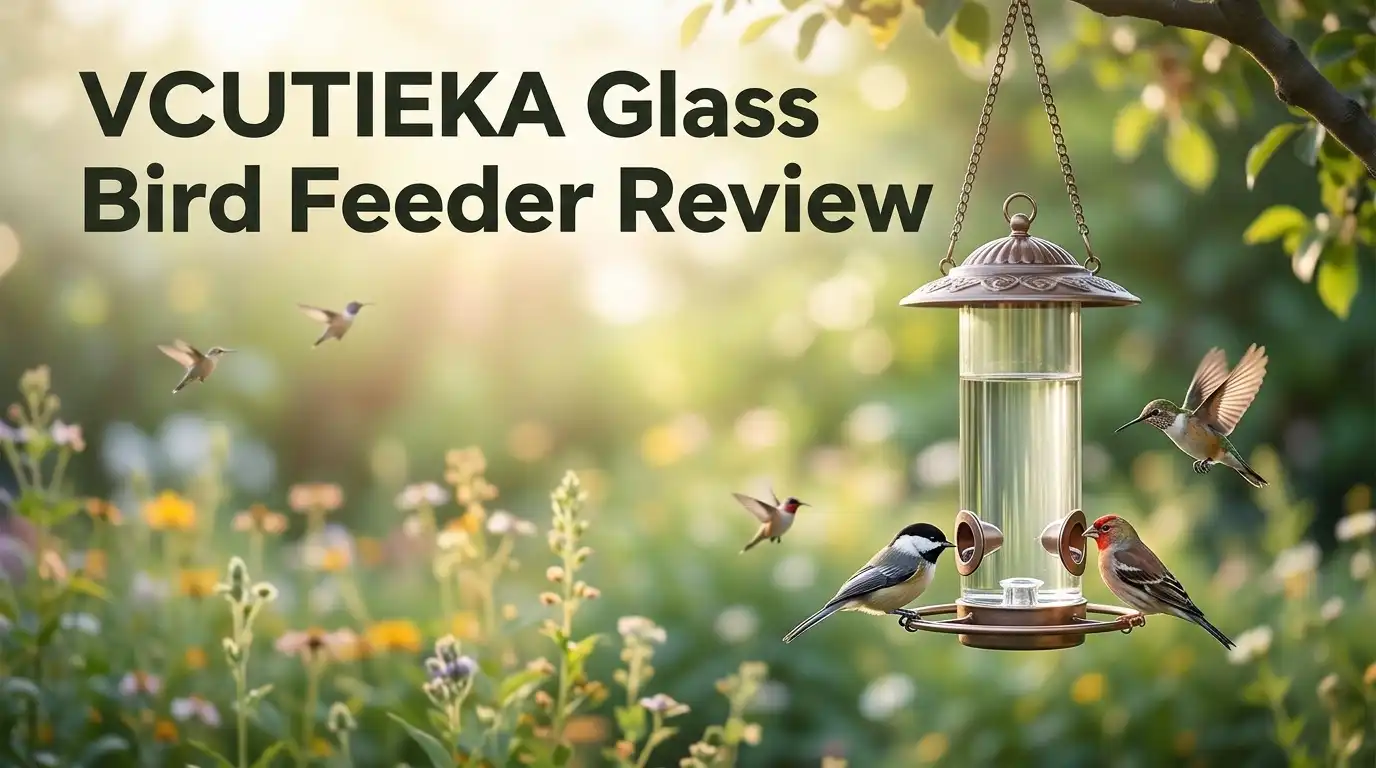
The VCUTEKA glass bird feeder is a hanging fly through seed dish. The body is a shallow round glass bowl. Colored glass tiles cover the outside in a mosaic pattern. A metal arch and wire loop sit on top for hanging.
Fly through means the bowl stays open. Birds land on the rim or hop straight inside. There is no roof, no dome, and no closing lid. Food access is instant, which is the main reason shy species adopt it fast.
VCUTEKA sells several versions. The 7 inch round mosaic model is the popular one and carries Amazon’s Choice status. A larger 13.3 inch solar version adds a small light on top. There is also a glass bird bath model with a metal stake for ground use.
Material is glass and plastic, with a metal hanger. Color options include White, Green, Black, Red, Yellow, and a Yellow and Red mix. Each unit varies slightly because the tiles are placed by hand.
The brand pitches it as both a feeder and a gift. That framing is accurate. Roughly half the buyer reviews mention giving it to a parent, a retiree, or a neighbor. It arrives looking like a present, not like hardware.
Unboxing Experience: What Arrives At Your Door
My box was small and light. VCUTEKA ships in the product packaging, so there is no giant outer carton. The printed box measures barely bigger than the feeder itself.
Inside, the bowl sat in a molded foam cradle. Two extra foam sheets pressed against the glass faces. The hanging wire came coiled and taped to the side. Nothing rattled when I shook the package, which is a good sign for glass.
Total contents were simple. One glass bowl, one attached metal hanger, one hanging wire or chain depending on version, and a tiny instruction card. There is no assembly. You uncoil the wire, hook it, and you are done in under a minute.
First impression of the glass was better than I expected. The tiles feel smooth on top and slightly rough at the grout lines. Colors read deeper in person than in the listing photos.
Two honest notes. My bowl had one tile with a visible glue smudge near the edge. Second, the bowl felt lighter than photos suggest. This is thin decorative glass, not thick cast glass. Handle it with two hands the first time you lift it.
Design And Build Quality Reviewed
The shape is a shallow saucer. Depth is about one and a half inches of usable seed space. Walls curve outward, which lets birds see the food from above while flying.
The mosaic tiles are the star. Sunlight passes through the translucent pieces and throws small color patches onto the ground. On a spinning wire, that effect is quietly beautiful at golden hour.
Build quality is fair for the price, not premium. The grout is uniform in most spots. Tile adhesion held through rain, frost, and summer heat in my test. One corner tile loosened after four months and I glued it back with clear silicone.
The metal hanger is the weakest part. It is thin, coated steel. Mine developed light surface rust at the crimp points by month five. A spray of clear enamel would prevent that.
There is a small drainage hole in the base. This detail matters more than the listing implies. It lets rainwater escape so seed stays drier. It also lets fine seed dust and cracked millet trickle out, which some buyers mistake for a defect.
Verdict on build: decorative grade, seasonal durability. Treat it like a garden ornament that feeds birds.
Top 3 Alternative for VCUTEKA Glass Bird Feeder

- COMPACT FLY-THROUGH SIZE: Designed as a small bird feeder for outdoor hanging, it measures 10 inches wide and 10 inches tall, with a 3.5-inch fly-through opening, and holds about 2 cups of seed. The wild bird feeder is for small birds only; larger birds such as cardinals and jays will not fit in the opening. A 12-inch hanging wire is included, and the bird seed feeder weighs just 2.2 pounds, making it easy to hang and reposition.
- ATTRACTS SMALL SONGBIRDS: The hanging bird feeder for outdoors features iridescent mosaic glass that catches the light and adds color to the garden, deck, or patio, while the open fly-through ring makes it easy for small songbirds, such as finches, chickadees, wrens, and sparrows, to land and feed. Placing the unique bird feeder near cover and giving birds a few days to find it helps them settle into a regular routine.
Last update on 2026-08-26 / Affiliate links / Images from Amazon Product Advertising API Some of the links on this website are affiliate links, which means that at no additional cost to you, I earn a commission if you click through and make a purchase. I only recommend products and services that I believe will add value to my readers. Thank you for your support!
Sunnydaze Mosaic Glass Bird Feeder for Outdoors, Indigo

- Durable Glass Bird feeder: 9”W x 3.75”D x 9”H mosaic design adds a colorful accent to any garden. Easy to fill, simple to clean, and works with all seed types.
- Simple Hanging Installation: Includes a sturdy hanging wire for quick setup on a tree branch, arbor, near a window, or any outdoor location.
Last update on 2026-08-29 / Affiliate links / Images from Amazon Product Advertising API Some of the links on this website are affiliate links, which means that at no additional cost to you, I earn a commission if you click through and make a purchase. I only recommend products and services that I believe will add value to my readers. Thank you for your support!
DUSVALLY Fly Through Bird Feeder, Hanging Glass Wreath Shaped Feeder

- Fly Through Bird Feeder: Features a fly-through design that allows birds to easily access seed. After they're done eating, they can fly away with ease as well. It's fun to watch them eat and fly back and forth to the feeder
- Solar Design: This bird feeder is equipped with a solar light, which can convert solar energy into electric energy and automatically emit light at night, saving energy and protecting environment. The waterproof design of solar panels can provide a longer service life in most weather conditions
Last update on 2026-08-26 / Affiliate links / Images from Amazon Product Advertising API Some of the links on this website are affiliate links, which means that at no additional cost to you, I earn a commission if you click through and make a purchase. I only recommend products and services that I believe will add value to my readers. Thank you for your support!
VCUTEKA Glass Bird Feeder, Fly Through Solar Birdfeeder
Setup And Hanging Options
Setup takes seconds, but placement decides whether birds show up. Hook the wire on a branch, a shepherd hook, a fence bracket, or an eave hook.
Height matters. I got the best traffic at five to six feet off the ground with a shrub within ten feet. Birds want a nearby escape perch before they commit to an open dish.
Wind is the real enemy. A shallow open bowl on a single wire spins and tilts. On gusty days, my feeder dumped seed twice. Two fixes worked. First, hang it under an eave or a dense branch. Second, swap the wire for a short chain to reduce swing.
Keep it away from hard walls. Glass plus brick equals chips. I moved mine eighteen inches out from the post after the first clunk.
Balcony users have an advantage here. A railing bracket gives shelter and a stable anchor, and the small size fits tight spaces where tube feeders feel bulky.
One more tip. Place it away from your window glass or very close to it, within three feet, to reduce collision risk. The middle distance zone is the dangerous one for birds.
Which Birds Actually Visit This Feeder
Real results from one season, filled mostly with black oil sunflower and a finch mix.
Regular visitors were house finches, goldfinches, chickadees, tufted titmice, house sparrows, and dark eyed juncos in cold months. These birds are light and small, and the rim suits their feet perfectly.
Cardinals showed up but behaved differently. They perched on the rim and leaned in rather than hopping inside. The 7 inch bowl is simply tight for a cardinal body.
Larger birds never used it. Mourning doves tried once, tipped the bowl, and gave up. Blue jays circled and left. If you want jays and doves, this is the wrong feeder.
Adoption speed surprised me. Birds found it within three days, which is faster than my covered hopper feeder took. The open design and reflective tiles seem to draw attention.
Nectar note. Some buyers try this as a hummingbird feeder. Do not. It is a seed dish. It has no ports, no ant moat, and open sugar water ferments and attracts wasps within a day. Buy a proper nectar feeder for hummingbirds instead.
Seed Capacity And Refill Frequency
The listing does not state a clear volume for the 7 inch model. Measured in my kitchen, the bowl held about one and a quarter cups filled level, or one cup filled safely without spillover.
That is small. For comparison, a standard tube feeder holds four to six cups. So expect frequent trips outside.
My refill pattern in a busy suburban yard looked like this. Summer, every three days. Fall migration, every two days. Winter with juncos, sometimes daily. Plan on two to four refills per week.
Seed choice affects results. Black oil sunflower vanished fastest. Safflower slowed the sparrow crowd. Cheap mixes with red millet left a wet pile of rejects in the bowl, which then clogged the drain hole.
Practical advice. Fill it only halfway during storm season. A half full bowl spills far less when it swings, and seed stays fresher.
Small capacity is not purely bad. Fast turnover means seed rarely sits long enough to mold, which is a real problem in big feeders during humid weeks. You trade convenience for freshness.
Cleaning And Maintenance Guide
This is where the design shines. There are no narrow tubes, no screw off ports, and no hidden corners.
My routine took two minutes. Dump old seed, rinse under a hose, scrub with a soft brush, dry with a cloth. Once a month I used a nine parts water to one part vinegar soak for ten minutes, then rinsed twice.
Avoid the dishwasher. Heat and jets can loosen tile adhesive and grout. Hand wash only, and use lukewarm water rather than hot.
Watch the drain hole. Wet millet dust plugs it, and then water pools, and then seed sours. I poke it clear with a toothpick every refill. That single habit prevented every mold issue I might have had.
Winter care needs one warning. Water left in the bowl can freeze, expand, and stress the glass. I bring mine inside during hard freezes, or I tip it after rain.
Grout is porous. Over time it darkens slightly from bird droppings and pollen. A soft toothbrush with mild soap restores most of it, though some staining becomes permanent after a year outdoors.
Weather Performance Over A Full Season
Rain performance was acceptable. The drain hole works. After a moderate shower, seed on top was damp and seed below stayed usable if I stirred it.
Heavy rain is different. An open bowl with no roof takes the full hit. After a two hour downpour, the whole load was soaked and I emptied it. This feeder needs shelter to perform in wet climates.
Sun exposure caused no color fading in my test. The glass tiles held their tone through a hot summer, which matches the brand claim about colors lasting.
Heat did dry seed out nicely. Airflow through the open top prevents the steamy mold pocket you get inside enclosed hoppers.
Cold weather brought two issues. Ice formed on the rim, making landings slippery. And thermal stress worries me. I saw no cracks, but reviews on similar VCUTEKA glass products mention cracking within six months, and glass plus freeze cycles is a known risk.
Wind remains the biggest weakness. Anything above fifteen miles per hour turns the bowl into a seed spinner. Sheltered placement is not optional in exposed yards.
Squirrel And Pest Reality Check
Let me be blunt. This feeder offers no squirrel protection whatsoever.
An open bowl on a wire is a squirrel buffet. Mine emptied the dish in one visit, twice. Squirrels also hang from the wire and swing, which is exactly how glass gets chipped.
Some listings for mosaic feeders use the phrase squirrel proof. Ignore that phrase completely. No open glass dish is squirrel proof.
What helped in my yard. A pole with a baffle underneath, positioned ten feet from any launch point. Also switching to safflower seed, which many squirrels dislike, cut raids by more than half.
Other pests deserve mention. Ants find spilled seed and wet residue. Wasps arrive if you leave fruit or sugar water. Larger birds like starlings cannot fit inside, which is an accidental benefit of the small bowl.
Rodent traffic at night is possible since food sits exposed. I now empty the bowl at dusk during peak squirrel season. That habit solved most of my problems and costs ten seconds.
What This Feeder Does Not Do Well
Every honest review needs this section. Here are the real weaknesses.
It has no roof. Rain, snow, and falling debris land directly in the seed. Buyers who hang it in open yards report soggy food constantly.
Capacity is tiny. One cup means constant refills. If you travel, or if you feed a large flock, this feeder will disappoint you.
Glass is fragile. Thin decorative glass chips against walls and can crack in freeze cycles. Reports of cracking within six months exist for VCUTEKA glass products, so treat it as seasonal gear.
The hanger rusts. The thin coated wire shows corrosion at stress points after several months outdoors.
Large birds are excluded. No cardinals inside, no doves, no jays. If those species are your goal, look elsewhere.
Wind stability is poor. Single point hanging plus a shallow bowl equals spilled seed on gusty days.
Not for nectar. People buy it hoping for hummingbirds. It cannot hold sugar water safely.
None of these flaws are hidden defects. They are consequences of the design. A pretty open glass dish trades protection for beauty and easy access. Know that before you buy.
Pros And Cons Summary
Pros
- Beautiful mosaic glass that catches light and adds color to any garden, patio, or balcony
- Fast bird adoption thanks to the open fly through design with no barriers
- Very easy to fill and clean, with no tubes, ports, or removable parts to fuss over
- Functional drainage hole in the base that lets rainwater escape
- Excellent gift item with multiple color choices including White, Green, Black, Red, and Yellow
- Small footprint suits tight spaces where a tube feeder feels too large
- Strong buyer rating near 4.6 out of 5 stars across hundreds of reviews
- Fast seed turnover reduces mold risk compared with high capacity feeders
- Fair price around the thirty dollar mark for a handmade glass piece
Cons
- No roof or dome, so heavy rain soaks the entire seed load
- Capacity of roughly one cup forces refills two to four times per week
- Zero squirrel resistance, and squirrels can empty it in a single visit
- Thin glass chips easily and may crack during freeze cycles
- Thin metal hanger develops surface rust within months
- Spins and spills in wind unless hung in a sheltered spot
- Too small for cardinals, doves, and jays to feed comfortably
- Cannot be used as a nectar or hummingbird feeder
- Occasional cosmetic flaws such as glue smudges on tiles
Price And Value In 2026
Current pricing sits near $28.99 for the 7 inch mosaic model, with the larger solar version costing more. Sales push it lower at times.
Is that fair? For a handmade mosaic glass piece, yes. Comparable Sunnydaze mosaic feeders sit in a similar range, and plain plastic feeders of the same capacity cost less but look ordinary.
Think of the value in two parts. You are paying for garden decor plus a feeding function. Judged only as a feeder, thirty dollars buys far more capacity elsewhere. Judged as decor that also feeds birds, the price makes sense.
Longevity affects value most. If your feeder survives three seasons, the cost per season is under ten dollars, which is excellent. If it cracks in six months, the value case collapses.
Two things protect your money. Buy from the VCUTEKA storefront so the thirty day free return window applies. And hang it in a sheltered, wind protected spot from day one.
My take. This is good value for gift buyers, casual feeders, and patio gardeners. It is poor value for anyone in a harsh winter climate with heavy squirrel traffic.
Who Should Buy This Bird Feeder
Buy it if you want a decorative feeder that draws small songbirds close to a window or patio. It performs that job well.
Buy it if you need a gift for a parent, grandparent, retiree, or new homeowner. Gift feedback in reviews is overwhelmingly positive, and the packaging supports gifting.
Buy it if you have a balcony, a small yard, or a covered porch. The size and sheltered placement match the design perfectly.
Buy it as a second or third feeder alongside a larger hopper or tube. That combination gives you beauty and volume at once.
Skip it if squirrels dominate your yard and you have no baffle solution. Skip it if you live somewhere with long hard freezes and you will not bring it indoors.
Skip it if you specifically want cardinals, doves, or jays feeding comfortably. Choose a wider platform feeder instead.
Skip it if you want a hummingbird feeder. Buy a dedicated nectar model with bee guards and an ant moat.
Final thought. Match the product to the job. This feeder is a charming small bird dish and garden ornament. Ask it to be that, and it succeeds.
Final Verdict
The VCUTEKA glass bird feeder earns a solid recommendation with clear limits. Rating: 4 out of 5 for the right buyer.
What works is real. The mosaic glass looks lovely, birds find it quickly, cleaning takes two minutes, and small songbirds use it daily. At thirty dollars, that combination is hard to beat visually.
What fails is also real. No roof, one cup capacity, fragile glass, a rust prone hanger, and no defense against squirrels or wind.
Hang it smart and it delights you for seasons. Hang it in an exposed yard full of squirrels and you will be frustrated within weeks. The difference is placement, not luck.
Frequently Asked Questions
How much seed does the 7 inch VCUTEKA feeder hold?
About one cup filled safely, or one and a quarter cups filled level. Expect refills two to four times per week in an active yard.
Is the VCUTEKA glass bird feeder squirrel proof?
No. It offers no squirrel protection at all. Use a pole with a baffle or switch to safflower seed to reduce raids.
Can I put sugar water in it for hummingbirds?
No. It is a seed dish with no ports or ant moat. Sugar water ferments quickly in an open bowl and attracts wasps. Buy a dedicated nectar feeder.
Will it survive winter outdoors?
Sometimes. Water can freeze in the bowl and stress the glass. Empty it after rain and bring it indoors during hard freezes.
What seed works best in this feeder?
Black oil sunflower gives the best traffic. Safflower deters squirrels and sparrows. Avoid cheap mixes heavy in red millet, which birds reject and which clogs the drain hole.
Does it attract cardinals?
Cardinals perch on the rim and lean in, but the 7 inch bowl is too tight for them to sit inside comfortably.
How do I clean it properly?
Dump old seed, rinse with a hose, scrub with a soft brush, and dry. Monthly, soak in a nine to one water and vinegar mix. Hand wash only, never the dishwasher.
Does the drainage hole leak seed?
Fine dust and small cracked pieces do trickle out. That is normal and not a defect. Keep the hole clear so rainwater drains.
Is it a good gift?
Yes. It arrives in tidy packaging, needs no assembly, and comes in several colors. Gift buyers make up a large share of positive reviews.
Which VCUTEKA version should I choose?
Pick the 7 inch mosaic model for balconies and small spaces. Pick the larger 13.3 inch solar version if you want more capacity and a decorative light at night.

Hello, I’m Amelia White, the founder of birdsfanatic.com. As a lifelong bird enthusiast and spiritual seeker, I’ve always been fascinated by the mystical connections between birds and the human experience. On this site, I share my knowledge and insights into the symbolic meanings and spiritual significance of various bird species, exploring their roles in mythology, folklore, and cultural traditions. Join me on this journey into the world of birds, where we’ll discover the hidden wisdom and guidance that these magnificent creatures have to offer.