
Lollyes Smart Bird Feeder Review 2026: Worth Buying?
Bird watching used to mean sitting still by a window with binoculars. Now a small camera does the waiting for you, and your phone buzzes the moment a cardinal lands.
The Lollyes smart bird feeder promises exactly that experience for a budget price. It records visiting birds, names the species, and runs on sunlight.
But budget smart feeders carry real tradeoffs. Some struggle with WiFi. Some hide monthly fees. Some raise privacy questions that make owners uneasy.
In A Nutshell:
- The camera is 1080P, not 2K or 4K. Most competing feeders in 2026 shoot at 2K or higher. Video looks acceptable on a phone screen but soft on a television or laptop.
- Solar power genuinely works. A 7W panel feeds a 5200mAh battery, and owners report roughly four months of runtime in decent sunlight. You rarely touch a charging cable.
- AI species identification covers a claimed 11,000 birds. Accuracy is good for common backyard species and shaky for sparrows, finches, and anything partly hidden behind seed.
- The app is the weakest part. Setup frustrates many buyers, the 2.4GHz WiFi requirement trips people up, and permission requests feel excessive for a bird camera.
- A subscription appears after the free trial. Cloud storage runs about $4.99 monthly. The feeder still records to the included 64GB card without paying, which many buyers do not realize.
- The Amazon listing sits around 3.5 stars and stock comes and goes. That rating is noticeably lower than rivals sitting at 4.3 or 4.4 stars.
Lollyes Smart Bird Feeder Overview

Last update on 2026-08-17 / Affiliate links / Images from Amazon Product Advertising API Some of the links on this website are affiliate links, which means that at no additional cost to you, I earn a commission if you click through and make a purchase. I only recommend products and services that I believe will add value to my readers. Thank you for your support!
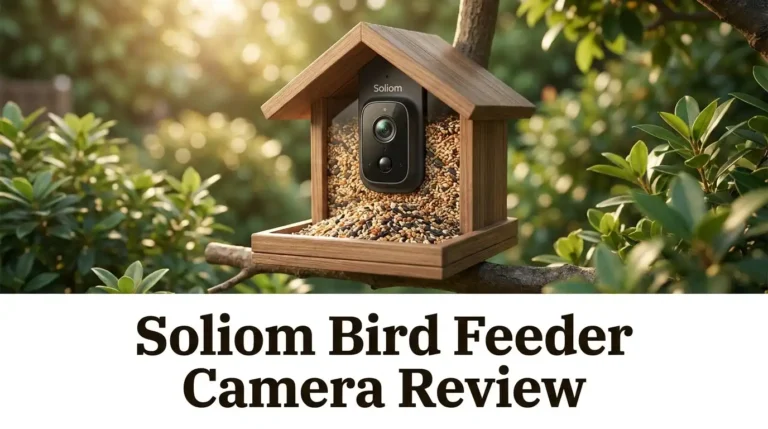
The Lollyes smart bird feeder is a plastic seed house with a camera module mounted above the perch. A solar panel sits on the roof and angles upward to catch light.
The body uses ABS plastic with an IP65 weather rating. Lollyes sells it in a few decorative finishes, including a tree pattern and a maple leaf pattern.
Inside, the seed hopper holds about 1.5 liters, which works out near five cups of mixed seed. Drainage holes sit in the tray floor so rain does not pool around the food.
The camera shoots 1080P video across a 180 degree field of view. That wide angle captures the whole perch and a slice of background, though edges look stretched.
A 5200mAh battery powers everything. The 7W solar panel tops it up daily, and Lollyes claims four months of use per full charge in low activity conditions.
Motion detection triggers recording. When a bird lands, the camera saves a clip, tags a species guess, and pushes an alert to your phone.
Lollyes includes a 64GB microSD card in the box. That card holds weeks of clips, which matters because it lets you skip the cloud subscription entirely.
Color night vision handles dusk and dawn visits. Nocturnal guests like flying squirrels or opossums show up in surprisingly watchable footage.
Price has hovered between $50 and $90 depending on coupons. Stock availability has been unreliable, and the main Amazon listing has gone out of stock more than once.
Unboxing Experience: What Actually Arrives
The box arrives smaller than expected. Lollyes ships the feeder in three main pieces rather than fully assembled, so the carton stays compact.
Open the flaps and you find the seed house body wrapped in a thin foam sleeve. The camera module sits in its own cardboard cradle to protect the lens.
Under that layer you get the solar roof panel, a mounting strap, a metal hook, a short USB C charging cable, and a screwdriver. Lollyes also tucks the 64GB microSD card into a tiny paper envelope, which is easy to throw away by accident.
The manual is a folded sheet with small print and diagrams. Instructions read like a rough translation, so the pictures help more than the words.
Assembly takes about ten minutes. The camera slides into a bracket on the roof, the solar panel clicks on top, and two screws lock everything in place.
Plastic quality feels thin in hand. The panels flex when you squeeze them, and the seed lid does not close with a satisfying snap.
The lens cover carries a protective film that many buyers forget to peel. Video looks hazy until you remove it, which explains a few angry reviews.
One real annoyance appears immediately. You cannot test the camera at all until you download the app, create an account, and scan the QR code on the device.
That gate frustrates people who just want to see if the hardware works. There is no local viewing mode and no simple Bluetooth pairing option.
Design And Build Quality
The shape works for birds even if the materials feel cheap. A long perch bar runs across the front, and small birds land on it comfortably.
The camera sits high and looks down at a slight angle. That position keeps the lens out of direct rain and away from droppings, which is smart placement.
Seed loading happens through a lid on top. You lift it, pour, and close it, no tools required after the first assembly.
The tray drains properly. After heavy rain, seed near the edges stays dry while the center may clump slightly.
Mounting options are limited but functional. The included strap wraps a tree trunk or a post, and the metal hook lets you hang the feeder from a branch.
There is no pole mount adapter in the box. Buyers who want a freestanding setup must buy a separate pole kit, which adds cost.
Squirrel resistance does not exist here. The plastic offers nothing that stops a determined squirrel from sitting in the tray and emptying it.
Larger birds also cause problems. Grackles, jays, and doves crowd the perch and block the lens, which fills your alerts with the same bird over and over.
Color fading appears in long term reports. After a full summer in strong sun, the painted patterns dull noticeably.
The plastic holds up better than the paint. Owners in cold climates report cracking only after freezing temperatures combined with impact, such as a falling branch.
Top 3 Alternative for Lollyes Smart Bird Feeder

- [Superbly Enhanced Pixel Quality] This bird feeder with camera features a unique 5MP lens that delivers an experience two levels above the 2K (3MP) bird cameras commonly found on the market. Whenever birds approach the feeder, your phone receives real-time alerts. You can open the live stream instantly, anytime, anywhere, to admire the birds' exquisite patterns and vivid expressions in ultra-high resolution
- [Exclusive Solar Panel Design] This solar powered bird feeder features our proprietary solar panel design. We've upgraded the panel material by using premium BC-grade components, boosting charging efficiency by 30% and enhancing performance on cloudy days. Additionally, the unique roof mounting bracket maintains drill-free installation convenience while ensuring adaptability for removable and additional mounting scenarios(backyard, balcony, or garden)

Last update on 2026-06-09 / Affiliate links / Images from Amazon Product Advertising API Some of the links on this website are affiliate links, which means that at no additional cost to you, I earn a commission if you click through and make a purchase. I only recommend products and services that I believe will add value to my readers. Thank you for your support!
COOAU 5MP Smart Bird Feeder with Camera

- Bird Feeder with Camera: Our smart bird feeder is equipped with an advanced artificial intelligence camera capable of identifying over 10,000 bird species. Designed with full-color night vision, it captures clear pictures and videos day and night, providing a delightful bird-watching experience for bird lovers. The AI camera notifies you of any feathered visitors via the VicoHome app on your phone, allowing you to enjoy bird watching from anywhere without disturbing the birds
- Smart App Control: Our bird feeder works seamlessly with the VicoHome app, keeping you informed whenever a bird stops by. You can view the bird feeding activity in real-time through the app (compatible with 2.4GHz WiFi). With built-in two-way voice and a siren alarm, you can deter unwelcome visitors like squirrels with just a tap on the app
Last update on 2026-08-17 / Affiliate links / Images from Amazon Product Advertising API Some of the links on this website are affiliate links, which means that at no additional cost to you, I earn a commission if you click through and make a purchase. I only recommend products and services that I believe will add value to my readers. Thank you for your support!
isYoung G08 Smart Bird Feeder with Camera

- Advanced AI Identifies 10,000+ Bird Species - Harnessing advanced AI technology, the Harymor smart bird feeder recognizes over 10,000 bird species. With a Vicohome app subscription, you can access detailed information about each identified bird. Perfect for both beginners and seasoned birdwatchers, it offers a fascinating way to learn about nature. Enjoy live viewing and turn every visit into a wildlife lesson for all ages
- Receive Bird Arrival Notification - Tired of relying on binoculars? The Harymor bird camera automatically detects visiting birds (like bluebirds, hummingbirds, etc.), records videos of birds entering the detection area, and sends real-time alerts to your phone with clear snapshots. The Harymor bird watching camera lets you capture close-up shots full of character and offers an enhanced birdwatching experience
Last update on 2026-07-01 / Affiliate links / Images from Amazon Product Advertising API Some of the links on this website are affiliate links, which means that at no additional cost to you, I earn a commission if you click through and make a purchase. I only recommend products and services that I believe will add value to my readers. Thank you for your support!
HARYMOR Smart Bird Feeder with Camera
Camera Quality And Video Performance
The 1080P sensor is the headline weakness in 2026. Rival feeders at similar prices now ship 2K and even 4K sensors, so Lollyes starts behind.
On a phone screen, footage looks fine. Feather detail on a cardinal or blue jay reads clearly, and colors stay natural in daylight.
Cast that same clip to a television and softness shows immediately. Fine markings on warblers and sparrows blur into general brown shapes.
The 180 degree lens creates visible barrel distortion. Birds near the frame edges look curved and slightly stretched.
Frame rate sits around 15 frames per second in most owner clips. Fast wing movement smears rather than freezing, so hummingbird footage disappoints.
Recording length per trigger runs short. Clips often stop at ten or fifteen seconds, which cuts off longer feeding sessions midway.
There is a lag between motion and recording start. Quick visitors sometimes appear only as a tail feather leaving the frame.
Color night vision performs better than expected. The feeder uses a small light rather than infrared, so night clips show actual color instead of gray.
That light does startle some birds and animals at first. Most adjust within a few nights and return normally.
Backlighting causes the biggest daytime problem. Point the feeder toward the afternoon sun and birds turn into silhouettes with no detail at all.
Placement solves much of this. Face the feeder north or east and image quality improves dramatically without changing any settings.
AI Bird Identification Accuracy
Lollyes claims recognition of more than 11,000 bird species. That number comes from the shared AI database many budget feeder brands license.
Real accuracy depends heavily on the bird. Distinctive species land correctly almost every time, including cardinals, blue jays, woodpeckers, chickadees, and mourning doves.
Small brown birds cause the most errors. House sparrows, house finches, and juvenile birds get swapped for each other constantly.
The AI also guesses when it should not. Owners report squirrels labeled as birds and shadows labeled as species entirely absent from their region.
Regional filtering seems weak or missing. Some users receive identifications for birds that do not live on their continent.
Partial views break the system. A bird facing away or half hidden behind the seed pile returns either no guess or a wildly wrong one.
The identification history feature is genuinely fun. The app builds a list of species seen in your yard with dates and thumbnails.
That log turns casual watching into a small personal project. Families with children find real value here even when accuracy slips.
You can correct wrong identifications manually in most app versions. Corrections do not appear to train the model, so the same mistakes repeat.
Treat every label as a suggestion rather than a fact. Cross check anything unusual against a proper field guide or a dedicated identification app before you get excited.
Solar Panel And Battery Life
This is where Lollyes performs honestly well. The 7W panel is generously sized for a feeder in this price bracket.
The 5200mAh battery charges from empty in about six hours by USB C. After that, sunlight handles the rest in most locations.
Owners in sunny regions report going entire seasons without a manual charge. The panel simply keeps pace with daily use.
Battery life depends almost entirely on bird traffic. A busy feeder recording fifty clips a day drains far faster than a quiet one recording five.
Winter changes the math. Short days, low sun angles, and cold temperatures combine to cut runtime sharply.
Cold weather alone reduces lithium battery capacity. Northern owners describe recharging monthly during December and January.
Snow on the panel stops charging completely. You must brush it clear, which defeats some of the convenience.
Shade placement causes the most complaints. Hang this feeder under dense tree cover and the panel never catches enough light to keep up.
Position the feeder where the roof sees direct sun for at least four hours. That single choice determines whether solar power feels magical or useless.
The app reports battery percentage clearly. Notifications warn you before the level gets critical, which prevents surprise outages.
You can charge the battery indoors without dismounting the whole feeder. The camera module detaches from the bracket, which makes winter top ups less painful.
App Setup And WiFi Connection
The app is where good hardware meets frustrating software. Setup requires an account, a QR code scan, and a patient attitude.
The feeder only accepts 2.4GHz WiFi. Modern routers that broadcast one combined network name confuse the pairing process badly.
Many buyers must temporarily split their WiFi bands to finish setup. That step intimidates anyone unfamiliar with router settings.
Guest networks often fail entirely. Owners who try to isolate the camera on a separate network report connection refusals with no clear error message.
Some users report needing to loosen router access controls before pairing succeeds. That tradeoff bothers privacy minded buyers, and reasonably so.
Signal strength matters more than the manual suggests. The feeder needs a solid connection at its mounting spot, and a mesh node or extender often becomes necessary.
Once connected, the app works acceptably. Live view loads in a few seconds, clips organize by date, and sharing to social media takes two taps.
Reliability wobbles though. Random offline periods appear in many reviews, usually fixed by a power cycle or a fresh pairing.
Notification volume overwhelms people at first. A busy feeder can push dozens of alerts hourly until you tune sensitivity settings.
Sensitivity adjustment helps but blunt. Lower it enough to stop squirrel alerts and you also miss small quick birds.
The interface carries rough translations and cluttered menus. Nothing breaks outright, but the polish sits well below what Ring or Nest owners expect.
Subscription Cost And Cloud Storage
Lollyes ships with a free cloud trial, commonly 30 days. After that, cloud storage costs roughly $4.99 per month.
Many buyers assume the feeder stops working without that payment. It does not. Recording continues to the included 64GB microSD card.
Cloud storage buys convenience rather than function. Clips upload automatically, survive card failure, and stay accessible if someone steals the camera.
The 64GB card holds a substantial archive. Expect several weeks of clips before the oldest files start overwriting.
You can pull the card and copy clips to a computer. That workflow is clumsy compared to cloud access but costs nothing.
Read the trial terms carefully at setup. Some owners report the trial converting to a paid plan because card details were entered during registration.
Cancellation happens inside the app rather than through Amazon. Keep the account email you used, because recovery is awkward without it.
Compare this against rivals before you decide. Several 2026 competitors advertise lifetime AI identification with no subscription at all, which weakens the Lollyes value story.
AI identification itself sometimes sits behind the paid tier depending on firmware version. That inconsistency across listings frustrates buyers who expected free species naming forever.
Ask the seller directly what remains free after the trial. Answers have varied between listings and production batches, so confirm before buying as a gift.
Privacy And Security Concerns
This section deserves real attention. Bird feeder cameras sit outdoors and stream to servers, and Lollyes has drawn specific criticism here.
Owners on birding forums have flagged the app for requesting broad phone permissions. Contact list access on a bird camera app serves no obvious purpose.
You can decline most permissions in your phone settings. The app usually still functions for live view and clip playback.
Account security also drew complaints. At least one owner reported weak protection around the account layer during a 2025 setup.
The bigger structural issue is network placement. Any internet connected camera that resists guest network isolation ends up sitting alongside your phones and computers.
That arrangement is not unique to Lollyes. Most budget smart feeders from small brands share the same weaknesses.
Practical steps reduce risk meaningfully. Use a strong unique password, decline unnecessary permissions, keep router firmware current, and change default router credentials.
Point the camera at the feeder only. Avoid angles that capture your back door, driveway, or a neighbor’s yard.
Understand that clips uploaded to cloud servers leave your control. If that bothers you, skip the subscription and keep everything on the local card.
Buyers who handle sensitive work from home may prefer a different approach entirely. A standard outdoor camera from an established brand pointed at an ordinary feeder gives similar results with better security practices.
What The Lollyes Feeder Does Not Do Well
Honest reviews name the failures plainly, so here they are without softening.
Video resolution lags the 2026 market. Paying similar money for a 2K feeder gets you visibly better footage.
Frame rate limits action shots. Wing motion smears and hummingbirds look like blurs rather than birds.
Squirrels defeat this feeder completely. No baffle, no weight mechanism, no cage, nothing.
The app quality sits below acceptable for many buyers. Setup difficulty alone drives a meaningful share of the returns.
Customer support responsiveness varies widely. Some owners report quick replacements, others report unanswered messages for weeks.
Stock availability has been unreliable. The main Amazon listing has shown as unavailable for extended stretches, which complicates warranty replacements.
The 3.5 star average rating tells its own story. Competing feeders from HARYMOR, COOAU, and isYoung sit near 4.3 or 4.4 stars with far more reviews.
Long term durability remains unproven. Paint fades within a season and the plastic feels thin under stress.
Large birds monopolize the perch. Without any size restriction, grackles and doves dominate your notification feed.
Weather sealing meets IP65, not IP67. Driving rain from an odd angle has caused lens fogging for some owners.
Pros And Cons Of The Lollyes Smart Bird Feeder
Pros
- Solar charging genuinely works, with roughly four months of runtime per charge in sunny placements
- The 64GB microSD card ships in the box, so you can skip the cloud subscription and still record everything
- Color night vision produces watchable footage of dusk, dawn, and nocturnal visitors
- AI identification names common backyard species reliably and builds an enjoyable species log over time
- The 1.5 liter hopper holds about five cups of seed, cutting refill trips to once or twice weekly
- Wide 180 degree coverage captures the entire perch, so birds rarely land outside the frame
- Frequent coupons push the price well below premium smart feeders
- Assembly takes ten minutes with the included screwdriver and needs no drilling
Cons
- 1080P resolution trails the 2K and 4K sensors common at this price in 2026
- Low frame rate blurs fast wing movement and ruins hummingbird footage
- App setup defeats many buyers, especially on combined 2.4GHz and 5GHz networks
- Permission requests and account security have drawn documented criticism from owners
- No squirrel deterrence whatsoever, and large birds crowd the perch
- Cloud storage costs about $4.99 monthly after the trial ends
- Amazon rating sits near 3.5 stars, below every major competitor
- Stock availability and customer support responsiveness have both been inconsistent
Who Should Buy It And Who Should Skip It
Buy this feeder if your expectations match its actual abilities. It suits casual watchers who want phone alerts and fun clips rather than reference quality footage.
It works well as an inexpensive introduction to smart feeders. Families with curious children get plenty of enjoyment from the species log alone.
Sunny yards suit it best. An open mounting spot with four or more hours of direct sun makes the solar system shine.
People comfortable with router settings will have the smoothest experience. Splitting WiFi bands and adjusting sensitivity takes ten minutes if you know how.
Skip it if you want photography grade images. Serious bird photographers will find 1080P at low frame rate deeply unsatisfying.
Skip it if squirrels dominate your yard. You will spend more on seed than you paid for the feeder.
Skip it if app frustration ruins products for you. The software is the single most complained about element, and no firmware update fully fixes it.
Skip it if network security is a priority. The pairing behavior and permission requests conflict with careful home network practices.
Gift buyers should think twice. A recipient who struggles with apps may never get the feeder working, which turns a thoughtful present into a burden.
Anyone hesitating between models should spend twenty dollars more. That small step up buys 2K video, better ratings, and often no subscription at all.
Final Verdict: Is The Lollyes Smart Bird Feeder Worth It In 2026?
Last update on 2026-08-17 / Affiliate links / Images from Amazon Product Advertising API Some of the links on this website are affiliate links, which means that at no additional cost to you, I earn a commission if you click through and make a purchase. I only recommend products and services that I believe will add value to my readers. Thank you for your support!
The Lollyes smart bird feeder delivers a real experience at a low price. Solar power works, the hopper holds plenty of seed, and watching a woodpecker arrive on your phone never stops being delightful.
But the product shows its age in 2026. A 1080P sensor at fifteen frames per second is no longer competitive, and the app remains genuinely difficult for ordinary buyers.
The 3.5 star rating reflects a product that satisfies some owners and defeats others. That variance comes down to WiFi setup, sunlight, and squirrel pressure in your specific yard.
I would recommend it only in one situation. If you find it heavily discounted below fifty dollars and you already know your WiFi and mounting spot cooperate, the value holds up.
At full price, better options exist. The COOAU, isYoung, and HARYMOR models offer sharper video, stronger ratings, and clearer subscription terms for similar money.
Score: 6.5 out of 10. Good hardware idea, weak execution on video and software.
Buy it as a low risk experiment in smart bird watching. Do not buy it expecting the polished experience that mainstream camera brands provide.
Check current pricing carefully before ordering. Coupons swing the value of this feeder more than any other single factor.
Frequently Asked Questions
Does the Lollyes bird feeder need a subscription to work?
No. The feeder records clips to the included 64GB microSD card without any payment. The subscription, around $4.99 monthly, adds cloud backup and easier remote access. Confirm with the seller whether AI identification stays free on your specific batch, because listings have varied.
What WiFi does the Lollyes smart bird feeder require?
It needs a 2.4GHz network and will not connect to 5GHz. If your router combines both bands under one name, temporarily separate them or disable 5GHz during pairing. Guest networks frequently fail, so use your main network for setup.
How long does the battery last on a full charge?
Expect roughly four months in sunny conditions with moderate bird traffic. Heavy activity, dense shade, or winter conditions cut that figure significantly. Northern owners often recharge monthly during December and January.
Is the video quality good enough to identify birds yourself?
On a phone screen, yes for most common species. On a larger display, fine feather detail blurs, so subtle differences between sparrows and finches stay hard to judge. The 180 degree lens also curves birds near the frame edges.
Can squirrels get into the Lollyes feeder?
Yes, easily. The feeder includes no baffle, weight mechanism, or cage. Add a separate pole baffle or hang the feeder away from jumping points if squirrels visit your yard.
Does the camera work at night?
Yes, using color night vision rather than infrared. Nocturnal visitors appear in color, though the small light startles some animals initially. Most adjust within a few nights.
Is the Lollyes bird feeder camera secure?
Owners have raised legitimate concerns about broad app permissions and account protection. Decline unnecessary permissions, use a strong unique password, keep your router firmware current, and aim the camera only at the feeder. These concerns apply to most budget smart feeders, not Lollyes alone.
How often do you need to refill the seed?
The 1.5 liter hopper holds about five cups. Busy yards empty it in three or four days, quieter yards last a week or more. Squirrel visits shorten that window dramatically.

Hello, I’m Amelia White, the founder of birdsfanatic.com. As a lifelong bird enthusiast and spiritual seeker, I’ve always been fascinated by the mystical connections between birds and the human experience. On this site, I share my knowledge and insights into the symbolic meanings and spiritual significance of various bird species, exploring their roles in mythology, folklore, and cultural traditions. Join me on this journey into the world of birds, where we’ll discover the hidden wisdom and guidance that these magnificent creatures have to offer.