
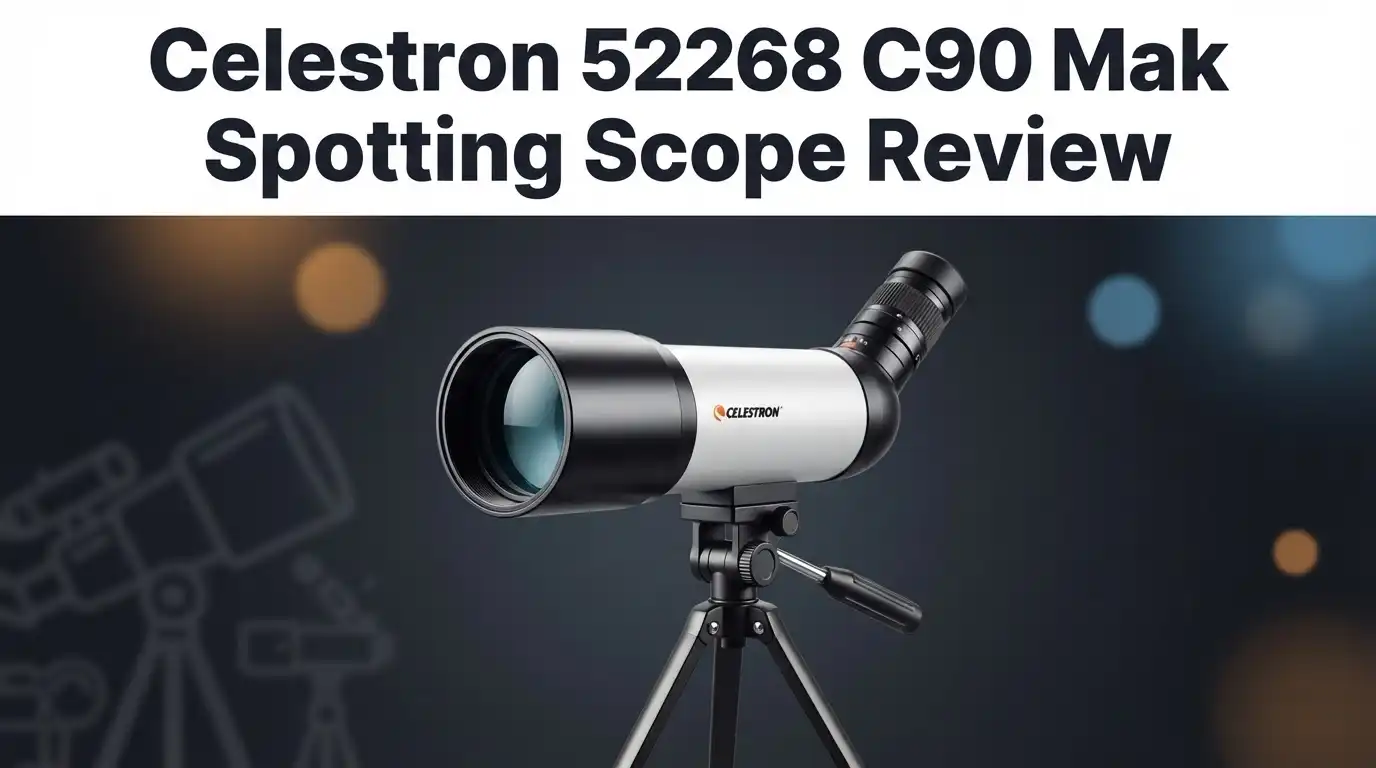
Celestron 52268 C90 Mak Spotting Scope Review 2026: Worth Buying?
The Celestron C90 Mak sits in a strange and wonderful place. It looks like a chunky spotting scope, but it behaves like a small telescope that escaped from an observatory.
Birders pick it up for its reach. Target shooters love its close focus. Backyard astronomers grab it because the Moon looks unreal through it.
So the real question in 2026 is simple. Does a 90mm Maksutov Cassegrain design still beat modern zoom spotting scopes at a similar price? I spent time with this scope on a tripod, on an equatorial mount, at the range, and under a dark sky. This review covers what impressed me, what annoyed me, and who should walk away from it.
In a Nutshell:
- The optics punch above the price. The 90mm Maksutov Cassegrain design delivers sharp, high contrast images with almost no color fringing. Star points stay tight. Rooflines stay crisp. Chromatic aberration is basically a non issue here.
- You get one fixed magnification out of the box. The included 32mm Plossl eyepiece gives roughly 39x. There is no zoom eyepiece, so scanning a wide field feels tight compared to standard birding scopes.
- Close focus is the hidden superpower. It focuses down to about 15 feet. Butterflies, feeders, and paper targets at 50 yards all look excellent. Most refractor spotting scopes cannot come close to this.
- It doubles as a real telescope. The Vixen style dovetail rail and T threaded rear cell let you mount it on an astronomy mount and swap in shorter eyepieces for planetary views up to 150x or more.
- Extras are almost mandatory. Plan on buying a sturdy tripod, extra eyepieces, and a 90 degree star diagonal if astronomy interests you. The stock accessory set is thin.
- It is not a weatherproof birding scope. No nitrogen purging and no full waterproof rating. Treat it with care in bad weather.
Celestron 52268 C90 Mak Spotting Scope Overview

- 90MM MAKSUTOV-CASSEGRAIN SPOTTING SCOPE: Compact and lightweight, the C90 is an ideal choice for bird watching, nature observation, target shooting, and digiscoping.
- BRIGHT, SHARP VIEWS OF DISTANT TARGETS: Ideal for spotting small land-based targets at great distances or viewing astronomical objects at night.
Last update on 2026-09-28 / Affiliate links / Images from Amazon Product Advertising API Some of the links on this website are affiliate links, which means that at no additional cost to you, I earn a commission if you click through and make a purchase. I only recommend products and services that I believe will add value to my readers. Thank you for your support!
The C90 Mak is a catadioptric scope, meaning it uses both a lens and mirrors. Light enters through a thick curved corrector lens, hits a spherical primary mirror, bounces off an aluminized spot on the back of the corrector, then exits to the eyepiece. That folded light path packs a 1250mm focal length into an 11 inch tube.
Celestron revived this model in the mid 2000s, and the modern version fixed the flaws of the vintage orange C90. You now get a proper primary mirror focuser instead of a twisting tube. Coatings are better too, so images look brighter. The design needs no collimation, which removes a common headache for beginners.
The result is a sealed, compact, high power instrument that weighs about as much as a heavy camera lens.
Unboxing Experience and First Impressions
The box is small enough that I double checked the label. Inside sits a soft nylon carry case with a zipper and shoulder strap, and the scope nests in a foam cradle.
Lift the tube out and the density surprises you. It weighs roughly three and a half pounds, yet it feels solid, like a machined tool rather than a plastic toy. The black satin finish resists fingerprints. The focus knob sits at the rear and turns with mild stiffness, which I actually prefer at high power.
You also get the 32mm Plossl eyepiece and a 45 degree correct image diagonal, both in small plastic sleeves. The whole setup takes under two minutes to assemble. No tools, no instructions needed. That first look at the glossy corrector lens sells the product on its own.
Key Specifications Made Simple
Here are the numbers that actually matter in the field.
Aperture measures 90mm, or about 3.5 inches. Focal length is 1250mm at roughly f/13.9. The bundled eyepiece produces close to 39x magnification with a 2.3mm exit pupil and a generous 20mm of eye relief. True field of view lands a little above one degree, which translates to roughly 70 feet of coverage at 1000 yards.
Close focus sits near 15 feet. The optical tube runs 11 inches long and accepts standard 1.25 inch eyepieces. The rear cell carries T threads for camera adapters, and the base includes a Vixen style dovetail rail plus a photo tripod socket.
That dovetail rail is the detail most buyers overlook, and it unlocks serious astronomy use.
Optical Performance in Daylight
Daylight is where this scope shines hardest. At 39x, the image looks bright, neutral in color, and sharp right across the center. Edge sharpness drops slightly, but only in the outer fifteen percent of the view.
I watched herons across a marsh at about 400 yards. Feather texture, beak detail, and eye color all resolved cleanly. Contrast stood out most. Dark subjects against bright sky kept their shape instead of smearing into glare.
Chromatic aberration stays nearly invisible thanks to the mirror based design. That is a real advantage over cheap refractor scopes, which often paint purple halos around branches.
Heat shimmer becomes the limiting factor on hot afternoons. At 39x over baking asphalt, air turbulence beats optics every single time. That is physics, not a flaw.
Top 3 Alternative for Celestron 52268 C90 Mak Spotting Scope

- ULTIMA ANGLED ZOOM SPOTTING SCOPE: This versatile all-around spotting scope with an 80mm objective lens, 20-60x zoom, and a 45° viewing angle is the ideal choice for any outdoor enthusiast. It's perfect for observing nature and long-distance viewing.
- INCLUDES ESSENTIALS FOR BETTER VIEWING: The Celestron Ultima 80 comes complete with a soft carrying case, an extended tripod mounting plate, a zoom eyepiece with an integrated T-adapter for digiscoping, an eyepiece pouch, a lens cloth, and more.

Last update on 2026-09-13 / Affiliate links / Images from Amazon Product Advertising API Some of the links on this website are affiliate links, which means that at no additional cost to you, I earn a commission if you click through and make a purchase. I only recommend products and services that I believe will add value to my readers. Thank you for your support!
Celestron Ultima 80 Angled Spotting Scope

- · PREMIUM OPTICS FOR BRIGHT, SHARP VIEWS: Fully multi-coated lenses with Celestron’s XLT coatings maximize light transmission for vivid color, high contrast, and crisp detail—even at dawn or dusk.
- · PHASE-COATED BAK-4 PRISMS: Premium BaK-4 prisms with phase coatings boost resolution and contrast for edge-to-edge clarity.
Last update on 2026-09-28 / Affiliate links / Images from Amazon Product Advertising API Some of the links on this website are affiliate links, which means that at no additional cost to you, I earn a commission if you click through and make a purchase. I only recommend products and services that I believe will add value to my readers. Thank you for your support!
Celestron TrailSeeker 80 Angled Spotting Scope

- Gosky Updated Newest 20-60x80 Spotting Scope - Variable 20x to 60x magnification and dynamic lens focusing system brings better optics, more stable images and easier focusing power. It’s the best choice for target shooting, archery, hunting, bird watching, wildlife watching, hiking, camping, scenery, outdoor sporting, astronomical observation etc
Last update on 2026-09-13 / Affiliate links / Images from Amazon Product Advertising API Some of the links on this website are affiliate links, which means that at no additional cost to you, I earn a commission if you click through and make a purchase. I only recommend products and services that I believe will add value to my readers. Thank you for your support!
Gosky Updated 80mm Spotting Scope with Tripod
Night Sky Performance on the Moon and Planets
Point the C90 at the Moon and you will forget the price tag. Craters along the terminator show terraced walls and central peaks. The high contrast Maksutov design makes lunar detail pop with almost no washed out glow.
Saturn’s rings separate clearly. Jupiter shows two main cloud belts plus the four Galilean moons as tiny discs. Mars stays small but shows a polar cap during a good opposition. Swap in a 6mm eyepiece and you reach roughly 208x, which this scope handles on steady nights.
Deep sky is a different story. With only 90mm of aperture and a narrow field, galaxies look like faint smudges. Big targets like the Pleiades will not fit in the view. Treat it as a lunar and planetary instrument, not a nebula hunter.
Build Quality and Design
The metal tube feels built to survive years of tailgate abuse. Nothing rattles. Nothing flexes. The corrector lens sits recessed behind a short lip that provides mild protection against stray light and rain.
The focuser moves the primary mirror along an internal rod. Motion stays smooth with only a small amount of image shift near the end of travel. That shift is common in this design and rarely bothers daytime users.
One gripe matters. The internal baffle tube has a shiny finish, and shiny surfaces scatter light. On bright targets that scatter reduces contrast slightly. Adding self adhesive flocking paper inside the tube fixes it for a few dollars.
The scope is sealed but not nitrogen purged and not rated fully waterproof, so heavy rain deserves respect.
Magnification and Eyepiece Options
The single fixed magnification defines the C90 experience. You get 39x and nothing else until you buy more eyepieces. That is the biggest behavioral difference from a zoom spotting scope.
The upside is huge flexibility. Because it accepts any 1.25 inch eyepiece, you can build a range that suits your use. A 25mm gives 50x. A 15mm gives around 83x. A 9mm gives roughly 139x.
A 1.25 inch zoom eyepiece also works, and many owners buy an 8mm to 24mm zoom to mimic a traditional spotter. That single purchase transforms the scope into a 52x to 156x variable instrument.
Remember the limit. Useful magnification caps near 180x to 200x on excellent nights, and atmospheric conditions decide the rest.
Close Focus Range and Nature Watching
Close focus at 15 feet is genuinely rare, and it changes how you use the scope. I aimed it at a backyard feeder from a porch and watched a chickadee fill the entire view. Feather barbs looked etched.
Insect watching becomes addictive. Dragonfly wings, spider webs, and flower stamens all reveal structure you cannot see with binoculars. Refractor spotting scopes usually need extension tubes to focus this close, and those tubes cut light.
The downside appears when you scan. At 39x the field is narrow, so finding a moving bird in thick brush takes patience. I learned to sight along the tube first, then look through the eyepiece.
A red dot finder or the optional finderscope solves this quickly and cheaply.
Hunting and Target Shooting Applications
Shooters get real value here. At 100 to 300 yards, 39x resolves bullet holes in paper with ease under decent light. The close focus range also covers pistol distances, which many zoom scopes struggle with at low magnification.
The 45 degree correct image diagonal keeps the view upright and correctly oriented, so movement tracks naturally. Sitting at a bench with an angled eyepiece feels comfortable during long sessions.
For spot and stalk hunting, portability helps. Three and a half pounds fits in a daypack easily. Field judging antlers at long range works well when air is stable.
The narrow field remains the tradeoff. Sweeping a hillside for movement is slow work at 39x, so bring binoculars for searching and use the C90 for confirming.
Digiscoping and Astrophotography Potential
The rear cell carries T threads, so a cheap T ring connects a mirrorless or DSLR camera directly. That gives you a 1250mm f/13.9 telephoto lens for a fraction of what a camera lens costs.
Lunar photography works beautifully. Single frames of the Moon look sharp, and planetary video stacking produces respectable Jupiter and Saturn images. Daytime wildlife photos are possible, though manual focus and slow aperture demand bright light.
Deep sky imaging is off the table. At f/13.9 the exposure times become impractical for galaxies and nebulae.
Phone digiscoping also works with a universal smartphone adapter over the eyepiece. Alignment takes practice, and video steadies better than photos. Results look shareable rather than professional.
Tripod and Mount Requirements
This is where budgets get real. High magnification amplifies every vibration, so a flimsy tripod ruins the experience. The small tripod included in some bundles is almost useless for serious viewing.
Plan on a tripod rated for at least ten pounds with a smooth pan and tilt head or a fluid video head. Slow motion control matters more than raw load capacity.
For astronomy, the Vixen style rail lets you attach the scope to an alt azimuth mount or a small equatorial mount. That combination turns the C90 into a capable grab and go telescope.
Budget accordingly. A decent tripod, an extra eyepiece or two, and a 90 degree star diagonal can add a meaningful amount to the total cost. The scope alone is only part of the picture.
What the C90 Does Not Do Well
Honest talk time. No single magnification. You either accept 39x or spend more money on eyepieces.
Cool down time is real. The thick corrector lens needs twenty to thirty minutes outdoors before high power views settle. Rush it and stars look bloated.
The narrow field makes scanning slow, and no finderscope ships in the standard package. Weather sealing falls short of premium birding scopes, so fog and heavy rain are risks.
The shiny internal baffle scatters light and lowers contrast slightly until you flock it. Image brightness also trails a quality 80mm refractor scope at matched magnification because of the central obstruction.
The eyecup is basic, and eyeglass wearers may want a better eyepiece. None of these kill the value, but they are real.
Pros and Cons
Pros
- Sharp, high contrast optics with virtually no color fringing
- Very compact at only 11 inches long and about three and a half pounds
- Excellent close focus down to roughly 15 feet
- Accepts any 1.25 inch eyepiece for magnification from 50x to 200x
- Doubles as a real telescope with the Vixen style dovetail rail
- T threads on the rear cell allow direct camera attachment
- Never needs collimation thanks to the sealed Maksutov design
- Strong lunar and planetary performance for the price
Cons
- Only one fixed magnification included
- No zoom eyepiece and no finderscope in the standard box
- Narrow field of view makes scanning slow
- Needs twenty to thirty minutes to reach thermal balance
- Not nitrogen purged or fully waterproof
- Shiny internal baffle tube reduces contrast until flocked
- Requires a sturdy tripod that costs extra
- Weak for deep sky astronomy and long exposure imaging
Who Should Buy It and Who Should Skip It
Buy it if you want maximum reach in a tiny package. Target shooters, hunters who glass at long range, and hybrid users who want both daytime spotting and lunar views will love it.
It also suits travelers. It fits in a carry on bag and needs no alignment. Anyone who enjoys tinkering with eyepieces will find it rewarding.
Skip it if you mainly scan wide areas for birds. A standard 80mm zoom spotting scope starting near 20x serves that job far better. Low power scanning is simply not this scope’s talent.
Also skip it if you want deep sky astronomy, or if you need a scope that shrugs off rain and dunking. A dedicated waterproof birding scope makes more sense there.
Price and Value in 2026
Pricing on the C90 has bounced around for years. It has sold as low as the high one hundreds and as high as the low three hundreds depending on stock and season. Check the current listing before deciding, because the value case shifts with the number.
At around two hundred dollars, it delivers optical quality that embarrasses similarly priced zoom scopes. You are buying glass and mirrors rather than features.
At three hundred or more, competition tightens. An 80mm ED scope with a zoom eyepiece becomes tempting for pure birding.
Factor in accessories honestly. The complete kit cost decides whether this is a bargain or merely fair. For a mixed use buyer, the flexibility still makes it a strong pick.
Final Verdict
- 90MM MAKSUTOV-CASSEGRAIN SPOTTING SCOPE: Compact and lightweight, the C90 is an ideal choice for bird watching, nature observation, target shooting, and digiscoping.
- BRIGHT, SHARP VIEWS OF DISTANT TARGETS: Ideal for spotting small land-based targets at great distances or viewing astronomical objects at night.
Last update on 2026-09-28 / Affiliate links / Images from Amazon Product Advertising API Some of the links on this website are affiliate links, which means that at no additional cost to you, I earn a commission if you click through and make a purchase. I only recommend products and services that I believe will add value to my readers. Thank you for your support!
The Celestron 52268 C90 Mak remains one of the smartest hybrid buys in optics. It gives you telescope grade sharpness in a spotting scope body, and it focuses closer than almost anything in its class.
You must accept its personality. One magnification, a narrow field, and a cool down wait. Add a good tripod and a zoom eyepiece and those limits mostly disappear.
I rate it 4.3 out of 5. It earns that score for optics, portability, and versatility, and it loses points for thin accessories and modest weather sealing.
If you want one compact instrument for wildlife, targets, and the Moon, this scope still deserves a spot on your tripod in 2026.
Frequently Asked Questions
What magnification does the Celestron C90 Mak come with?
The included 32mm Plossl eyepiece produces about 39x. You can change magnification by swapping in any 1.25 inch eyepiece. A 12mm gives roughly 104x and a 9mm gives about 139x.
Can the C90 Mak be used as a telescope?
Yes. It has a 1250mm focal length and a Vixen style dovetail rail. Mount it on an astronomy mount, add a 90 degree star diagonal, and it works as a capable lunar and planetary telescope.
Is the Celestron C90 waterproof?
No. The optical tube is sealed but it is not nitrogen purged and carries no full waterproof rating. Light rain and mist are survivable with care, but avoid heavy downpours and submersion.
Do I need a special tripod for this scope?
You need a sturdy one. Aim for a tripod rated for at least ten pounds with a fluid video head or a pan and tilt head with slow motion control. High magnification shows every vibration.
How does the C90 compare to an 80mm zoom spotting scope?
The C90 offers sharper high power views and much closer focusing. An 80mm zoom scope offers brighter images at low power, wider fields for scanning, and better weather sealing.
Can I attach a camera to the C90 Mak?
Yes. The rear cell has T threads, so a T ring connects most mirrorless and DSLR bodies directly. Smartphone adapters also work over the eyepiece for casual digiscoping.

Hello, I’m Amelia White, the founder of birdsfanatic.com. As a lifelong bird enthusiast and spiritual seeker, I’ve always been fascinated by the mystical connections between birds and the human experience. On this site, I share my knowledge and insights into the symbolic meanings and spiritual significance of various bird species, exploring their roles in mythology, folklore, and cultural traditions. Join me on this journey into the world of birds, where we’ll discover the hidden wisdom and guidance that these magnificent creatures have to offer.