
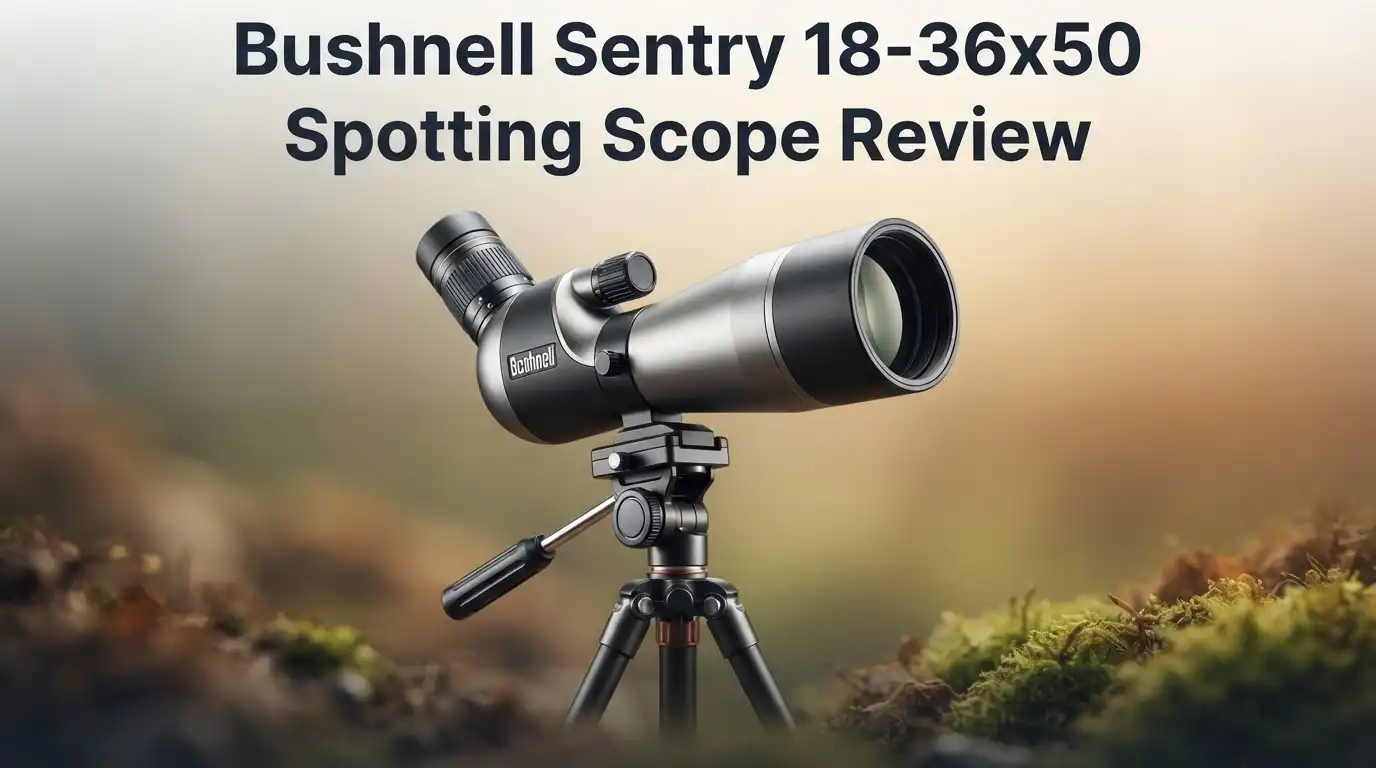
Bushnell Sentry 18-36×50 Spotting Scope Review 2026: Still Worth It?
Spotting scopes used to cost a small fortune. The Bushnell Sentry 18-36×50 broke that rule years ago, and it is still sitting on shelves in 2026 at a price most shooters can shrug off. But cheap optics age fast, and the market has filled up with 80mm scopes that cost about the same money.
So the real question matters. Does a compact 50mm porro prism scope from a legacy brand still earn a spot in your range bag? Or has it become a relic that survives on brand recognition alone?
I spent time with this scope at a 100 yard bay, in a backyard, and on a cold morning where the light was terrible. This review covers the unboxing, the glass, the wobbly tripod, and the parts Bushnell does not advertise. You will get the honest weak points, not just the spec sheet.
In a Nutshell:
- The price is the whole story. The Sentry carries a $149.95 list price but usually sells far below that. At street prices near $90 to $130, it competes with toys, not with real optics. That context changes how you should judge it.
- Daylight performance is genuinely fine. Fully multi coated glass and BaK-4 porro prisms give you clean, usable images at 18x and 24x. You can see .22 caliber holes at 100 yards on a clean white target without squinting.
- The top end of the zoom is a letdown. At 36x the exit pupil shrinks to 1.4mm. The image gets dim, soft, and hard to hold steady. Most owners settle around 20x to 25x and leave it there.
- Portability is the hidden strength. At 30.9 ounces and 14.7 inches long, it slips into a daypack. Full size 80mm scopes cannot do that.
- The included tripod is the weak link. It is a small tabletop unit. Plan on buying a real tripod, and budget for it.
- Water resistance is rated IPX4, not submersible. Older marketing said waterproof. Current specs say splash resistant. Know the difference before you trust it in a storm.
Bushnell Sentry 18-36×50 Spotting Scope: Full Overview

- 20 ft (6M) minimum focus distance
- 18 to 36x magnification and 50mm objective lens spotting scope
Last update on 2026-09-28 / Affiliate links / Images from Amazon Product Advertising API Some of the links on this website are affiliate links, which means that at no additional cost to you, I earn a commission if you click through and make a purchase. I only recommend products and services that I believe will add value to my readers. Thank you for your support!
The Sentry sits at the entry point of the Bushnell spotting scope lineup. Bushnell builds it around a 50mm objective lens and a porro prism design, which is the classic offset shape you see on older binoculars. The model number is 783618 for the straight black version.
The zoom runs from 18x to 36x. That range is modest by modern standards, and that is intentional. Bushnell aimed this scope at casual users: range shooters checking targets, backyard birders, and hikers who want more reach than binoculars.
The body wears a rubber armor coating. It feels grippy and takes knocks without complaint. A sliding sunshade sits at the front, and a twist up eyecup handles the back end.
This is not a hunting scope for judging antler mass at 800 yards. It is a light, simple, affordable optic. Judge it on those terms.
Unboxing Experience: What Actually Arrives
The box is small. That is the first surprise if you have handled full size scopes before. It is roughly the size of a shoebox and light enough to carry with two fingers.
Inside you find the scope wrapped in a soft padded case. The case has a shoulder strap and a simple zip. It protects against scratches and dust, not against drops.
A compact tabletop tripod sits beside it in a molded tray. The legs are short, maybe six inches extended. There is a small pan head with a single locking lever.
You also get lens caps for both ends, a lens cloth, and a folded instruction sheet. The paperwork is thin and mostly covers tripod mounting and eyecup use.
First impression? The scope itself feels better than expected. The rubber armor is thick and the barrel has real heft. The tripod feels like an afterthought.
Key Specifications at a Glance
Here is what Bushnell publishes for this model. These numbers tell you a lot once you know how to read them.
The magnification runs 18x to 36x with a 50mm objective. The prism system is porro with BaK-4 glass, and the lenses are fully multi coated. That coating level matters, because cheaper scopes often use partial coatings.
Field of view measures 112 feet at 1000 yards. Eye relief is 16.5mm. Exit pupil ranges from 2.8mm down to 1.4mm across the zoom range. Close focus is 20 feet.
Physically it measures 14.7 inches long and weighs 30.9 ounces. Water resistance is rated IPX4.
Translation: the 1.4mm exit pupil at full zoom is the number that predicts the dim, murky image at 36x. Your eye pupil is far larger than that even in bright sun.
Top 3 Alternative for Bushnell Sentry 18-36×50

- ULTIMA ANGLED ZOOM SPOTTING SCOPE: This versatile all-around spotting scope with an 80mm objective lens, 20-60x zoom, and a 45° viewing angle is the ideal choice for any outdoor enthusiast. It's perfect for observing nature and long-distance viewing.
- INCLUDES ESSENTIALS FOR BETTER VIEWING: The Celestron Ultima 80 comes complete with a soft carrying case, an extended tripod mounting plate, a zoom eyepiece with an integrated T-adapter for digiscoping, an eyepiece pouch, a lens cloth, and more.

Last update on 2026-09-13 / Affiliate links / Images from Amazon Product Advertising API Some of the links on this website are affiliate links, which means that at no additional cost to you, I earn a commission if you click through and make a purchase. I only recommend products and services that I believe will add value to my readers. Thank you for your support!
Celestron Ultima 20-60×80 Angled Spotting Scope

- Same Trusted Design: This Trophy Xtreme 20-60x65 is built on the same great platform as our previous model, but now comes in black rubber armor. This model provides a cheaper option for those not needing a tabletop tripod.
- Black Rubber Armor: Engineered for extreme conditions, the Trophy Xtreme spotting scope features a durable rubber-armored housing and 100% waterproof construction—ideal for trophy hunting, wildlife observation, and birding in any environment.
Last update on 2026-09-17 / Affiliate links / Images from Amazon Product Advertising API Some of the links on this website are affiliate links, which means that at no additional cost to you, I earn a commission if you click through and make a purchase. I only recommend products and services that I believe will add value to my readers. Thank you for your support!
Bushnell Trophy Xtreme 20-60×65 Waterproof Spotting Scope

- Gosky Updated Newest 20-60x80 Spotting Scope - Variable 20x to 60x magnification and dynamic lens focusing system brings better optics, more stable images and easier focusing power. It’s the best choice for target shooting, archery, hunting, bird watching, wildlife watching, hiking, camping, scenery, outdoor sporting, astronomical observation etc
Last update on 2026-09-13 / Affiliate links / Images from Amazon Product Advertising API Some of the links on this website are affiliate links, which means that at no additional cost to you, I earn a commission if you click through and make a purchase. I only recommend products and services that I believe will add value to my readers. Thank you for your support!
Gosky Updated 20-60×80 Spotting Scope with Tripod
Optical Performance in Good Daylight
This is where the Sentry earns its keep. On a bright day at 18x, the image is bright, flat, and pleasantly sharp across most of the frame.
Colors look neutral. There is no strong yellow or blue cast, which is common in budget glass. Contrast holds up well on tree bark, feathers, and printed targets.
Chromatic aberration shows up as purple fringing on high contrast edges. Look at a dark branch against white sky and you will see it. It is mild at 18x and grows noticeable by 30x.
Edge softness appears in the outer 15 percent of the view. Center sharpness stays good through about 28x, then falls off.
The sweet spot is clear. Set it near 20x to 24x and the Sentry behaves like a scope costing twice as much. Push past 30x and you start fighting the optics instead of using them.
Low Light Performance and Why 36x Struggles
Dawn and dusk expose the limits of a 50mm objective. There is simply not enough glass up front to gather light.
At 18x the exit pupil is 2.8mm. That is workable at sunrise. You can identify a deer shape or a duck silhouette, though detail fades.
At 36x the exit pupil drops to 1.4mm. The image goes dim and grainy. Your eye also becomes very sensitive to head position, so the view blacks out if you shift slightly.
Compare that to an 80mm scope at 60x, which still delivers a 1.3mm exit pupil but starts with far more light. The bigger scope wins every time in poor light.
Practical advice: treat the Sentry as a daylight instrument. If most of your glassing happens in the golden hour, this is the wrong tool and you should size up.
Build Quality and Weather Protection
The chassis feels solid. Rubber armor wraps the main tube and absorbs shock well. I dropped mine about two feet onto grass with no damage and no loss of collimation.
The tripod foot is metal with a standard 1/4 20 thread. That is good news, because plastic mounting feet fail on many cheap scopes.
Weather sealing deserves care. Current Bushnell specs list IPX4, which means splash resistance from any direction. Older packaging and many retailer listings still claim fully waterproof and fogproof with O ring seals and nitrogen purging.
Those claims conflict. Treat the conservative rating as truth. Rain is fine. Submersion is not.
Fogging has not been an issue in my use, including moving from a cold car into humid air. Still, do not assume the internal purge matches premium models.
The Included Tripod: An Honest Assessment
Let me be blunt. The bundled tabletop tripod is the weakest part of this package.
The legs are short and thin. On a shooting bench it works, barely. Set it on grass or gravel and it wobbles enough to blur your view at 30x.
The pan head has a single lever. Fine adjustment is nearly impossible. You loosen it, the scope flops, you tighten it, and your aim point shifts.
Vibration is the real enemy at high magnification. Every bump to the bench travels straight to the image.
My recommendation is simple. Budget an extra $40 to $80 for a real tripod. A basic video tripod with a fluid pan head transforms this scope. The image steadiness improves so much that people assume you bought better glass.
Focus Wheel and Zoom Ring Feel
The Sentry uses a center focus wheel on top of the body. It is a ribbed rubber knob, easy to find without looking away from the eyepiece.
Travel from close focus to infinity takes roughly one and a half turns. That is reasonably fast. The action is smooth with light resistance and no gritty spots on my sample.
The zoom collar sits at the rear of the eyepiece. It rotates with moderate friction and has index marks at 18, 24, 30, and 36.
Here is a real annoyance. Zooming shifts the focus slightly. You will need to touch up focus after every magnification change. Premium scopes hold focus through the zoom range. This one does not.
Another small gripe: the zoom collar sits close to the eyecup. Gloved hands sometimes grab both at once.
Field of View and Eye Relief for Glasses Wearers
The field of view is 112 feet at 1000 yards at the low end. That is narrow. A good 8×42 binocular gives you three times that width.
Finding your target takes practice. I recommend a simple habit: locate the subject with binoculars first, note a landmark, then sweep the scope to it.
Eye relief measures 16.5mm. For glasses wearers that is adequate but not generous. With the twist up eyecup collapsed, most eyeglass users see the full field at 18x.
At higher magnification the usable eye relief tightens. Some glasses wearers report a slight vignette at 30x and above.
Sunglasses with thick frames cause more trouble than thin prescription lenses. If you wear heavy wraparound eyewear, test before committing.
Range Use: Can You Spot Bullet Holes?
This is the most common use case, so let me give specific results.
At 100 yards, .22 caliber holes in a clean white target are visible at 24x. They appear as small gray dots. Add a black bullseye and you will struggle, because black on black hides holes.
At 200 yards, .30 caliber holes are spottable at 30x under good light. .22 holes at that distance are unreliable.
Beyond 200 yards, forget individual holes. You can see hits on steel and splash on dirt, which covers most practical shooting.
Shoot N C style reactive targets change everything. With those, the Sentry easily shows hits well past 200 yards because the contrast does the work for you.
Mirage affects the image heavily on hot days. Dropping to 18x cuts the shimmer and often reveals more detail than zooming in.
Birding and Wildlife Viewing
Birders will find both strengths and frustrations here. The 20 foot close focus is a real limitation. Many dedicated birding scopes focus down to 15 feet or less, which matters for feeders and nearby ponds.
For distant water birds the Sentry works well. Ducks on a lake at 200 yards show clear plumage patterns at 24x.
Songbird identification requires good light and a steady tripod. Subtle field marks like wing bars and eye rings become visible around 24x in bright conditions.
The straight body design is a mixed blessing. It is easier for beginners to aim, but uncomfortable for viewing anything above eye level.
Color accuracy is good enough for identification work. You will not confuse a yellow warbler with a goldfinch because of a color cast, which is a genuine problem with some bargain scopes.
Digiscoping With a Phone: Does It Work?
Plenty of people want to photograph what they see. The honest answer is that the Sentry is a poor digiscoping platform.
The eyepiece is small in diameter, which makes phone adapter alignment fussy. Cheap universal adapters clamp on, but centering takes patience.
Vignetting is heavy. You will get a dark circle around your image at most zoom settings. Cropping fixes it, but you lose resolution.
Image quality through a phone drops noticeably compared to what your eye sees. Expect soft, low contrast results suitable for documentation, not for sharing.
The wobbly included tripod compounds the problem. Every tap on your phone screen shakes the image.
If photography is a priority, buy an 80mm scope with a wide eyepiece and a sturdy tripod instead. The Sentry is for looking, not for capturing.
What the Bushnell Sentry Does Not Do Well
Authentic reviews name the flaws, so here they are without softening.
The 36x setting is mostly marketing. The image degrades so much that you rarely use it. Functionally this is an 18x to 28x scope.
The tripod is inadequate. Treating it as a real accessory sets you up for disappointment.
Low light performance is poor. A 50mm objective cannot compete with 65mm or 80mm designs at dawn and dusk.
Focus shifts when you zoom. Minor, but constant.
No angled eyepiece option in this model. Awkward for shared viewing and for anything overhead.
Water resistance claims are inconsistent across sources, with current specs at IPX4 rather than fully submersible.
Close focus at 20 feet limits feeder and butterfly watching.
None of these are dealbreakers at the price. They become dealbreakers if you paid full list price expecting premium performance.
Pros and Cons
Pros
- Excellent value at street prices. Often available near $90 to $130, which undercuts nearly every comparable spotting scope with real glass quality.
- Genuinely portable. At 30.9 ounces and 14.7 inches, it packs into a daypack without complaint. Full size scopes cannot make that claim.
- Sharp, bright images in the 18x to 25x range. Fully multi coated optics and BaK-4 prisms deliver clean views with neutral color in good light.
- Tough rubber armored body. Survives bench abuse, transport, and light rain without drama.
- Metal tripod foot with standard threading. Upgrades to any tripod you already own.
- Bushnell warranty support and wide parts availability. Backed by a brand that has been around for decades.
Cons
- 36x magnification is barely usable. The 1.4mm exit pupil makes the top end dim and soft.
- Included tabletop tripod is too flimsy for steady viewing above 24x.
- Weak low light performance caused by the small 50mm objective.
- Narrow 112 foot field of view makes target acquisition slow.
- Focus shifts during zoom changes, requiring constant readjustment.
- Poor digiscoping results with heavy vignetting and soft images.
Who Should Buy the Bushnell Sentry 18-36×50?
- 20 ft (6M) minimum focus distance
- 18 to 36x magnification and 50mm objective lens spotting scope
Last update on 2026-09-28 / Affiliate links / Images from Amazon Product Advertising API Some of the links on this website are affiliate links, which means that at no additional cost to you, I earn a commission if you click through and make a purchase. I only recommend products and services that I believe will add value to my readers. Thank you for your support!
This scope fits a specific buyer. Match yourself against the list before ordering.
Buy it if you shoot at 100 to 200 yards and want to check targets without walking downrange. It handles that job every weekend without fuss.
Buy it if you want a first spotting scope and refuse to spend $300 to find out whether you like the hobby. This is the cheapest honest entry point.
Buy it if portability outranks image quality. Backpackers and travelers will appreciate the size.
Skip it if you hunt at dawn and dusk. The low light limits will frustrate you.
Skip it if you plan to digiscope or judge fine detail past 300 yards.
My honest take: pair it with a proper tripod and it punches well above its price. Use it with the bundled tripod at 36x and you will hate it.
Price and Final Verdict for 2026
Bushnell lists the Sentry at $149.95. Almost nobody pays that. Real world pricing typically lands between $85 and $130 depending on the retailer and the season.
At $90 the value is outstanding. At $150 the calculation changes, because an 80mm scope with a real tripod sits within reach at that price.
The competition has gotten stronger. Budget 80mm scopes now deliver more aperture for similar money, though they weigh three times as much.
My verdict: the Bushnell Sentry 18-36×50 remains a solid buy in 2026, but only at a discount and only for daylight use. It is honest glass in a small package with clear limits.
Rating: 3.8 out of 5. It does the simple things well and does not pretend to be more than it is. That kind of honesty is rare in budget optics.
Frequently Asked Questions
Is the Bushnell Sentry 18-36×50 waterproof?
Current Bushnell specifications rate it IPX4, which means splash resistant from all directions. Older packaging claimed full waterproofing. Treat it as rain safe but never submerge it.
Can you see bullet holes at 200 yards with this scope?
Yes, for .30 caliber holes on clean white targets in good light at 30x. Smaller .22 caliber holes at 200 yards are unreliable. Reactive targets solve this problem completely.
Does the Bushnell Sentry come with a tripod?
It includes a small tabletop tripod with short legs and a basic pan head. The scope also has a standard 1/4 20 metal mount, so upgrading to a full size tripod is strongly recommended.
Is 36x magnification actually usable?
Rarely. At 36x the exit pupil narrows to 1.4mm, producing a dim and soft image that shakes easily. Most owners find 20x to 25x delivers the best balance of detail and brightness.
How does it compare to an 80mm spotting scope?
An 80mm scope gathers far more light and holds detail at higher magnification. The Sentry wins on weight, size, and price. Choose based on whether you carry your scope or leave it on a bench.
Is the Bushnell Sentry good for bird watching?
It works for medium and long distance birding in good light. The 20 foot close focus and narrow field of view limit its use for nearby feeder watching or fast moving songbirds.

Hello, I’m Amelia White, the founder of birdsfanatic.com. As a lifelong bird enthusiast and spiritual seeker, I’ve always been fascinated by the mystical connections between birds and the human experience. On this site, I share my knowledge and insights into the symbolic meanings and spiritual significance of various bird species, exploring their roles in mythology, folklore, and cultural traditions. Join me on this journey into the world of birds, where we’ll discover the hidden wisdom and guidance that these magnificent creatures have to offer.