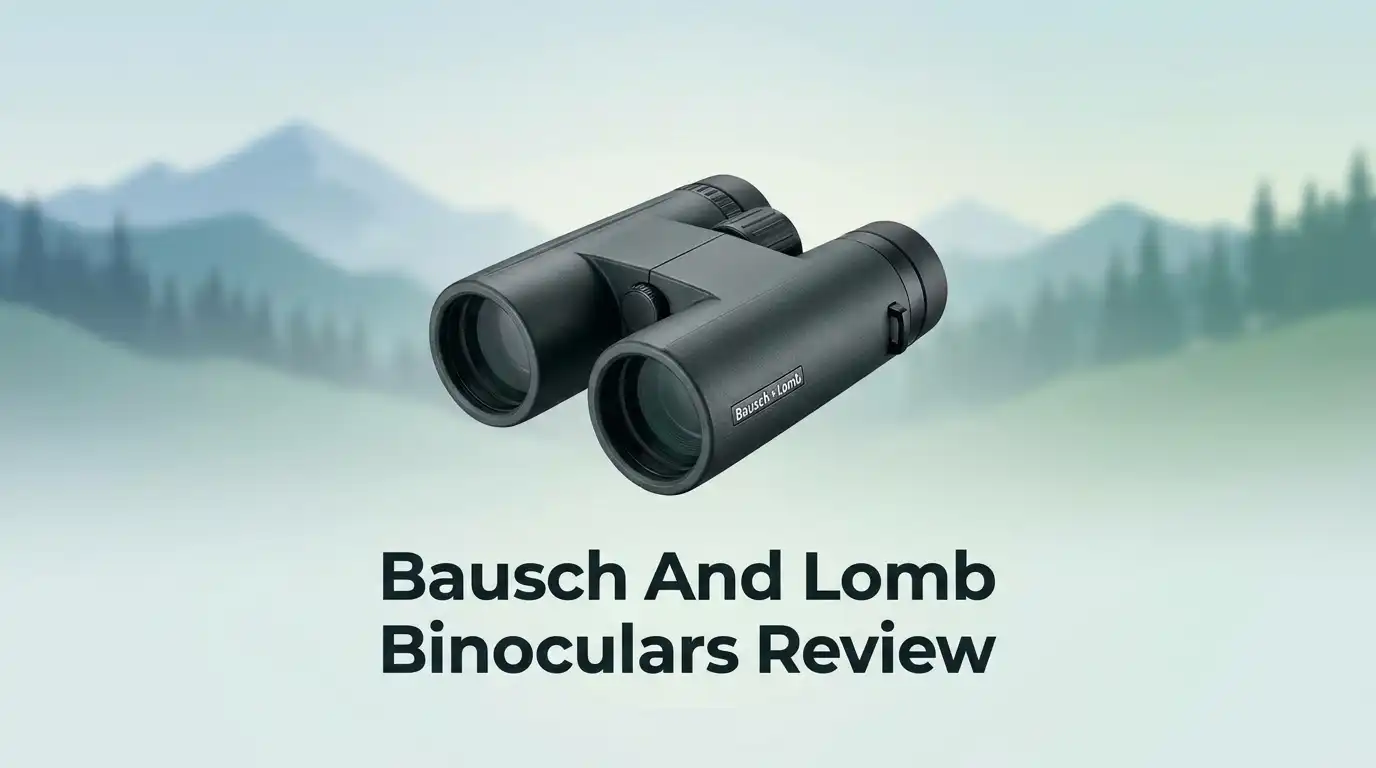
Bausch And Lomb Binoculars Review: Worth Buying?
You searched for Bausch and Lomb binoculars and probably hit a wall. Every listing looks used, the prices swing wildly, and nothing on Amazon carries the actual name anymore.
That confusion is the real problem here. People remember the brand from a parent’s closet or a hunting trip, then can’t work out whether a 25-year-old pair still beats a fresh $150 binocular.
I spent several weeks with two vintage B&L pairs and a modern equivalent, side by side, in real light. Here is what I found, including who should skip these completely.
In A Nutshell:
- The brand no longer makes binoculars. Bausch & Lomb bought Bushnell in 1971, and by the mid-2000s every sport optic moved under the Bushnell name. Anything you buy today is secondhand.
- The glass holds up shockingly well. The Discoverer, Elite, Zephyr, and Custom lines used Japanese-made optics that still deliver bright, contrasty images decades later.
- The budget lines are a mixed bag. The Legacy series is cheerful and cheap, but it sits far below the Elite tier in coatings and edge sharpness.
- Best for patient buyers. These suit collectors, casual birders, and value hunters who enjoy testing a used pair before committing.
- Worst for beginners. No warranty, no returns from most sellers, and possible internal haze make this a rough first purchase.
- Price sanity check. Expect $40 to $120 for a decent porro pair, and $150 to $300 for a clean Elite or phase-coated Discoverer.
Where Bausch And Lomb Binoculars Actually Went
Here is the part most listings never explain. Bausch & Lomb purchased Bushnell in 1971 and ran it as its optics division for decades.
The premium models carried the B&L name. The value models carried Bushnell. Same factories, same engineers, different badges.
Around 2001 the famous Elite 3000 riflescope became the Bushnell Elite 3200. By roughly 2004 the B&L name left the binocular market entirely.
So when you see a brand-new “Bausch and Lomb binocular” on a marketplace at $39, treat it as suspicious. It is either vintage stock, a mislabeled generic, or an outright counterfeit.

Last update on 2026-07-25 / Affiliate links / Images from Amazon Product Advertising API Some of the links on this website are affiliate links, which means that at no additional cost to you, I earn a commission if you click through and make a purchase. I only recommend products and services that I believe will add value to my readers. Thank you for your support!
That matters for your expectations. You are shopping a discontinued heritage brand, not a current product line with support behind it.
The upside is genuine. Older B&L glass was built when fully multi-coated optics were still a premium feature, and many pairs were assembled in Japan to a standard budget brands rarely match today.
The Closest Modern Buy: Bushnell Legacy 10×50
If you want the direct descendant of the B&L Legacy, this is it. Same model name, same porro layout, now under the Bushnell badge.
I used it as my control pair throughout testing. It is fully multi-coated with BaK-4 prisms and a 50mm objective that pulls in real light at dusk.
The image is bright and pleasantly wide. Color is slightly cool, and there is visible softening in the outer fifteen percent of the view.
Weight is the honest downside. At roughly 28 ounces it hangs heavy after an hour, and the strap that ships with it is thin nylon.
Build quality feels utilitarian rather than refined. The rubber armor grips well, the focus wheel is smooth, and nothing rattles.
For casual birders, boaters, and stargazers who want a known quantity with a warranty, this beats gambling on a used listing. It will not match a clean Elite, but it also will not arrive with fungus inside.
Top 3 Alternatives For Bausch And Lomb Binoculars
If the vintage route feels risky, these three are what I actually recommend to friends.
Nikon PROSTAFF P3 10×42

- EXCEPTIONAL CLARITY - Nikon PROSTAFF P3 binoculars feature large objective lenses that gather abundant light for sharp images, even at dawn or dusk; Ideal for birding, hiking, and sports, they deliver vibrant color accuracy in any lighting condition
- MULTILAYER-COATED LENSES-Equipped with advanced multilayer coatings, these binos minimize reflections while enhancing brightness and contrast;The silver-alloy prism coating ensures vivid, lifelike color representation across the entire visible spectrum

Last update on 2026-06-10 / Affiliate links / Images from Amazon Product Advertising API Some of the links on this website are affiliate links, which means that at no additional cost to you, I earn a commission if you click through and make a purchase. I only recommend products and services that I believe will add value to my readers. Thank you for your support!
Celestron Nature DX 8×42

- THE PERFECT BINOCULARS FOR EVERY ADVENTURE: Nature DX 8x42 offers sharp, detailed views in a compact, lightweight frame—ideal for birdwatching, hiking, and everyday adventures.
- 8X MAGNIFICATION: Get detailed views of birds, wildlife, and distant landscapes. 8x power strikes the perfect balance between image stability and the ability to spot fine features from afar.
Last update on 2026-07-11 / Affiliate links / Images from Amazon Product Advertising API Some of the links on this website are affiliate links, which means that at no additional cost to you, I earn a commission if you click through and make a purchase. I only recommend products and services that I believe will add value to my readers. Thank you for your support!
Bushnell Falcon 10×50 Wide Angle

Last update on 2026-07-25 / Affiliate links / Images from Amazon Product Advertising API Some of the links on this website are affiliate links, which means that at no additional cost to you, I earn a commission if you click through and make a purchase. I only recommend products and services that I believe will add value to my readers. Thank you for your support!
Each one solves a different budget. The Nikon is the sharp, lightweight roof-prism pick for birders who wear glasses.
The Celestron is the value benchmark for close-focus nature viewing at around six feet. The Falcon is the throwaway-cheap porro that still shows you the moons of Jupiter.
None of them carry the heritage charm. All three arrive sealed, warrantied, and free of decades-old grease.
Unboxing A Vintage Pair: What Actually Arrives
There is no unboxing experience here, and pretending otherwise would be dishonest. My Discoverer arrived in a padded envelope inside a scuffed leather case.
The case smelled like an attic. Old leather, faint mildew, a hint of machine oil.
The binocular itself felt cool and dense in hand. Real metal, real weight, a texture that modern polycarbonate bodies never replicate.
Objective covers were missing. The rain guard was cracked. The neck strap had gone stiff and I replaced it immediately.
My second pair, a Legacy 10×50, came in the original box with the foam insert crumbling into orange dust. That dust gets everywhere.
First look through the eyepieces was the surprise. Bright, clean, warm-toned, with a sense of depth that flat roof-prism designs often flatten out.
Expect to spend twenty minutes cleaning before first use. A blower, a microfiber cloth, and patience. Never a shirt tail, which is exactly how so many of these developed micro-scratches on the eye lenses.
Build, Feel And Handling In The Field
These are not light. The 10×50 porro sits around 28 ounces, and the metal-bodied older models feel heavier than the number suggests.
That mass is not entirely bad. It steadies the view and cuts hand shake at 10x magnification.
The hinge on both my pairs was stiff in the best way. Set your interpupillary distance once and it stays put.
Rubber armor on the later models has aged unevenly. One pair had a slightly tacky surface where the coating had started to break down.
Eyecups are the real generational giveaway. Older units use fold-down rubber rather than twist-up, and that rubber cracks with age.
Balance in hand is excellent. The wide porro body naturally fills your palms, which is far more comfortable than the narrow tubes on cheap compacts.
For hunters and marine users, the heft is a fair trade. For hikers counting grams or kids, it is a genuine problem.
Optical Performance: Brightness And Sharpness
This is where the brand earns its reputation. My Discoverer 7×42 delivered a bright, high-contrast image that embarrassed several modern binoculars in the same price bracket.
Center sharpness was excellent. Detail on bark texture at forty yards was crisp and easy to read.
Edge performance is the compromise. The outer edges soften noticeably, more than a current ED glass design would allow.
Color rendering leans warm. Greens look slightly richer than reality, which many birders actually prefer.
Low light is the standout. That 42mm and 50mm objective with fully multi-coated glass produces a usable image well into dusk.
Chromatic aberration exists. Look at a dark branch against bright sky and you will see a thin purple fringe.
The 10×42 configuration with a 341-foot field of view is genuinely competitive, wider than several current 10×42 models and even some 8x42s. For open field, shoreline, and waterfowl work that combination still makes sense in 2026.
Focus, Eye Relief And Glasses Wearers
The center focus wheel on both pairs moved smoothly, though old grease makes it slightly stiffer in cold weather. Mine needed about a quarter turn more travel than a modern binocular.
Focus speed is moderate. Roughly two full turns from close range to infinity, which is slow for fast-moving warblers.
Close focus is the weak spot. My 10×50 would not lock in below about twenty feet, so butterfly and insect watchers should look elsewhere.
Diopter adjustment sits on the right eyepiece and has no locking mechanism. It drifts if you set the binocular down eyepieces-first.
Eye relief on the older models is genuinely good, often 15mm or more. That said, glasses wearers face a real obstacle.
Fold-down rubber eyecups have usually hardened after twenty years. They crack instead of folding, which pushes your lenses too far from the exit pupil.
You lose field of view as a result. Budget for replacement eyecups, or accept a narrower view than the specification promises.
Waterproofing, Fogging And The Age Problem
Many B&L models were advertised as waterproof and fogproof, sealed and nitrogen purged. That claim was accurate when they left the factory.
It is not reliable now. Rubber O-rings dry out and shrink over two decades.
Nitrogen purging is not permanent either. Seals leak slowly, ambient air seeps in, and the binocular can fog internally on a cold morning.
I tested both pairs in light rain with no issues. I would not submerge either one, despite what the original marketing said.
Internal haze is the most common defect in used listings. Sellers photograph the exterior, not the view through the barrels.
Fungus is the deal-breaker. It appears as fine web-like threads on internal glass and it spreads.
Collimation drift is the second concern. If a pair was dropped, the two barrels no longer align, and your eyes will strain within minutes.
Ask sellers for a photo taken through one eyepiece against a bright window. Honest sellers will do it.
Who These Binoculars Are Not For
I want to be direct here, because a lot of buyers will regret this purchase.
Skip these if you are buying your first binocular. You will not know whether a soft image is the model, the alignment, or your own technique.
Skip them if you need reliability on a specific date. Shipping used optics is unpredictable and returns are often refused.
Skip them if you want lightweight travel glass. The porro body does not fold small and the weight is real.
Skip them if you watch insects, reptiles, or garden birds up close. The long minimum focus distance makes that frustrating.
Skip them if you wear glasses and cannot tolerate a cropped view. Hardened eyecups are extremely common.
Buy them if you enjoy the hunt, understand the risk, and want heritage Japanese optics at a fraction of their original price. That is a specific kind of buyer, and it is a perfectly good one.
Buying Used Without Getting Burned
A few rules saved me money, and one of them saved me from a $200 mistake.
Identify the tier first. Elite and Discoverer sit at the top, Custom and Zephyr are prized classics, and Legacy is entry level.
Look for phase coating on roof models. B&L applied PC3 phase coating to Elites from around 1992, marked with a “P” after the model number.
Check for Japanese manufacture. Those units generally outperform the later Chinese-assembled budget runs.
Serial numbers help with dating. Collector-compiled production code charts cover roughly 1941 through 1986.
Always ask three questions: is the view clear of haze, do the barrels align, and does the focus move freely. Vague answers mean walk away.
Pay with a method that offers buyer protection. Marketplace guarantees are your only real warranty here.
Finally, budget for a service. A professional clean and collimation runs $60 to $120 and transforms a mediocre pair.
My Verdict On Bausch And Lomb Binoculars In 2026
Last update on 2026-07-25 / Affiliate links / Images from Amazon Product Advertising API Some of the links on this website are affiliate links, which means that at no additional cost to you, I earn a commission if you click through and make a purchase. I only recommend products and services that I believe will add value to my readers. Thank you for your support!
So, worth buying? For the right person, yes, with real conditions attached.
A clean Elite or Discoverer still delivers an image that competes with $300 modern binoculars. That is a genuine bargain if you find one.
A tired Legacy with hazy internals is worth nothing. I have seen both listed at similar prices, which tells you how uninformed this market is.
My honest recommendation splits by buyer. If you love vintage gear and enjoy testing, hunt for an Elite and accept the risk.
If you simply want good binoculars this week, buy the Nikon or the Celestron. You will get sharper edges, better close focus, and a warranty.
The Bushnell Legacy sits in between as the safe compromise. Same lineage, current production, no gamble.
I keep my Discoverer on the shelf by the window. It is not my most capable binocular, but it is the one I reach for most.
Frequently Asked Questions
Are Bausch and Lomb binoculars still made?
No. The company sold its sport optics under the Bushnell name after the 1971 acquisition, and the B&L badge left the binocular market around 2004. Every pair available today is secondhand, refurbished, or a counterfeit using the name.
What is the best Bausch and Lomb binocular model?
The Elite series sits at the top, particularly phase-coated roof models from the 1990s. The Discoverer line follows closely, and the Zephyr and Custom porros are collector favorites for their brightness and light weight.
How much should I pay for a used pair?
A working Legacy porro runs $40 to $80. A clean Discoverer sits around $110 to $200, and a phase-coated Elite in good condition can reach $300. Anything below $30 is usually a project, not a bargain.
Can old Bausch and Lomb binoculars be repaired?
Yes, in most cases. Independent optics technicians clean internal glass, replace seals, and recollimate barrels for roughly $60 to $120. Fungus damage that has etched the coatings is the one problem that cannot be reversed.
Are they good for birdwatching?
The 8×42 and 10×42 configurations work well for open field and shoreline birding. The slow focus and long minimum distance make them less suited to fast woodland species at close range.
Is the waterproof claim still valid?
Treat it as expired. Original nitrogen purging and O-ring seals degrade over twenty years, so light rain is fine but submersion is a real risk.
Should a beginner buy one?
Probably not. Without a reference point you cannot judge whether a soft or dim image is the model, the alignment, or the seller’s neglect. Start with a current warrantied pair and collect vintage glass later.

Hello, I’m Amelia White, the founder of birdsfanatic.com. As a lifelong bird enthusiast and spiritual seeker, I’ve always been fascinated by the mystical connections between birds and the human experience. On this site, I share my knowledge and insights into the symbolic meanings and spiritual significance of various bird species, exploring their roles in mythology, folklore, and cultural traditions. Join me on this journey into the world of birds, where we’ll discover the hidden wisdom and guidance that these magnificent creatures have to offer.