
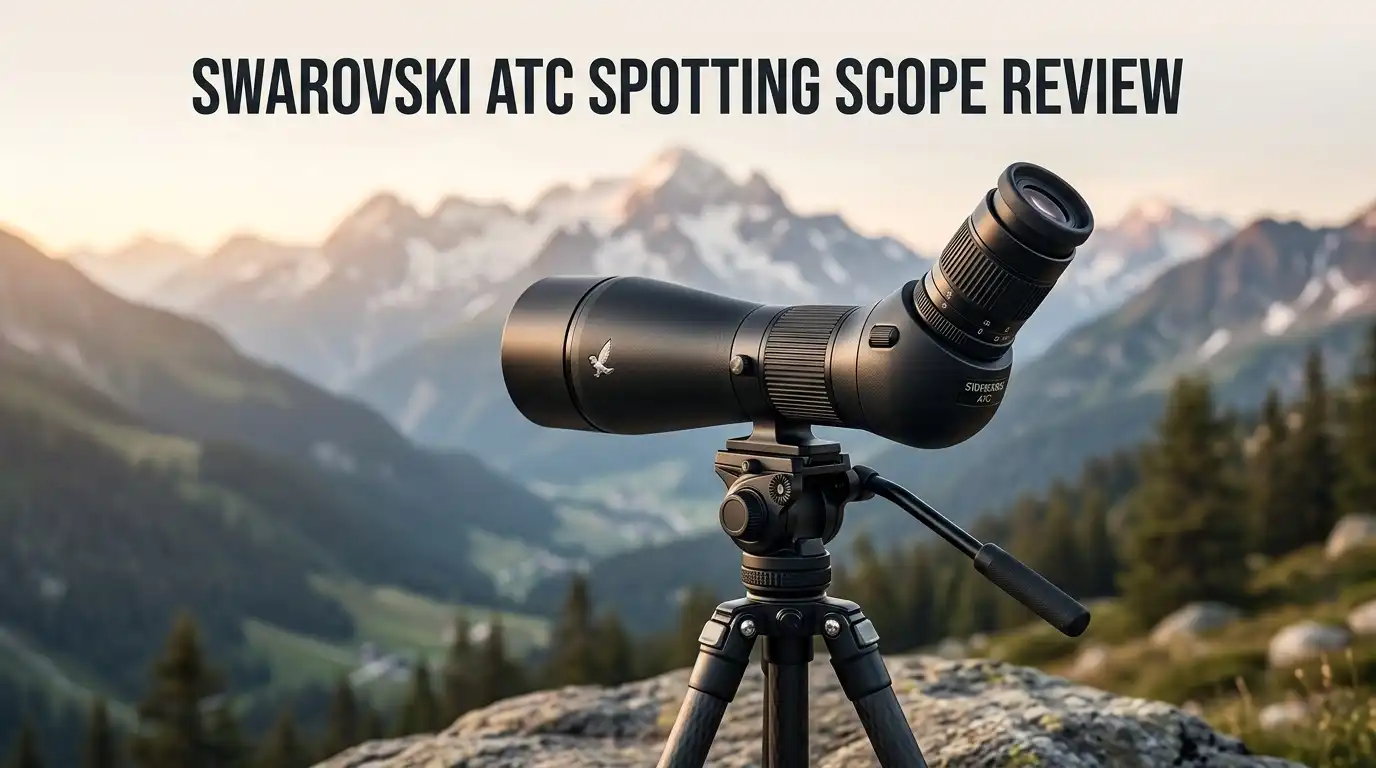
Swarovski ATC Spotting Scope Review 2026: Worth It?
Compact spotting scopes used to mean compromise. You gave up brightness, you gave up sharpness, and you gained a scope that fit in a daypack. The Swarovski ATC 17-40×56 broke that pattern.
It weighs about as much as a full water bottle, it fits inside a backpack sleeve, and it still shows feather detail at 800 yards. I carried this scope through cold mornings, dusty ridges, and one very wet coastal walk.
This review covers what the ATC does brilliantly, what frustrates owners, and whether the price still makes sense in 2026. No marketing fluff. Just field notes, specs, and honest criticism.
In A Nutshell:
- The ATC 17-40×56 weighs 34.2 ounces and measures 10.2 inches. That is roughly half the bulk of a standard 65mm scope. It slides into a daypack without a fight, and your shoulders notice the difference after five miles.
- Optical quality sits at the top of the compact class. HD glass, field flattener lenses, and SWAROVISION coatings deliver edge to edge sharpness with almost no color fringing. The image looks flat, clean, and natural.
- The 17x low end is the hidden strength. A wide 186 feet at 1000 yards field of view makes scanning fast. Many users report they rarely push past 30x anyway.
- Real weaknesses exist. The image dims noticeably above 35x. The tripod foot can rotate on some quick release plates. A minority of users struggle with the eyebox at high magnification.
- Price is $2,999 at Swarovski for 2026. That buys a 10 year warranty and glass that holds resale value, but budget alternatives now come surprisingly close for a third of the cost.
Swarovski ATC 17-40×56 Angled Spotting Scope

- SUPERIOR CLARITY - Experience unmatched image quality with the 56mm objective lens, capturing bright, clear images even in low-light conditions, enhancing every viewing experience with exceptional detail.
- VERSATILE MAGNIFICATION - Seamlessly adjust from 17x to 40x magnification, allowing you to zoom in on distant subjects with ease, perfect for detailed observation of wildlife or landscapes.
Last update on 2026-09-20 / Affiliate links / Images from Amazon Product Advertising API Some of the links on this website are affiliate links, which means that at no additional cost to you, I earn a commission if you click through and make a purchase. I only recommend products and services that I believe will add value to my readers. Thank you for your support!
The ATC is Swarovski’s smallest spotting scope. The letters stand for Angled Travel Compact. It pairs a 56mm objective lens with a fixed 17x to 40x zoom eyepiece, and the eyepiece does not detach. That single decision shaped the whole product. No eyepiece mount means a shorter body, fewer sealing points, and less weight.
Swarovski built the housing around a magnesium chassis with a green rubber armor coating. An orange version also exists, sold as a limited color. A removable half shell wraps the underside, so the scope sits flat on a rock or a pack without tipping.
The scope focuses down to 3.4 meters, which is close enough for butterflies and dragonflies in a garden. Eye relief measures 20mm. The body is waterproof and fog proof, nitrogen sealed, and rated for hard weather. Swarovski backs it with a 10 year warranty. This is a travel scope built without the usual travel scope excuses.
Unboxing Experience: What Actually Arrives
The box is understated. Swarovski ships the ATC in a slim cardboard sleeve with a printed product photo, not a glossy display case. Inside, molded foam holds the scope on its side.
You get the scope, an eyepiece cover, an objective lens cover, a padded carrying strap, the removable half shell already attached, an adapter plate for tripod mounting, and a cleaning cloth. A printed manual and warranty card sit underneath.
The first thing you notice is density. The ATC looks small in photos, then feels solid in the hand, like a well made camera lens. The rubber armor grips without feeling sticky. Focus and zoom wheels turn with a smooth, damped resistance right out of the box.
One small disappointment: there is no included case. A scope at this price should ship with soft protection. Swarovski sells a stay on case separately. Budget another $100 or so if you want that coverage.
Optical Performance In The Field
This is where the ATC earns its badge. The view is bright, flat, and clean from the center all the way to the edge. Field flattener lenses remove the soft, curved edges that plague most compact scopes. You scan across a hillside and the whole frame stays usable.
Chromatic aberration is very well controlled. On high contrast targets like a dark branch against white sky, you see almost no purple fringing in the center. A faint trace appears at the extreme edge, which is normal for every small scope on the market.
Color rendering leans neutral. Browns look brown. Greens look green. Nothing feels oversaturated or cool.
The sweet spot runs from 17x to about 32x. In that range the image stays bright and comfortable. Push past 35x and the view darkens, especially in low light. On a sunny afternoon 40x is perfectly usable. At dawn or dusk, you will drop back down and be happier for it.
Top 3 Alternative for Swarovski ATC 17-40×56

- The 11-33x50 Angled Razor is ultra-lightweight and packable for your convenience. The focus wheel is broken down to macro and micro adjustments, allowing the user to rapidly focus while the micro adjustment allows you to fine tune the image.
- Triplet Apochromatic lens combined with high density, extra-low dispersion glass delivers unparalled resolution and color fidelity. XR Plus anti-reflective coatings were applied to the lenses to yield maximum brightness for critical low-light glassing.

Last update on 2026-09-20 / Affiliate links / Images from Amazon Product Advertising API Some of the links on this website are affiliate links, which means that at no additional cost to you, I earn a commission if you click through and make a purchase. I only recommend products and services that I believe will add value to my readers. Thank you for your support!
Vortex Optics Razor HD 11-33×50 Angled Spotting Scope

- Waterproof Scope: TSN-500 is fully waterproof and nitrogen-filled, this tough little scope is designed to perform in harsh environments
- Lightweight Scope: Weighing only 400g, the TSN-500 series spotting scope is light enough to take with you even on the longest treks and expeditions
Last update on 2026-09-20 / Affiliate links / Images from Amazon Product Advertising API Some of the links on this website are affiliate links, which means that at no additional cost to you, I earn a commission if you click through and make a purchase. I only recommend products and services that I believe will add value to my readers. Thank you for your support!
Kowa TSN-501 20-40×50 Angled Spotting Scope

- Easily carried in vest or coat pocket, in belt pack, or shoulder bag
- ED lens optical system provides sharp, clear images with vivid, well-managed color
Last update on 2026-06-28 / Affiliate links / Images from Amazon Product Advertising API Some of the links on this website are affiliate links, which means that at no additional cost to you, I earn a commission if you click through and make a purchase. I only recommend products and services that I believe will add value to my readers. Thank you for your support!
Celestron Hummingbird ED 9-27×56 Angled Micro Spotting Scope
Weight And Packability On Real Hikes
Numbers tell part of the story. At 34.2 ounces for the angled model and 34.6 ounces for the straight STC, the ATC undercuts most 65mm scopes by a full pound. Standard full size spotters often pass 50 ounces before you add a tripod.
The length matters more than the weight. At 10.2 inches, the ATC is shorter than a sheet of printer paper. It drops into a daypack vertically, sits inside a carry on bag, and does not force you into a larger pack.
I carried it on a nine mile ridge walk with binoculars, water, and lunch. The scope never became the reason I wanted to turn around. That is the highest compliment you can pay a piece of glass.
Pair it with a light carbon tripod and the full kit lands near four pounds. That total is what convinces backcountry hunters and travel birders to spend Swarovski money.
Eye Relief And The Eyebox Truth
Swarovski lists 20mm of eye relief. On paper that sounds generous, and for most eyeglass wearers it is. Several long term owners say the ATC is the most glasses friendly scope they have used.
The reality is more complicated. A noticeable minority of users report blackouts and a tight eyebox, especially above 25x. Your eye has to sit in a precise spot or the image darkens at the edges. One birder tested the ATC beside a Maven CS.1A and described the difference in eyebox ease as night and day, in favor of the Maven.
The fix, when it works, is eyecup adjustment. The twist in eyecup has no click stops, so you can set any height. Many owners run it short at 17x to 22x and fully extended above that.
Try before you buy if your eyes are fussy. Eyebox comfort is personal, and no spec sheet predicts it.
Focus Wheel, Zoom Ring, And Handling
Both wheels sit on the body barrel, wide and easy to find with gloves on. The focus wheel turns roughly two full rotations from close focus to infinity. That is fast enough for birds in flight and precise enough for judging antler tines.
Most owners describe both wheels as smooth and free of backlash. Reviewers who have handled four or five units call the mechanism consistent and well damped.
A handful of buyers received units with a defect where the rubber armor lifted slightly and rubbed against the focus ring, creating a stiff, jerky feel toward infinity. That is a quality control miss, not a design flaw, and warranty service resolves it.
The half shell is genuinely clever. It keeps both wheels clear of the ground when the scope rests on a flat surface. You can glass off a rock with no tripod at all, which is exactly what you want when a bull steps out unexpectedly.
The Tripod Mount Problem Nobody Hides
This is the most consistent complaint about the ATC and it deserves a full section. The tripod foot is small and smooth. With a slick aluminum quick release plate, the scope can rotate on the plate under hand pressure.
The feeling is unsettling on a $2,999 instrument. You tighten the screw, you grab the eyepiece, and the whole scope twists a few degrees.
Owners have found workarounds. A plate with a rubber or cork surface grips far better. Using the 3/8 inch thread instead of the 1/4 inch thread helps. Some apply a wrap of plumber tape or a drop of thread locker on the screw and report zero movement for years afterward.
Newer ATC bodies include two blind holes in the base at the 3 and 9 o’clock positions for an antirotation pin. The spacing does not match standard aftermarket pins, so you may need a custom plate. Kowa clearly wins this round with its rotating collar design.
What The ATC Does Not Do Well
Honest reviews list the misses. Here are the ATC’s real limits.
The scope tops out at 40x, and the usable ceiling in dim light is closer to 32x. Hunters who need to count points at 1200 yards will want an 85mm scope.
The eyepiece is permanently fixed. You cannot swap in a wide angle fixed eyepiece or a higher power option. Competing modular scopes give you that flexibility.
Low light performance trails larger objectives by a clear margin. A 56mm lens simply gathers less light than a 65mm or 85mm lens. At last shooting light, bigger glass wins.
There is no included carry case, and the tripod mount needs attention before your first serious outing.
Finally, the price. You are paying roughly triple what a very good compact competitor costs, for an improvement that is real but incremental. That math works for some buyers and not for others.
Pros And Cons Of The Swarovski ATC
Pros
- Only 34.2 ounces and 10.2 inches long, so it disappears into a daypack.
- Edge to edge sharpness from field flattener lenses, with almost no color fringing.
- Wide 186 feet at 1000 yards field of view at 17x makes scanning fast and relaxed.
- Close focus at 3.4 meters covers butterflies, insects, and garden birds.
- Half shell design lets you glass from a rock, log, or backpack without a tripod.
- Fully waterproof and fog proof, backed by a 10 year Swarovski warranty.
- Excellent digiscoping platform when paired with the VPA 2 phone adapter.
Cons
- Image dims noticeably above 35x, limiting dawn and dusk range.
- Tripod foot can rotate on smooth quick release plates without a workaround.
- Eyebox feels tight for some users at higher magnification.
- Fixed eyepiece removes all upgrade flexibility.
- No case included at a $2,999 price point.
- A 56mm objective cannot match 65mm or 85mm scopes in fading light.
ATC Versus STC: Angled Or Straight
Swarovski sells the same scope in two body styles. The ATC uses an angled eyepiece. The STC uses a straight eyepiece. Optics, weight, and controls are effectively identical, with the STC adding 0.4 ounces.
Choose the angled ATC if you glass uphill often, share the scope with people of different heights, or want to run a shorter, lighter tripod. The angled eyepiece lets you sit low and keep the tripod legs short.
Choose the straight STC if you glass downhill from a ridge, shoot prone, or want faster target acquisition. Pointing a straight scope is intuitive. You look along the barrel and you are on target.
Hunters who glass from above tend to prefer the STC. Birders who set up on tripods in flat terrain usually prefer the ATC.
Neither choice is wrong. Think about the angle you look from most often, then pick accordingly.
How It Compares To Rivals
The Kowa TSN-553 is the ATC’s closest competitor. Kowa offers a rotating collar that solves the tripod issue entirely, plus excellent fluorite glass. The Swarovski counters with a wider field of view and slightly better edge performance.
The Maven CS.1A 15-45×65 costs far less and gives a larger objective, higher top magnification, and a genuinely easier eyebox. It weighs more and shows a narrower field of view. Several buyers who struggled with the ATC eyebox moved to the Maven and stayed there.
The Vortex Razor HD 11-33×50 runs around $1,000 and delivers strong optics with an even wider low end. Image quality falls short of the ATC, but the value is obvious.
The Kowa TSN-501 sits near $400 and remains the budget champion of the compact class.
The ATC is the best of this group optically. Whether the gap justifies the price gap is your call, not mine.
Price, Warranty, And Value In 2026
Swarovski lists the ATC 17-40×56 at $2,999 in 2026. Retail pricing stays consistent because Swarovski enforces minimum pricing. Deals are rare. The orange version occasionally sells at a small premium or discount depending on stock.
The 10 year warranty covers manufacturing defects and workmanship. Swarovski service has a strong reputation, and repairs generally come back fast and correct.
Resale value is a real factor. Swarovski optics hold value better than almost any other brand. A used ATC in good condition often sells for 70 to 80 percent of retail. That softens the true cost of ownership considerably.
Factor in the accessories you will want: a stay on case, a quality quick release plate with grip, and possibly the VPA 2 digiscoping adapter.
Realistic all in cost lands near $3,300. If you glass hundreds of hours a year, that spreads out to very little per session.
Who Should Buy The Swarovski ATC
Buy the ATC if weight and packability rank at the top of your list. Backcountry hunters who count ounces, travel birders flying with carry on limits, and hikers who want real magnification without a real burden are the target audience.
Buy it if you already own alpha binoculars and want matching image quality in a scope. The visual character lines up nicely with Swarovski NL Pure and EL models.
Buy it if you rarely push past 35x. The ATC excels in the 17x to 30x range, which covers most birding and a lot of scouting.
Skip it if you need maximum magnification for long range target work or trophy judging at extreme distance. An 85mm scope serves you better.
Skip it if a tight budget means the $2,000 difference could go toward a tripod, a rifle, or a trip. Good glass matters. Being out there matters more.
Frequently Asked Questions
Is the Swarovski ATC worth the price in 2026?
For weight conscious users who glass often, yes. The optical quality and 34.2 ounce weight combination remains unmatched. For casual users, a Vortex Razor or Maven CS.1A delivers 80 percent of the experience for a third of the price.
What is the difference between the ATC and STC?
The ATC has an angled eyepiece. The STC has a straight eyepiece. Optics and controls are identical. The ATC weighs 34.2 ounces and the STC weighs 34.6 ounces.
Does the ATC work well for digiscoping?
Yes. Paired with the Swarovski VPA 2 phone adapter, the ATC produces clean phone images. The flat field helps a lot. Keep magnification near 20x to 25x for the sharpest results.
Can you use the ATC without a tripod?
Yes, for short looks. The half shell lets it rest on rocks, packs, or fence posts. For extended glassing above 25x, a tripod is still necessary.
How does the ATC perform in low light?
Fine up to about 32x. Above 35x the image dims noticeably. A 56mm objective cannot match larger scopes at last light.
What warranty comes with the Swarovski ATC?
Swarovski provides a 10 year warranty covering manufacturing and workmanship defects, with a strong service reputation in North America and Europe.

Hello, I’m Amelia White, the founder of birdsfanatic.com. As a lifelong bird enthusiast and spiritual seeker, I’ve always been fascinated by the mystical connections between birds and the human experience. On this site, I share my knowledge and insights into the symbolic meanings and spiritual significance of various bird species, exploring their roles in mythology, folklore, and cultural traditions. Join me on this journey into the world of birds, where we’ll discover the hidden wisdom and guidance that these magnificent creatures have to offer.