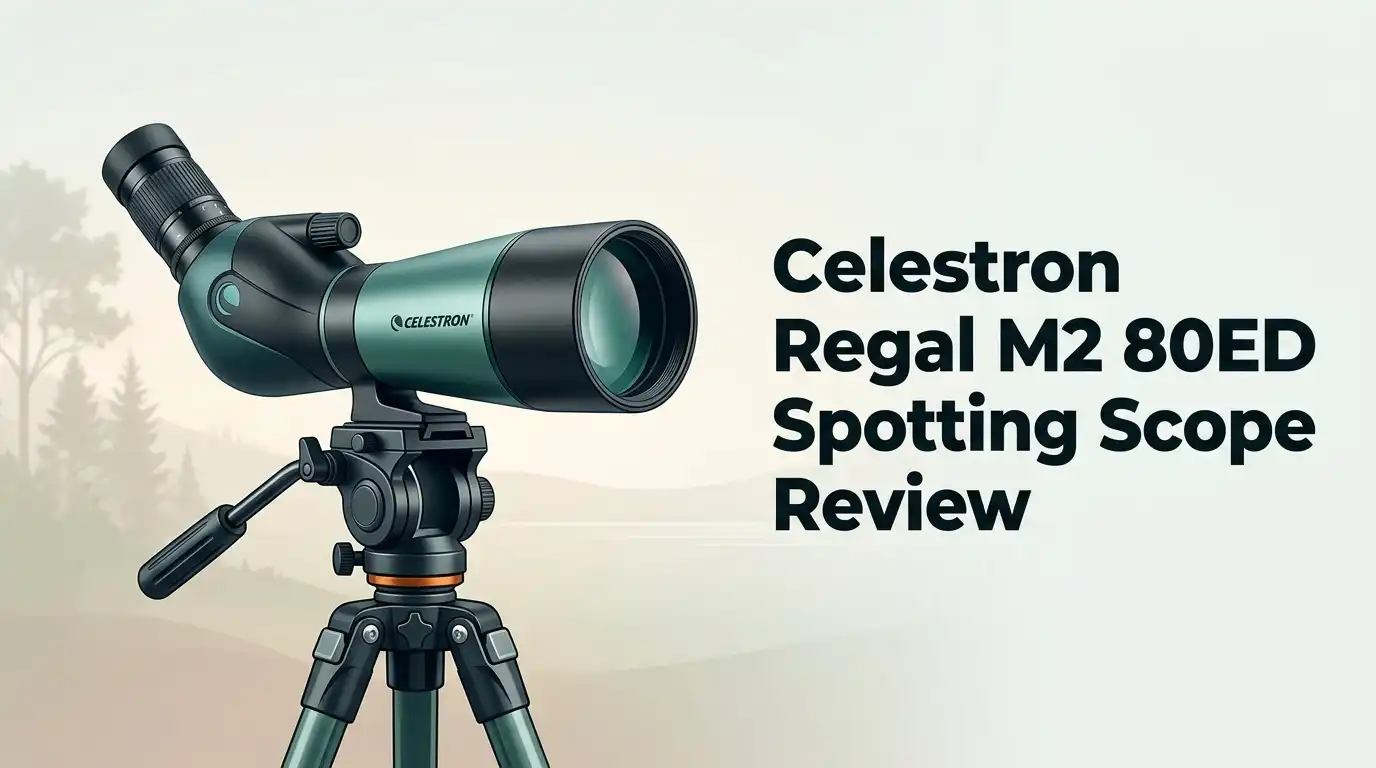
Celestron Regal M2 80ED Spotting Scope Review 2026
The Celestron Regal M2 80ED has been around for over a decade, and it refuses to fade away. Birders still recommend it. Hunters still buy it. Astronomy hobbyists still drag it outside on cold nights. That kind of staying power is rare in optics, where new models arrive every season and disappear just as fast.
So the real question in 2026 is simple. Does an older ED glass spotter at roughly $880 still beat the newer competition? I spent weeks with this scope at a marsh boardwalk, a shooting range, and my own backyard under a half moon.
This review covers the unboxing, the honest optical strengths, the flaws nobody mentions in ads, and who should skip it entirely.
In A Nutshell:
- The ED glass is the main reason to buy this scope. Color fringing stays low at 20x through about 45x, and fine feather detail looks clean. You see real color, not a purple halo around branches.
- The magnesium alloy body keeps weight down to 66.6 ounces with the eyepiece attached. That is about 4.2 pounds, which sits comfortably on a mid weight tripod without constant rebalancing.
- The dual focus system works faster than most single knob designs. Coarse focus gets you close, fine focus locks it in. Some users report slight image shift while focusing, and I noticed a small amount myself.
- Image quality drops noticeably above 50x. The 4mm exit pupil at 20x shrinks to just 1.3mm at 60x, so brightness and contrast fade in low light.
- The 1.25 inch eyepiece thread is the hidden bonus. You can swap in astronomy eyepieces and use this as a small refractor telescope. Very few spotting scopes let you do that.
- It is not the best value if you only need 300 yards. A 65mm scope saves weight and money for casual use.
What Is The Celestron Regal M2 80ED?

- QUALITY ED OBJECTIVE LENS: Extra-low dispersion optical glass with special dispersion properties to dramatically reduce chromatic aberration, rendering razor-sharp images with superb color correction. Enjoy true-to-life color with enhanced resolution and contrast.
- XLT LENS COATINGS: Fully multi-coated with Celestron’s proprietary XLT optical coatings – the same coatings used on observatory-class telescopes. This coating maximizes light transmission through the optical path for brighter images. A great addition to your field gear!

Last update on 2026-09-17 / Affiliate links / Images from Amazon Product Advertising API Some of the links on this website are affiliate links, which means that at no additional cost to you, I earn a commission if you click through and make a purchase. I only recommend products and services that I believe will add value to my readers. Thank you for your support!
The Regal M2 80ED is an angled zoom spotting scope with an 80mm objective lens. Celestron lists it as item 52305. The included zoom eyepiece delivers 20x to 60x magnification through a 480mm focal length tube.
The scope replaced the older Regal F ED series. Celestron swapped the aluminum housing for magnesium alloy, which cut total weight by more than 14 percent. They also upgraded the focus mechanism so it reaches focus roughly twice as fast.
The optical package includes Extra Low Dispersion glass in the objective and Celestron’s XLT multicoating across the light path. Prisms are BaK4 with full multicoating. The body is nitrogen purged and fully waterproof.
This is a serious mid tier scope, not a budget toy. It competes with the Vortex Diamondback HD line, the Athlon Ares G2 UHD, and the Vanguard Endeavour HD 82A. It sits well below alpha glass from Swarovski, Zeiss, or Kowa, and nobody at Celestron pretends otherwise.
Unboxing Experience: What Arrives In The Box
My unit arrived in a plain brown Celestron carton with foam end caps. Inside sat the padded carrying case, and the scope lived inside that. Celestron calls it a view through case, which means you can leave the case on while you observe. Zippered flaps open over the objective and the eyepiece.
The case is green woven nylon with decent padding. It feels outdoorsy rather than luxurious. The zippers are the weakest part of the whole package, and I would not trust them after five hard seasons.
Lift the scope out and the weight registers immediately. It feels dense and cold, in a good way. The magnesium tube has a slightly textured green finish that hides scuffs well.
Accessories come tucked in a small bag: the 20x to 60x zoom eyepiece, an objective cap, an eyepiece cover, an eyepiece mount cap, a T adapter ring, a lens cloth, and the manual. The T adapter ring is a genuinely nice inclusion at this price.
Mounting the eyepiece takes seconds. It threads on smoothly and locks with a collar.
Top 3 Alternative for Celestron Regal M2 80ED

- The redesigned Diamondback HD spotting scope has all the optical horsepower the western hunter needs, and excels in low light. It features a streamlined exterior for a sleeker profile and a built-in helical focus wheel for fast and fine adjustments.
- HD optical system delivers exceptional resolution, cuts chromatic aberration and provides outstanding color fidelity, edge-to-edge sharpness and light transmission. Multiple anti-reflective coatings on all air-to-glass surfaces increase light transmission
Last update on 2026-09-17 / Affiliate links / Images from Amazon Product Advertising API Some of the links on this website are affiliate links, which means that at no additional cost to you, I earn a commission if you click through and make a purchase. I only recommend products and services that I believe will add value to my readers. Thank you for your support!
Vortex Diamondback HD Spotting Scope 20x to 60×85 Angled

- Hunting Accessories for Sharp Image: Precision-built scope for a clear image; perfect for spotting targets for the range
- Bird Watching & Shooting Range Gear: High-quality spotting scope for sports and outdoors; spotting scope designed for clear vision and long range
Last update on 2026-09-13 / Affiliate links / Images from Amazon Product Advertising API Some of the links on this website are affiliate links, which means that at no additional cost to you, I earn a commission if you click through and make a purchase. I only recommend products and services that I believe will add value to my readers. Thank you for your support!
Athlon Optics Ares G2 UHD 20x to 60×85 Spotting Scope

- QUALITY ED OBJECTIVE LENS: Extra-low dispersion optical glass with special dispersion properties to dramatically reduce chromatic aberration, rendering razor-sharp images with superb color correction. Enjoy true-to-life color with enhanced resolution and contrast.
- XLT LENS COATINGS: Fully multi-coated with Celestron’s proprietary XLT optical coatings – the same coatings used on observatory-class telescopes. This coating maximizes light transmission through the optical path for brighter images. A great addition to your field gear!
Last update on 2026-09-17 / Affiliate links / Images from Amazon Product Advertising API Some of the links on this website are affiliate links, which means that at no additional cost to you, I earn a commission if you click through and make a purchase. I only recommend products and services that I believe will add value to my readers. Thank you for your support!
Celestron Regal M2 65ED Spotting Scope
Optical Performance In Real Daylight
At 20x, this scope sings. The image is bright, flat, and sharp nearly to the edge. I picked out individual reed stems at 200 yards and counted rings on a distant target.
The ED glass does its job through the middle of the zoom range. Chromatic aberration stays faint on high contrast edges like a dark heron against bright sky. Push to 60x and you will see some color fringing appear on those same edges.
Color rendition leans neutral with a very slight warm tone. Bird plumage looks accurate, which matters more than punchy contrast when you are identifying sparrows.
Sharpness holds strong to around 45x. Between 45x and 55x the image softens gradually. At the full 60x it becomes usable but clearly mushy, and heat shimmer makes it worse on warm afternoons.
The field of view runs 110 feet at 1000 yards at 20x, narrowing to 52 feet at 60x. That wide end helps enormously when you are tracking movement.
Edge sharpness is good, not perfect. The outer 10 percent softens slightly.
Low Light And Dusk Viewing
Spotting scopes earn their keep in the last twenty minutes of light. The 80mm objective gathers plenty of photons, and the twilight factor runs from 40.0 up to 69.3 across the zoom range.
Dusk performance is genuinely good at low magnification. At 20x the 4mm exit pupil feeds your dilated eye well. I identified ducks on open water fifteen minutes after sunset without straining.
The problem appears when you zoom. At 60x the exit pupil drops to just 1.3mm. The image gets dim, contrast collapses, and your eye placement becomes fussy. This is basic physics, not a Celestron flaw, but it limits how you should use the scope at dawn and dusk.
My practical rule became simple. Stay at or below 40x once the sun touches the horizon.
Compared to newer 85mm scopes with better coatings, the Regal M2 gives up a small amount of brightness. The gap is visible but not dramatic.
Build Quality And Weather Sealing
The magnesium alloy housing feels solid. There is no flex, no rattle, and no creak when you rotate the tripod collar. Celestron built the tube properly.
Waterproofing held up through two heavy rain sessions and one accidental splash from a kayak. Nitrogen purging prevented any internal fogging when I moved the scope from a cold car into humid air.
The sliding sunshade deserves praise. It glides with firm friction, stays where you put it, and carries an etched sighting line on top. That line helps you aim the scope roughly before you look through it.
The rotating tripod mount has detent stops. You can set the eyepiece at 45 degrees left, straight up, or anywhere between. This matters more than you think when sharing the scope with someone shorter or taller.
Honest negative: the rubber armor coverage is partial rather than full. The exposed metal picks up dings. My unit already shows two small marks near the objective ring.
Focus System: Coarse And Fine Knobs
Celestron gives you two focus wheels stacked together on top of the tube. The larger coarse wheel moves focus quickly across the full range. The smaller fine wheel makes tiny adjustments.
This setup works well in practice. I could go from a bird at 30 yards to a hilltop at two miles in about one second with the coarse wheel. Then a quarter turn of the fine wheel nailed it.
The knobs have grippy rubber and turn smoothly. Cold weather stiffened them slightly but never enough to complain about.
Now the flaw. I noticed mild image shift while focusing, meaning the subject drifts a small distance in the field as you turn the wheel. Other owners report the same thing, especially on the smaller 65ED model. At high magnification on a small target, this forces you to recenter.
Close focus sits at 21.3 feet, roughly 6.5 meters. That is acceptable but not impressive. Butterfly watchers will want something closer.
Digiscoping And Photography Potential
The Regal M2 80ED was built with cameras in mind. Celestron includes a T adapter ring in the box, and you add your own camera specific T ring.
Prime focus photography through the 480mm tube produces reasonable results at low magnification. Bird photographers in online groups report crisp images at around 50 yards with the zoom set near the wide end.
Push the magnification up and image quality falls apart quickly for photography. The sweet spot is 20x to 30x.
Phone digiscoping works too, but you must buy an adapter separately. The twist up eyecup gives 20mm of eye relief at 20x, which helps phone lenses line up.
Do not expect DSLR telephoto quality. Digiscoping through any mid tier spotter produces softer images with lower contrast. It works for documentation and rare bird records, not gallery prints.
The 1.25 inch eyepiece thread also opens up astronomy eyepieces. Swapping in a quality 8mm or 12mm eyepiece delivers better sharpness than the stock zoom at equivalent power.
Using The Regal M2 80ED For Astronomy
This is where the scope surprises people. The standard 1.25 inch eyepiece mount turns it into a small ED refractor.
Limiting stellar magnitude reaches about 12.02 under ideal skies. That is enough for hundreds of deep sky objects. I split double stars cleanly and pulled out crisp lunar crater detail at 60x.
Saturn showed its rings clearly. Jupiter showed two belts and all four Galilean moons. An 80mm ED objective is a legitimate astronomy aperture, not a novelty.
The angled eyepiece position actually helps for overhead targets. Most spotting scopes become neck breakers when aimed high. This one stays comfortable.
Limitations exist. The 480mm focal length is short, so high magnification requires very short eyepieces. The stock zoom underperforms good fixed astronomy eyepieces above 40x. You also cannot reach the zenith on many photo tripods.
Honest verdict for stargazers: excellent dual purpose value, but a dedicated 80mm apochromatic refractor on an equatorial mount beats it easily for deep sky work.
Tripod Requirements And Field Setup
Do not put this scope on a cheap tripod. At 4.2 pounds with the eyepiece attached, it needs real support.
I used a carbon fiber tripod with a fluid video head, and the combination felt rock steady at 60x. Wind still caused vibration, which is normal.
A pan and tilt photo head will work at 20x to 30x. Above 40x you will fight it constantly. A proper fluid head is the single best accessory upgrade for this scope.
The tripod mount uses a standard quarter inch thread. There is no built in Arca Swiss dovetail, which newer scopes like the Vortex Diamondback HD now include. Add your own plate.
Setup in the field takes about thirty seconds. Extend the sunshade, twist up the eyecup, set the collar angle, and you are watching.
Balance is decent. The mount sits slightly forward of center, so the scope tips nose down if you loosen the head. Keep a hand on it.
Pros Of The Celestron Regal M2 80ED
- True ED glass at a mid tier price. Color correction beats most scopes near this cost, and views stay natural rather than artificially punchy.
- Magnesium alloy body reduces weight without losing strength. At 66.6 ounces with the eyepiece attached, it travels far more easily than comparable 85mm glass.
- Fast dual focus mechanism. Coarse and fine wheels together save real seconds when a bird moves.
- Standard 1.25 inch eyepiece mount. This single feature makes the scope a dual use instrument for birding and astronomy.
- T adapter ring included in the box. Camera photography needs only one extra part.
- Fully waterproof and nitrogen purged. Rain, humidity, and temperature swings caused zero fogging in my testing.
- Rotating tripod collar with detents. Sharing the scope with other people becomes painless.
- Padded view through carry case included. You can observe with the case still fitted.
- Limited lifetime warranty from Celestron. Long term support carries weight on an older model.
- Excellent brightness and edge sharpness at 20x to 40x. The most useful magnification range is also the strongest.
Cons Of The Celestron Regal M2 80ED
- Image quality falls off above 50x. Softness and dimming become obvious, so the top of the zoom range is largely marketing.
- Mild image shift during focusing. The target drifts slightly as you adjust, which is annoying at high power.
- Color fringing returns at maximum magnification. ED glass reduces it but does not eliminate it at 60x.
- Close focus of 21.3 feet is mediocre. Insect and nearby flower viewing is limited.
- No Arca Swiss compatible foot. Competitors now include this, so you must buy a plate.
- Case zippers feel cheap. They are the most likely failure point over years of use.
- Partial rubber armor only. Exposed metal marks easily and offers less impact protection.
- Stock zoom eyepiece is only average. Aftermarket astronomy eyepieces reveal how much the included zoom holds back the objective.
- Eye relief shrinks as you zoom. Eyeglass wearers lose comfort above 40x.
- The design is over a decade old. Newer coatings and body designs have moved forward since launch.
Who Should Buy This Scope And Who Should Skip It
Buy the Regal M2 80ED if you want one instrument that handles birding and casual astronomy. That 1.25 inch eyepiece thread is the deciding factor for dual use buyers. No mainstream competitor matches it.
It also makes sense for birders who observe mostly between 20x and 40x. In that range the optics punch well above the price.
Target shooters who need to read bullet holes at 300 yards will find it capable in good light, though heat shimmer limits everyone at that distance.
Skip it if you need maximum sharpness at 60x. Spend more on a Kowa TSN 55 or a used alpha scope instead.
Skip it if weight matters most. The Regal M2 65ED saves over a pound and a fair amount of money.
Skip it if you want current generation features like an integrated dovetail foot and locking helical focus. The Vortex Diamondback HD delivers those.
Skip it if your budget is under $500. Good 65mm ED options serve you better there.
Frequently Asked Questions
Is the Celestron Regal M2 80ED good for astronomy?
Yes, and it is one of the few spotting scopes that genuinely qualifies. The standard 1.25 inch eyepiece mount accepts astronomy eyepieces, and the 80mm ED objective reaches roughly magnitude 12 under dark skies. Lunar and planetary views are sharp. A dedicated refractor on an equatorial mount still wins for serious deep sky observing.
How much does the Regal M2 80ED weigh?
The scope body weighs 55.5 ounces, about 1574 grams, without the eyepiece attached. With the included zoom eyepiece fitted it reaches 66.6 ounces, roughly 1889 grams or 4.2 pounds.
Does the Regal M2 80ED come with an eyepiece?
Yes. Celestron includes a 20x to 60x zoom eyepiece in the box, along with an objective cap, eyepiece cover, eyepiece mount cap, T adapter ring, lens cloth, padded case, and manual.
Is the Regal M2 80ED waterproof?
Yes. The body is fully waterproof and nitrogen purged, so internal fogging does not occur during temperature or humidity changes. It survived heavy rain in my testing without issue.
What is the close focus distance?
Close focus sits at approximately 21.3 feet, or 6.5 meters, at 20x. Butterfly and insect observers may find that too far.
Should I choose the 65ED, 80ED, or 100ED?
Pick the 65ED for hiking and travel where weight rules. Pick the 80ED as the balanced choice for most birders and dual use observers. Pick the 100ED only if you observe from a vehicle or fixed spot and want maximum light gathering.
Is it still worth buying in 2026?
Yes, for the right buyer. The optics remain competitive at 20x to 40x, and the eyepiece versatility is unmatched near this price. Buyers who want current body features and better high power performance should compare newer 85mm models first.

Hello, I’m Amelia White, the founder of birdsfanatic.com. As a lifelong bird enthusiast and spiritual seeker, I’ve always been fascinated by the mystical connections between birds and the human experience. On this site, I share my knowledge and insights into the symbolic meanings and spiritual significance of various bird species, exploring their roles in mythology, folklore, and cultural traditions. Join me on this journey into the world of birds, where we’ll discover the hidden wisdom and guidance that these magnificent creatures have to offer.