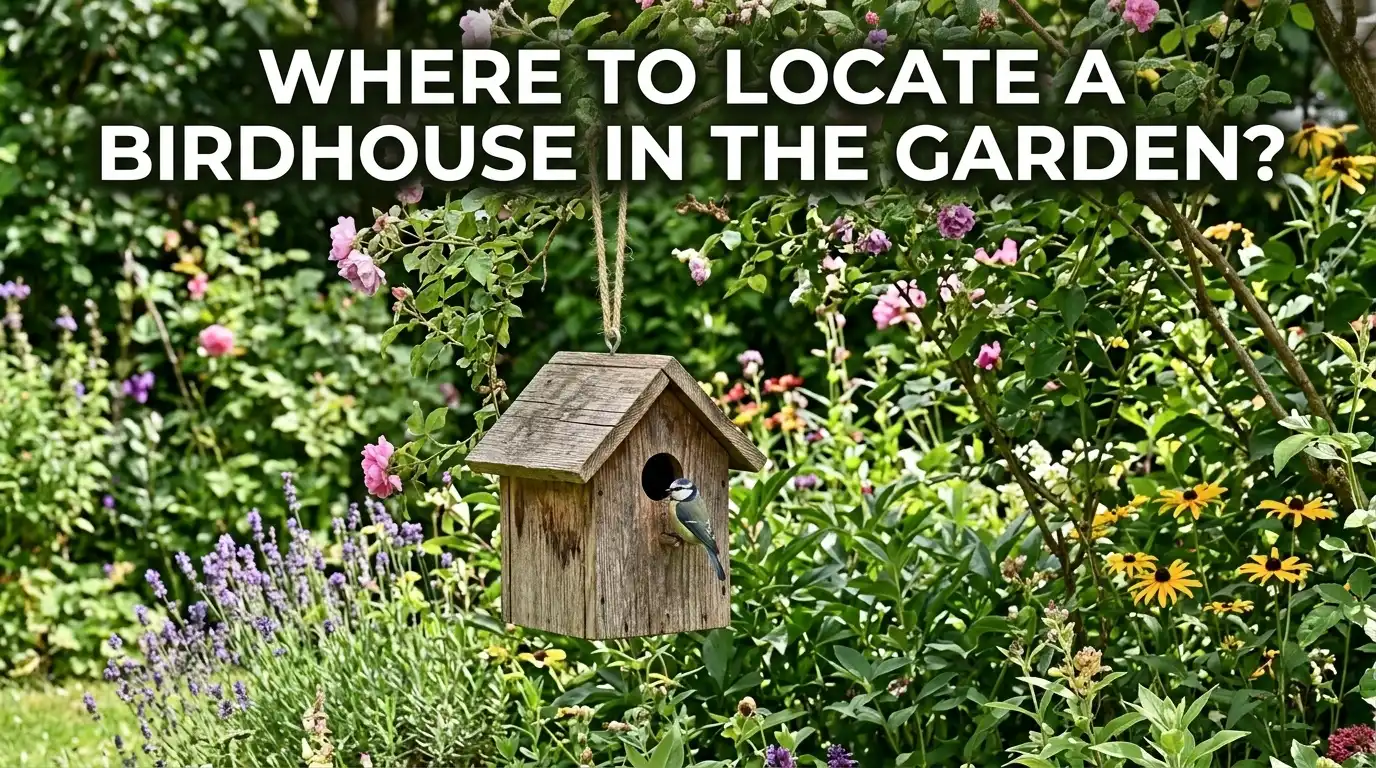
Where to Locate a Birdhouse in the Garden? A Simple Placement Guide
You hung a beautiful birdhouse last spring. You waited. Nothing came. No chickadee, no wren, not even a curious sparrow poking around the hole.
Here is the honest truth: birds rarely reject a birdhouse because of how it looks. They reject it because of where it sits. A box in the wrong spot is too hot, too exposed, too easy for cats to reach, or simply invisible to the birds passing through.
The good news is that placement is something you control completely. You do not need a bigger garden or a fancier box. You need the right height, the right direction, the right distance from danger, and a little patience.
Key Takeaways
- Height depends on the species, not on your reach. Most small garden birds accept boxes between five and fifteen feet high. Bluebirds nest happily as low as three to six feet. Chickadees, titmice, and nuthatches prefer five to fifteen feet. Screech owls and kestrels want ten to thirty feet. Pick your target bird first, then pick your height.
- Face the entrance hole between north and east in most gardens. This catches gentle morning sun and avoids the fierce afternoon heat that can cook nestlings. It also turns the hole away from the prevailing wind and driving rain in most regions.
- A free standing metal pole beats a tree trunk every time. Poles let you mount a baffle, they block climbing cats and raccoons, and they keep snakes from dropping in from branches above. Predator guards raise nesting success measurably.
- Give the box breathing room. Keep a clear flight path to the hole, leave several feet of open space in front, and space multiple boxes according to species. Bluebirds want roughly three hundred feet between pairs. House wrens want about one hundred feet.
- Put the box up early. Late winter or very early spring works. Fall works even better, because birds use boxes as winter roosts and remember them when breeding season arrives.
- Avoid sprayed areas and busy corners. Pesticides remove the insects that feed nestlings, and constant foot traffic near a nest causes desertion.
Why Birdhouse Placement Matters More Than the Birdhouse Itself
A birdhouse is a substitute for a natural tree cavity. Birds judge it exactly the way they judge a hole in a dead limb. They ask three silent questions: is it safe, is it comfortable, and is there food nearby?
Placement answers all three. A box nailed to a sunny south facing fence in July can reach temperatures that kill eggs and chicks. A box screwed to a low tree trunk becomes a snack bar for cats.
The box body only handles rain and insulation. The location handles survival.
Think of it like choosing a house for yourself. The building matters, but the neighborhood, the street noise, and the commute to the grocery store matter more.
Once you accept that placement carries the weight, the rest of this guide becomes a simple checklist. You are no longer guessing. You are matching a species to a spot that mimics what it would choose in the wild.
Start By Reading Your Garden Like a Bird
Before you drill anything, walk your garden slowly and look up. Notice where the sun lands at two in the afternoon. Notice where wind funnels between buildings. Notice where your cat likes to sit.
Birds already made these observations before you did.
Sketch a rough map. Mark the open lawn areas, the dense shrub borders, the mature trees, the fences, and the water sources. Each zone attracts a different set of cavity nesting birds.
Open lawn with scattered trees suits bluebirds and tree swallows. Mature hardwoods and leafy edges suit chickadees, titmice, and nuthatches. Thick shrubby corners suit house wrens and Carolina wrens.
Pros of mapping first: you avoid moving the box mid season, which can cause abandonment. You also spot hazards early.
Cons: it takes an hour of your afternoon, and it feels slow when you are excited to hang something. That hour saves you a wasted season.
The Best Height for a Birdhouse in a Garden
Height is the question everyone asks first, and the answer is refreshingly flexible. Most garden species accept a wide range. Placement precision matters far less than people fear.
Use these tested ranges. Eastern bluebirds do well at three to six feet. Tree swallows sit happily at five to six feet. House wrens prefer five to ten feet. Chickadees, titmice, and nuthatches like five to fifteen feet. Screech owls and flickers want ten to thirty feet.
A practical rule for beginners: five to seven feet suits most small garden birds and keeps the box within easy reach for cleaning.
Pros of a lower box: you can monitor and clean it without a ladder, and you can watch the activity comfortably from a window.
Cons of a lower box: cats and raccoons reach it more easily, so a baffle becomes essential rather than optional. Higher boxes gain safety but cost you convenience and a clear view.
Which Direction Should the Entrance Hole Face
Direction is the second big question, and here the advice is consistent across regions. Aim the entrance hole somewhere between north and east.
An east facing hole catches soft morning sunlight. That warmth helps parents dry off and warms the nest after a cold night. By midday, the hole sits in shade.
Avoid a west or southwest facing hole in hot climates. Late afternoon sun strikes those walls hardest, and interior temperatures climb fast.
Also consider your prevailing weather. If storms usually blow in from the southwest, turn the hole away from that direction so rain does not drive straight inside.
Bluebirds add one more preference. They like the hole to face open ground, ideally a lawn or meadow, so fledglings have a clear landing zone. Their order of preference runs east, then north, then south, then west.
Pros of following the north to east rule: cooler boxes, drier nests, higher fledging rates. Cons: your ideal direction may point the hole away from your kitchen window. Bird comfort wins that argument.
Sun, Shade, and Temperature Control
Heat kills more nestlings than most gardeners realize. A sealed wooden box in full sun behaves like a parked car. Aim for a spot that receives morning sun and afternoon shade.
Dappled shade from a nearby tree canopy works beautifully, as long as branches do not touch the box. Chickadees specifically favor sites receiving roughly forty to sixty percent sunlight.
If your only available spot bakes in the afternoon, add shade rather than skipping the site. A leafy shrub planted to the west, a trellis, or a wider roof overhang all reduce interior heat.
Light colored boxes reflect more heat than dark stained ones. Ventilation holes near the top of the side walls help hot air escape.
Pros of a shaded location: stable temperatures and calmer parents. Cons: deep shade all day can leave the box damp and cold in early spring, which slows nesting. Balance is the goal, not total darkness.
Mounting Options: Pole, Tree, Fence, or Wall
Where you attach the box changes its safety profile dramatically. Here are the four common choices with their honest tradeoffs.
Free standing metal pole or PVC pipe. Pros: you can mount higher, most predators struggle to climb smooth metal, and baffles attach easily. This is the safest option available. Cons: it costs more, and installation takes real effort with a post hole and concrete or a driven anchor.
Tree trunk. Pros: it looks natural, costs nothing extra, and suits woodland species like chickadees and nuthatches. Cons: squirrels, snakes, and cats climb trees effortlessly. Nails also damage living wood. Use straps or wire with padding instead.
Fence post. Pros: quick, cheap, and already in place. Cons: limited height, and posts often sit along cat patrol routes.
House wall or shed. Pros: excellent weather protection under an eave, and easy monitoring. Cons: human traffic nearby, and reflected heat from sunny walls.
If you can only follow one recommendation from this guide, choose the pole with a baffle.
How Far Apart to Space Multiple Birdhouses
Enthusiasm leads people to hang five boxes in a small garden. Birds respond by ignoring four of them. Most cavity nesters defend a territory and will not tolerate neighbors of their own species.
Rough minimum spacing looks like this. Bluebirds need about three hundred feet between pairs. House wrens need about one hundred feet. Chickadees vary widely, from thirty feet for Carolina chickadees to several hundred for black capped chickadees. Tree swallows tolerate roughly thirty five feet.
There is one clever exception called pairing. Placing two boxes fifteen to twenty five feet apart, or back to back on one pole, lets a bluebird pair and a tree swallow pair coexist. Each drives away its own species but tolerates the other.
Pros of pairing: two species nest in the space of one territory. Cons: it only works for specific species combinations, and it needs open habitat.
In a small suburban garden, one or two well placed boxes will outperform six crowded ones.
Keeping the Birdhouse Safe From Predators
Placement is your first line of defense. Never place a box where a cat can leap onto the roof in a single jump. Keep it away from fence tops, low walls, sheds, and overhanging branches.
Pole mounted boxes should stand well clear of trees so snakes cannot drop in from above. A gap of at least eight to ten feet from the nearest branch is sensible.
Then add hardware. A stovepipe baffle or a cone shaped metal collar mounted below the box stops climbing mammals. A Noel guard, which is a wire mesh tunnel over the entrance, stops raccoons and cats from reaching inside.
A roof that overhangs the front by about five inches makes paw dipping much harder.
Pros of guards: nesting success rises noticeably, and cone and stovepipe designs perform best. Cons: guards cost a little, need annual checks, and no guard is completely foolproof against a determined large snake.
Distance From Feeders, Bird Baths, and Human Traffic
Gardeners often cluster the feeder, the bath, and the birdhouse together for a tidy look. Birds find that arrangement stressful.
Keep nest boxes well away from busy feeders. Feeders attract crowds, squabbles, and predators including cats, hawks, and rodents. Nesting parents want quiet, not a food court outside the door.
A separation of at least twenty to thirty feet helps. More is better in a larger garden.
Bird baths are gentler neighbors, and a shallow water source within reasonable distance benefits nesting adults. Just avoid placing the bath directly beneath the entrance hole.
Human traffic deserves the same caution. Avoid doorways, patios, washing lines, play areas, and the path you walk twenty times a day.
Pros of a quiet corner: fewer disturbances and a higher chance of a completed nest. Cons: you see less of the action. Solve that with binoculars from a window rather than by moving the box closer.
Give the Entrance a Clear Flight Path
Watch a chickadee approach a natural cavity. It flies in fast, sometimes from a nearby perch, and lands directly at the hole. Dense foliage in front of the entrance blocks that approach.
Leave several feet of open air in front of the hole. Trim back climbing roses, clematis, and shrubby growth that has crept across the flight line.
Vegetation directly in front also gives cats a hiding place. An open approach lets parent birds spot danger before they land.
At the same time, birds appreciate a perch within about ten to twenty feet. A shrub, a fence rail, or a low branch gives them a staging point to check for threats before entering.
Pros of an open approach with a nearby perch: faster feeding trips and safer parents. Cons: an open site feels exposed in windy gardens, so pair it with a windbreak on the weather side.
Shelter From Wind, Rain, and Winter Weather
Wind driven rain is a common cause of failed nests. Water entering the hole soaks the nest material and chills the chicks.
Tilt the box slightly forward, just a few degrees. This simple trick sheds rain away from the entrance and stops water running down the inner front wall.
Place the box so a hedge, wall, garden building, or tree canopy blocks the prevailing wind. The box should feel sheltered without being buried in vegetation.
Do not seal the box against airflow. Drainage holes in the floor and small vents near the top of the sides remain essential.
Pros of a sheltered site: dry nests, steadier temperatures, and use as a winter roost by chickadees and wrens. Cons: sheltered corners can also be damp, so check that the spot dries out after rain rather than staying soggy.
Match the Location to the Bird You Want
This is where everything comes together. Choose your species, then match the habitat, the height, and the hole size.
Bluebirds want open lawn or meadow with short grass, a box three to six feet high, and a hole facing open ground. House wrens want a box five to ten feet high near shrubs and small trees, with a one inch hole.
Chickadees and titmice want mature trees and leafy edges, a box five to fifteen feet high, and a hole facing away from prevailing wind. Adding an inch of wood shavings inside encourages chickadees to excavate.
Tree swallows want open ground near water at five to six feet. Screech owls want woodland edges at ten to thirty feet with wood shavings inside.
One critical warning: hole size controls who moves in. A hole larger than one and a half inches invites starlings, which are aggressive competitors in North America.
The Best Time of Year to Put Up a Birdhouse
Timing decides whether birds find the box before they commit to another site. Late winter and very early spring are the practical deadlines.
In southern regions, have boxes up by February. In northern regions, aim for mid to late March. Early nesters like bluebirds and chickadees begin scouting well before the weather feels springlike to us.
Fall installation is the quiet secret. Boxes placed in autumn get used as winter roosts, which means the birds already know the location when breeding season starts.
Pros of early or fall placement: higher first year occupancy and useful winter shelter. Cons: the box weathers a little longer, and you may need to clear out mouse nests before spring.
If you missed the window, hang it anyway. Second broods happen, and late arrivals still search for sites into summer.
Placement Mistakes to Avoid and How to Fix Them
Most empty birdhouses share a short list of problems, and all of them are fixable.
Mistake one: the box faces the hot afternoon sun. Fix it by rotating the pole or relocating the box outside the nesting season, between late autumn and midwinter.
Mistake two: it sits on a fence within cat jumping range. Fix it by moving to a pole with a baffle.
Mistake three: too many boxes crowded together. Remove the extras and spread the remainder across your property.
Mistake four: the garden is sprayed with pesticides. Insects feed nearly every nestling. Stop spraying near the box and let the caterpillars return.
Mistake five: moving or opening the box during active nesting. Wait until the season ends, then clean out old material.
Pros of correcting mistakes in the off season: no disturbance risk. Cons: you wait months for results. Patience here protects the birds you are trying to help.
Frequently Asked Questions
How high should a birdhouse be off the ground in a small garden?
Five to seven feet suits most small garden birds and keeps cleaning easy. Bluebirds accept three to six feet, while chickadees and nuthatches will use boxes up to fifteen feet high. Choose a height you can safely reach, then add a predator baffle to compensate for the lower position.
Which direction should a birdhouse face?
Face the entrance hole somewhere between north and east in most gardens. This gives gentle morning sun, avoids intense afternoon heat, and turns the hole away from driving rain. Bluebird boxes should also face open ground so fledglings have a clear first flight.
Can I hang a birdhouse on a tree?
Yes, and woodland species like chickadees use tree mounted boxes readily. The drawback is predator access, since squirrels, snakes, and cats climb trunks easily. Use straps or padded wire rather than nails, and consider a smooth metal wrap around the trunk below the box.
How far should a birdhouse be from a bird feeder?
Keep at least twenty to thirty feet between them, and more if you have space. Feeders draw crowds and predators, which stresses nesting parents. A quiet corner of the garden gives a nesting pair the calm they need to raise a brood successfully.
Why is no bird using my birdhouse?
The usual causes are an overheating location, an unsafe position within reach of cats, a blocked flight path, a hole size that suits no local species, or a late installation date. Work through those five points in order. Many boxes also sit empty for a full year simply because the birds have not discovered them yet.
Should I put nesting material inside the birdhouse?
For most species, no. Birds bring their own material. The exceptions are chickadees, nuthatches, screech owls, and flickers, which appreciate an inch or more of clean wood shavings on the floor. Never use cotton wool, dryer lint, or synthetic fibers, which trap moisture and tangle around tiny legs.

Hello, I’m Amelia White, the founder of birdsfanatic.com. As a lifelong bird enthusiast and spiritual seeker, I’ve always been fascinated by the mystical connections between birds and the human experience. On this site, I share my knowledge and insights into the symbolic meanings and spiritual significance of various bird species, exploring their roles in mythology, folklore, and cultural traditions. Join me on this journey into the world of birds, where we’ll discover the hidden wisdom and guidance that these magnificent creatures have to offer.


