Should You Put a Perch on a Birdhouse? The Honest Answer
You spot two birdhouses at a garden shop. One has a cute little dowel sticking out under the hole. The other looks plain. Your instinct says the bird needs somewhere to land, so you reach for the cute one.
That instinct feels right, and it is completely wrong.
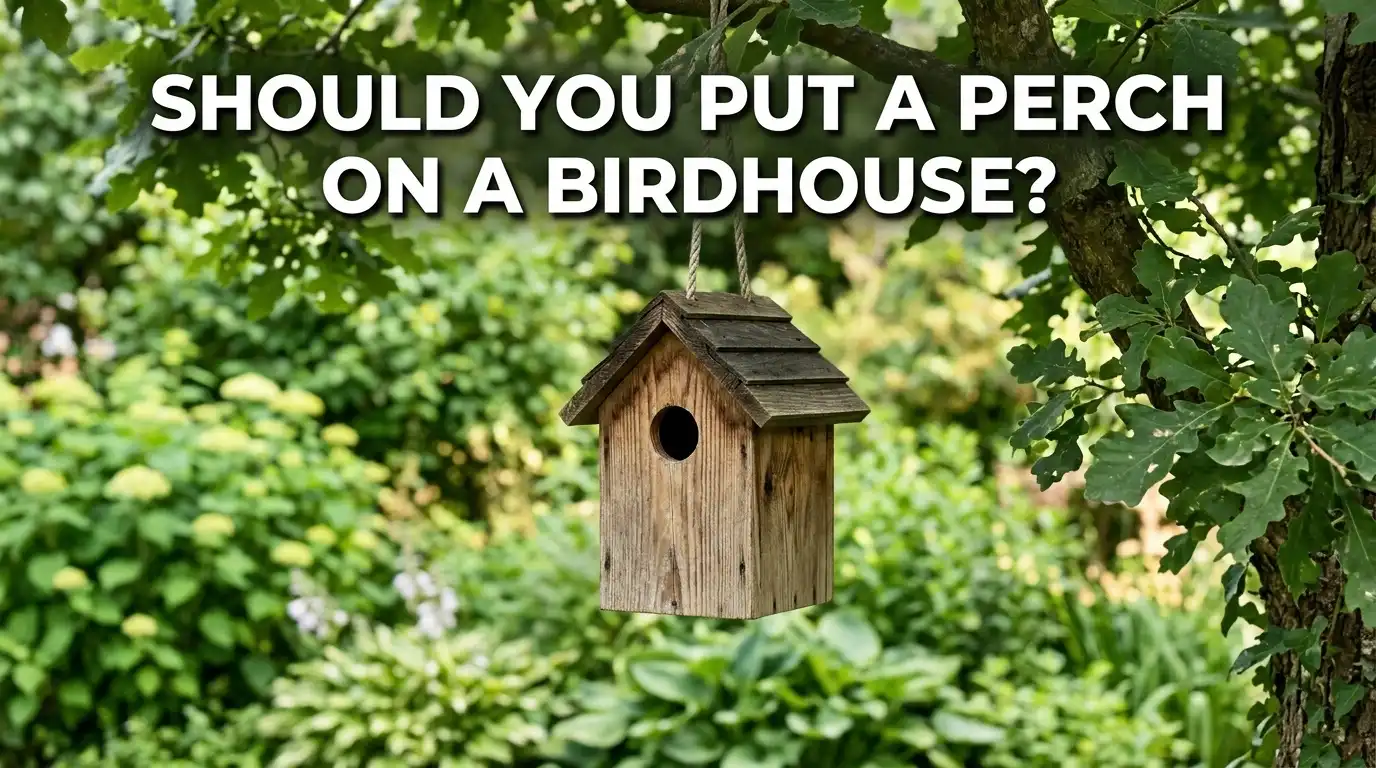
The small wooden dowel under the entrance hole is the single most common design flaw in backyard birdhouses. It looks charming to us. To a raccoon, a snake, or an aggressive House Sparrow, it looks like a free handle.
Key Takeaways
- Skip the perch on almost every birdhouse. Cavity nesting birds like bluebirds, chickadees, wrens, titmice, nuthatches, and tree swallows land directly on the entrance hole and pull themselves inside. They have strong feet and stiff tails built for gripping rough wood. A perch adds nothing they need.
- A perch mainly serves the animals you do not want. Raccoons, cats, squirrels, chipmunks, snakes, and jays use it as a grip point while they reach inside. House Sparrows and European Starlings, both non native and aggressive, are strongly drawn to boxes with perches. A perch turns a safe cavity into an easy target.
- Remove the dowel from any birdhouse you already own. Snap it, cut it flush, sand the stub, and seal the leftover hole with untreated wood glue and a plug. The job takes ten minutes and costs nothing.
- Replace the perch with features that truly help. Rough interior walls or shallow horizontal grooves under the entrance give chicks a ladder to climb when they fledge. This one detail saves nestlings that would otherwise die inside the box.
- Match the hole size to your target species. A 1 1/8 inch hole suits chickadees. A 1 1/2 inch hole suits bluebirds. Anything at or above 1 9/16 inch lets starlings in. Hole size protects birds far more effectively than any accessory.
- Purple martin housing is the main exception. Martins use porches and railings for preening and for keeping clumsy young from falling. Different bird, different rules.
What a Perch on a Birdhouse Actually Does
A birdhouse perch is a short dowel, peg, or small shelf mounted just below the entrance hole. Manufacturers add it because shoppers expect it. It sells houses.
Functionally, it gives any animal a stable foothold directly in front of the opening. That is its entire effect.
Think about what that means in practice. A songbird approaching a nest cavity flies straight at the hole and grabs the rim. It does not hover, land, rest, then walk in. The landing and the entry are one smooth motion.
Now picture a raccoon. It needs somewhere to brace a back foot while it reaches a front paw inside. Bare vertical wood gives it nothing. A dowel gives it exactly what it lacks.
The perch is not neutral decoration. It is a structural advantage handed to the wrong visitor.
The Short Answer From Nest Box Experts
Ask any nest box monitoring program and you get the same reply. Leading birding organizations list “no outside perches” as a standard feature of a good nest box, right alongside drainage holes, ventilation, thick walls, and a sloped roof.
The reasoning is consistent across sources. A perch is unnecessary for the birds and can help predators reach the nest.
Long running bluebird trail groups say the same thing. Volunteers who monitor hundreds of boxes each season report more disturbance and more takeovers at boxes with perches.
There is also fledging data suggesting boxes with perches produce fewer successful fledglings than boxes without them.
So the short answer is simple. Do not put a perch on a birdhouse. If you want one sentence to remember, use this one: the hole is the perch.
How Perches Help Predators Reach the Nest
Predation is the leading cause of nest box failure in backyards. A perch makes several common predators noticeably more effective.
Raccoons are the biggest concern in suburbs. They are smart, they remember box locations year after year, and they return night after night. A perch lets a raccoon steady itself and sweep a paw through the cavity.
Cats are strong jumpers. A dowel gives a cat something to hook a claw into while it swipes at the entrance.
Snakes such as rat snakes and racers climb well. They need friction points. Any protrusion helps them pause and position their head at the hole.
Squirrels and chipmunks use perches while they chew the entrance wider. Once the hole is enlarged, the box is compromised for good.
Removing the perch does not stop every predator. It simply removes one free assist.
How Perches Invite House Sparrows and Starlings
This point matters as much as predation, and most people never hear it.
House Sparrows and European Starlings are non native cavity nesters. Both are aggressive. Both will enter an occupied box, destroy eggs, kill nestlings, and sometimes kill the adult female while she sits.
Both species also love perches. They perch, sing, and display in front of a cavity as part of claiming it. A dowel under the hole is practically an advertisement.
Native cavity nesters do not need that display platform. Chickadees, wrens, nuthatches, and bluebirds get on with it from the hole rim.
So a perch quietly shifts the odds toward the species you least want. You built the house for bluebirds and handed the keys to sparrows.
Take the perch off and you tilt those odds back in favor of native birds.
Why Cavity Nesting Birds Do Not Need a Perch
Birds that nest in boxes evolved using natural tree cavities. Old woodpecker holes have no dowels. Neither do split limbs, hollow snags, or rotted knots.
These birds have anatomy built for the job. Their toes grip rough bark easily. Woodpeckers and nuthatches also use stiff tail feathers as a brace against the trunk.
Watch a chickadee at a nest box and you will see the whole technique. It flies in, grabs the lower edge of the hole with both feet, and vanishes inside in under a second.
Adults leaving the box do the reverse. They climb the interior wall, poke their head out, and launch.
Nothing in that sequence requires an external platform.
A perch is a human idea projected onto a bird that never needed one. It solves a problem that does not exist.
When a Perch or Porch Actually Helps
There are real exceptions, and honesty matters here.
Purple martin housing is the clearest one. Martins are colony nesters, and conventional martin houses include porches with guard railings. The porch gives martins a place to preen and socialize. The railing helps keep young birds from tumbling to the ground before they can fly.
Experienced martin landlords also note that porches and perches increase how attractive housing looks to territory seeking males, especially younger ones.
Some people add perch racks above martin housing rather than at the entrances, which keeps the landing zone clear.
Wood duck and screech owl boxes have their own rules too, though they rely on interior mesh rather than exterior perches.
The exception applies to martins and a few specialist boxes. It does not apply to your bluebird, wren, or chickadee house.
How to Remove a Perch From a Birdhouse You Already Own
Good news. You do not need to throw the birdhouse away.
Do this outside the nesting season, ideally in late fall or winter, so you disturb nobody.
First, check that the box is empty. Open it, look inside, and listen.
Second, remove the dowel. Grip it with pliers and twist while pulling. If it is glued, cut it close to the wall with a small handsaw or flush cut saw.
Third, sand the remaining stub level with the surface. Leave no ledge wider than a pencil line.
Fourth, fill the socket. Push a short piece of untreated dowel or a wood plug into the hole with plain wood glue, then sand it smooth once dry.
Fifth, skip paint and sealant on that spot. Bare untreated wood is safest for nesting birds.
Pros: fast, free, and it upgrades a box you already like. Cons: a glued plug can loosen after a few wet seasons, so inspect it each year.
Better Alternatives That Genuinely Help Chicks
Here is the feature that deserves your attention far more than any perch.
Nestlings must climb the inside front wall to reach the entrance when they fledge. On smooth plywood or slick interior boards, they cannot get traction. Chicks have died inside boxes for exactly this reason.
The fix is called a kerf. It is a shallow horizontal groove cut into the inner face below the hole.
Cut grooves about 1/8 inch deep, spaced roughly 1/4 to 1/2 inch apart, running from just under the entrance down toward the floor. A table saw, router, or hand saw all work.
No power tools? Rough the surface with coarse sandpaper, a chisel, or an awl. Small dings work fine.
This is the true replacement for a perch. It helps the birds instead of their enemies.
Pros: cheap, invisible, and directly improves fledging success. Cons: needs doing before assembly or with the door panel removed.
Choose the Right Entrance Hole Size
Hole size is your strongest tool for controlling who moves in. Get this right and you solve several problems at once.
Common sizes used across North America:
Chickadees and small nuthatches do well with 1 1/8 inch. House Wrens use 1 1/8 to 1 1/4 inch. Tree Swallows prefer about 1 3/8 inch. Eastern Bluebirds use 1 1/2 inch. Purple Martins need roughly 2 1/8 inch round or a crescent shaped opening.
Two numbers are worth memorizing. House Sparrows cannot squeeze through anything smaller than 1 1/4 inch. European Starlings cannot fit through anything smaller than 1 9/16 inch.
So a 1 1/2 inch bluebird hole reliably blocks starlings, though sparrows can still enter.
Drill precisely. Even a quarter inch of extra width changes which species can get in.
Predator Guards That Beat Any Perch
If your goal is a successful nest, spend your effort here.
A stovepipe baffle is the most effective option for pole mounted boxes. It is a metal cylinder around 8 inches wide and 24 to 36 inches long, hung below the box so it wobbles when climbed.
A cone baffle is a metal collar about 3 feet across, mounted under the box. It is simpler to install and works well against raccoons and cats.
A Noel guard is a wire mesh tunnel attached over the entrance. Predators cannot reach through it. It suits boxes mounted on trees or fences where baffles fail.
An extended roof overhang of 2 to 4 inches at the front adds another layer of protection.
Pros: baffles stop the majority of climbing predators. Cons: they cost money, need annual checks, and cannot help if vegetation lets an animal bypass the pole.
Where to Mount the Box for Real Safety
Placement often matters more than the box itself.
Mount nest boxes on a smooth metal pole. Avoid trees, wooden posts, and fence lines. Those give squirrels, snakes, and raccoons a clean route up.
Set most small songbird boxes 5 to 8 feet above the ground. That height keeps them easy to monitor while staying above casual reach.
Keep the box away from overhanging branches, deck railings, and rooftops. Cats jump surprisingly far from a raised launch point.
Face the entrance away from prevailing wind and driving rain. Many monitors point boxes toward an open area so fledglings have a clear first flight.
Skip brush piles nearby, since they attract snakes.
Good placement plus a baffle plus no perch equals a box that actually raises birds.
Decorative Birdhouses Versus Working Nest Boxes
It helps to be honest about what you are buying.
Decorative birdhouses are garden ornaments. They often feature bright paint, thin walls, glued joints, no drainage, no ventilation, no cleanout door, and yes, a perch.
Working nest boxes are simple, plain, and built from untreated pine, cedar, or cypress with walls at least 3/4 inch thick.
You can enjoy both. Hang the pretty one under a covered porch where no bird will nest, and mount the functional one on a pole in the open.
Pros of decorative houses: they look lovely and cost little. Cons: they can overheat, soak through, trap chicks, and attract predators.
If a bird might actually nest in it, judge it by function, not by charm. Cute should never outrank safe.
Yearly Cleaning and Monitoring Routine
A birdhouse is equipment, not furniture. It needs a little care.
Check boxes once a week during nesting season. Approach quietly, tap the side, open it briefly, count eggs or chicks, and close it. Stop opening the box once nestlings are around twelve to fourteen days old, since older chicks may fledge too early.
Clean out old nesting material after each brood finishes. Old nests hold parasites and mites.
Do a full clean in late fall. Scrape the interior, brush it out, and rinse with a weak vinegar solution if needed. Let it dry fully before closing.
Inspect hinges, screws, drainage holes, and baffles each winter.
Ten minutes of maintenance protects an entire season of nesting.
Quick Checklist Before You Hang Any Birdhouse
Run through this list and you will avoid nearly every common mistake.
No exterior perch. Untreated wood at least 3/4 inch thick. Four drainage holes in the floor. Two ventilation holes near the top of each side wall. A roof that overhangs the front by 2 to 4 inches.
Rough or grooved interior wall below the entrance. A correctly sized hole for your target species. A hinged side or roof for cleaning. Galvanized screws instead of nails or staples.
Metal pole mounting with a baffle. No paint or stain on the interior.
If a birdhouse fails on the perch, the wall thickness, or the drainage, keep looking.
Every item on this list exists because someone lost a nest learning it the hard way.
Frequently Asked Questions
Will birds refuse to use a birdhouse that has a perch?
No. Birds regularly nest in boxes with perches, and many broods succeed. The concern is risk, not rejection. A perch raises the chance of predation and takeover by House Sparrows or starlings, so the same box performs better once the dowel comes off.
Do any backyard birds need a perch on their house?
Purple Martins benefit from porches and railings on colony housing. Beyond martins and a few specialist boxes, no common North American cavity nester needs an exterior perch. Bluebirds, chickadees, wrens, titmice, nuthatches, and tree swallows all enter directly from the hole.
Can I just cut the perch off instead of buying a new birdhouse?
Yes, and that is usually the best move. Cut the dowel flush, sand the stub smooth, and plug the leftover socket with untreated dowel and wood glue. Do the work outside nesting season so you do not disturb an active nest.
What should I add under the entrance hole instead of a perch?
Add roughness on the inside, not the outside. Shallow horizontal grooves cut into the interior front wall act as a ladder for fledglings. Coarse sandpaper, chisel dings, or a stapled piece of mesh work too, though mesh should be tight so feet cannot tangle.
Does a perch really let raccoons into a birdhouse?
A raccoon cannot enter a properly sized hole, but it can reach in with a paw. A perch gives it a brace point that makes that reach easier and steadier. A baffle below the box remains the most effective defense.
How high should a birdhouse be mounted?
Most small songbird boxes work well between 5 and 8 feet on a smooth metal pole. Keep them clear of branches, fences, and rooftops so cats and squirrels cannot jump across. Purple Martin housing sits much higher, usually 10 to 15 feet in open space.

Hello, I’m Amelia White, the founder of birdsfanatic.com. As a lifelong bird enthusiast and spiritual seeker, I’ve always been fascinated by the mystical connections between birds and the human experience. On this site, I share my knowledge and insights into the symbolic meanings and spiritual significance of various bird species, exploring their roles in mythology, folklore, and cultural traditions. Join me on this journey into the world of birds, where we’ll discover the hidden wisdom and guidance that these magnificent creatures have to offer.

