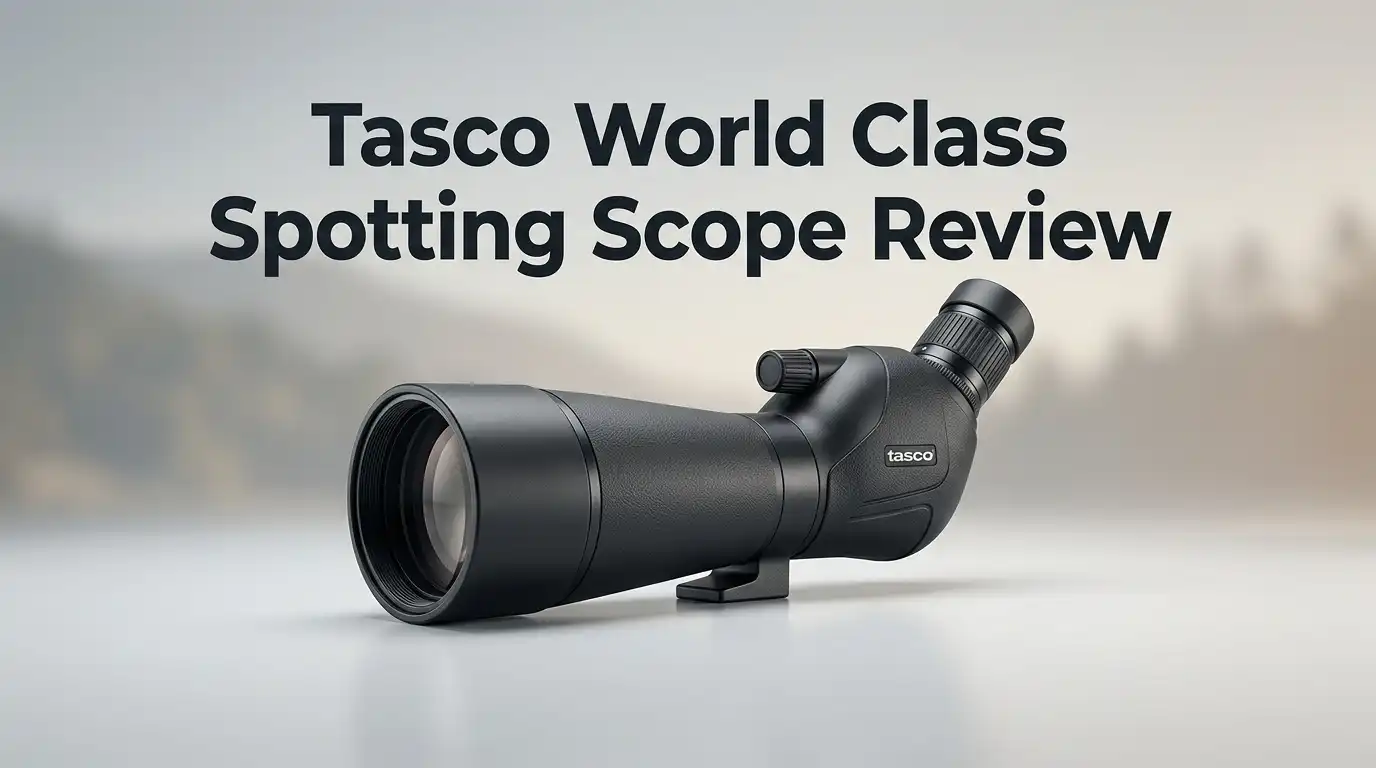
Tasco World Class Spotting Scope Review 2026: Worth Buying?
Budget spotting scopes promise a lot. A 60mm objective, 60x magnification, a tripod, a hard case, and a price near one hundred dollars.
The Tasco World Class sits right in that space, and it has been selling for decades. So the real question in 2026 is simple. Does this scope actually help you see more, or does it just look impressive on a spec sheet?
I spent time with this scope at a 100 yard range, in an open field at dusk, and on my back deck under a clear sky. The results were mixed in ways that matter. Some parts genuinely surprised me.
Key Takeaways
- The price is the main selling point. This scope usually lands between eighty and one hundred twenty dollars. At that number, expectations need to stay realistic. You are buying usable magnification, not sharp glass.
- Image quality falls apart past 40x. Below 30x the view is acceptable and bright enough. Push the zoom ring higher and the picture turns grainy, dim, and soft at the edges. This is the single biggest weakness.
- The included tripod is nearly useless. Almost every owner says the same thing. It wobbles, it sits too low, and it limits your angle. Budget another thirty dollars for a real tripod.
- Short eye relief causes real problems. You must press your eye close to the cup. That causes fogging on humid days and frost on cold mornings.
- Spotting .22 holes at 100 yards works. Spotting .30 caliber holes is inconsistent. Lighting decides the outcome more than magnification does.
- It shines for one unexpected task. Moon and planet viewing looks genuinely fun on a sturdy mount.
What Is the Tasco World Class Spotting Scope?

- Bright, vivid color and high contrast viewing with fully coated optics
- Zoom in with maximum magnification utilizing the selectable power range. Optimal for birdwatching, nature viewing, hunting, target shooting, hiking camping, moon gazing and general observation.
Last update on 2026-09-20 / Affiliate links / Images from Amazon Product Advertising API Some of the links on this website are affiliate links, which means that at no additional cost to you, I earn a commission if you click through and make a purchase. I only recommend products and services that I believe will add value to my readers. Thank you for your support!
The Tasco World Class is a porro prism spotting scope with a 60mm objective lens and a zoom range of 20x to 60x. Tasco also sells an 80mm version of the same family. Both use a 45 degree angled eyepiece, fully coated optics, and a rubber armored body. The 60mm model weighs around 30 ounces and measures close to 13.8 inches long.
Bushnell now owns the Tasco name, so warranty support actually exists. That matters more than people expect with cheap optics.
The scope targets three buyers. Hunters who scout open country. Target shooters who want to skip the walk downrange. Beginners who want their first scope without spending five hundred dollars. Tasco built this product around price, and every design choice reflects that goal.
The Unboxing Experience
The box itself feels thin and plain. No premium packaging, no foam cradle, just cardboard and plastic trays. Inside you get the scope, a hard shell carry case, a soft nylon pouch, two lens caps, a small aluminum tripod, and a folded instruction sheet.
The hard case surprised me. It closes firmly, holds shape, and protects the scope during transport. That case alone would cost twenty dollars on its own.
The scope feels heavier in hand than the photos suggest, which reads as solid at first. Then you pick up the tripod. The legs are thin, the pan head has noticeable play, and the whole thing feels like an accessory from a toy aisle. My excitement dropped the moment I extended those legs. The lens caps also fit loosely and pop off inside a backpack.
Build Quality and Body Design
The rubber armor covers most of the barrel and grips well with damp hands. The sunshade slides forward smoothly and stays put. The eyepiece rotates through 360 degrees on the collar, so you can shift the angle without moving the tripod head. That feature works well and costs you nothing.
The focus knob sits on top near the eyepiece. Travel is long, which slows you down when a deer steps out. The zoom ring turns with moderate stiffness and never felt gritty during my use.
Tasco lists the scope as waterproof, fogproof, and shockproof. I would describe it as water resistant in practice. Light rain caused no issues. I would not submerge it or leave it in a downpour. Treat the sealing claims as marketing language rather than a guarantee.
Top 3 Alternatives for Tasco World Class Spotting Scope

- ULTIMA ANGLED ZOOM SPOTTING SCOPE: This versatile all-around spotting scope with an 80mm objective lens, 20-60x zoom, and a 45° viewing angle is the ideal choice for any outdoor enthusiast. It's perfect for observing nature and long-distance viewing.
- INCLUDES ESSENTIALS FOR BETTER VIEWING: The Celestron Ultima 80 comes complete with a soft carrying case, an extended tripod mounting plate, a zoom eyepiece with an integrated T-adapter for digiscoping, an eyepiece pouch, a lens cloth, and more.

Last update on 2026-09-13 / Affiliate links / Images from Amazon Product Advertising API Some of the links on this website are affiliate links, which means that at no additional cost to you, I earn a commission if you click through and make a purchase. I only recommend products and services that I believe will add value to my readers. Thank you for your support!
Celestron Ultima 20 to 60×80 Angled Spotting Scope

- Gosky Updated Newest 20-60x80 Spotting Scope - Variable 20x to 60x magnification and dynamic lens focusing system brings better optics, more stable images and easier focusing power. It’s the best choice for target shooting, archery, hunting, bird watching, wildlife watching, hiking, camping, scenery, outdoor sporting, astronomical observation etc
Last update on 2026-09-13 / Affiliate links / Images from Amazon Product Advertising API Some of the links on this website are affiliate links, which means that at no additional cost to you, I earn a commission if you click through and make a purchase. I only recommend products and services that I believe will add value to my readers. Thank you for your support!
Gosky 20 to 60×80 Spotting Scope with Tripod and Phone Adapter

- Same Trusted Design: This Trophy Xtreme 20-60x65 is built on the same great platform as our previous model, but now comes in black rubber armor. This model provides a cheaper option for those not needing a tabletop tripod.
- Black Rubber Armor: Engineered for extreme conditions, the Trophy Xtreme spotting scope features a durable rubber-armored housing and 100% waterproof construction—ideal for trophy hunting, wildlife observation, and birding in any environment.
Last update on 2026-09-17 / Affiliate links / Images from Amazon Product Advertising API Some of the links on this website are affiliate links, which means that at no additional cost to you, I earn a commission if you click through and make a purchase. I only recommend products and services that I believe will add value to my readers. Thank you for your support!
Bushnell Trophy Xtreme 20 to 60×65 Waterproof Spotting Scope
Optical Performance From 20x to 30x
This zoom range is where the scope earns its keep. At 20x the image looks reasonably bright, colors stay neutral, and the center of the frame holds decent detail. Edge softness appears, but your eye mostly ignores it.
At 25x to 30x, detail still holds together. I could read large letters on a sign at 400 yards and separate individual branches on a treeline. For casual scouting, this range does the job.
Here is the honest comparison though. I set the Tasco next to a 10×40 rifle scope at the same range. The Tasco did not clearly beat it. A 60mm objective should pour in far more light than a 40mm objective. That gap tells you the glass and coatings are the limiting factor, not the aperture.
What Happens Above 40x
This part disappoints. Past 40x the image darkens quickly and grain takes over. Contrast collapses. Fine detail that existed at 25x simply disappears instead of growing larger.
Several long term owners describe the same behavior, and my experience matched theirs exactly. The scope reaches 60x on paper. In practice, 60x gives you a bigger blur rather than more information.
Heat shimmer makes this worse. On a warm afternoon at 100 yards, the upper zoom range turns into rippling soup. Low light destroys it entirely. Thirty minutes before sunset, anything above 35x becomes unusable.
My advice is direct. Treat this as a 20x to 35x scope and ignore the rest of the dial. Judged that way, the scope performs fine for the money.
The Included Tripod Problem
The tripod deserves its own section because it affects everything else. It stands only a few inches tall, so you need a table, truck hood, or shooting bench. It offers very little tilt adjustment, which makes aligning on a target frustrating.
Worse, the legs flex. Every touch of the focus knob sends the image dancing. At 40x that vibration takes several seconds to settle.
The good news is the fix costs little. The scope uses a standard quarter inch camera thread. Any decent photo tripod transforms the experience. I mounted mine on a mid range aluminum tripod and the perceived image quality improved immediately, simply because the view stopped shaking.
Plan on buying a tripod the same day you buy this scope. The one in the box is a placeholder.
Eye Relief and Fogging Issues
Tasco lists eye relief around 18mm, but the rubber eyecup forces your face close to the glass. You end up pressing against it to find the full field of view.
That creates two real problems. On humid days, warm breath and skin moisture fog the eyepiece within minutes. On cold mornings, that same moisture freezes on the lens surface. I dealt with both during testing and neither is pleasant when you are watching a field.
Eyeglass wearers will struggle most. You will either remove your glasses or lose part of the view.
This is a comfort failure, not an optical one, and it gets tiring during long sessions. Fold the eyecup down if your model allows it, and keep a microfiber cloth in your pocket at all times.
Performance at the Shooting Range
Range use is the most common reason people buy this scope, so I tested it carefully at 100 yards with a white target.
Results depended heavily on light. With sun behind me and a clean target, I could spot .22 caliber holes at roughly 25x to 30x. Larger .30 caliber holes showed up more easily, though not at every hour of the day. Overcast light made holes harder to find than bright light did.
Pasters and shot up targets made everything worse. Once a target gets ragged, this scope stops helping.
It saves you some walking at 100 yards. At 200 yards and beyond, plan on walking anyway. Owners who shoot long range consistently report the same ceiling, and I agree with them.
Bird Watching and Nature Viewing
For backyard birding, the scope works better than I expected. Birds sit close, light is usually good, and 20x to 30x shows plumage detail that binoculars miss. I watched a woodpecker at 60 yards and could count markings clearly.
Problems appear with distance and movement. Finding a small moving bird through a narrow field of view takes practice, and the slow focus knob makes you miss quick action.
Color rendering leans slightly cool but never looked wrong. Serious birders will outgrow this scope within one season, mostly because of the dim view in early morning and late evening when birds are most active.
Think of it as a learning tool. It teaches you what features you actually want before you spend real money on glass.
Stargazing Was the Pleasant Surprise
This was the highlight of my testing. On a solid tripod, the Tasco turns into a fun casual astronomy instrument.
The moon looks genuinely impressive at 40x. Craters, ridges, and the terminator line all show clearly, because the moon provides enormous brightness and the scope has plenty of light to work with. Jupiter appears as a small disc, and I could make out its brightest moons as points of light.
The upright image helps too. Unlike an astronomical telescope, movements translate naturally, so finding objects feels intuitive.
This will not replace a telescope for deep sky viewing. Star clusters look faint and galaxies stay invisible. Still, for moon nights with family, it delivers more entertainment than its price suggests.
Pros and Cons
Here is the balanced summary after real use.
Pros
- Very low price compared to almost every other 60mm spotting scope on the market.
- Usable, bright enough image across the 20x to 35x range, which covers most practical needs.
- Hard carry case included and genuinely protective, plus a soft bag for lighter trips.
- Rubber armor grips well and survives normal field handling without damage.
- 360 degree rotating eyepiece collar adds real flexibility when shooting from awkward positions.
- Standard tripod thread allows instant upgrades with any camera tripod.
- Bushnell now backs the brand, so warranty claims have a path forward.
- Fun performance on the moon and bright planets.
Cons
- Image degrades badly above 40x, with heavy grain and darkening.
- Included tripod is flimsy, short, and barely adjustable.
- Short practical eye relief forces eye contact with the cup and causes fogging.
- Slow focus knob makes tracking moving animals difficult.
- Loose lens caps fall off during transport.
- Low light performance falls well behind modern budget rivals.
- Noticeable edge softness and some chromatic fringing on high contrast targets.
What This Scope Does Not Do Well
I want to be blunt here, because too many reviews skip this part.
This scope does not deliver reliable 100 yard hole spotting for small calibers in poor light. It does not perform in the last thirty minutes before dark, which is exactly when hunters need glass most. It does not give you a comfortable viewing session longer than about twenty minutes.
It also does not stay competitive with current options. An 80mm budget scope from Celestron or Gosky now sells near two hundred dollars and clearly outperforms this one in brightness and high zoom usability.
Buy it knowing the limits. If you expect premium behavior from a hundred dollar product, disappointment follows. If you expect a simple magnifier for daylight use, you will feel satisfied.
Who Should Buy It and Who Should Skip It
Buy this scope if you want your first spotter, shoot mostly at 100 yards in daylight, scout casually, or need something cheap to leave in a truck. It also makes a reasonable gift for a curious kid, since damage will not hurt your wallet.
Skip it if you shoot long range, hunt at dawn and dusk, wear glasses while viewing, or plan to compare targets through a spotting scope competitively.
Here is my honest suggestion. If you can stretch your budget to the two hundred dollar range, do it. The jump in brightness and usable magnification is large. If one hundred dollars is the hard ceiling, this scope beats having no scope at all.
Price and Value in 2026
Street prices in 2026 sit roughly between seventy nine and one hundred twenty nine dollars for the 60mm model, with the 80mm version running higher.

- Brand name: Tasco
- Spotting scope with variable 20 to 60x magnification and 80mm objective lens
Last update on 2026-10-07 / Affiliate links / Images from Amazon Product Advertising API Some of the links on this website are affiliate links, which means that at no additional cost to you, I earn a commission if you click through and make a purchase. I only recommend products and services that I believe will add value to my readers. Thank you for your support!
At seventy nine dollars, the value proposition makes sense. You get working optics, a protective case, and warranty backing. At one hundred twenty nine dollars, the math gets harder, because used mid tier scopes and new budget 80mm models enter the conversation.
Watch for sales and buy only at the low end of that range. Pair it with a thirty dollar tripod and your total stays near one hundred ten dollars.
The value here is access, not performance. You are paying to get started, and that has worth for plenty of people.
Final Verdict
The Tasco World Class spotting scope earns a cautious recommendation with clear conditions. It performs honestly at low zoom, travels well in its hard case, and costs very little. It also disappoints above 40x, ships with a poor tripod, and strains your eye during long sessions.
I would score it around six out of ten for value and four out of ten for optical quality. That combination suits beginners and casual users only.
If you treat 35x as your maximum, mount it on a real tripod, and use it in good light, this scope will serve you reliably for years. Ask more from it than that and you will be shopping again by next season.
Frequently Asked Questions
Can you see bullet holes at 100 yards with the Tasco World Class?
Yes, with conditions. In bright light on a clean target, .22 and larger holes become visible around 25x to 30x. Overcast skies, shot up targets, and heat shimmer all reduce your success rate. Do not expect consistent results at 200 yards.
Is the included tripod good enough to use?
No. The legs flex, the height is very low, and tilt adjustment is minimal. Almost every owner replaces it. The scope uses a standard camera thread, so any inexpensive photo tripod works and improves the image noticeably.
Is the Tasco World Class truly waterproof?
Tasco lists it as waterproof and fogproof. In real use I would call it water resistant. Light rain causes no trouble. Heavy exposure or submersion is a risk I would not take with this price point of sealing.
Does Tasco still make spotting scopes?
Bushnell owns the Tasco brand and continues selling Tasco branded optics. That ownership also means warranty support exists, which is rare for scopes in this price class.
Should I choose the 60mm or the 80mm model?
The 80mm gathers more light and holds up slightly better at higher zoom. It also costs more and weighs more. If low light viewing matters to you, pick the 80mm or consider a Celestron Ultima instead.
Is this scope good for beginners?
Yes. It teaches you how spotting scopes work, what magnification you actually use, and why tripods matter. Many owners move up after one season, which is a normal and healthy path.

Hello, I’m Amelia White, the founder of birdsfanatic.com. As a lifelong bird enthusiast and spiritual seeker, I’ve always been fascinated by the mystical connections between birds and the human experience. On this site, I share my knowledge and insights into the symbolic meanings and spiritual significance of various bird species, exploring their roles in mythology, folklore, and cultural traditions. Join me on this journey into the world of birds, where we’ll discover the hidden wisdom and guidance that these magnificent creatures have to offer.