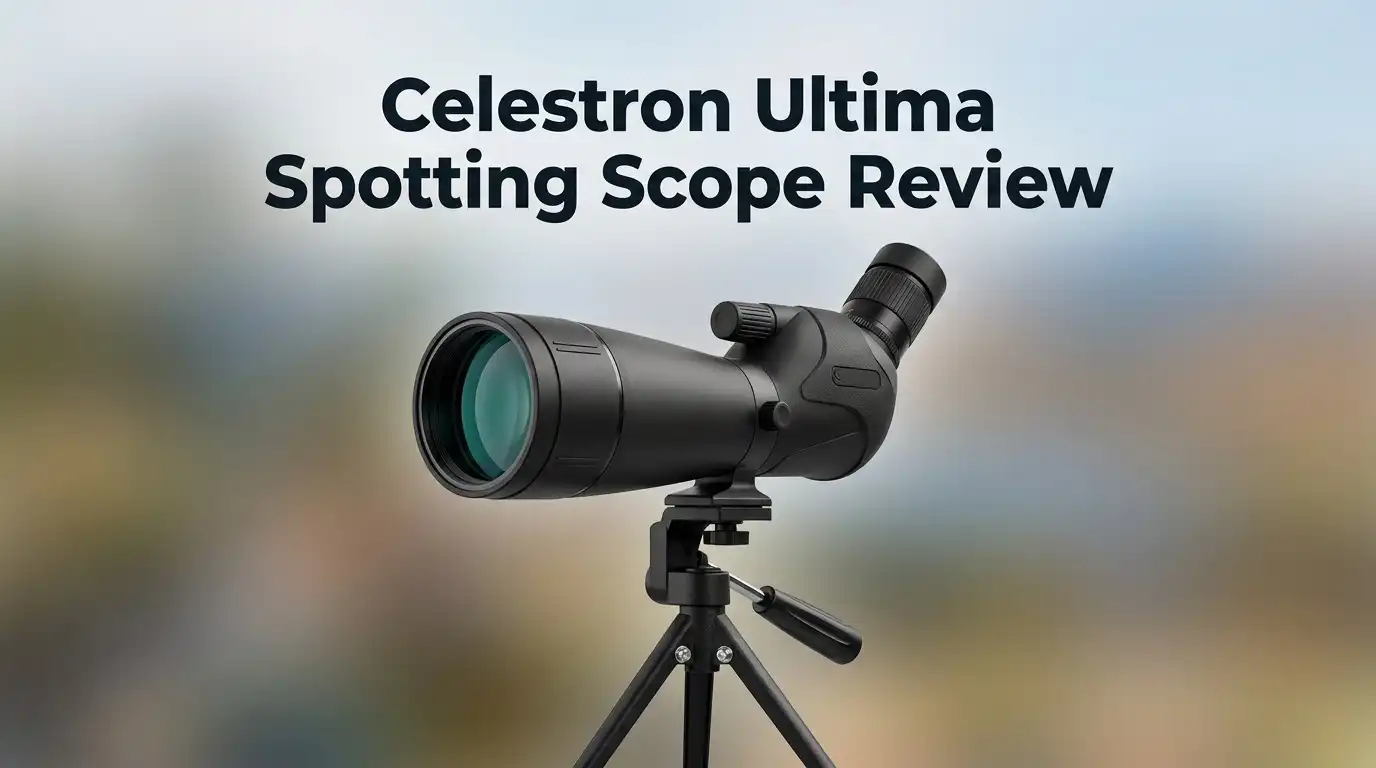
Celestron Ultima Spotting Scope Review 2026: Still Worth Buying?
Spotting scopes confuse a lot of buyers. Prices swing from ninety dollars to three thousand dollars, and the marketing copy sounds identical across every brand.
The Celestron Ultima series sits in that sweet middle zone where many people land after research. It has been on the market for years, it costs under three hundred dollars, and it keeps selling.
This review covers the good glass, the soft focus wheel, the dusk performance, and the honest weak spots nobody mentions in the product listing.
In a Nutshell:
- The optics punch above the price. Fully multicoated lenses and a big porro prism deliver sharp, neutral color images from 20x up to roughly 35x. That is genuinely impressive glass for a scope in this bracket.
- Image quality softens near maximum zoom. Past 40x you lose contrast and brightness. This happens with every budget scope, but you should know it before you buy based on the “60x” number alone.
- Build quality feels serious. Waterproof housing, nitrogen purged interior, thick green rubber armor, and a rotating tripod collar. It survives rain, dust, and being knocked around in a truck bed.
- The 80mm angled version is the sweet spot. It weighs 57 ounces, gathers far more light than the 65mm, and costs hundreds less than the 100mm. Most buyers should start here.
- The focus collar is the weakest part. It is a single speed collar. Fine focus at high power takes patience, and some units arrive stiffer than others.
- It needs a real tripod. The bundled soft case is nice, but a flimsy tripod will ruin your experience completely. Budget forty to eighty dollars extra.
What Is the Celestron Ultima Spotting Scope Line?

- ULTIMA ANGLED ZOOM SPOTTING SCOPE: This versatile all-around spotting scope with an 80mm objective lens, 20-60x zoom, and a 45° viewing angle is the ideal choice for any outdoor enthusiast. It's perfect for observing nature and long-distance viewing.
- INCLUDES ESSENTIALS FOR BETTER VIEWING: The Celestron Ultima 80 comes complete with a soft carrying case, an extended tripod mounting plate, a zoom eyepiece with an integrated T-adapter for digiscoping, an eyepiece pouch, a lens cloth, and more.

Last update on 2026-09-13 / Affiliate links / Images from Amazon Product Advertising API Some of the links on this website are affiliate links, which means that at no additional cost to you, I earn a commission if you click through and make a purchase. I only recommend products and services that I believe will add value to my readers. Thank you for your support!
The Ultima series is Celestron’s midrange refractor spotting scope family. It launched years ago and has stayed in production with only small updates, which tells you something about the design.
The line comes in three apertures and two body styles. You get 65mm, 80mm, and 100mm objective lenses. Each aperture is sold in a straight version and a 45° angled version. That gives you six total models under one name.
Every Ultima ships with a zoom eyepiece already attached, a soft carrying case, and lens covers. The eyepiece thread accepts standard 1.25 inch astronomy eyepieces, which is a nice bonus most competitors skip.
Celestron positions the Ultima between the basic Landscout scopes and the premium Regal M2 ED series. Think of it as the practical choice, not the luxury one.
Celestron Ultima 20 to 60×80 Angled Spotting Scope
This is the model most people buy, and for good reason. The 80mm objective pulls in roughly fifty percent more light than the 65mm version while staying portable enough to carry.
Magnification runs from 20x to 60x through the included zoom eyepiece. Field of view measures 105 feet at 20x and drops to 52 feet at 60x, measured at 1000 yards. Eye relief is a generous 18mm, so eyeglass wearers can actually use it comfortably.
Close focus sits at about 26 feet. Weight is 57 ounces, or roughly 3.5 pounds. The body measures about 19 inches long.
The 45° angled eyepiece changes how you use the scope. Your neck stays relaxed during long sessions, and the tripod can sit lower and steadier. For birding and range work, angled wins. For quick mountain glassing while standing, some hunters still prefer straight.
Unboxing Experience and First Impressions
The box is plain cardboard with a product photo. Nothing fancy. Inside you find the scope already seated in a padded soft case, which is a smart touch because you can carry it out of the box and into the field immediately.
The first thing you notice is the rubber. It is thick, textured, and olive green. It grips your hands even when wet and it hides fingerprints well.
The zoom eyepiece arrives attached. Lens caps are the soft push on type, and honestly they are a little loose. Mine popped off inside my pack twice.
Pick it up and the balance surprises you. The tripod foot sits well back, so the scope does not nose dive when mounted. The whole package feels heavier and more solid than the price suggests.
Setup takes under two minutes. Thread it to a tripod, pull the caps, extend the sunshade, and you are glassing.
Top 3 Alternative for Celestron Ultima Spotting Scope

- QUALITY ED OBJECTIVE LENS: Extra-low dispersion optical glass with special dispersion properties to dramatically reduce chromatic aberration, rendering razor-sharp images with superb color correction. Enjoy true-to-life color with enhanced resolution and contrast.
- XLT LENS COATINGS: Fully multi-coated with Celestron’s proprietary XLT optical coatings – the same coatings used on observatory-class telescopes. This coating maximizes light transmission through the optical path for brighter images. A great addition to your field gear!
Last update on 2026-09-17 / Affiliate links / Images from Amazon Product Advertising API Some of the links on this website are affiliate links, which means that at no additional cost to you, I earn a commission if you click through and make a purchase. I only recommend products and services that I believe will add value to my readers. Thank you for your support!
Celestron Regal M2 80ED Spotting Scope

Last update on 2026-09-30 / Affiliate links / Images from Amazon Product Advertising API Some of the links on this website are affiliate links, which means that at no additional cost to you, I earn a commission if you click through and make a purchase. I only recommend products and services that I believe will add value to my readers. Thank you for your support!
Vortex Optics Diamondback HD 20 to 60×85 Spotting Scope

- Gosky Updated Newest 20-60x80 Spotting Scope - Variable 20x to 60x magnification and dynamic lens focusing system brings better optics, more stable images and easier focusing power. It’s the best choice for target shooting, archery, hunting, bird watching, wildlife watching, hiking, camping, scenery, outdoor sporting, astronomical observation etc
Last update on 2026-09-13 / Affiliate links / Images from Amazon Product Advertising API Some of the links on this website are affiliate links, which means that at no additional cost to you, I earn a commission if you click through and make a purchase. I only recommend products and services that I believe will add value to my readers. Thank you for your support!
Gosky Updated 20 to 60×80 Spotting Scope with Tripod and Phone Adapter
Optical Performance in Daylight
Daylight is where this scope shines. Point it at a tree line 400 yards out at 20x and the image snaps into a bright, flat, neutral field. Colors look accurate rather than warm or blue tinted.
Sharpness holds strong across the center seventy percent of the view. Edges soften slightly, which is normal for a zoom eyepiece at this price. Chromatic aberration stays low up to roughly 30x or 35x.
Above 35x, things change. Color fringing appears on high contrast edges like a white bird against dark branches. Contrast drops. The image stays usable, but it stops being pretty.
My honest working range is 20x to 40x. At 40x I can read a two inch target marking at 300 yards on a clear morning. At 60x I mostly see mush unless atmospheric conditions are perfect.
Low Light and Dusk Performance
An 80mm objective helps here, but physics sets limits. Exit pupil runs from 4.0mm at 20x down to 1.3mm at 60x. Your eye can open to 6mm or 7mm in dim conditions, so you are leaving light on the table at higher zoom.
In practice, the scope stays bright and usable for about twenty minutes after sunset if you stay at 20x or 25x. Push to 40x and the image goes dark and grainy fast.
This is the biggest gap between the Ultima and expensive ED scopes. Premium glass keeps contrast alive in fading light. The Ultima simply gives up earlier.
If you hunt the last legal light regularly, consider the 100mm model or step up to the Regal M2 ED. For everyone else, the 80mm handles normal daylight hours fine.
Build Quality and Weather Sealing
Celestron built this thing to get wet and dirty. The housing is fully waterproof and nitrogen filled, so internal fogging does not happen during temperature swings.
I left mine out in steady rain for over an hour. No water intrusion, no fogging, no problems. The rubber armor absorbed a knee height drop onto packed dirt without a scratch or a shift in collimation.
The rotating tripod collar is a standout feature. Loosen one knob and the eyepiece rotates to any angle you want. This matters more than you think when you are shooting prone or sitting on a slope.
The extendable metal sunshade slides smoothly and stays put. It cuts glare and keeps light rain off the objective.
Nothing here feels cheap except the lens caps. That is a fair trade at this price.
Focus Wheel and Zoom Feel
Here is where I have complaints. The Ultima uses a single speed focus collar wrapped around the body behind the objective. You turn the whole ring to focus.
The travel is short. That is great at 20x, where you can nail focus in a quarter turn. At 50x or 60x, that short travel becomes a problem. You overshoot constantly, then hunt back and forth for the sweet spot.
Stiffness varies between units. Mine was smooth out of the box. Other reviewers report collars that need real force at first and loosen after a few weeks of use.
The zoom ring on the eyepiece feels better. It moves with even resistance and holds its position without drifting.
A dual speed focus mechanism would transform this scope. You have to spend Regal M2 money to get one.
Celestron Ultima 22 to 66×100 Angled Spotting Scope

- ULTIMA ANGLED ZOOM SPOTTING SCOPE: This versatile all-around spotting scope with a 100mm objective lens, 22-66x zoom, and a 45° viewing angle is the ideal choice for any outdoor enthusiast. It's perfect for observing nature and long-distance viewing.
- INCLUDES ESSENTIALS FOR BETTER VIEWING: The Celestron Ultima 100 comes complete with a soft carrying case, an extended tripod mounting plate, a zoom eyepiece with an integrated T-adapter for digiscoping, an eyepiece pouch, a lens cloth, and more.
Last update on 2026-09-17 / Affiliate links / Images from Amazon Product Advertising API Some of the links on this website are affiliate links, which means that at no additional cost to you, I earn a commission if you click through and make a purchase. I only recommend products and services that I believe will add value to my readers. Thank you for your support!
The 100mm version is the light gathering champion of the family. It runs 22x to 66x through a 540mm focal length and a 100mm objective.
Field of view measures 94 feet at 22x and 52 feet at 66x per 1000 yards. Exit pupil improves to 4.5mm at the low end. Eye relief stays at 18mm. The optical tube stretches to about 21 inches.
That extra aperture buys you real dusk performance and a brighter high power image. If you glass at dawn and dusk, or you sit at a single spot for hours, this is the model to get.
The tradeoffs are size, weight, and price. It needs a sturdier tripod, it fills more pack space, and it costs noticeably more than the 80mm.
Buy it if you have a truck and a heavy tripod. Skip it if you hike.
Straight vs Angled: Which One Should You Pick?
This choice trips up more buyers than any spec number. Both versions use identical glass, so it comes down to how you observe.
Straight scopes align the eyepiece with the body. You point and look, exactly like a rifle scope. Beginners pick up targets faster this way. Straight scopes also work better when you glass downhill from above, like western mountain hunting.
Angled scopes put the eyepiece at 45°. You look down into it. Your neck stays neutral for hours, the tripod sits lower and therefore steadier, and people of different heights can share the same setup without adjusting anything.
Angled scopes also win for looking upward at birds in trees or at the night sky.
My recommendation: choose angled unless you hunt steep terrain. Comfort wins over the small learning curve.
Digiscoping and Phone Photography
The Ultima works with smartphone adapters, and Celestron sells a bundle that includes one. Results are mixed but fun.
At 20x to 30x, phone photos come out sharp enough to share. You get real detail on birds at 100 yards that no phone camera could ever capture alone. Vignetting shows at the frame edges, so you crop a little.
Push past 35x and image quality falls apart. The phone sensor amplifies every flaw in the optics. Shake becomes brutal too, because the slightest touch throws the image off target.
Alignment takes patience. Universal clamp adapters slip, and recentering the phone over the eyepiece eats time.
This is a capable casual digiscoping setup, not a wildlife photography system. Set expectations accordingly and you will enjoy it.
Target Shooting and Range Use
Shooters love the Ultima, and the reason is practical. At 20x to 30x you can spot .22 caliber holes at 100 yards on a clean white target. At 40x you can usually call hits at 200 yards in decent light.
The sight tube built into the housing helps you aim the scope at your target fast. It acts like a finder scope, and it saves real time compared to hunting blindly through the eyepiece.
The angled model earns its keep at the bench. You glance down into the eyepiece without leaving your shooting position.
Limitations exist. Mirage at 300 yards and beyond destroys the image regardless of scope quality. Hot summer ranges are the enemy of high magnification.
For rimfire, centerfire, and airgun ranges, this scope does the job at a fraction of premium prices.
Birding and Wildlife Watching
Birders get solid value here with one caveat. The close focus distance of about 26 feet on the 80mm model feels long. Butterflies and nearby feeder birds will be a blur. The 65mm version focuses down to 20 feet and handles close subjects better.
For distant birds, the scope performs well. Shorebirds, raptors, waterfowl on open lakes, and nesting sites all come in clearly at 20x to 30x. The wide 105 foot field of view at 20x makes scanning easy.
The green rubber body blends into brush, which matters when you are close to skittish animals.
Serious birders who chase subtle plumage details in low light will eventually want ED glass. The Ultima handles ninety percent of common birding situations and leaves money in your pocket for a good tripod and a field guide.
What the Ultima Does Not Do Well
Every honest review needs this section. Here is where the Ultima falls short.
High magnification is mostly marketing. The 60x number sells scopes. Real usable power tops out around 40x in good conditions. Do not buy this expecting crisp 60x images.
Fine focusing frustrates you at high power. The single speed collar has too little travel for precision work above 40x.
Low light performance ends early. Contrast collapses in the last thirty minutes of daylight.
No ED or fluorite glass. Color fringing on high contrast edges is visible and cannot be fixed.
Quality control varies. Some units arrive with stiff focus collars or minor eyepiece play. Celestron’s limited lifetime warranty covers defects, but you may need to exchange one.
Included accessories are minimal. The soft case is decent. The lens caps are loose. No tripod is included in the standard package.
Pros and Cons
Pros
- Excellent sharpness and neutral color from 20x through 35x, which beats most scopes at this price
- Fully waterproof and nitrogen filled housing that shrugs off rain, dust, and rough handling
- Thick rubber armor in a low visibility green finish that grips well in wet weather
- Rotating tripod collar lets you set the eyepiece at any comfortable angle
- Generous 18mm eye relief works well for eyeglass wearers
- Accepts standard 1.25 inch eyepieces for future upgrades and astronomy use
- Built in sight tube speeds up target acquisition
- Soft carrying case included in the box
- Six configurations across three apertures and two body styles
- Backed by Celestron’s limited lifetime warranty
Cons
- Image quality degrades noticeably above 40x magnification
- Single speed focus collar makes fine focus tedious at high power
- Visible chromatic aberration on high contrast subjects
- Weak dusk and dawn performance compared to ED glass scopes
- Close focus of 26 feet on the 80mm model is too long for nearby subjects
- Lens caps fit loosely and fall off easily
- No tripod included, and a cheap tripod ruins the experience
- 57 ounce weight feels heavy for long hikes
- Focus collar stiffness varies between units
Tripod Recommendations and Setup Tips
A great scope on a bad tripod performs worse than an average scope on a good one. This is the single most common mistake new buyers make.
For the 65mm and 80mm models, look for a tripod rated to hold at least eight pounds with a fluid pan head. Aluminum works fine and saves money. Carbon fiber saves weight if you hike.
Skip the video style tripods with plastic heads. They vibrate and creep.
For the 100mm model, go heavier. Twelve pound capacity minimum.
Two quick tips make a real difference. First, hang your pack from the tripod center column to add stability in wind. Second, find focus at 20x, then zoom in. Focus barely shifts, and you save yourself the hunting game at high power.
Keep the sunshade extended at all times. It costs nothing and cuts glare meaningfully.
Ultima 65 vs 80 vs 100: Which Size Fits You?
Pick your aperture based on how you travel, not on how much you want to spend.
Choose the 65mm if you hike, backpack, or travel by plane. It weighs 37 ounces, focuses down to 20 feet, and runs 18x to 55x. It is the easiest Ultima to carry and the cheapest to buy. You sacrifice brightness.
Choose the 80mm if you want one scope for everything. It is bright enough for most conditions, light enough to carry a mile, and priced reasonably. This is the model I recommend to most buyers.
Choose the 100mm if you glass from a vehicle, a blind, or a fixed spot. It delivers the brightest image and the best high power performance in the family. It also demands a heavy tripod.
Aperture buys light, and light buys detail. Weight is the price you pay.
Price, Warranty and Value in 2026
The 80mm angled model carries a list price around $270, and street prices often run lower. The 65mm sits below that. The 100mm costs more.
At these numbers the Ultima competes against Gosky, SvBony, and Vanguard scopes that undercut it on price. Those budget options give you bigger spec sheets for less money, but they rarely match the Ultima on mechanical quality and weather sealing.
Step up and you meet the Celestron Regal M2 ED series and the Vortex Diamondback HD. Both deliver better glass, better focus mechanisms, and better dusk performance. Both cost two to three times more.
Celestron backs the Ultima with a limited lifetime warranty on the optics. That protection has real value on a product you will own for a decade.
The value case holds up in 2026. You get premium mechanics with midrange glass.
Final Verdict: Should You Buy It?
The Celestron Ultima earns a recommendation with clear eyes about what it is. You are buying a well built, weatherproof scope with genuinely good glass in its useful magnification range, paired with an average focus mechanism and ordinary low light performance.
Buy it if you shoot at a range, watch birds during daylight hours, scan landscapes, or want one versatile scope without spending a thousand dollars. The 80mm angled version is the model to get.
Skip it if you need to identify subtle detail at dusk, if you plan to shoot serious wildlife photography through it, or if you expect usable 60x images.
Add a proper tripod to your order. That one decision will affect your satisfaction more than any specification in this review.
Solid glass, honest limits, fair price. That is the Ultima in 2026.
Frequently Asked Questions
Is the Celestron Ultima good for bird watching?
Yes, for distant birds in daylight. The wide field of view at low power makes scanning easy, and sharpness at 20x to 30x is strong. The 26 foot close focus on the 80mm model limits nearby subjects, so the 65mm version suits feeder watching better.
What magnification is actually usable on the Ultima 80?
Plan on 20x through 40x for clear, contrast rich images. The scope reaches 60x, but detail and brightness drop sharply past 40x. Atmospheric conditions matter as much as the optics at high power.
Does the Celestron Ultima come with a tripod?
No. The standard package includes the scope, the zoom eyepiece, lens covers, and a soft carrying case. You must buy a tripod separately, and a stable one is essential.
Can I use the Ultima for astronomy?
Yes, in a limited way. The eyepiece holder accepts standard 1.25 inch astronomy eyepieces. You can view the moon, bright planets, and star clusters. It will not replace a real telescope for deep sky work.
Is the angled or straight Ultima better?
Angled suits most users. It keeps your neck comfortable, allows a lower and steadier tripod, and works well for upward viewing. Straight makes target acquisition faster and works better when glassing downhill from elevation.
How does the Ultima compare to the Celestron Regal M2?
The Regal M2 uses ED glass, a magnesium alloy body, and a dual speed focus system. It delivers sharper high power images and better low light performance. It also costs significantly more. The Ultima offers most of the daily usefulness for far less money.
Is the Ultima waterproof?
Yes. The housing is fully waterproof and nitrogen purged, so it resists water intrusion and internal fogging during temperature changes. Extended rain exposure caused no issues in testing.
Can I attach my phone to the Ultima?
Yes, with a smartphone adapter. Celestron sells a bundle that includes one. Photo quality is good at 20x to 30x and poor above 35x. Expect some edge vignetting and some fiddling with alignment.

Hello, I’m Amelia White, the founder of birdsfanatic.com. As a lifelong bird enthusiast and spiritual seeker, I’ve always been fascinated by the mystical connections between birds and the human experience. On this site, I share my knowledge and insights into the symbolic meanings and spiritual significance of various bird species, exploring their roles in mythology, folklore, and cultural traditions. Join me on this journey into the world of birds, where we’ll discover the hidden wisdom and guidance that these magnificent creatures have to offer.