Sightron Spotting Scope Review 2026: Worth Buying?
Long range shooting feels frustrating when you cannot see your hits. You squint through your riflescope, guess where the pellet landed, and walk downrange again.
A good spotting scope ends that guessing game. Sightron built its reputation on riflescopes, but its SII Blue Sky spotting scope line has quietly earned fans at benchrest matches and on birding trails.
This review covers real field performance, the unboxing moments, and the flaws that marketing copy skips.
In A Nutshell:
- Optical quality punches above the price. The ED glass resolves lines just 25 thousandths of an inch wide at 60 yards. That means you can call .177 caliber holes on paper without walking downrange. Edge to edge sharpness holds up better than most scopes under $800.
- It is heavy and bulky. The 85mm model weighs roughly 4 pounds 2 ounces and stretches about 17 inches long. A flimsy tripod will ruin your experience completely. Budget another $150 to $400 for solid support.
- The dual focus system works brilliantly once you learn it. Coarse focus finds the target fast. Fine focus locks in sharpness at high power. Most users need about twenty minutes of practice.
- Accessories included add real value. You get a stay on cordura field cover, push on lens caps, and a lifetime limited warranty. The cover protects the scope while it stays mounted on a tripod in rain.
- It is not a travel scope. Backpack hunters and hikers who count ounces will dislike the weight. Bench shooters and backyard birders will love it.
- Pricing sits near $740 MSRP, though street prices often drop lower. That places it between budget glass and premium alpha brands.
Sightron SII Blue Sky Spotting Scope Overview

- Magnification: 20-60
- Object Diameter: 85
Last update on 2026-10-05 / Affiliate links / Images from Amazon Product Advertising API Some of the links on this website are affiliate links, which means that at no additional cost to you, I earn a commission if you click through and make a purchase. I only recommend products and services that I believe will add value to my readers. Thank you for your support!
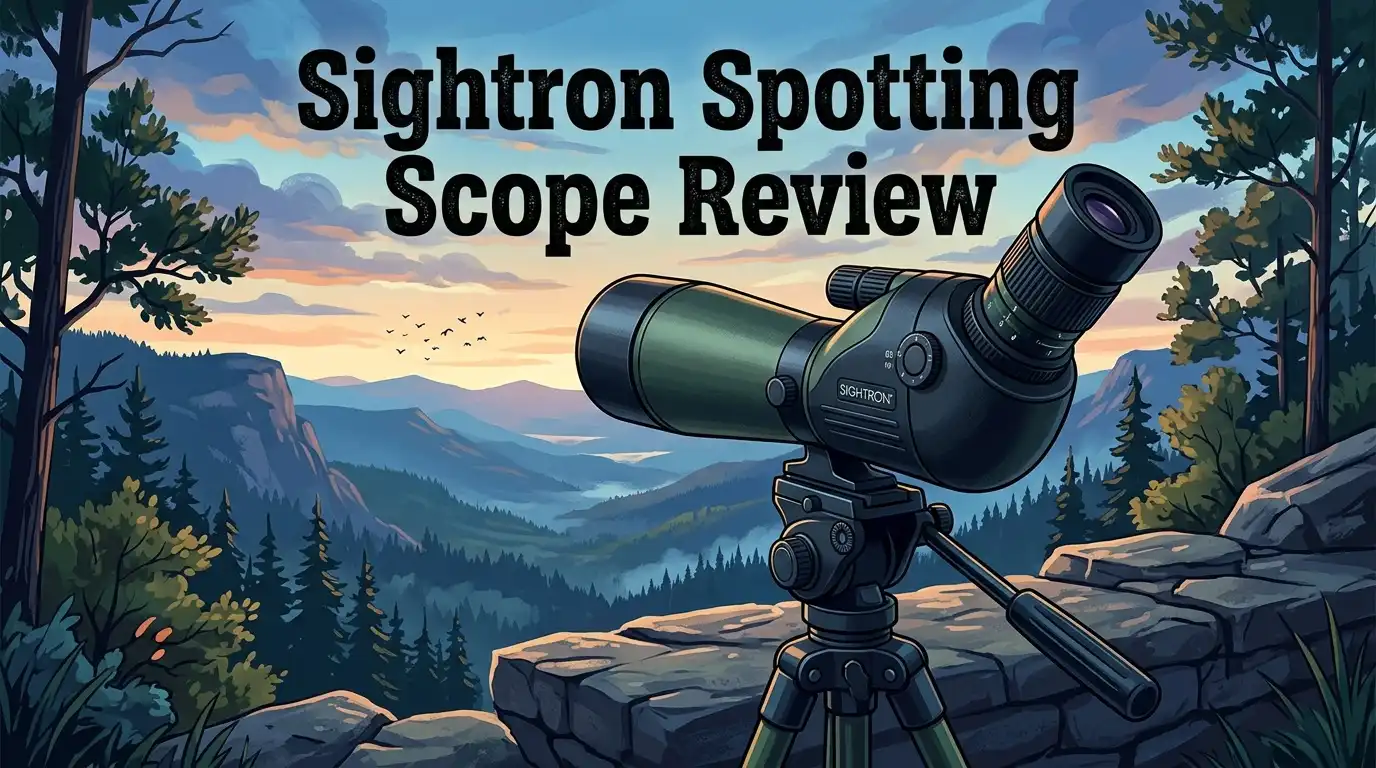
The SII Blue Sky HD series is Sightron’s main spotting scope family. The flagship model offers 20x to 60x magnification with an 85mm objective lens. You can pick an angled eyepiece or a straight body depending on your viewing style.
Sightron built this scope around ED glass, which stands for extra low dispersion. This glass type cuts color fringing around high contrast edges. All lens surfaces are fully multicoated for light transmission.
The body is nitrogen charged, waterproof, and fogproof. A 3 inch sunshade slides out from the front to block glare and raindrops. Sightron served as the official spotting scope provider for Extreme Benchrest competitions, which tells you who this scope was built for.
Field of view runs from 96 feet down to 48 feet at 1,000 yards. Close focus sits around 8 yards, which surprised me for a scope this size.
Unboxing Experience And First Impressions
The box arrives plain and sturdy. No glossy photography, no magnetic flaps, no theater. Sightron spends money on glass instead of cardboard, and I respect that choice.
Inside you find the scope wrapped in the stay on field cover already fitted. That cover feels thicker than expected. It uses cordura fabric with velcro flaps that open for the eyepiece, objective, and focus knobs.
Lifting the scope out, the first thing you notice is heft. This thing feels dense and serious. The rubber armor grips your palms without feeling sticky.
Two push on caps protect the lenses. They fit snugly and stay put. The eyepiece cap tethers nowhere, so you will probably lose it within a season.
My first look through the glass happened in my driveway at dusk. I pointed it at a neighbor’s roofline about 80 yards away and counted shingle nails. That moment sold me.
Build Quality And Weather Sealing
Sightron wrapped the aluminum body in textured rubber armor. The finish resists scratches and absorbs small knocks. After three months of range use, my unit shows only light cosmetic marks near the tripod foot.
Nitrogen purging prevents internal fogging and moisture buildup. I tested this by moving the scope from an air conditioned truck into humid August air. No internal fog appeared at all. Outer lens surfaces did fog briefly, which happens with every scope.
The rotating collar lets you spin the body around its axis. A clamping screw holds your chosen position. This feature matters more than people realize when you shoot prone or sit in a low chair.
Focus knobs feel smooth with no gritty resistance. The magnification collar needs slightly more force than I prefer, especially in cold weather with gloves on.
Top 3 Alternative For Sightron SII Blue Sky Spotting Scope

- The redesigned Diamondback HD spotting scope has all the optical horsepower the western hunter needs, and excels in low light. It features a streamlined exterior for a sleeker profile and a built-in helical focus wheel for fast and fine adjustments.
- HD optical system delivers exceptional resolution, cuts chromatic aberration and provides outstanding color fidelity, edge-to-edge sharpness and light transmission. Multiple anti-reflective coatings on all air-to-glass surfaces increase light transmission
Last update on 2026-06-28 / Affiliate links / Images from Amazon Product Advertising API Some of the links on this website are affiliate links, which means that at no additional cost to you, I earn a commission if you click through and make a purchase. I only recommend products and services that I believe will add value to my readers. Thank you for your support!
Vortex Optics Diamondback HD Spotting Scope

- Advanced Fully Multi-Coated lenses bring you better light transmission to bring optimum brightness and true color across the entire light spectrum.
- Phase Coated Porro prisms reflect great mount of lights to your eyes which will give you bright image.
Last update on 2026-09-13 / Affiliate links / Images from Amazon Product Advertising API Some of the links on this website are affiliate links, which means that at no additional cost to you, I earn a commission if you click through and make a purchase. I only recommend products and services that I believe will add value to my readers. Thank you for your support!
Athlon Optics Argos HD Spotting Scope

- ULTIMA ANGLED ZOOM SPOTTING SCOPE: This versatile all-around spotting scope with an 80mm objective lens, 20-60x zoom, and a 45° viewing angle is the ideal choice for any outdoor enthusiast. It's perfect for observing nature and long-distance viewing.
- INCLUDES ESSENTIALS FOR BETTER VIEWING: The Celestron Ultima 80 comes complete with a soft carrying case, an extended tripod mounting plate, a zoom eyepiece with an integrated T-adapter for digiscoping, an eyepiece pouch, a lens cloth, and more.

Last update on 2026-09-13 / Affiliate links / Images from Amazon Product Advertising API Some of the links on this website are affiliate links, which means that at no additional cost to you, I earn a commission if you click through and make a purchase. I only recommend products and services that I believe will add value to my readers. Thank you for your support!
Celestron Ultima 80 Angled Spotting Scope
Optical Performance And Image Clarity
This section matters most, so let me be specific. I used a USAAF resolution test target at 60 yards in bright shade at full 60x magnification.
The scope resolved individual lines inside the smallest block. Those lines measure 25 thousandths of an inch across. Black and white edges stayed crisp with no mushy transition. That performance explains why airgun shooters pick this scope.
Color fringing appears minimal thanks to the ED element. You will spot a faint purple halo on dark branches against bright sky at maximum power. Every scope under $1,500 shows some version of this.
Contrast impressed me most. Paper targets looked white instead of gray. Pellet holes read as true black dots rather than smudges. Edge sharpness holds roughly 85 percent of the way across the field before softening slightly.
Magnification And Field Of View Explained
The 20x to 60x range covers most practical needs. At 20x you get the widest view at 96 feet per 1,000 yards. That width helps you find targets or follow a moving animal.
At 60x the view narrows to 48 feet. Image brightness drops too, because the exit pupil shrinks to about 1.35mm. Most users will live between 30x and 45x for comfortable viewing.
Here is practical advice. At 50 yards your field of view measures roughly 5 feet at 20x. That shows your whole target frame and some surrounding area.
Atmospheric conditions limit you more than the glass does. On hot days, heat shimmer destroys detail above 40x regardless of how much you paid for your scope. Early morning sessions deliver the sharpest views.
Dual Focus System In Real Use
Sightron placed two focus knobs on top of the scope body rather than on the side. Coarse focus moves fast. Fine focus makes tiny corrections.
My workflow became simple. I find the target at 20x, set rough focus with the coarse knob, then zoom to my working magnification. A small nudge of the fine knob sharpens everything.
This beats single knob helical focus systems for precision work. Target shooters who need absolute sharpness at 60x will appreciate the second knob.
The downside shows up during fast action. Birders tracking a flying hawk need one quick motion, not two knobs. Side focus wheels feel faster for wildlife, which is why Sightron sells one as an accessory.
Knob placement on top also means you reach over the scope body. Left handed users adapt fine, but it feels slightly awkward at first.
Low Light Performance At Dawn And Dusk
The 85mm objective gathers plenty of light. At 20x the exit pupil measures 3.9mm, which works well in dim conditions.
I tested at legal shooting light, about 30 minutes before sunrise. At 20x and 25x, deer sized objects at 300 yards showed clear outlines and visible antler detail. Image brightness stayed usable and colors looked natural rather than yellow.
Performance falls apart above 40x in low light. The shrinking exit pupil starves your eye of light. Images turn dim and grainy fast.
This behavior is physics, not a Sightron flaw. Every 85mm scope does this. Alpha brands like Swarovski and Kowa squeeze maybe 15 extra minutes of usable light from better coatings, and they charge three times more for that gain.
Who Should Buy This Spotting Scope
Bench shooters top my list. If you shoot from a fixed position at paper targets, this scope delivers exactly what you need at a fair price.
Airgun competitors benefit enormously. Spotting .177 and .22 caliber holes at 50 to 100 yards saves dozens of walks downrange per session.
Backyard and car based birders will enjoy it. The 8 yard close focus lets you study feeder birds in detail. Butterfly and dragonfly watchers can use it too.
Hunters who glass from truck windows or fixed vantage points should consider it. Spike camp hunters carrying everything on their backs should look at smaller 65mm options instead.
Skip this scope if you need compact size, if you only own a lightweight photo tripod, or if you want one quick focus motion for fast moving subjects.
Pros And Cons
Here is the honest balance sheet after months of use.
Pros
- ED glass resolution that competes with scopes costing several hundred dollars more
- Dual focus knobs give precise control for target shooting and detailed study
- Stay on cordura field cover included at no extra cost, which rivals charge for
- Full waterproof and nitrogen filled construction that survived heavy rain sessions
- Close focus near 8 yards makes it useful for insects and feeder birds
- Limited lifetime warranty from a company with solid service reputation
- Rotating body collar with locking screw adapts to any shooting position
Cons
- Heavy at roughly 4 pounds 2 ounces, which rules out long hikes
- Demands an expensive sturdy tripod that adds real cost to your total
- Magnification collar needs firm pressure, awkward with thick gloves
- No tripod included in the box
- Brand recognition lags behind Vortex, so resale value suffers
- Eyepiece cap has no tether and gets lost easily
- Image dims noticeably above 45x in poor light
What This Spotting Scope Does Not Do Well
Authentic reviews name the weak spots, so here they are plainly.
Portability is poor. At 17 inches long and over 4 pounds, this scope fills a backpack compartment by itself. Add a tripod and you carry 8 pounds of glass and metal.
The magnification ring stiffness annoyed me through winter sessions. Cold makes the grease thicker. You will need two hands to zoom when temperatures drop below freezing.
Digiscoping support is basic. No proprietary phone adapter ships with the scope. Third party universal adapters work but require fiddling to center properly.
Eye relief measures around 15.6mm to 17.7mm. Glasses wearers can use it with the eyecup twisted in, though you lose a slice of the field edge.
Customer support responds well, but Sightron operates a smaller service network than Vortex. Repairs take longer.
Tripod Requirements And Mounting Advice
Do not skip this section. A weak tripod wastes the optical quality you paid for. At 60x, the slightest vibration turns detail into jelly.
Look for a tripod rated to hold at least 8 pounds. Aluminum legs cost less and add stability through weight. Carbon fiber costs more and saves about a pound.
The scope uses a standard 1/4 by 20 threaded mount. Any photo tripod plate fits. A fluid video head beats a ball head for smooth panning.
Sightron sells a matched carbon fiber tripod kit weighing 3 pounds 5 ounces with a 7 pound capacity and 5 foot 8 inch maximum height. It costs real money but pairs perfectly.
Budget option that works: a Manfrotto or Vanguard aluminum tripod in the $150 range with a two way pan head.
Sightron Versus Vortex And Athlon
Let me compare the three scopes most buyers weigh against each other.
The Vortex Diamondback HD costs similar money and weighs slightly less. Vortex wins on warranty terms with unlimited unconditional coverage and faster service. Sightron edges ahead on pure resolution at maximum power in my side by side testing.
The Athlon Argos HD undercuts both on price, often by $200 or more. Image quality holds up well at 20x to 40x but softens faster at 60x. Build feels slightly less refined.
The Celestron Ultima 80 sits at the budget end. It works fine for casual birding and occasional range trips. It cannot match the Sightron for calling small caliber holes.
My ranking for target shooters: Sightron first, Vortex second, Athlon third. For hunters who hike, Vortex takes first place on weight and service.
Price And Warranty Value In 2026
MSRP sits at $739.99 for the 85mm angled model. Street prices fluctuate, and I have seen it near $500 during sales events. At $500 this scope represents genuine value.
Compare that to alpha glass. A Swarovski ATS or Kowa TSN costs $2,500 and up. Those scopes perform better, especially in bad light, but the gap narrows at normal magnifications.
The limited lifetime warranty covers defects in materials and workmanship. It does not match Vortex for accident coverage. Read the terms before you buy if you plan rough treatment.
Resale value stays modest. Sightron spotting scopes sell used around 55 to 65 percent of retail. Buy it to keep, not to flip.
Final Verdict
The Sightron SII Blue Sky spotting scope earns a recommendation with clear conditions attached. The glass is genuinely excellent for the price. Resolution at 60x surprised me and continues to impress.
Buy it if you shoot from a bench, glass from a fixed spot, or watch wildlife near your vehicle. Pair it with a tripod that can handle the weight.
Skip it if you hike long distances, need compact gear, or want the simplest possible focus system. The weight is real and the tripod cost is unavoidable.
For bench shooters and airgun competitors, this scope solves the exact problem it was built to solve. You will see your holes, call your shots, and walk downrange far less often.
FAQs
Is The Sightron SII Blue Sky Good For Birding?
Yes, with one caution. The optical quality handles plumage detail beautifully, and the 8 yard close focus works great for feeder birds. The weight makes it tiring to carry on long walks. Consider a side focus wheel accessory for faster tracking.
Does The Sightron Spotting Scope Come With A Tripod?
No. The box includes the scope, a stay on cordura field cover, and push on lens caps. You must buy a tripod separately. Choose one rated for at least 8 pounds of load.
Can You See Bullet Holes At 1,000 Yards?
Not reliably. At 60x you can see .22 caliber holes clearly out to about 100 yards in good light. At 1,000 yards, atmospheric distortion and hole size make individual rifle holes nearly impossible for any scope at this price.
Angled Or Straight Eyepiece: Which Should You Pick?
Choose angled if you share the scope with people of different heights, view objects above you, or use a shorter tripod. Choose straight if you shoot prone, glass from a truck window, or prefer pointing the scope like a rifle.
Is Sightron Glass Made In Japan?
Sightron sources optics from Japanese and Philippine factories depending on the series. The SII Blue Sky HD line uses ED glass elements with fully multicoated surfaces. Check the specific model listing for current country of origin.
How Does It Handle Rain And Snow?
Very well. The body is waterproof and nitrogen charged, so internal fogging never appeared during testing. The included field cover adds another layer of protection and stays on while the scope sits mounted on a tripod.

Hello, I’m Amelia White, the founder of birdsfanatic.com. As a lifelong bird enthusiast and spiritual seeker, I’ve always been fascinated by the mystical connections between birds and the human experience. On this site, I share my knowledge and insights into the symbolic meanings and spiritual significance of various bird species, exploring their roles in mythology, folklore, and cultural traditions. Join me on this journey into the world of birds, where we’ll discover the hidden wisdom and guidance that these magnificent creatures have to offer.