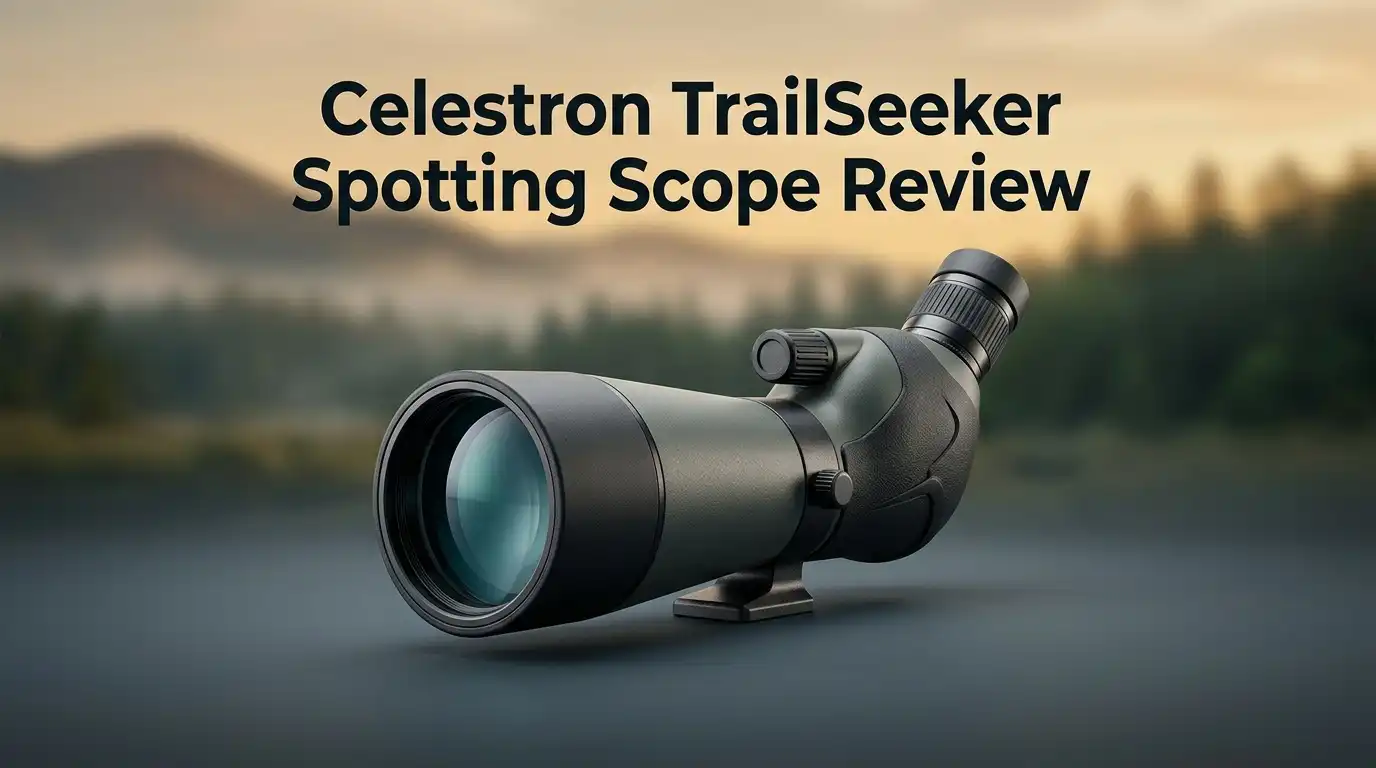
Celestron TrailSeeker Spotting Scope Review 2026: Still Worth It?
Spotting scopes sit in a strange price gap. Cheap ones blur past 40x. Premium ones cost more than a used car. The Celestron TrailSeeker tries to land right in the middle, and it has quietly held that spot for years.
I spent weeks with this scope at a coastal mudflat, a backyard feeder, and a 200 yard range. This review covers the honest wins and the real weak spots. No marketing fluff. Just what you see through the glass.
In a Nutshell:
- Image quality punches above the price. The center sharpness is genuinely impressive for a scope under $400. Colors look natural, and contrast holds up well in good light.
- The dual focus wheel is the standout feature. You get a coarse wheel for fast target grabbing and a fine wheel for precise tuning. Most scopes at this price offer only one.
- Build quality feels serious. The body is fully waterproof, nitrogen purged, and wrapped in thick rubber armor. It survived rain and a short drop onto grass without complaint.
- Low light performance drops off. Past 45x in twilight, the image turns dim and soft. This is the scope’s clearest weakness, and you should plan around it.
- You must budget for a tripod. No tripod is included. A flimsy tripod will ruin this scope faster than bad weather.
- Two sizes cover two different users. The 65mm model suits hikers and travelers. The 80mm model suits birders and shooters who stay near the car.
What Is the Celestron TrailSeeker Spotting Scope?

- · PREMIUM OPTICS FOR BRIGHT, SHARP VIEWS: Fully multi-coated lenses with Celestron’s XLT coatings maximize light transmission for vivid color, high contrast, and crisp detail—even at dawn or dusk.
- · PHASE-COATED BAK-4 PRISMS: Premium BaK-4 prisms with phase coatings boost resolution and contrast for edge-to-edge clarity.

Last update on 2026-09-28 / Affiliate links / Images from Amazon Product Advertising API Some of the links on this website are affiliate links, which means that at no additional cost to you, I earn a commission if you click through and make a purchase. I only recommend products and services that I believe will add value to my readers. Thank you for your support!
The TrailSeeker is Celestron’s midrange spotting scope family. It sits above the budget Ultima line and below the premium Regal M2 series with ED glass.
Celestron sells it in three sizes. The 65mm compact model zooms from 16x to 48x. The 80mm model zooms from 20x to 60x. A larger 100mm version zooms from 22x to 67x.
All versions use fully multicoated optics with Celestron’s XLT coating, BaK4 prisms, and a removable zoom eyepiece. The body accepts standard 1.25 inch astronomy eyepieces once you remove the stock zoom.
This matters more than it sounds. You can upgrade the eyepiece later without buying a new scope. Very few scopes under $400 allow that.
Celestron TrailSeeker 20x to 60×80 Angled Spotting Scope
The 80mm model is the one most buyers choose. It gathers noticeably more light than the 65mm and handles higher magnification with less image breakdown.
Specs are straightforward. The objective lens measures 80mm. Focal length is 480mm. Eye relief runs from 18mm down to 15mm as you zoom in. Field of view spans 105 feet to 52 feet at 1000 yards. Close focus sits near 24 feet, though several owners report focusing closer to 16 feet in practice.
Weight lands around 3.4 pounds with the eyepiece attached. That is normal for an 80mm scope. It is not a backpacking tool, but it is not a boat anchor either.
The 45 degree angled body helps when sharing views with people of different heights.
Celestron TrailSeeker 16x to 48×65 Compact Spotting Scope

- PREMIUM OPTICS FOR BRIGHT, SHARP VIEWS: Fully multi-coated lenses with Celestron’s XLT coatings maximize light transmission for vivid color, high contrast, and crisp detail—even at dawn or dusk.
- PHASE-COATED BAK-4 PRISMS: Premium BaK-4 prisms with phase coatings boost resolution and contrast for edge-to-edge clarity.
Last update on 2026-09-30 / Affiliate links / Images from Amazon Product Advertising API Some of the links on this website are affiliate links, which means that at no additional cost to you, I earn a commission if you click through and make a purchase. I only recommend products and services that I believe will add value to my readers. Thank you for your support!
The 65mm version trades light gathering for portability. It weighs roughly 2.4 pounds and shortens the body by several inches.
Audubon magazine tested this model and scored it 7.1 with a “good value” label. Their testers praised the center sharpness, the zoom action, and the easy focusing. That is meaningful praise from people who compare scopes costing five times more.
The lower 16x starting magnification gives you a wider and more forgiving field of view. Finding a distant bird becomes much easier. Beginners often struggle to locate targets at 20x, so this helps.
The tradeoff is honest. A 65mm objective collects about 34 percent less light than an 80mm objective. Dawn and dusk sessions will feel dimmer.
Unboxing Experience and First Impressions
The box is plain cardboard with a product photo. Nothing fancy. Inside you find the scope wrapped in foam, a soft padded case, a lens cloth, and objective and eyepiece caps.
The first thing you notice is the rubber armor. It feels dense and grippy rather than thin and rubbery. The scope has real heft in your hands.
Celestron includes a nylon stay on case. You can leave it attached while using the scope, and the zippered flaps fold back for access. The case is decent but not waterproof, so treat it as dust protection.
What is missing is obvious. There is no tripod, no phone adapter, and no hard case. Budget another $80 to $200 for a usable tripod before you order.
Top 3 Alternative for Celestron TrailSeeker Spotting Scope

- ULTIMA ANGLED ZOOM SPOTTING SCOPE: This versatile all-around spotting scope with an 80mm objective lens, 20-60x zoom, and a 45° viewing angle is the ideal choice for any outdoor enthusiast. It's perfect for observing nature and long-distance viewing.
- INCLUDES ESSENTIALS FOR BETTER VIEWING: The Celestron Ultima 80 comes complete with a soft carrying case, an extended tripod mounting plate, a zoom eyepiece with an integrated T-adapter for digiscoping, an eyepiece pouch, a lens cloth, and more.
Last update on 2026-09-13 / Affiliate links / Images from Amazon Product Advertising API Some of the links on this website are affiliate links, which means that at no additional cost to you, I earn a commission if you click through and make a purchase. I only recommend products and services that I believe will add value to my readers. Thank you for your support!
Celestron Ultima 20x to 60×80 Angled Spotting Scope

- The redesigned Diamondback HD spotting scope has all the optical horsepower the western hunter needs, and excels in low light. It features a streamlined exterior for a sleeker profile and a built-in helical focus wheel for fast and fine adjustments.
- HD optical system delivers exceptional resolution, cuts chromatic aberration and provides outstanding color fidelity, edge-to-edge sharpness and light transmission. Multiple anti-reflective coatings on all air-to-glass surfaces increase light transmission
Last update on 2026-09-17 / Affiliate links / Images from Amazon Product Advertising API Some of the links on this website are affiliate links, which means that at no additional cost to you, I earn a commission if you click through and make a purchase. I only recommend products and services that I believe will add value to my readers. Thank you for your support!
Vortex Optics Diamondback HD Spotting Scope 20x to 60×85

- Nitrogen Purging uses the inertia gas to purge moisture out of the tube giving you better waterproofing and thermal stability
- Fully Multi-Coated lenses gives you great light transmission and bring bright images to your eyes
Last update on 2026-09-17 / Affiliate links / Images from Amazon Product Advertising API Some of the links on this website are affiliate links, which means that at no additional cost to you, I earn a commission if you click through and make a purchase. I only recommend products and services that I believe will add value to my readers. Thank you for your support!
Athlon Optics Talos 20x to 60×80 Spotting Scope
Build Quality and Weatherproofing
The TrailSeeker body is aluminum under the rubber armor. It is fully waterproof and nitrogen purged, so internal fogging is not a concern.
I used the 80mm model through steady drizzle for about two hours. No moisture entered the optical path. The rubber stayed grippy even when wet, which matters when your hands are cold.
The rotating tripod collar uses click stops. You loosen a knurled ring, rotate the barrel, and it settles into position with a satisfying detent. This lets you switch between horizontal scanning and sky viewing without remounting.
The sliding sunshade extends about two inches. It cuts glare and keeps rain off the objective lens.
One small complaint. The eyecup twists up and down stiffly out of the box. It loosens after a few weeks of use.
Optical Performance in Bright Daylight
This is where the TrailSeeker earns its reputation. In good light at 20x to 35x, the image looks bright, sharp, and color accurate.
I resolved individual feather barring on a great blue heron at roughly 300 yards. Text on a range sign stayed readable at 200 yards through the 80mm model.
Edge sharpness holds better than expected. Most budget scopes turn mushy in the outer 20 percent of the view. The TrailSeeker keeps useful detail nearly to the edge at lower magnifications.
Chromatic aberration exists but stays controlled. You see purple fringing on high contrast subjects, like a dark bird against a bright sky. It becomes more noticeable when tracking moving targets.
The XLT coatings do real work here. Glare resistance is solid, even shooting into partial backlight.
Low Light and Twilight Performance
Here is the honest weakness. This scope is not ED glass, and twilight exposes that.
Between 20x and 30x, the 80mm model handles dawn and dusk acceptably. You lose some contrast but keep usable detail for maybe 20 minutes after sunset.
Push past 45x in that same light and the image turns murky. Colors flatten. Fine detail disappears. You will find yourself zooming back out rather than fighting it.
The 65mm model reaches this wall sooner. Its smaller exit pupil at high magnification simply cannot feed your eye enough light.
Plan your expectations around the 25x to 35x range. Experienced birders already live there. Buyers expecting crisp 60x views at dusk will feel disappointed, and that disappointment is on the marketing, not the user.
Zoom Eyepiece and Dual Focus System
The dual focus mechanism is the best feature on this scope. Two textured wheels sit on top of the barrel.
The large wheel moves focus quickly. It travels a little over four full turns from close focus to infinity. The small wheel fine tunes with high precision.
This setup beats single knob designs by a wide margin. You snap onto a target fast, then dial in razor sharpness without overshooting.
The one design flaw is spacing. The two wheels sit close together, so you occasionally grab the wrong one. Muscle memory fixes this within a week.
The zoom collar rotates smoothly and has a grippy texture about two fingers wide. It stays where you put it. No drift, no slop, no accidental zoom changes when you bump the scope.
Field of View and Eye Relief
The 80mm model gives you 105 feet of view at 1000 yards at 20x. That narrows to 52 feet at 60x.
Those numbers are average for the class. Not wide, not tight. You will find birds without much hunting at low magnification.
Above 45x, a noticeable tunnel effect appears. The image shrinks into a smaller apparent circle. This is common in budget zoom eyepieces and it is one reason most users stay below 45x anyway.
Eye relief runs 18mm at low power and drops to 15mm at high power. Eyeglass wearers will manage, but barely at full zoom. Fold the eyecup down and you should see the full field.
The 65mm model offers a wider apparent view thanks to its lower starting magnification.
Tripod Requirements and Field Balance
No tripod is included, and this is not optional equipment. A spotting scope on a weak tripod is useless.
At 60x, every heartbeat and breath shows up as image shake. A cheap $40 photo tripod will vibrate for several seconds after you touch the focus wheel.
I recommend a tripod rated for at least 8 pounds with a fluid pan head. Fluid heads make tracking moving wildlife dramatically smoother.
The rotating collar has a solid brass threaded socket, which is a nice touch at this price. Plastic sockets strip over time, and this one will not.
Balance on the tripod feels good. The mounting point sits close to the center of gravity, so the scope does not nose dive when you loosen the head.
Digiscoping with a Smartphone
Digiscoping means shooting photos through the scope with your phone. The TrailSeeker handles this reasonably well.
No adapter comes in the box. You will need a universal phone bracket, which costs about $25 to $40.
Results at 20x to 30x look good enough for identification photos and social media. Detail is respectable and colors stay natural.
Higher magnifications cause problems. Vignetting appears, meaning dark corners creep into the frame. Focus also becomes very touchy.
The angled body makes phone mounting slightly awkward compared to a straight scope. The bracket sits at an angle and can shift under the phone’s weight.
This is a capable digiscoping platform, not a dedicated one. Treat photos as a bonus feature rather than a primary reason to buy.
TrailSeeker vs Ultima vs Regal M2
Celestron offers three tiers, and the differences are real.
The Ultima costs less and skips the dual focus system. Its single focus knob feels slower and less precise. Image quality is a step down, especially at the edges. It suits casual users watching a backyard feeder.
The TrailSeeker adds dual focus, better coatings, a rotating collar, and interchangeable eyepiece capability. It is the value sweet spot in the lineup.
The Regal M2 adds ED glass, which nearly eliminates chromatic aberration. Twilight performance improves substantially. It costs roughly three to four times more.
Here is the simple rule. If purple fringing bothers you or you hunt at dawn constantly, save for the Regal M2. Otherwise the TrailSeeker delivers 80 percent of the performance for far less money.
What the TrailSeeker Does Not Do Well
Authentic reviews name the flaws. Here are the TrailSeeker’s real ones.
It struggles at maximum magnification. The top third of the zoom range is technically available but practically soft. Many owners rarely exceed 45x.
Chromatic aberration is visible. Non ED glass shows color fringing on bright edges. It is manageable, not invisible.
Twilight performance is average. ED competitors pull ahead noticeably once the sun sets.
The eyecup is stiff initially. Minor, but real.
Accessories are absent. No tripod, no phone adapter, no hard case.
The stock zoom eyepiece is the weak link. Owners who swap in a quality wide angle 1.25 inch eyepiece report a clear improvement, which tells you the objective lens outclasses the eyepiece it ships with.
Pros and Cons
Pros
- Excellent center sharpness for the price, with detail holding close to the edges in daylight
- Dual focus wheels give fast target acquisition plus precise fine tuning, a rare feature under $400
- Fully waterproof and nitrogen filled body with thick, grippy rubber armor that handles rain and rough handling
- Removable eyepiece accepts standard 1.25 inch astronomy eyepieces, so you can upgrade the optics later
- Click stopped rotating tripod collar with a brass threaded socket that will not strip
- Sliding sunshade cuts glare and shields the objective lens from rain
- Two size options cover both travel users and stationary birders
Cons
- Image softens and dims significantly above 45x, especially in low light
- Visible chromatic aberration on high contrast subjects due to non ED glass
- No tripod, phone adapter, or hard case included in the box
- Eyecup twists stiffly until broken in
- Focus wheels sit too close together and get confused at first
- Tunnel vision effect appears at the top of the zoom range
Who Should Buy the Celestron TrailSeeker?
This scope fits specific people very well and others poorly.
Buy it if you are a serious beginner or intermediate birder. The optics reward attention without demanding a $2000 budget. You will grow into this scope, not out of it quickly.
Buy it if you shoot at a range. Spotting bullet holes in paper at 100 to 300 yards is easy work for the 80mm model.
Buy the 65mm if you hike. The weight savings genuinely change whether the scope leaves your house.
Skip it if you hunt at first light constantly. Save for ED glass instead.
Skip it if you refuse to buy a tripod. The scope will frustrate you and you will blame the wrong thing.
Price and Value in 2026
The 65mm model carries a $299.95 list price from Celestron. Street prices often dip to the $250 to $280 range. The 80mm model typically runs $350 to $400.
At those numbers, the value case is strong. Competing scopes with dual focus systems and interchangeable eyepieces usually start higher.
The Vortex Diamondback HD delivers better glass and an unconditional lifetime warranty, but costs roughly double. Warranty matters to some buyers more than optics, and Vortex genuinely leads there.
Celestron offers a limited lifetime warranty on the TrailSeeker, which is solid but not unconditional.
Prices shift constantly, so check current listings. The TrailSeeker frequently appears in seasonal sales, and patient buyers save real money.
Final Verdict
The Celestron TrailSeeker remains a smart buy in 2026. It delivers sharp daylight optics, a genuinely useful dual focus system, and weatherproof construction that survives field abuse.
It is not a low light champion. It is not an ED glass scope. Anyone promising otherwise is selling something.
Rated honestly, this is a strong 4 out of 5 for the price. Optics score about 3.5, handling about 3.5, and value scores a solid 4.
Choose the 80mm if you mostly observe from a fixed spot. Choose the 65mm if weight matters. Then spend real money on a stable tripod with a fluid head.
Do those two things and this scope will show you birds and targets you did not know were there.
Frequently Asked Questions
Does the Celestron TrailSeeker come with a tripod?
No. Celestron ships the scope with a soft carrying case, lens caps, and a cleaning cloth only. You must buy a tripod separately. Choose one rated for at least 8 pounds with a fluid pan head for smooth tracking.
Is the TrailSeeker waterproof?
Yes. The body is fully waterproof and nitrogen purged. Rain and humidity will not cause internal fogging. The included soft case is not waterproof, so do not rely on it for storage in wet conditions.
Can I use the TrailSeeker for astronomy?
Yes, for casual viewing. You will see the moon in good detail, the four Galilean moons of Jupiter, and Saturn’s rings as a small shape. The eyepiece is removable and accepts 1.25 inch astronomy eyepieces, which improves results.
Which is better, the 65mm or the 80mm model?
The 80mm gathers more light and performs better at higher magnification. The 65mm weighs about a pound less and starts at a wider 16x view. Choose based on whether you carry the scope or set it down.
How far can you see with a TrailSeeker spotting scope?
You can identify birds clearly at 300 to 500 yards in good light with the 80mm model. Bullet holes in paper are visible at 100 to 300 yards. Atmospheric heat shimmer limits useful range more than the optics do.
Does the TrailSeeker have ED glass?
No. The TrailSeeker uses fully multicoated standard glass with Celestron’s XLT coatings. For ED glass from Celestron, look at the Regal M2 series, which costs significantly more but reduces color fringing.

Hello, I’m Amelia White, the founder of birdsfanatic.com. As a lifelong bird enthusiast and spiritual seeker, I’ve always been fascinated by the mystical connections between birds and the human experience. On this site, I share my knowledge and insights into the symbolic meanings and spiritual significance of various bird species, exploring their roles in mythology, folklore, and cultural traditions. Join me on this journey into the world of birds, where we’ll discover the hidden wisdom and guidance that these magnificent creatures have to offer.