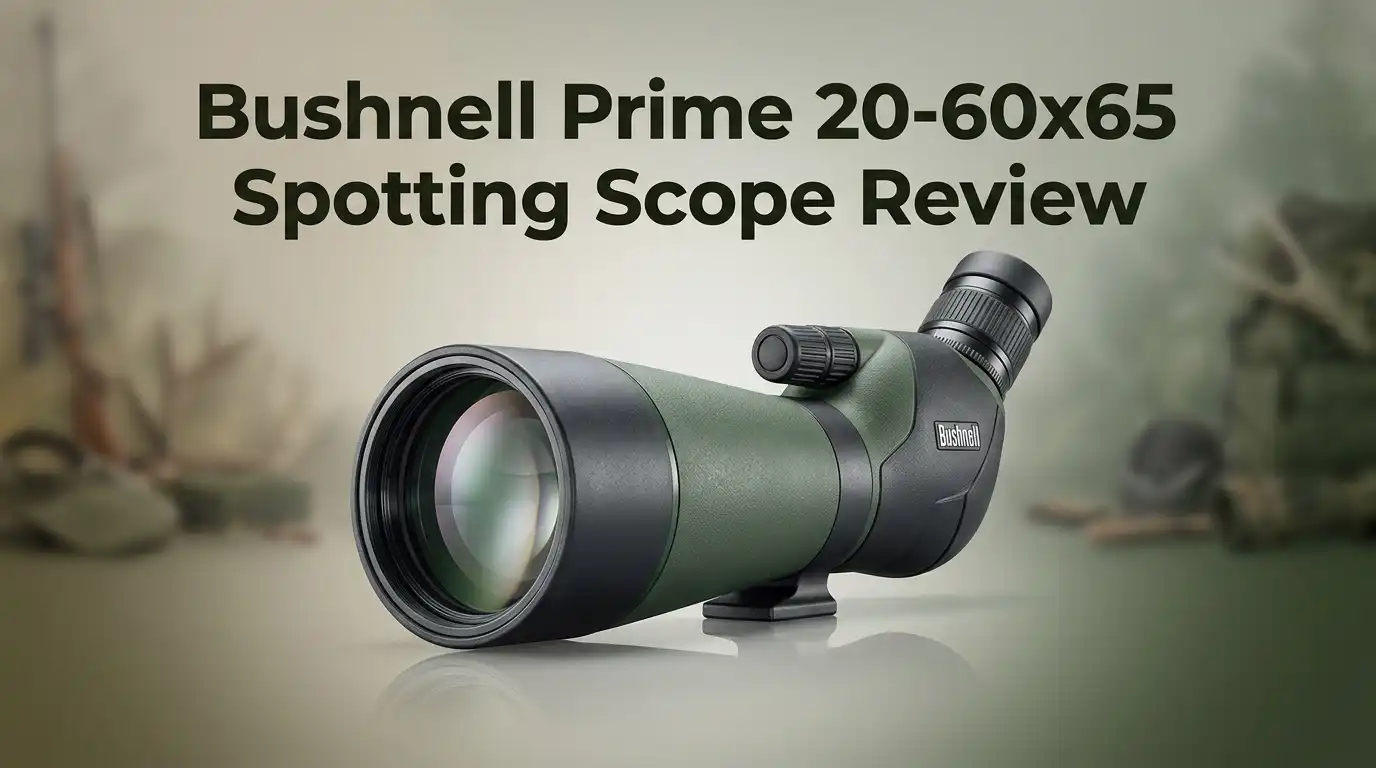
Bushnell Prime 20-60×65 Spotting Scope Review 2026: Worth Buying?
Long distance viewing used to demand a serious budget. That has changed. The Bushnell Prime 20-60×65 sits in the sweet spot where price meets real performance, and shooters, birders, and hunters keep asking the same thing about it.
I spent weeks with this scope at the range, on trails, and propped against a truck window. I watched sunrise light hit a marsh at 400 yards. I squinted through it at 60x when the heat waves made everything wobble. I also found things that annoyed me.
This review covers all of it. You will read about the unboxing, the glass, the focus wheel, the weatherproofing, and the moments where this scope falls short.
In a Nutshell:
- Price to performance is the main story. The Bushnell Prime 20-60×65 usually sells between $280 and $400 depending on the retailer and season. At that price you get ED glass, BaK4 prisms, and full multicoating. Scopes with that spec sheet cost far more from Swarovski or Zeiss. You are buying most of the performance for a fraction of the money.
- Clarity holds strong from 20x to about 40x. This is the honest usable range. Images stay bright, sharp, and color accurate. Above 45x the picture softens and dims noticeably. That 60x number on the box is a marketing figure more than a working setting.
- Weatherproofing is genuinely good. IPX7 rating, O ring seals, nitrogen purging, and Bushnell’s EXO Barrier coating on the exterior glass. Rain, fog, and dust do not stop it. I left it out in a downpour and it shrugged it off.
- Eye relief measures 18mm, which is generous. Eyeglass wearers can use this scope comfortably with the twist down eyecup. That alone separates it from many budget competitors.
- The weaknesses are real. The zoom ring is stiff. Low light performance fades fast at dusk. The included tripod in some bundles is too short and too flimsy for serious use. Edge sharpness drops off at high power.
- Best suited for: range shooting under 600 yards, casual birding, spotting game at moderate distance, and daytime scenic viewing. Not ideal for: serious low light hunting or competition benchrest work where you need to read small bullet holes at distance.
Bushnell Prime 20-60×65 Spotting Scope Overview

- Hunting scopes spotting
- Versatile top of the line
Last update on 2026-09-17 / Affiliate links / Images from Amazon Product Advertising API Some of the links on this website are affiliate links, which means that at no additional cost to you, I earn a commission if you click through and make a purchase. I only recommend products and services that I believe will add value to my readers. Thank you for your support!
The Bushnell Prime line launched as the brand’s value tier, sitting below the Nitro and Forge families. This 65mm model is the spotting scope in that family, and it targets buyers who want real optical quality without a four figure invoice.
Core specs are straightforward. Magnification runs 20x to 60x. The objective lens measures 65mm. Field of view spans roughly 100 feet at 20x down to 50 feet at 60x, measured at 100 yards. Eye relief is 18mm. Close focus sits near 20 feet. Weight lands around 2.4 pounds, or 1080 grams.
Bushnell offers both angled 45 degree and straight eyepiece versions. The angled model works better on a tripod with multiple viewers. The straight model suits quick target acquisition from a bench or vehicle window.
The headline feature is ED Prime glass, Bushnell’s extra low dispersion element that reduces color fringing around high contrast edges.
Unboxing Experience: What Arrives in the Box
The box is plain cardboard with product photography on the front. Nothing luxurious. Bushnell spent the money on glass instead of packaging, which I respect.
Inside, the scope sits in molded foam. A zippered soft case surrounds the body, and this case is better than expected. It has a padded shell, a shoulder strap, and cutouts so you can use the scope while it stays inside the case. That stay on design protects the body during rough handling.
You also get objective and eyepiece caps, a microfiber cleaning cloth, and the instruction sheet. Some retail bundles add a compact tripod and a window mount.
The first thing you notice lifting it out is the density. It feels heavier than the numbers suggest. Rubber armor covers the barrel with a slightly tacky texture that grips well in wet hands. The finish looks matte black and does not shine in sunlight.
Build Quality and Handling in the Field
The chassis feels solid. Knock it against a rock and you hear a dull thud rather than a hollow rattle. The rubber armor absorbs bumps and keeps the metal body protected.
Two controls matter here. The zoom ring sits at the rear near the eyepiece. It has ridged rubber and rotates with firm resistance. Too firm, honestly. Changing magnification takes deliberate effort, and with cold fingers it becomes a two hand job. The upside is that you never bump it accidentally.
The focus wheel sits forward on the barrel. It is smaller and turns smoothly. Placement is good because your fingers land on it naturally while your eye stays on the eyepiece. Making focus corrections without breaking your view feels effortless.
The eyecup twists up and down with clear detents. The tripod foot has a standard quarter twenty thread and rotates a full 360 degrees with a locking collar.
Top 3 Alternative for Bushnell Prime 20-60×65 Spotting Scope

- The redesigned Diamondback HD spotting scope has all the optical horsepower the western hunter needs, and excels in low light. It features a streamlined exterior for a sleeker profile and a built-in helical focus wheel for fast and fine adjustments.
- HD optical system delivers exceptional resolution, cuts chromatic aberration and provides outstanding color fidelity, edge-to-edge sharpness and light transmission. Multiple anti-reflective coatings on all air-to-glass surfaces increase light transmission
Last update on 2026-09-17 / Affiliate links / Images from Amazon Product Advertising API Some of the links on this website are affiliate links, which means that at no additional cost to you, I earn a commission if you click through and make a purchase. I only recommend products and services that I believe will add value to my readers. Thank you for your support!
Vortex Optics Diamondback HD Spotting Scope 20-60×85 Angled

- ULTIMA ANGLED ZOOM SPOTTING SCOPE: This versatile all-around spotting scope with an 80mm objective lens, 20-60x zoom, and a 45° viewing angle is the ideal choice for any outdoor enthusiast. It's perfect for observing nature and long-distance viewing.
- INCLUDES ESSENTIALS FOR BETTER VIEWING: The Celestron Ultima 80 comes complete with a soft carrying case, an extended tripod mounting plate, a zoom eyepiece with an integrated T-adapter for digiscoping, an eyepiece pouch, a lens cloth, and more.

Last update on 2026-09-13 / Affiliate links / Images from Amazon Product Advertising API Some of the links on this website are affiliate links, which means that at no additional cost to you, I earn a commission if you click through and make a purchase. I only recommend products and services that I believe will add value to my readers. Thank you for your support!
Celestron Ultima 20-60×80 Angled Spotting Scope

- Same Trusted Design: This Trophy Xtreme 20-60x65 is built on the same great platform as our previous model, but now comes in black rubber armor. This model provides a cheaper option for those not needing a tabletop tripod.
- Black Rubber Armor: Engineered for extreme conditions, the Trophy Xtreme spotting scope features a durable rubber-armored housing and 100% waterproof construction—ideal for trophy hunting, wildlife observation, and birding in any environment.
Last update on 2026-09-17 / Affiliate links / Images from Amazon Product Advertising API Some of the links on this website are affiliate links, which means that at no additional cost to you, I earn a commission if you click through and make a purchase. I only recommend products and services that I believe will add value to my readers. Thank you for your support!
Bushnell Trophy Xtreme 20-60×65 Waterproof Spotting Scope
Optical Performance: How Clear Is the Image?
This is where the scope earns its reputation. At 20x through 35x, the image looks bright, contrasty, and pleasantly neutral in color. Whites appear white. Greens look natural rather than yellowed.
The ED glass does its job. Look at a dark tree branch against bright sky, the classic torture test, and you see only faint purple fringing at the extreme edges. Cheaper scopes smear that boundary with obvious color halos.
Center sharpness is genuinely impressive for the price. I could read a license plate at 200 yards without strain. Feather detail on a heron at 300 yards stayed crisp.
Edge sharpness is a different story. The outer 20 percent of the field softens, more so as you zoom in. Most users will not care because you naturally center your subject, but pixel peepers will notice.
Contrast holds well until light levels drop.
Magnification Range Explained: Where the Sweet Spot Sits
Zoom eyepieces always involve compromise. This one is no exception.
At 20x you get the widest field and the brightest image. Exit pupil measures 3.25mm here, which is respectable. Finding your target is easy and the view feels relaxed.
Between 25x and 40x the scope performs at its best. Detail increases while brightness stays acceptable. This band is where I spent 80 percent of my viewing time.
Push past 45x and problems stack up. Exit pupil shrinks toward 1mm at full zoom. The image dims, contrast flattens, and atmospheric distortion becomes the limiting factor anyway. On a warm afternoon, heat shimmer destroys detail at 60x long before the optics do.
Treat 60x as an emergency setting, not a daily driver. Every scope in this price class behaves the same way. Bushnell is not uniquely guilty here.
Eye Relief and Comfort for Glasses Wearers
Eye relief measures 18mm, and this number deserves attention.
Many budget spotting scopes offer 12mm to 14mm. That forces eyeglass wearers to press their lenses against the eyecup and still lose part of the field of view. Frustrating does not begin to cover it.
With 18mm, I kept my glasses on and saw the entire field. The twist down eyecup has firm detents that hold position instead of sliding back up mid session.
Non glasses users twist the cup up and get proper spacing with good blackout from stray light. The rubber feels soft against the brow.
Long viewing sessions stay comfortable, which matters more than spec sheets suggest. I glassed a ridgeline for 90 minutes without eye fatigue. That is a real practical win.
The angled version reduces neck strain further when you view upward or share the scope with others.
Weatherproofing and the EXO Barrier Coating
Bushnell rates this scope IPX7. That means submersion in one meter of water for 30 minutes without leakage. Realistically, it means rain is a non issue.
The body uses O ring seals throughout. Internal air is purged and replaced with dry nitrogen, so the interior glass will not fog when you move between temperature extremes. I carried it from a heated cabin into 20 degree air. No internal fogging.
The EXO Barrier coating is the interesting part. Bushnell bonds a hydrophobic layer to the exterior lens surfaces. Water beads and rolls off. Oil, dust, and fingerprints resist adhesion.
In practice this means less cleaning and clearer views in drizzle. Rain droplets slide away instead of sitting on the objective and smearing your image.
The coating does wear over years of aggressive cleaning, so use the microfiber cloth gently.
Performance for Target Shooting and the Range
Range shooters form a large part of this scope’s audience. Here is what it delivers.
At 100 yards, spotting .22 caliber holes in paper is easy at 30x. Clean and simple.
At 200 yards, you can see .30 caliber holes reliably on white paper in good light. At 300 yards, .30 caliber holes become difficult and you will want a target with contrasting backers.
Beyond 400 yards, forget individual bullet holes. Use steel with paint or a splatter target instead. The scope tracks impacts on steel out past 800 yards without trouble because you are watching splash, not holes.
Vapor trail spotting works well at 20x to 25x thanks to the wider field. Several shooters report tracking trace to 450 meters comfortably.
For general range work under 600 yards, this scope covers the job. Competition benchrest shooters need something better.
Birdwatching and Wildlife Viewing Results
Birders will find plenty to like and a few limits.
Color rendition is accurate, which matters enormously for identification. Subtle plumage shades show correctly rather than shifting warm or cool. I identified shorebirds at 250 yards by leg color and bill shape.
Close focus sits around 20 feet. That is adequate but not excellent. Premium birding scopes focus down to 12 feet, which helps with nearby feeders and butterflies.
The 65mm objective limits you at dawn and dusk. These are exactly the hours when birds and mammals are most active. An 80mm scope gathers roughly 50 percent more light and shows the difference clearly in that last half hour.
During daylight hours, the Prime performs beautifully. Waterfowl on open water, raptors on distant poles, and deer across a field all resolve with satisfying detail.
Digiscoping with a Smartphone
Phone photography through a spotting scope has become popular, and this scope supports it reasonably well.
The eyepiece diameter accepts most universal phone adapters. I used a generic clamp style adapter and got alignment within a minute.
Results are best between 20x and 30x. At those settings you get a full circular image with minimal vignetting and enough brightness for fast shutter speeds. Photos of perched hawks at 200 yards came out shareable, though not print quality.
Higher magnification causes problems. Vignetting increases, brightness drops, and any tripod vibration ruins the shot. Even a light breeze introduces shake at 50x.
The generous 18mm eye relief actually helps digiscoping because your phone lens sits at a workable distance from the eyepiece.
Video works better than stills for documenting behavior. Just use a heavy tripod and a remote shutter.
What the Bushnell Prime Does Not Do Well
Honest reviews name the flaws. Here are the real ones.
Low light performance disappoints. The 65mm objective simply cannot gather enough light for serious dawn and dusk work. Images go dim and muddy in that golden hour when hunters need them most. An 80mm scope handles this far better.
The zoom ring stiffness frustrates. It works, but it requires more force than it should, especially in cold weather.
Included tripods are inadequate. Bundle tripods stand too short for seated use and wobble at high magnification. Budget an extra $80 to $150 for a proper tripod.
Edge softness shows at high power. The outer field loses detail above 40x.
Chromatic aberration returns at full zoom. The ED glass controls it well through the middle range, then color fringing creeps back at 55x and 60x on high contrast subjects.
Quality control varies. A minority of buyers report soft units or stiff focus, so test yours early.
Pros and Cons of the Bushnell Prime 20-60×65
Here is the summary in plain terms.
Pros
- ED Prime glass delivers sharp, color accurate images with minimal fringing through the usable magnification range
- 18mm eye relief makes it comfortable for eyeglass wearers, which is rare at this price
- IPX7 waterproofing, nitrogen purging, and EXO Barrier coating handle harsh weather without complaint
- Lightweight at 2.4 pounds, so backpack carry stays reasonable
- Included stay on soft case with shoulder strap is genuinely useful
- Strong value compared to scopes costing two or three times more
- Bushnell’s warranty support has a solid reputation in North America
Cons
- Low light performance fades quickly because of the 65mm objective
- Zoom ring turns too stiffly, particularly in cold conditions
- Usable magnification realistically tops out near 45x, not 60x
- Bundled tripods are too small and unstable for serious use
- Edge sharpness softens at higher power settings
- Close focus at 20 feet trails dedicated birding scopes
- Occasional quality control inconsistency between units
Tripod Advice: The Upgrade That Changes Everything
I cannot overstate this point. Your tripod affects image quality more than you expect.
A 65mm scope at 40x magnifies every vibration. A flimsy tripod turns a sharp image into a shimmering mess. Many people blame the scope when the tripod is the actual culprit.
Look for a tripod with a load rating of at least 8 pounds. Aluminum works fine and costs less than carbon fiber. A fluid pan head beats a ball head for smooth tracking of moving subjects.
Height matters too. You want the eyepiece at seated eye level minimum, or standing eye level if you glass on your feet.
Manfrotto, Vanguard, and SIRUI all make suitable options in the $100 to $200 range. Budget models from Amazon Basics work for casual use but flex in wind.
Window mounts help for vehicle based viewing and cost under $40.
Price and Value in 2026: Who Should Buy This
Current pricing typically runs $280 to $400 in the United States depending on eyepiece style and retailer promotions. Sales during hunting season often drop it lower.
At that money, the competition includes the Celestron Ultima 80, the Bushnell Trophy Xtreme, and the Athlon Talos. The Prime beats most of them on glass quality and weatherproofing. The Ultima 80 wins on light gathering because of its larger objective.
Buy this scope if you shoot at the range regularly, watch birds and wildlife during daylight, hike with your optics, or want your first serious spotting scope.
Skip it if you hunt in low light frequently, need to read small bullet holes past 300 yards, or already own quality glass and want a meaningful upgrade.
For beginners and intermediate users, the value equation lands firmly in the positive column.
Final Verdict: Is the Bushnell Prime Worth It in 2026?
Yes, with clear eyes about what you are buying.
The Bushnell Prime 20-60×65 delivers about 75 percent of premium scope performance for roughly 20 percent of the price. That ratio is hard to beat. The ED glass, the generous eye relief, and the serious weatherproofing all punch above the price tag.
The honest limits are the small objective and the optimistic top magnification. Accept that you have a very good 20x to 40x scope rather than a great 60x scope, and you will be satisfied.
Pair it with a proper tripod. That single addition transforms the experience more than any other accessory.
For range shooters, casual hunters, and daylight birders, this scope earns a confident recommendation. Serious low light hunters should save toward an 80mm or 85mm model instead.
Frequently Asked Questions
Is the Bushnell Prime 20-60×65 waterproof?
Yes. The scope carries an IPX7 rating, meaning it survives submersion in one meter of water for 30 minutes. O ring seals and nitrogen purging prevent internal fogging across temperature changes. The EXO Barrier coating on exterior lenses repels water, oil, and dust.
Can I see bullet holes at 300 yards with this scope?
You can see .30 caliber holes at 300 yards under good light on high contrast targets, though it takes effort. Smaller calibers become very difficult. For consistent hole spotting past 300 yards, you need a larger objective and higher optical quality.
Should I choose the angled or straight eyepiece version?
Choose angled if you use a tripod, share the scope with others, or view uphill often. It reduces neck strain. Choose straight if you shoot from a bench, use a window mount, or want faster target acquisition. Both versions use identical optics.
Does the Bushnell Prime work for astronomy?
It works for casual lunar viewing and bright objects like Jupiter’s moons. The 65mm aperture limits deep sky performance significantly. Dedicated telescopes serve astronomy far better at similar prices.
What tripod should I use with this spotting scope?
Pick a tripod rated for at least 8 pounds with a fluid pan head. Height should reach your seated eye level minimum. Expect to spend $100 to $200 for a model that eliminates vibration at higher magnification.
How does it compare to the Vortex Diamondback HD?
The Vortex Diamondback HD 20-60×85 offers a larger objective, better low light performance, and Vortex’s unlimited lifetime warranty. It also costs significantly more and weighs more. The Bushnell Prime wins on portability and price.
What is the warranty on the Bushnell Prime?
Bushnell provides a limited lifetime warranty on the Prime series in North America, covering defects in materials and workmanship. Registration through Bushnell’s website is recommended. Terms vary by region, so verify with your local distributor.

Hello, I’m Amelia White, the founder of birdsfanatic.com. As a lifelong bird enthusiast and spiritual seeker, I’ve always been fascinated by the mystical connections between birds and the human experience. On this site, I share my knowledge and insights into the symbolic meanings and spiritual significance of various bird species, exploring their roles in mythology, folklore, and cultural traditions. Join me on this journey into the world of birds, where we’ll discover the hidden wisdom and guidance that these magnificent creatures have to offer.