
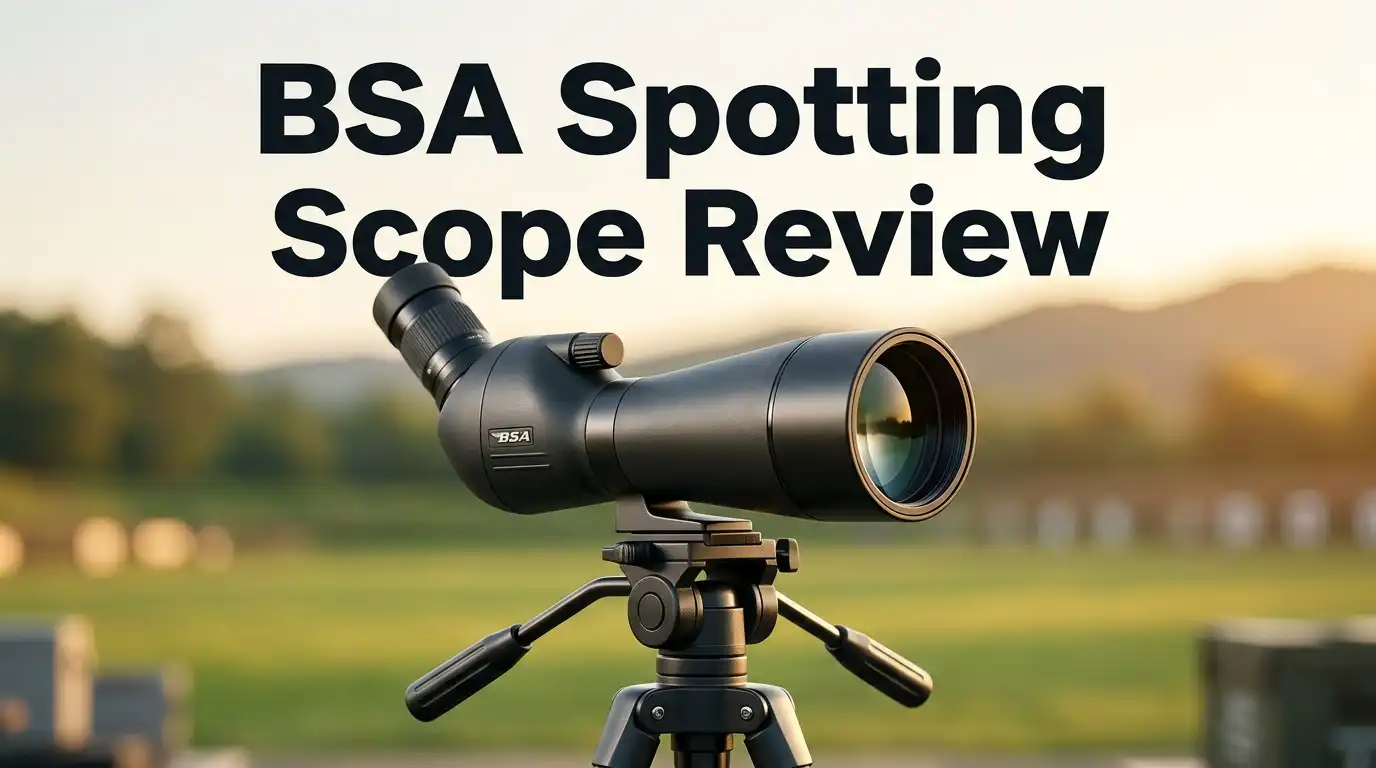
BSA Spotting Scope Review 2026: Worth Buying?
You want a spotting scope. You do not want to spend rifle money on it. That is the exact spot where BSA Optics lives, and it has lived there for decades.
BSA sells budget glass under a famous old British name. The 20x to 60x 60mm model shows up in shooting ranges, backyards, and truck consoles all over the country. It costs less than a decent pair of boots. So the real question is simple. Does cheap glass still show you the hole in the paper at 200 yards?
I spent time with this scope at a public range, in a backyard, and on a cold morning by a marsh. This review covers what it does well, what it does badly, and who should skip it entirely. No sugar coating. Let us get into it.
In A Nutshell:
- Price is the headline feature. The BSA 20x to 60x 60mm spotting scope usually sells for a fraction of what mid tier brands charge. You get a scope, a tripod, and a soft case for roughly the price of two boxes of match ammo.
- Image quality is fine at low power and poor at high power. Between 20x and about 30x, the view is bright and usable. Push past 40x and the picture goes soft, dim, and washed out. This is normal for a 60mm budget scope, but it still disappoints people who bought it for the 60x number.
- The included tripod is the weak link. It is short, light, and wobbly. Most buyers replace it within a month. Budget an extra amount for a real tripod.
- It works for paper punching at 100 yards. You can see .22 holes at 100 yards in good light. You can see .30 caliber holes further out. That covers most range days.
- It is not a hunting or birding scope for serious use. Low light performance falls apart at dusk. Color accuracy is only okay. Birders will want more aperture and better coatings.
- Treat it as a starter tool. Buy it to learn what you actually need. Then upgrade later if spotting becomes a regular habit.
BSA Optics 20x To 60x 60mm Spotting Scope (SS2060X60G)

- 20X-60x zoom magnification
- 60 mm objective
Last update on 2026-09-25 / Affiliate links / Images from Amazon Product Advertising API Some of the links on this website are affiliate links, which means that at no additional cost to you, I earn a commission if you click through and make a purchase. I only recommend products and services that I believe will add value to my readers. Thank you for your support!
This is the model most people mean when they say BSA spotting scope. It carries a 60mm objective lens, a zoom eyepiece running from 20x to 60x, BAK4 porro prisms, and fully multicoated glass according to the maker. The body wears a green rubber armor coat that grips well in cold hands.
The kit bundles a small tabletop tripod and a soft carry case. Weight sits in the three pound range with the scope alone, so a daypack handles it fine.
BSA itself traces back to the Birmingham Small Arms Company. The optics line today is a value brand under Gamo. Keep that history in mind. You are buying a licensed budget label, not British precision glass. The price tag reflects that honestly, and so should your expectations.
Unboxing Experience: What Arrives In The Box
The box is plain cardboard with a printed photo on the front. Nothing fancy. Inside, the scope sits in a molded foam tray with the tripod tucked beside it in a plastic bag.
You get five things. The scope body, the tabletop tripod, a soft zippered case, a thin lens cloth, and a folded instruction sheet.
First impressions are mixed in an interesting way. The scope itself feels better than expected. The rubber armor is thick. The focus wheel turns with light resistance. The zoom collar clicks through its range with a bit of grit but no sloppiness.
Then you pick up the tripod and the mood changes. It is thin aluminum and plastic, light enough to tip over in a breeze. Lens caps are simple push on plastic and they fall off easily. Set up takes under two minutes.
Optical Performance At The Range
This is where the scope earns or loses your money. At 20x on a bright day, the image is genuinely good for the price. Contrast holds up. Black bullseyes look black, not gray.
At 100 yards, I could count .22 holes in white paper at 20x to 25x. At 200 yards, .308 holes showed clearly at around 30x. That covers most of what a range shooter needs.
Push the zoom higher and the picture degrades fast. At 50x the image dims noticeably. At 60x it turns mushy and the edges blur. The usable ceiling sits around 35x to 40x in strong light.
Chromatic aberration is visible. Purple and green fringing appears on high contrast edges like a black target frame against a bright sky. Mirage also hits harder at high power, though that is physics, not BSA.
Top 3 Alternative For BSA 20x To 60x 60mm Spotting Scope

- 20-60x60 HD Optics: Designed for target shooting and outdoor observation with high-definition optical performance
- Ultra-Light Spotting Scope Kit for Effortless Travel: Weighing just 1.31lbs, this spotting scope with tripod comes with a soft shoulder-strap carrying case, easy to sling over your shoulder or compact storage in a backpack without taking space.
Last update on 2026-09-17 / Affiliate links / Images from Amazon Product Advertising API Some of the links on this website are affiliate links, which means that at no additional cost to you, I earn a commission if you click through and make a purchase. I only recommend products and services that I believe will add value to my readers. Thank you for your support!
Emarth 20x to 60x 60mm Angled Spotting Scope

- 25-75x zoom: SV28 spotting scope is easy to focus and change magnification; easily set up when looking at birds and scenery; a great spotting scope for beginner to novice
- 70mm large object lens: more powerful light gathering ability; 70mm tube allows plenty of light and decent view of the target once set; extendable sunshade built onto the main barrel to reduce glare
Last update on 2026-06-09 / Affiliate links / Images from Amazon Product Advertising API Some of the links on this website are affiliate links, which means that at no additional cost to you, I earn a commission if you click through and make a purchase. I only recommend products and services that I believe will add value to my readers. Thank you for your support!
SVBONY SV28 25x to 75x 70mm Spotting Scope

- ULTIMA ANGLED SPOTTING SCOPE: The outdoor enthusiast’s choice is our great all-around spotting scope with an 80mm objective lens and a 45° viewing angle. Perfect for observing nature and long-distance viewing.
- INCLUDES ESSENTIALS FOR BETTER VIEWING – PLUS DIGISCOPING: Celestron Ultima 80 includes an extended tripod mounting plate, a zoom eyepiece with an integrated T-adapter for digiscoping, a carrying case, an eyepiece lens cap, an eyepiece port cover, a soft carrying case, an eyepiece pouch, a lens cloth, instruction manual, and a smartphone adapter so you can quickly and easily capture images and video through the scope with your smartphone.

Last update on 2026-06-09 / Affiliate links / Images from Amazon Product Advertising API Some of the links on this website are affiliate links, which means that at no additional cost to you, I earn a commission if you click through and make a purchase. I only recommend products and services that I believe will add value to my readers. Thank you for your support!
Celestron Ultima 80 Angled Spotting Scope
Build Quality And Weather Resistance
The body feels solid in hand. Rubber armor covers most of the barrel and absorbs knocks. I dropped it about two feet onto grass with no damage and no shift in focus.
The focus ring is the large knurled type near the eyepiece. It moves smoothly with no dead zone. The zoom collar takes more effort, and you will nudge your aim slightly while turning it.
Weather sealing is the soft spot. BSA markets some models as fog and water resistant, but this is not a nitrogen purged, fully submersible scope in the way premium models are. Light rain is survivable. A soaking is a risk.
Treat it like a camera, not a hammer. Wipe it dry, store it in the case, and keep the caps on. Handled that way, owners report years of service.
The Tripod Problem
I need a full section for this because it decides your experience. The bundled tripod stands roughly eight inches tall with legs extended. It is meant for a bench.
At 40x, the smallest touch sends the image bouncing. You tap the focus knob and the target swims off screen for two full seconds. That shake makes the scope feel worse than it actually is.
Swap the tripod and the scope gains a grade. A simple aluminum photo tripod with a pan head transforms the view. Even a cheap tabletop model with a wider stance helps.
My advice is blunt. Plan on the tripod being packing material. Mount the scope on something stable, weigh the legs down with a small bag, and judge the optics only after that.
Eye Relief, Eyecup And Glasses Users
Eye relief is short. You must press your eye close to the eyepiece to see the full circle of view.
Glasses wearers will struggle. The rubber eyecup folds down, which helps a little, but the edges of the image still vanish at higher magnification. If you shoot with glasses on, expect to remove them or accept a cramped view.
Eye placement is also fussy. Move your head a few millimeters off axis and dark crescents appear at the edge. New users often think the scope is broken when it is only alignment.
There is a practical fix. Get comfortable first, then look. Set your chair height so your eye lands naturally behind the eyepiece. A stable shooting stool beats leaning over a bench every time.
Birding And Wildlife Viewing Performance
Birders should read this section carefully. The BSA can show you a hawk on a pole at 300 yards and let you identify it. It can show you ducks across a pond.
What it cannot do is resolve fine feather detail or deliver honest color at distance. Warblers in a shady tree turn into vague shapes. Color rendering skews slightly warm and flat.
Low light is the real limit. A 60mm objective at 40x gives a tiny exit pupil, so dawn and dusk viewing goes dark quickly. Serious birders should look at 80mm glass instead.
That said, casual backyard watching works well. Feeder birds at fifty feet look great at 20x. Families and kids enjoy it. Just match the tool to the task.
Digiscoping With A Phone
Many buyers want to film targets or wildlife through the scope. The BSA kit does not include a phone adapter, so you must buy one separately.
Universal clamp style adapters fit the eyepiece diameter on most units. Once mounted, results are mixed. At 20x to 25x you can capture watchable video. Above 30x, vignetting and softness ruin most clips.
Alignment is finicky. You will spend several minutes centering the phone lens over the eyepiece each time. Any bump breaks the alignment.
Video also exposes every tripod flaw. Handheld phone taps on the screen shake the whole rig. Use a timer or a voice command to start recording.
For casual proof of a good group at 100 yards, it works. For content creation, buy a scope built with digiscoping in mind.
What The BSA Spotting Scope Does Not Do Well
An honest review lists the failures plainly, so here they are.
It does not deliver a usable image at 60x. That number is marketing. Real world clarity fades past 40x.
It does not perform at dawn or dusk. The image dims fast when light drops, which hurts hunters most.
It does not include a tripod worth using. This is the most common complaint in owner feedback and it is fully deserved.
It does not match the edge sharpness of scopes costing three times more. Center sharpness is acceptable. Edges stay soft.
It does not offer premium sealing or a lifetime no questions warranty like some competitors.
And it does not survive rough handling forever. Owners report loose eyepieces and internal dust after heavy use. Treat it gently.
Pros And Cons Of The BSA Spotting Scope
Here is the balanced view in list form.
Pros
- Very low price that fits almost any budget, often less than a single premium binocular strap setup.
- Bright, clear image in the 20x to 30x range where most practical spotting happens.
- Thick rubber armor that grips well and shrugs off small bumps.
- Light enough at around three pounds to carry in a daypack all day.
- Complete starter kit with scope, tripod, and case in one box.
- Smooth focus wheel with no dead spot or backlash.
- Good enough to spot .22 holes at 100 yards in strong daylight.
Cons
- Image quality collapses above 40x, making the top of the zoom range mostly useless.
- Bundled tripod is too short and too shaky for real work.
- Short eye relief makes life hard for glasses wearers.
- Visible purple and green color fringing on high contrast edges.
- Weak low light performance at dawn and dusk.
- No phone adapter included despite strong demand for digiscoping.
- Weather sealing is limited compared with sealed and purged rivals.
BSA Versus Other Budget Spotting Scopes
The budget shelf is crowded now, so context matters. The Emarth 20x to 60x 60mm sits at a similar price and offers an angled eyepiece, which many shooters prefer at a bench.
The SVBONY SV28 gives you a 70mm objective for roughly the same money. More aperture usually beats more magnification in this price class.
Step up to the Celestron Ultima 80 and the difference is obvious. Bigger glass, better coatings, real waterproofing, and a proper tripod plate. It costs several times more and it shows.
Here is my honest read. BSA is competitive on price and build feel. It is behind on aperture and accessories. If your budget stretches even slightly, the 70mm and 80mm options give a bigger jump in real performance than any zoom number.
Who Should Buy The BSA Spotting Scope In 2026
- 20X-60x zoom magnification
- 60 mm objective
Last update on 2026-09-25 / Affiliate links / Images from Amazon Product Advertising API Some of the links on this website are affiliate links, which means that at no additional cost to you, I earn a commission if you click through and make a purchase. I only recommend products and services that I believe will add value to my readers. Thank you for your support!
Buy it if you are a casual range shooter who sights in a rifle a few times a year. It saves you the walk downrange and pays for itself in time.
Buy it if you are new to spotting scopes and want to learn what features matter before spending real money. That education is worth the price alone.
Buy it for a teenager, a scout, or a backyard nature setup where a scratch or a drop would hurt an expensive scope.
Skip it if you hunt at first light. Skip it if you identify small birds for a life list. Skip it if you shoot past 300 yards and need to read small holes.
Match the tool to the job and this scope makes sense. Ask it to be a premium optic and it will let you down.
Setup Tips For Sharper Images
Small habits make a big difference with budget glass. Start at the lowest magnification and find your target there. Focus sharply, then zoom in slowly.
Use the scope early in the morning or late in the day to dodge heat mirage on the ground. Mirage ruins more range sessions than bad optics do.
Mount the scope on a proper tripod at seated eye height. Hang a bag from the center column to kill vibration.
Keep the lenses clean with a blower first and a microfiber cloth second. Grit plus cloth equals scratches.
Let the scope temperature settle. Moving it from a warm truck to cold air fogs the glass for several minutes. Set it out early and let it adjust while you get organized.
Final Verdict
The BSA 20x to 60x 60mm spotting scope is a fair deal at a low price, and nothing more than that. It does one job well, which is confirming your shots on paper at 100 to 200 yards in daylight.
Everything above that ask starts to strain. The high zoom range is optimistic. The tripod is disposable. Dusk viewing is weak.
I would still recommend it to a specific person. That person is a casual shooter or a curious beginner who wants working glass today without a big spend.
My rating is a solid three and a half out of five for value, and about two and a half out of five for pure optical quality. Buy it with clear eyes, add a real tripod, and you will be satisfied.
Frequently Asked Questions
Is the BSA spotting scope good for 1000 yard shooting?
No. At 1000 yards you will see the target frame and maybe large steel, but not bullet holes. A 60mm objective simply does not gather enough light for that job. You need 80mm or larger glass with better coatings and, honestly, a much higher budget.
Can you see .22 bullet holes at 100 yards?
Yes, in good light with clean white paper. Set the zoom around 20x to 30x, use a stable tripod, and wait for calm air. Dirty or dark targets make the holes much harder to find.
Does the BSA spotting scope come with a tripod?
Yes, a small tabletop tripod ships in the box. It is the weakest part of the kit. Most owners replace it quickly with a standard photo tripod for steadier viewing.
Is BSA a good optics brand?
BSA is a value brand licensed from the historic Birmingham Small Arms name. It builds affordable optics that perform acceptably for the money. It does not compete with Vortex, Celestron, or Leupold on glass quality or warranty support.
Angled or straight, which is better?
Straight bodies point faster and suit standing use from a vehicle. Angled bodies feel more comfortable at a bench and let several people share one setup without adjusting the tripod height.
Is it waterproof?
Treat it as water resistant only. Light rain is survivable if you dry it afterward. Do not submerge it and do not leave it out in a storm.

Hello, I’m Amelia White, the founder of birdsfanatic.com. As a lifelong bird enthusiast and spiritual seeker, I’ve always been fascinated by the mystical connections between birds and the human experience. On this site, I share my knowledge and insights into the symbolic meanings and spiritual significance of various bird species, exploring their roles in mythology, folklore, and cultural traditions. Join me on this journey into the world of birds, where we’ll discover the hidden wisdom and guidance that these magnificent creatures have to offer.