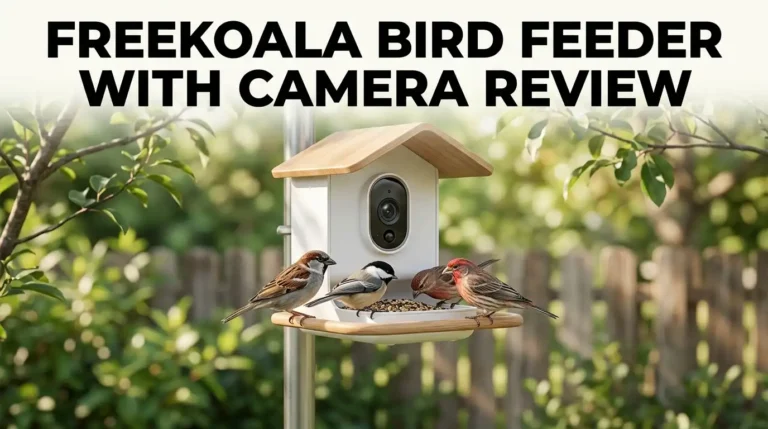
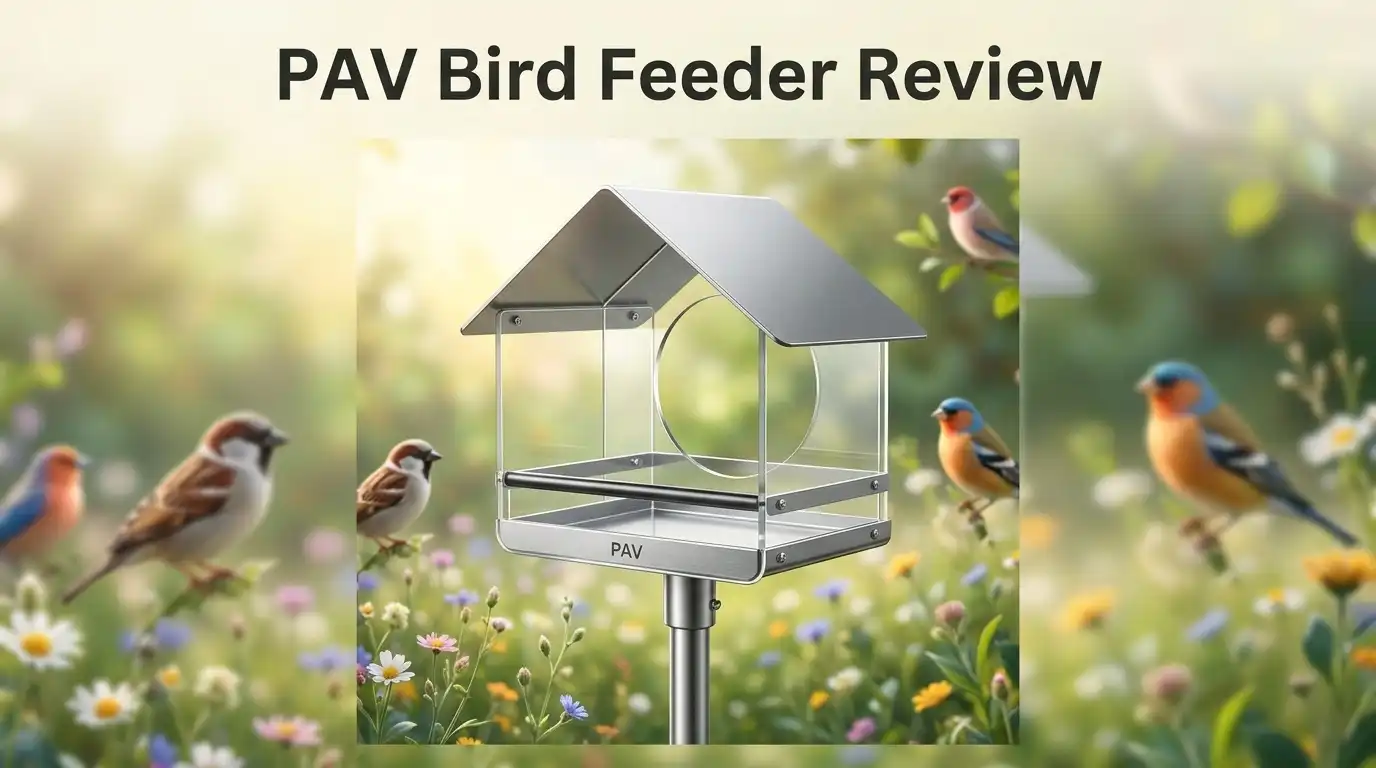
PAV Bird Feeder Review 2026: Worth Buying?
Bird watching used to mean sitting still by a window for hours. The PAV Bird Feeder changes that habit. This feeder holds seed, films visitors in 2K, and names the species for you inside an app. You get alerts on your phone while you sit at work or lie in bed.
The birdsnap PAV feeder sells for under $100 on Amazon most weeks. That price undercuts Bird Buddy and Birdfy by a wide margin. So a fair question follows: does the low price hide a weak product?
I mounted one on a fence post, filled it with black oil sunflower seed, and watched it for weeks. Cardinals came. Squirrels came too. The app worked well on some days and stalled on others. This review covers every part of that experience, including the parts the brand would rather skip.
In a Nutshell:
- The camera quality punches above the price. The 2K sensor with a 155 degree wide lens shows feather detail on chickadees and finches. Colour holds up in morning light. Night vision uses infrared, so clips turn black and white after dark.
- AI identification needs a paid membership. The listing shouts about 10,000 species. The recognition engine sits behind a subscription that starts near $2.99 per month. Free users still get live video and short clips, but species names stop after the trial.
- Solar power works, with conditions. The 3W panel and 5200mAh battery keep the feeder running through sunny weeks. Place it in shade or a cloudy climate and you will carry it indoors for a USB charge.
- Capacity beats most rivals. The hopper swallows roughly 4 pounds of seed. Heavy traffic still empties it in a few days, but you refill less often than with a 1 litre competitor.
- Squirrels are a real problem on base models. Only the higher trims ship with the metal guard. Buy the cheapest version and grey squirrels will treat your hopper like a buffet.
- Build material is plastic, not metal. It survives rain at IP65, yet it feels light in the hand and creaks when you tighten the strap too hard.
What Is the PAV Bird Feeder?

- 📲【2K Live Bird-Watching】 Featuring a 2K HD camera with a 155°ultra-wide-angle lens, this bird feeder camera automatically captures and uses AI to identify over 10,000 bird species. You will receive instant alerts and enjoy full-color, day-and-night live viewing via the APP to ensure you never miss a visit from your feathered friends
- 🎤【3 Versatile Attachments & Squirrel-Proof】 The smart bird feeder includes a 1.8L large-capacity seed container plus three interchangeable feeders: 1 fruit forks, 1 hummingbird feeder and 1 jelly box—perfect for attracting hummingbirds, orioles, and more. With a built-in microphone and speaker, you can listen to birdsong and gently deter squirrels right from the app
Last update on 2026-07-01 / Affiliate links / Images from Amazon Product Advertising API Some of the links on this website are affiliate links, which means that at no additional cost to you, I earn a commission if you click through and make a purchase. I only recommend products and services that I believe will add value to my readers. Thank you for your support!
The PAV Bird Feeder is a smart feeder made by birdsnap. It combines three things in one shell: a seed hopper, a solar panel, and a WiFi camera. Birds land on the perch. The camera wakes, records, and pushes a notification to your phone.
The body measures about 12.5 inches tall and 8.3 inches wide with the panel attached. The seed chamber holds roughly 4 pounds of dry seed. A clear window on the side shows the seed level, so you can check supply from a distance.
The camera is the selling point. It shoots 2K video through a 155 degree ultra wide lens. That angle matters more than the resolution number. A narrow lens misses birds that land on the edge of the perch. This one captures the whole tray plus a slice of background.
Power comes from a 5200mAh battery topped up by a 3W solar panel on the roof. There is no cable to run across your lawn. Storage splits two ways: a 64GB card sits in the box on most bundles, and short clips also land in the cloud.
The feeder mounts on a tree, a fence, a wall, or a pole. Straps and screws come included. Setup takes one person and about fifteen minutes.
Who is it for? Casual bird lovers, parents with curious kids, and gift buyers. Serious ornithologists will want sharper glass. Everyone else gets plenty for the money.
Unboxing the PAV Bird Feeder
The box arrives smaller than expected. Mine measured about the size of a shoebox and weighed just over four pounds. The outer carton uses plain cardboard with a printed photo of the feeder on the front. Nothing fancy, and nothing crushed in transit either.
Lift the lid and you find the feeder body wrapped in a thin foam sleeve. The camera lens sits behind a plastic film. Peel it off before you mount anything, because the film blurs your first test video and confuses new owners.
Under the feeder sits a small accessory tray. Mine contained a mounting strap, two screws with wall plugs, a short USB C charging cable, a 64GB microSD card in a tiny paper envelope, a hummingbird nectar box, a jam container, and two fruit forks. The fruit forks surprised me. They push into slots on the perch so you can spike apple or orange halves for orioles.
The manual is a folded sheet with small print. It covers pairing in six steps and includes a QR code for the app. The English reads slightly stiff but stays clear enough to follow.
First impressions of the build: the plastic feels thinner than the product photos suggest. The seed lid clicks shut with a satisfying snap, though. The camera module looks tidy and sits flush with the housing. No sharp burrs, no loose screws, no chemical smell.
Charge it fully before mounting. Mine arrived at roughly 40 percent.
Top 3 Alternative for PAV Bird Feeder

- Wide-Angle Videos & Bird Portrait. While the wide-angle lens captures video clips with slow motion capability, the smart portrait lens automatically zooms in, sending feather-detailed bird photos straight to your device, making your backyard the goal of every birdwatcher.
- Dual-Lens Camera with Night Vision. Capture stunning, detailed photos with the 3MP portrait lens featuring 2K resolution, while the 2MP wide-angle lens, Birdfy video bird feeder provides 1080P resolution with night vision for broader views.

Last update on 2026-07-11 / Affiliate links / Images from Amazon Product Advertising API Some of the links on this website are affiliate links, which means that at no additional cost to you, I earn a commission if you click through and make a purchase. I only recommend products and services that I believe will add value to my readers. Thank you for your support!
Birdfy 2 Pro Solar Bird Feeder Camera

- Advanced AI Identifies 10,000+ Bird Species - Harnessing advanced AI technology, the Harymor smart bird feeder recognizes over 10,000 bird species. With a Vicohome app subscription, you can access detailed information about each identified bird. Perfect for both beginners and seasoned birdwatchers, it offers a fascinating way to learn about nature. Enjoy live viewing and turn every visit into a wildlife lesson for all ages
- Receive Bird Arrival Notification - Tired of relying on binoculars? The Harymor bird camera automatically detects visiting birds (like bluebirds, hummingbirds, etc.), records videos of birds entering the detection area, and sends real-time alerts to your phone with clear snapshots. The Harymor bird watching camera lets you capture close-up shots full of character and offers an enhanced birdwatching experience
Last update on 2026-07-01 / Affiliate links / Images from Amazon Product Advertising API Some of the links on this website are affiliate links, which means that at no additional cost to you, I earn a commission if you click through and make a purchase. I only recommend products and services that I believe will add value to my readers. Thank you for your support!
HARYMOR Smart Bird Feeder with Camera

- Watch Birds from Your Phone Anytime, Anywhere. NETVUE by Birdfy smart bird feeder with camera automatically captures every coming birds and sends real-time alerts. Get close-up shots whether home or away - the perfect backyard birdwatching upgrade.
- See Birds in Stunning Detail with 2.4Ghz Wi-Fi. With full 1080P high definition resolution and color night vision, you can enjoy crystal-clear videos and images of birds—even in low light. Admire intricate feather patterns and tiny details up close, just like a bird selfie. Comes with a powerful antenna ensures a stable 2.4GHz Wi-Fi connection with wider coverage and better outdoor performance. (Please note: 5GHz Wi-Fi is NOT supported.)
Last update on 2026-07-01 / Affiliate links / Images from Amazon Product Advertising API Some of the links on this website are affiliate links, which means that at no additional cost to you, I earn a commission if you click through and make a purchase. I only recommend products and services that I believe will add value to my readers. Thank you for your support!
NETVUE by Birdfy Smart Bird Feeder with 2K AI Camera
Setup and App Pairing
Setup starts with the app. Download the birdsnap app, create an account, and press the power button on the camera until it chirps. The app scans for the device and asks for your WiFi details.
Here is the first hurdle. The camera accepts 2.4GHz networks only. It ignores 5GHz completely. Modern mesh routers often merge both bands under one name, which breaks pairing. You may need to split the bands or create a guest network at 2.4GHz. Plenty of one star reviews trace back to this single issue.
The second hurdle is location permission. If your phone blocks location access, the app cannot list nearby WiFi names. Grant permission, restart the app, and the list appears.
Once paired, mounting takes minutes. Choose a spot four to six feet off the ground with clear sky above for the solar panel. Wrap the strap around a post and pull it tight. Aim the lens so the perch fills the lower third of the frame.
My advice: pair indoors first, then mount outside. Standing on a ladder while wrestling with a WiFi list is no fun.
Signal strength decides your experience. The brand claims up to 100 metres in open air. In my test, a brick wall between router and feeder cut the live stream to stutters at 25 metres. Keep the feeder within reasonable range or add a repeater.
Total time from box to first bird clip: about twenty minutes.
Camera and Video Quality
The 2K sensor delivers the biggest surprise in this price bracket. Daylight footage shows individual wing bars on a house finch. Cardinal red looks accurate rather than oversaturated. Motion stays smooth at close range.
The 155 degree lens sits close to the perch, so birds fill the frame. Sparrows look enormous. A blue jay barely fits. That framing creates dramatic clips that people love sharing.
Weak spots exist. Backlit shots wash out badly. Point the lens east and morning sun turns your cardinal into a silhouette. Face the feeder north or west for better results. The sensor also struggles with fast wing motion, producing slight blur on takeoff.
Night vision uses infrared beads. Clips turn monochrome and the beads glow faintly red. Birds rarely feed at night, so this feature mostly records raccoons, opossums, and rain. Still fun, but not the reason to buy.
Free accounts record clips up to 20 seconds. Paid tiers stretch that to three minutes. A long visit from a woodpecker gets chopped off mid meal on the free plan, which frustrates some owners.
Storage flexibility helps. Clips save to the microSD card even when cloud storage expires. Cards up to 128GB work. Pull the card and load footage onto a computer whenever you like.
Overall the camera earns solid marks. It will not match a 4K dual lens rival, and the price reflects that gap honestly.
AI Bird Identification and Membership Costs
The AI feature identifies species from the video frame and labels the clip. Recognition speed impressed me. A chickadee landed and the notification named it within seconds.
Accuracy sits around good rather than perfect. Common backyard birds like cardinals, blue jays, mourning doves, and house finches came back correct almost every time. Sparrow species confused it. It once labelled a squirrel as a bird, which gave me a laugh.
Now the part that annoys buyers. AI identification requires a membership. The free lifetime plan gives you live video, camera sharing, three days of cloud history, and 20 second clips. Species naming, smart notifications, longer clips, custom alert zones, and extended cloud history all sit behind the paywall.
Plans start near $2.99 per month for 15 days of history. Mid tier runs about $4.49 per month for 30 days. The top tier reaches roughly $7.49 per month for 45 days. Prices shift with promotions, so check current rates before you commit.
One bundle solves this. The highest trim includes a lifetime basic membership with free AI identification. It costs more upfront and saves money over two years. Do the maths for your own budget.
I understand the subscription model. Cloud servers and AI processing cost money. Still, the Amazon listing leads with the 10,000 species claim without shouting about the fee. That gap causes most of the negative reviews.
Solar Power and Battery Life
The 3W solar panel forms the roof of the feeder. It angles slightly upward and feeds the 5200mAh battery underneath.
In sunny weather the system works exactly as promised. Through a bright stretch of days my battery held between 90 and 100 percent, and I never touched the charging cable. Bird traffic averaged around thirty visits daily.
Cloudy weeks tell a different story. Four overcast days dropped the charge by roughly 25 percent. Heavy traffic drains faster because each recording wakes the camera and the WiFi radio. Owners in northern climates report monthly indoor charges through winter.
Shade is the real enemy. Mount the feeder under dense tree cover and the panel gathers almost nothing. Choose a spot with several hours of direct sun even if that means moving away from your favourite viewing window.
Battery care tips that helped me: lower the video resolution during winter, shorten clip length, and switch off night recording. Each change buys extra days between charges.
Charging happens through the USB C port under a rubber flap. A full top up took about five hours from a phone adapter. You must unmount the feeder to do it, since the cable does not reach outdoors safely. That small inconvenience adds up over a season.
The battery is sealed. You cannot swap it yourself. Rival brands share this flaw, and it limits the lifespan of every smart feeder to a handful of years.
Seed Capacity and Refills
Capacity is a quiet strength here. The hopper takes roughly 4 pounds of seed, which beats several rivals that hold barely a litre.
Fill it through the hinged lid on top. The opening is wide enough for a standard scoop. Seed flows down to a tray with a raised lip that stops spillage in wind.
Black oil sunflower seed worked best in my test. It attracts cardinals, chickadees, titmice, and finches. Mixed seed brought more house sparrows and more waste, since sparrows fling unwanted filler onto the ground. Skip cheap mixes with red millet. They clog the tray and rot after rain.
Refill frequency depends on traffic. A busy garden empties 4 pounds in three to four days. A quiet balcony stretches the same amount across two weeks. Check the level through the side window rather than opening the lid, because opening it startles nearby birds.
The accessories add variety. The nectar box clips on for hummingbirds. The jam container holds grape jelly for orioles. The fruit forks hold apple or orange halves. These extras cost nothing and widen the species list, which raises your chance of interesting clips.
One design flaw stands out. Seed dust collects in the corner near the lens and slowly fogs the view. Wipe the lens every two weeks with a soft cloth. Skip that chore and your footage turns hazy without you noticing why.
Squirrel Guard and Pest Problems
Let us talk about squirrels honestly. The base model offers no squirrel protection at all.
A grey squirrel found my feeder on day two. It sat on the perch, wedged its head into the tray, and cleared several ounces of seed in one sitting. The camera dutifully recorded the whole raid and sent me alerts about it.
Only the upper trims ship with the metal squirrel proof guard. That guard is a cage that blocks large animals while letting small birds slip through. It works well against squirrels and grackles. If squirrels roam your neighbourhood, pay extra for the guarded version rather than buying the guard later.
Other pests visit too. Raccoons climb at night and can knock the feeder loose from a weak strap. Ants march up poles toward the jelly container. Starlings arrive in groups and empty the hopper faster than any squirrel.
Placement helps more than gadgets. Mount the feeder on a smooth metal pole at least ten feet from the nearest branch. Squirrels jump further than you think. A baffle below the feeder blocks climbers effectively.
The plastic body carries a related risk. A determined squirrel gnaws plastic. Several owners report chewed perch edges after a few months. A metal bodied rival resists that damage better, though it costs considerably more.
Weather Resistance and Durability
The feeder carries an IP65 rating. That means dust protection and resistance to water jets, not full submersion. Rain runs off the sloped roof and away from the camera.
Through several heavy downpours my seed stayed dry and the camera kept filming. The rubber flap over the USB port held firm. No fogging appeared inside the lens housing.
Cold weather is harder. Lithium batteries lose capacity below freezing. Owners in cold regions report shorter runtime and slower charging through winter months. Snow on the solar panel stops charging completely until you brush it off.
Heat brings a different issue. Direct summer sun on dark plastic warms the seed and can turn oily sunflower kernels rancid. Fill smaller amounts during hot spells rather than packing the hopper full.
The plastic shows its limits over time. Sunlight fades colour and makes the material brittle after a year or two outdoors. The plastic also creaks under strap tension. Tighten firmly but stop before you hear cracking.
Compared with metal bodied feeders, this one feels less permanent. That is the trade for the price. Treat it as a two or three season product rather than an heirloom.
The 24 month warranty from birdsnap adds reassurance. Owners who contacted support about dead batteries and connection faults report replacements arriving without much argument, which is better service than the price suggests.
Pros and Cons of the PAV Bird Feeder
Every product has trade offs. Here are mine after weeks of daily use.
Pros
- Strong camera for the money. The 2K sensor and 155 degree lens deliver clear, close footage that rivals feeders costing twice as much.
- Large seed capacity. Roughly 4 pounds means fewer trips outside with a scoop, especially in winter.
- Genuine solar independence in sunny spots. The panel and 5200mAh battery kept mine running for weeks without a cable.
- Free basic tier is usable. Live video, camera sharing, and short clips cost nothing, so the feeder still works if you refuse to subscribe.
- Useful accessories included. The nectar box, jam cup, and fruit forks widen the species list at no extra cost.
- Fast AI recognition on common species. Notifications name cardinals, jays, and finches within seconds.
- Flexible mounting. Tree, fence, wall, and pole options all work with the included hardware.
- Local storage support. MicroSD cards up to 128GB keep your footage even without cloud storage.
Cons
- AI identification sits behind a subscription. The headline feature stops working once the trial ends unless you pay monthly.
- No squirrel guard on cheaper trims. Squirrels raid the base model freely.
- 2.4GHz WiFi only. Mesh router owners face a frustrating pairing process.
- Plastic construction. It feels light, fades in sun, and tempts chewing rodents.
- Backlit footage washes out. Lens placement demands careful thought about sun direction.
- Sealed battery. No replacement option limits the product lifespan.
- 20 second clip limit on the free plan. Long visits get cut short.
What the PAV Bird Feeder Does Not Do Well
Honest reviews name the failures clearly, so here they are without softening.
It does not replace a proper wildlife camera. The lens sits inches from the perch. Anything beyond arm’s length looks soft and small. You cannot use this to watch a nest across the yard.
It does not fully identify uncommon birds. The AI handles backyard regulars well. Warblers, sparrows, and juvenile plumage confuse it often. Do not trust it for a serious life list.
It does not survive careless placement. Shade kills the solar charging. Backlight ruins the footage. Distance from the router kills the stream. This product punishes bad siting more than a simple feeder does.
It does not deter pests on its own. Base trims invite squirrels, starlings, and raccoons. You need the guard trim, a pole baffle, or both.
It does not feel premium. The plastic body, the thin manual, and the basic packaging all remind you of the price. Buyers expecting Bird Buddy polish will feel let down.
It does not offer a repairable battery. When the cell degrades, the camera becomes a paperweight. That fact bothers me more than any other flaw.
It does not stream reliably on weak WiFi. Buffering and dropped connections appear in many owner reports, and most trace back to router distance rather than a faulty device.
Know these limits before you buy and the feeder will please you. Ignore them and you will write an angry review.
PAV Bird Feeder Price and Value
- 📲【2K Live Bird-Watching】 Featuring a 2K HD camera with a 155°ultra-wide-angle lens, this bird feeder camera automatically captures and uses AI to identify over 10,000 bird species. You will receive instant alerts and enjoy full-color, day-and-night live viewing via the APP to ensure you never miss a visit from your feathered friends
- 🎤【3 Versatile Attachments & Squirrel-Proof】 The smart bird feeder includes a 1.8L large-capacity seed container plus three interchangeable feeders: 1 fruit forks, 1 hummingbird feeder and 1 jelly box—perfect for attracting hummingbirds, orioles, and more. With a built-in microphone and speaker, you can listen to birdsong and gently deter squirrels right from the app
Last update on 2026-07-01 / Affiliate links / Images from Amazon Product Advertising API Some of the links on this website are affiliate links, which means that at no additional cost to you, I earn a commission if you click through and make a purchase. I only recommend products and services that I believe will add value to my readers. Thank you for your support!
Price is the strongest argument for this feeder. Amazon listings hover near $79.98 for the standard bundle, and brand promotions drop trim levels between roughly $109 and $179 depending on camera sensor and guard inclusion.
Compare that with the market. Bird Buddy sits well above $200. Birdfy metal models climb past $250 with dual lenses. The PAV feeder delivers 70 percent of that experience for a third of the money.
Factor in the subscription before you celebrate. Two years of the basic AI plan adds roughly $72. That maths pushes the lifetime membership bundle into good value territory for long term owners.
Where the value shines: first time smart feeder buyers, gift purchases, and households testing whether they enjoy camera bird watching. Spending $80 to find out beats spending $250.
Where the value fades: owners in heavy squirrel areas who must buy the guard trim, and owners in cloudy northern climates who will fight the battery every winter. Those buyers should compare metal bodied rivals with larger batteries.
Resale value is minimal, as with all sealed battery electronics. Treat the purchase as consumable rather than an investment.
My verdict on value: strong for the money, provided you accept plastic construction and a monthly fee for the smartest feature. Watch for seasonal discounts around holidays, since the brand cuts prices aggressively and stacks coupons on Amazon.
Who Should Buy the PAV Bird Feeder?
This feeder suits specific people better than others.
Buy it if you are new to smart feeders. The low entry price lets you test the concept without regret. You learn what features matter to you before spending big.
Buy it as a gift. Parents and grandparents love these feeders. The included accessories make the package feel generous, and the app sharing feature lets the whole family watch the same birds.
Buy it if you have a sunny mounting spot. Solar performance decides your satisfaction. Full sun means no cables and no fuss.
Buy the guarded trim if squirrels rule your garden. The extra spend saves seed and frustration.
Skip it if you own a mesh router you cannot split. The 2.4GHz limitation causes real pain.
Skip it if you live under heavy tree cover. You will charge the battery indoors every few weeks and resent it.
Skip it if you want 4K footage or dual lenses. Higher end rivals exist for that purpose, and they cost accordingly.
Skip it if subscriptions offend you. The free tier works, but you will watch the best feature sit locked behind a paywall every day.
My own recommendation: choose a mid or upper trim with the metal guard and the lifetime membership if the budget allows. That configuration removes the two biggest complaints in one purchase and turns a decent feeder into a genuinely satisfying one.
Final Verdict
The PAV Bird Feeder earns a recommendation with clear conditions. The camera performs well above its price. The seed capacity beats most rivals. Solar power genuinely works in sunny locations. Setup takes twenty minutes once you sort the WiFi band.
The flaws are real too. Plastic construction limits lifespan. The subscription gates the headline AI feature. Base trims invite squirrels. Cloudy climates drain the battery.
Rated against the price, it scores about 4 out of 5. Rated against premium metal feeders, it scores closer to 3.5. Both numbers feel fair.
I still check the app every morning. That habit tells you more than any spec sheet. Watching a cardinal land in 2K while you drink coffee is a small daily pleasure, and this feeder delivers it cheaply.
Buy the guarded version, mount it in sun, face it away from sunrise, and keep the lens clean. Do those four things and you will enjoy it.
Frequently Asked Questions
Does the PAV Bird Feeder need a subscription?
No for basic use, yes for AI features. The free lifetime plan gives live video, camera sharing, three days of cloud history, and clips up to 20 seconds. Species identification, smart notifications, longer recordings, and extended history require a paid plan starting near $2.99 monthly. One upper trim includes free lifetime AI identification.
Does it work with 5GHz WiFi?
No. The camera supports 2.4GHz networks only. Split your router bands or create a 2.4GHz guest network before pairing. Set the security to WPA2 and use a password, since open networks fail to connect.
How long does the battery last?
The 5200mAh battery paired with the 3W solar panel runs indefinitely in full sun. Under cloud or shade, expect roughly two to four weeks before you need a USB charge. Cold weather and heavy bird traffic shorten that window.
Is the PAV Bird Feeder squirrel proof?
Only the trims that include the metal guard. Base models offer no protection, and squirrels raid them easily. Add a pole baffle and mount the feeder ten feet from branches for better results.
Can it record without WiFi?
It records to the microSD card during brief outages, but pairing and live viewing need a network connection. Cards up to 128GB work.
What seed works best?
Black oil sunflower seed attracts the widest range of desirable birds and creates little waste. Avoid cheap mixes heavy in red millet, since they clog the tray and attract sparrow flocks.
Is it waterproof?
It carries an IP65 rating, which handles rain and dust well. Do not submerge it or spray it with a pressure washer.

Hello, I’m Amelia White, the founder of birdsfanatic.com. As a lifelong bird enthusiast and spiritual seeker, I’ve always been fascinated by the mystical connections between birds and the human experience. On this site, I share my knowledge and insights into the symbolic meanings and spiritual significance of various bird species, exploring their roles in mythology, folklore, and cultural traditions. Join me on this journey into the world of birds, where we’ll discover the hidden wisdom and guidance that these magnificent creatures have to offer.