
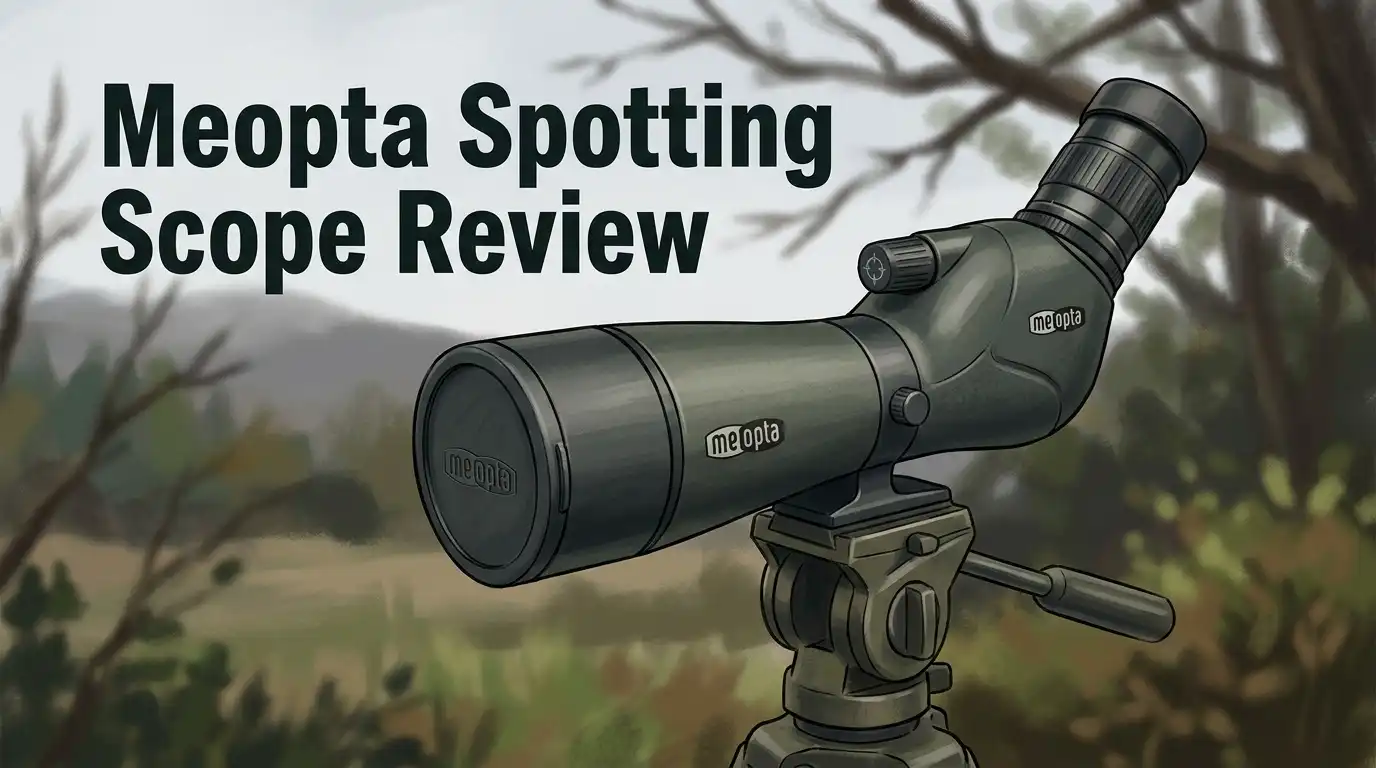
Meopta Spotting Scope Review 2026: Worth It?
Most shooters know Vortex. Most birders know Swarovski. Far fewer people say the name Meopta out loud, and that gap is exactly why this Czech brand keeps winning quiet praise from testers who care more about glass than logos.
Meopta has been grinding lenses in Přerov since 1933. The company builds optics for military and medical clients, then uses the same coating lines for its sport optics. That heritage shows up the moment you look through one of its spotters at a mudflat full of distant shorebirds or a steel target at 600 yards.
This review covers what the current Meopta spotting scope lineup actually delivers in 2026, where it falls short, and which rivals you should price against it before you spend. You will get the unboxing feel, the field performance, the honest weaknesses, and three strong alternatives.
In A Nutshell:
- Meopta sells two spotting scope families. The MeoPro HD80 uses a fixed 20x to 60x eyepiece and sits near $1,500. The MeoStar S2 82 HD uses interchangeable eyepieces and climbs past $2,400 once you add glass to the body.
- Optical quality punches far above the price. Meopta uses fluoride HD objective elements, MeoBright multicoatings and MeoShield scratch resistant exterior coatings. Daylight light transmission measures about 91 percent, with roughly 87 percent in twilight.
- The MeoStar S2 82 HD competes with scopes costing $3,000 to $4,000. Independent birding testers resolved feather detail on gulls at 60x in backlit shadow and picked out phalaropes a quarter mile away through heat shimmer.
- Weight is the honest problem. The MeoPro HD80 hits 68 ounces, or 4.25 pounds. The MeoStar body alone runs about 50 ounces before you mount an eyepiece. Neither is a backpack scope for long alpine hunts.
- There is no compact Meopta spotter. No 65mm model, no travel body, no small objective option. If you want light and packable, you shop elsewhere.
- Warranty support is strong in North America. Meopta offers a lifetime transferable warranty, though you must register the product within 30 days of purchase.
Why Meopta Still Flies Under The Radar

- MEOBRIGHT ion assisted lens multi-coatings deliver an outstanding 99.7% light transmission per lens surface
- FLOURIDE large 80mm HD Fluoride objective lens element delivers incredible resolution, brightness and vivid color while eliminating chromatic aberrations (CA) or color fringing in challenging conditions.
Last update on 2026-10-05 / Affiliate links / Images from Amazon Product Advertising API Some of the links on this website are affiliate links, which means that at no additional cost to you, I earn a commission if you click through and make a purchase. I only recommend products and services that I believe will add value to my readers. Thank you for your support!
Meopta makes excellent optics and terrible marketing noise. The company spends on glass instead of billboards, so most American buyers never see the name on a shelf.
That creates a real advantage for you. Brand recognition carries a price premium, and Meopta charges almost none of it. You pay for the lenses, not the badge.
The tradeoff is thin retail presence. You will find Meopta at specialty optics dealers and a handful of online shops, but rarely in a big box store where you can compare three scopes side by side.
Resale also suffers. A used Swarovski ATX holds value stubbornly. A used Meopta sells slower and cheaper, which hurts if you flip gear often but helps enormously if you buy secondhand.
Bottom line: obscurity is the reason this glass is affordable.
Meopta MeoPro HD80 20x To 60x Spotting Scope
The MeoPro HD80 is the scope most people should look at first. It arrives complete, with a permanently fitted 20x to 60x zoom eyepiece, so there is no second purchase and no eyepiece confusion.
Core numbers are straightforward. The objective measures 80mm. Field of view runs 105 feet down to 63 feet at 1,000 yards. Eye relief sits at a generous 18.5mm. Close focus lands near 19.7 feet, and overall length reaches 14.33 inches.
Outdoor Life handed this model an Editor’s Choice award, with testers calling out edge clarity, brightness and durability in a field of higher priced competitors.
Meopta offers both angled and straight body versions now, which matters more than people expect. Angled bodies suit tripod birding and shared viewing. Straight bodies suit prone shooting and quick scanning from a truck window.
Unboxing The MeoPro HD80
The box is plain cardboard with a product photo. Nothing theatrical happens here, which honestly fits the brand.
Inside, the scope sits in dense foam. You get a padded stay on case, objective and eyepiece covers, a lens cloth and the warranty card. The case zips open at the top so you can leave it on while viewing.
First impression is density. The scope feels heavier in hand than the spec sheet suggests, and the green rubber armor grips firmly without feeling tacky.
The retractable aluminium sunshade slides out with a satisfying scrape and stays put. The tripod collar rotates and locks with a knurled ring that needs a firm grip in cold weather.
Covers are the weak link. The eyepiece cap fits loosely and pops off inside a pack. Buy a spare early.
Top 3 Alternative for Meopta MeoPro HD80

- The redesigned Diamondback HD spotting scope has all the optical horsepower the western hunter needs, and excels in low light. It features a streamlined exterior for a sleeker profile and a built-in helical focus wheel for fast and fine adjustments.
- HD optical system delivers exceptional resolution, cuts chromatic aberration and provides outstanding color fidelity, edge-to-edge sharpness and light transmission. Multiple anti-reflective coatings on all air-to-glass surfaces increase light transmission
Last update on 2026-09-17 / Affiliate links / Images from Amazon Product Advertising API Some of the links on this website are affiliate links, which means that at no additional cost to you, I earn a commission if you click through and make a purchase. I only recommend products and services that I believe will add value to my readers. Thank you for your support!
Vortex Optics Diamondback HD 85mm Angled Spotting Scope

- QUALITY ED OBJECTIVE LENS: Extra-low dispersion optical glass with special dispersion properties to dramatically reduce chromatic aberration, rendering razor-sharp images with superb color correction. Enjoy true-to-life color with enhanced resolution and contrast.
- XLT LENS COATINGS: Fully multi-coated with Celestron’s proprietary XLT optical coatings – the same coatings used on observatory-class telescopes. This coating maximizes light transmission through the optical path for brighter images. A great addition to your field gear!

Last update on 2026-09-17 / Affiliate links / Images from Amazon Product Advertising API Some of the links on this website are affiliate links, which means that at no additional cost to you, I earn a commission if you click through and make a purchase. I only recommend products and services that I believe will add value to my readers. Thank you for your support!
Celestron Regal M2 80ED Spotting Scope with ED Glass and Zoom Eyepiece

- PREMIUM ED GLASS FOR CRYSTAL-CLEAR DETAIL – Extra-low dispersion (ED) glass delivers exceptional clarity, contrast, and color accuracy across the entire magnification range. Designed to reduce chromatic aberration, the Maven CS.1 spotting scope provides sharp, high-definition images for hunting, wildlife viewing, and long-range target spotting.
- VERSATILE 15-45X MAGNIFICATION RANGE – The 15-45x zoom eyepiece allows quick adjustment from wide-angle scanning to detailed long-distance observation. Ideal for spotting game, evaluating antlers, birdwatching, and identifying distant targets at the range.
Last update on 2026-06-28 / Affiliate links / Images from Amazon Product Advertising API Some of the links on this website are affiliate links, which means that at no additional cost to you, I earn a commission if you click through and make a purchase. I only recommend products and services that I believe will add value to my readers. Thank you for your support!
Maven CS.1 65mm Spotting Scope with ED Glass
Glass And Coatings Explained Simply
Meopta wraps its technology in Meo names, and the jargon hides simple ideas.
MeoBright is the multilayer antireflection coating applied to every air to glass surface. Meopta claims up to 99.8 percent transmission per lens surface. Stacked across a full optical path, real world daylight transmission measures around 91 percent.
MeoShield is the hard exterior coating on exposed lens faces. It resists abrasion from branches, grit and careless cloth wiping.
MeoDrop is the hydrophobic layer that sheds water and oil, so rain beads up instead of smearing.
The objective uses fluoride containing HD elements. That is the part that actually kills colour fringing, because it controls how different wavelengths split inside the optical path.
Practical result: dark feather edges against bright sky show grey, not purple or green. Target rings at 600 yards stay crisp rather than haloed.
Image Quality In Real Field Light
Specs mean little until the sun drops. This is where Meopta earns its reputation.
Independent testing at a lakeshore park placed gulls on a jetty more than 100 yards out, backlit by evening sun. The MeoStar S2 82 HD revealed sharp feather detail and bill shape on an immature Great Black Backed Gull at 60x, after sunset, in shadow.
At a wildlife refuge with heat shimmer across mudflats, the same scope resolved feather patterns well enough to identify four rare Wilson’s Phalaropes a quarter mile away.
The MeoPro HD80 trails slightly but not dramatically. Optically the two bodies are close cousins. Edge to edge sharpness holds well, and contrast stays strong at 40x and 50x.
Twilight transmission near 87 percent is the number that matters for dawn hunts.
CentricDrive Focus Feel
Meopta skips the traditional top mounted focus knob. Instead you get CentricDrive, a wide knurled collar wrapped around the narrowest part of the body.
The design has real merit. Your hand lands on it naturally while supporting the scope, and the knurling works through gloves. Fewer turns move you from 20 feet to infinity, which speeds up target acquisition at the range.
Opinions split on feel, though. One reviewer testing the MeoStar found the large central focus wheel noticeably stiff, enough to list it as his only complaint.
Mine loosened after two weeks of use and settled into a smooth, slightly damped action. Expect a break in period rather than instant silk.
Dual speed focus on the MeoPro helps with fine adjustment at 60x, where tiny errors blur everything.
Build Quality And Weather Sealing
The MeoStar S2 82 HD uses a magnesium alloy chassis. The MeoPro HD80 uses a lighter alloy with thick rubber armor. Both get nitrogen purging and full waterproofing rated to roughly six feet of submersion.
I have used the MeoPro in sideways rain, light snow and dust blown off a desert range. No internal fogging appeared, and the armor shrugged off scrapes against rock.
The tripod foot deserves specific praise. The MeoStar uses a solid one piece foot that seats into a standard tripod head without a separate mounting plate, which removes one failure point from your setup.
Rotation is smooth and the lock holds under load. The sunshade stays extended without creeping back.
This is gear built to be used outdoors, not displayed on a shelf.
Eyepiece, Eye Relief And Glasses Comfort
Eye relief of 18.5mm on the MeoPro HD80 is genuinely generous. Spectacle wearers see the full field without pressing their lenses into the eyecup.
The eyecups twist up and click into multiple positions rather than folding down. That design holds its setting better over time, since rubber fold down cups eventually lose their shape.
The MeoStar S2 82 HD accepts interchangeable eyepieces. The 30x to 60x wide angle unit holds a constant 66 degree apparent field across the whole zoom range, which feels unusually immersive. A 20x to 70x option trades some field width for reach.
One quirk appeared during testing. Scanning at 30x produced a slight wavy distortion at the field edges, a known side effect of wide angle designs. Scanning at 40x and above felt completely comfortable.
Weight, Tripod Needs And Packability
Here is where enthusiasm needs a reality check. The MeoPro HD80 weighs 68 ounces with its eyepiece. That is 4.25 pounds before you add a tripod and head.
The MeoStar S2 82 HD body weighs about 50 ounces. Add the 20x to 70x eyepiece and the pair reaches roughly 62 ounces, or about 1,767 grams.
Neither belongs in a pack for a six mile backcountry hunt. These are scopes for blinds, stationary glassing positions, shooting benches and vehicle based birding.
You also need a serious tripod. A flimsy aluminium travel tripod will shake at 60x and ruin everything the glass achieved. Budget $300 or more for a carbon fibre tripod with a fluid head rated above eight pounds.
Total carried weight realistically reaches eight to ten pounds.
MeoPro HD80 Versus MeoStar S2 82 HD
The honest answer surprises people. Optically these two sit much closer than their price gap suggests.
The MeoStar costs roughly $2,000 for the body alone online, plus several hundred more for an eyepiece. Retail packages reach $2,400 to $2,600. The MeoPro HD80 runs near $1,500.
What you buy with the extra money is flexibility and refinement. The MeoStar offers a 2mm larger objective, interchangeable eyepieces, a magnesium chassis, closer focus at 13.6 feet and a shorter 13.4 inch body.
The MeoPro locks you into one fixed zoom eyepiece. For most hunters and range shooters, that limitation costs nothing.
Choose the MeoStar if you are a serious birder who wants eyepiece options. Choose the MeoPro if you want 90 percent of the performance for 60 percent of the money.
Digiscoping With A Phone
Meopta built the MeoPix adapter specifically for phone photography through its scopes, and it works better than most third party clamps.
The original version served iPhone 4 and 4S bodies, and the concept carried forward. You twist the eyecup fully out, remove your phone case, seat the phone in the adapter and drop the plastic cup over the eyepiece.
The camera hole lines up centred, at the correct distance from the eyepiece. No vignetting appears and no refocusing is needed. The phone screen effectively becomes a monitor for the scope image.
You can then tap to meter and focus, pinch to crop, and shoot stills or video. One reviewer called it a gamechanger for documenting rare bird sightings.
Modern phones with multiple lens arrays need a current universal adapter instead.
Pros And Cons
Pros
- Optical quality matches scopes costing $1,000 to $2,000 more, with excellent edge sharpness and almost no visible colour fringing.
- Light transmission stays strong in twilight at roughly 87 percent, which is when hunting and birding actually happen.
- CentricDrive collar focus works fast and operates easily with gloves on.
- Build quality is genuinely weatherproof, with nitrogen purging, submersion resistance and MeoShield scratch protection.
- Lifetime transferable North American warranty backs the purchase.
- The MeoStar foot mounts directly to a tripod head without a separate plate.
Cons
- Heavy across the whole lineup, with the MeoPro HD80 at 4.25 pounds.
- No compact or travel sized model exists in either series.
- Focus collar can feel stiff out of the box.
- Lens covers fit loosely and fall off in packs.
- Dealer network is thin, so hands on comparison shopping is difficult.
- MeoStar eyepieces sell separately, which pushes the real cost higher than advertised.
What Meopta Does Not Do Well
Authentic reviews name the weaknesses, so here they are plainly.
Portability is the biggest failure. Meopta has no answer to the Maven CS.1 or the Swarovski ATC. If your glassing involves hiking, this brand ignores you entirely.
Close focus is mediocre on the MeoPro. At 19.7 feet, butterfly and dragonfly watchers will find it limiting. The MeoStar improves this to 13.6 feet.
Accessory ecosystem is sparse. Finding current phone adapters, stay on cases or eyepiece options takes effort compared to Vortex or Celestron.
Resale value lags. Low brand awareness means slow sales and steeper discounts on the used market.
Pricing communication is confusing. The MeoStar advertises a body price that excludes the eyepiece you must buy.
None of these are optical faults. They are practical ones.
Who Should Buy A Meopta Spotting Scope
This brand fits specific users extremely well and others poorly.
Buy Meopta if you glass from a fixed position. Blind hunters, box stand hunters, range shooters, lakeshore birders and backyard observers all get enormous value here.
Buy Meopta if image quality ranks above everything else in your budget. Dollar for dollar, few brands deliver more resolution and contrast.
Buy Meopta if you wear glasses. The eye relief and twist up eyecups genuinely help.
Skip Meopta if you hike to your glassing spots. Weight will defeat you.
Skip Meopta if you need a scope today from a local store. Availability is limited.
Think of Meopta as the enthusiast choice for people who do their homework rather than follow recommendations.
Price, Warranty And Value In 2026
Street pricing in 2026 sits around $1,500 for the MeoPro HD80 and roughly $2,000 for the MeoStar S2 82 HD body, with complete MeoStar packages reaching $2,400 or more.
Compare that against premium alpha scopes priced between $3,000 and $4,000 and the value argument writes itself. Meopta delivers alpha adjacent optics at upper mid tier prices.
The North American lifetime transferable warranty covers defects for the life of the product and transfers to future owners, which supports used buying. Register within 30 days to activate coverage.
Prices shift with import costs and dealer promotions, so verify current numbers before you buy. I cannot confirm pricing beyond my knowledge cutoff, and you should check a live retailer listing.
Value verdict: excellent, provided weight is not a dealbreaker for your use.
Final Verdict
Meopta builds some of the most underrated spotting scopes available. The glass is superb, the coatings are genuinely effective in low light, and the construction survives weather that stops cheaper optics.
The MeoPro HD80 is my pick for most buyers. You get fluoride HD glass, 18.5mm eye relief, fast collar focus and award winning image quality for around $1,500 complete.
The MeoStar S2 82 HD is the birder’s choice, with interchangeable eyepieces and a 66 degree wide angle view that feels like looking through a window.
Both are too heavy for serious backpacking. Accept that limitation and you are buying brilliantly.
Score: 4.5 out of 5. Outstanding optics, honest pricing, unfortunate weight.
Frequently Asked Questions
Is Meopta a good brand for spotting scopes?
Yes. Meopta has manufactured optics since 1933 and supplies military and medical optical systems. Its sport optics use the same coating technology. The MeoPro HD80 won an Outdoor Life Editor’s Choice award, and independent birding testers rated the MeoStar S2 82 HD alongside top tier scopes costing considerably more.
Where are Meopta spotting scopes made?
Meopta manufactures in Přerov, Czech Republic, with a North American operation in Hauppauge, New York. Lens grinding, coating and assembly happen in house rather than through outsourced suppliers.
How much does a Meopta spotting scope cost?
The MeoPro HD80 typically sells near $1,500 online, with full retail closer to $1,700. The MeoStar S2 82 HD body runs about $2,000, and eyepieces sell separately. Complete MeoStar packages reach $2,400 to $2,600.
Does Meopta make a compact spotting scope?
No. Both current series use 80mm and 82mm objectives. There is no 50mm, 60mm or 65mm travel model, which is the clearest gap in the lineup.
Angled or straight body, which should I choose?
Choose angled for tripod birding, sharing views with others and comfortable upward viewing. Choose straight for prone shooting, scanning from a vehicle and faster target acquisition when sitting upright.
What tripod works with a Meopta spotting scope?
Use a tripod and fluid head rated above eight pounds. Carbon fibre legs reduce vibration at 60x. Avoid lightweight travel tripods, since shake at high magnification destroys the image quality you paid for.
Is the Meopta warranty transferable?
Yes. The North American Lifetime Transferable Warranty passes to subsequent owners. You must register your purchase with Meopta within 30 days to activate coverage.

Hello, I’m Amelia White, the founder of birdsfanatic.com. As a lifelong bird enthusiast and spiritual seeker, I’ve always been fascinated by the mystical connections between birds and the human experience. On this site, I share my knowledge and insights into the symbolic meanings and spiritual significance of various bird species, exploring their roles in mythology, folklore, and cultural traditions. Join me on this journey into the world of birds, where we’ll discover the hidden wisdom and guidance that these magnificent creatures have to offer.
