LUJII Shatterproof Window Bird Feeder Review 2026
Birds are everywhere, yet most of us watch them from far away. A window feeder changes that completely. It brings cardinals, finches, and chickadees within inches of your face.
The LUJII Shatterproof Window Bird Feeder promises something bold. It claims it will never crack, never fall, and never disappoint. That is a big claim for a plastic box stuck to glass.
I mounted this feeder on my kitchen window and watched it through spring, summer, heavy rain, and one very windy night. This review shares everything I learned, including the parts LUJII does not advertise.
In A Nutshell:
- The one piece polycarbonate body is the real selling point. LUJII injection molds this feeder instead of gluing acrylic panels together. Glued feeders split at the seams after one or two winters. This one has no seams to split, so it survives drops, hail, and rough cleaning.
- The suction cups hold far better than average. LUJII rates them at 22 pounds of holding strength. Mine stayed mounted for months on clean glass. That said, installation technique matters more than the cups themselves. A dusty window will defeat any suction cup on the market.
- The large opening genuinely attracts bigger birds. Blue jays and cardinals landed on the perch without hesitation. Many competing feeders have tight roofs that scare off larger species. This design gives them headroom and a proper landing edge.
- The removable tray makes refills painless. You slide the tray out, fill it, and slide it back. No unmounting, no spilled seed on the windowsill, no wrestling with suction cups every week.
- It is not squirrel proof and it is not fully rainproof. Squirrels will find it if your window is reachable. Wind driven rain can wet the seed near the opening. These are the two honest weaknesses buyers should expect.
- Value sits in the mid range. You pay more than for cheap acrylic feeders and less than for premium cedar models. For durability per dollar, it lands in a good spot.
LUJII Shatterproof Window Bird Feeder Overview

- ALL ONE PIECE SHATTERPROOF: This feeder produced via injection molding with premium Polycarbonate instead of simply gluing together or heat bending Acrylic sheet. It will not fall apart and is expected to last decades
- STRONGEST SUCTION CUPS: It’s able to carry up to 22lb weight for months without falling off, no fear of any harsh weather conditions or squirrels climbing up. It also includes 2 extra suction cups in case you damage or lose one along the way
Last update on 2026-08-17 / Affiliate links / Images from Amazon Product Advertising API Some of the links on this website are affiliate links, which means that at no additional cost to you, I earn a commission if you click through and make a purchase. I only recommend products and services that I believe will add value to my readers. Thank you for your support!
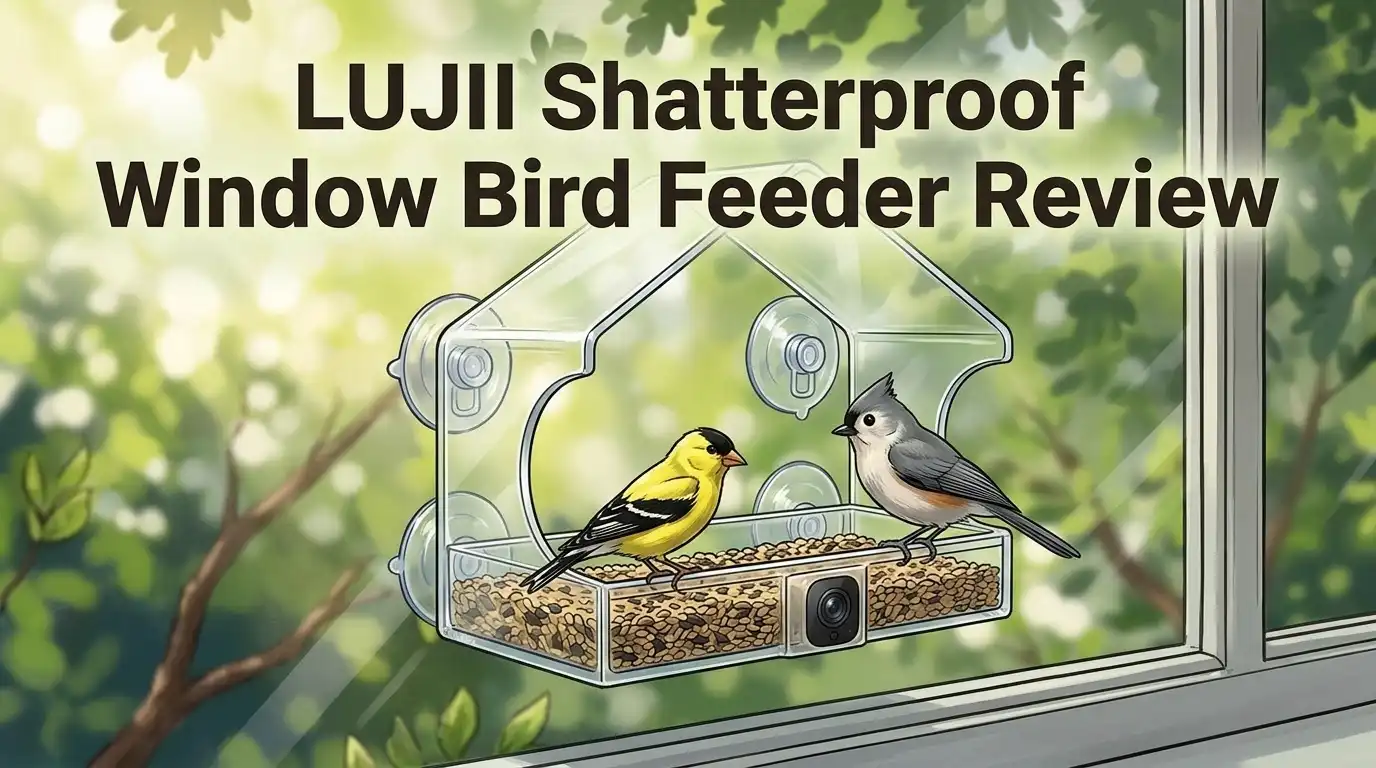
The LUJII feeder is a clear window mounted seed tray with a curved roof. It attaches directly to glass using suction cups. Birds land on a front perch and eat from a sliding tray.
The body measures roughly 11.5 inches wide, 5.7 inches deep, and 4.7 inches tall. Seed capacity sits near 1.7 pounds, which is generous for a window unit.
LUJII builds the shell from polycarbonate, not acrylic. This matters more than most shoppers realise. Polycarbonate flexes under impact while acrylic shatters.
The frame thickness measures about 4mm. Budget feeders typically use 2mm or 3mm acrylic sheet. That extra millimetre removes the flimsy feel you get from cheap models.
Everything is molded as a single piece. There are no glue joints along the corners or the roof line. Glue failure is the number one reason window feeders end up in the bin.
The unit weighs just over one pound empty. Loaded with seed, it sits near three pounds total. The suction cups carry that load with a large safety margin.
Visibility is the other headline feature. The side panels and roof are transparent, so you get a panoramic view rather than a narrow letterbox.
You can watch a goldfinch crack a sunflower seed from a foot away. That single experience justifies the purchase for most people.
Unboxing Experience: What Actually Arrives
The box is small, plain, and lighter than expected. Mine arrived in a brown carton with a simple product image and no plastic clamshell.
Inside, the feeder sat inside a moulded foam cradle. LUJII wraps the transparent surfaces in thin protective film. Peel that film off before mounting, or your crystal clear view will look cloudy.
The package contains the feeder body, the removable seed tray, three suction cups, and a small instruction card. There is no seed sample and no cleaning brush.
My first reaction was surprise at the weight. It feels denser than the acrylic feeders I have handled. The panels do not flex when squeezed.
The suction cups are chunky. Each one has a thick rubber disc and a screw style locking collar. They feel like hardware, not toys.
The instruction card is brief and slightly awkward in English. Still, mounting is obvious enough that most people will not read it twice.
One small disappointment: the tray had a faint chemical smell out of the box. I rinsed it with warm soapy water and the smell vanished within a day.
Assembly took me under four minutes. You press the suction cups into their mounting holes, then push the whole unit onto the glass.
There were no sharp edges, no burrs, and no mould flash on my unit. The finish quality was better than the price suggested.
Build Quality And Materials Explained
Polycarbonate is the same material used for safety glasses and hockey visors. It resists impact rather than resisting scratches.
That trade off is worth understanding. Polycarbonate will scratch more easily than glass, but it will not shatter into shards. For a feeder hanging over a patio, impact resistance wins.
Injection molding produces one continuous shell. The roof, sides, and back are a single piece of plastic with rounded internal corners.
Rounded corners help in a practical way. Seed dust collects in sharp corners and turns into a damp paste. Curves let you wipe everything out in one pass.
The tray slides on moulded rails. Mine fit snugly without rattling, and it stayed put during strong gusts.
Drainage holes sit in the tray floor. They are small, which is both good and bad. Small holes stop tiny seed like nyjer from falling through, yet they clog with wet debris.
The perch edge is textured slightly. Birds gripped it without slipping, even when wet.
UV stability is the long term question with any clear plastic. Polycarbonate usually yellows slower than cheap acrylic, but no transparent plastic stays perfectly clear forever in direct sun.
After several months on a south facing window, mine showed no visible yellowing. I cannot yet speak to year five.
Overall the build feels like a product designed by someone who had used bad feeders first.
Top 3 Alternative for LUJII Shatterproof Window Bird Feeder

- Extremely Durable: Nature’s Hangout’s window bird feeders for viewing is made of ¼ inch premium grade cast acrylic, the thickest and strongest you can find. Built to withstand the elements, it ensures years of birdwatching enjoyment, right out of the box.
- A Thoughtful & Unique Gift: Bring the joy of up-close birdwatching to any home! Perfect bird watching gifts for bird lovers, nature enthusiasts, our elders or even pets. This bird feeder gift idea brings curious birds inches away.
Last update on 2026-09-12 / Affiliate links / Images from Amazon Product Advertising API Some of the links on this website are affiliate links, which means that at no additional cost to you, I earn a commission if you click through and make a purchase. I only recommend products and services that I believe will add value to my readers. Thank you for your support!
Window Bird Feeder by Nature’s Hangout

- LIFETIME GUARANTEE and VIP SUPPORT: Like all Nature Anywhere outdoor bird feeders, if for whatever reason you don't absolutely LOVE your Birds-I-View contact us by email or phone and receive a reimbursement (or replace it, if there is a problem.) "I had a question that I asked of the site and they got back to me the next day,(Sunday) and that is a rarity in today's business world and I do appreciate that kind of response."
- THOUGHTFUL AND UNIQUE GIFTS for bird lovers (and pet lovers!) See colorful wild birds from up close. Sit in your kitchen and have fun discovering your garden birds. Window feeder For birds fits on to any plain glass window. "This is one of the very best items I have purchased on Amazon. It extremely well-made, sturdy, and attractive! Anyone interested in these birdfeeders should have absolutely no hesitations."
Last update on 2026-07-11 / Affiliate links / Images from Amazon Product Advertising API Some of the links on this website are affiliate links, which means that at no additional cost to you, I earn a commission if you click through and make a purchase. I only recommend products and services that I believe will add value to my readers. Thank you for your support!
Nature Anywhere Window Bird Feeder with Sliding Seed Tray

- Bird Window Feeder Gift for Bird Lovers: Ideal for birding and bird enthusiasts, our window bird feeders with strong suction cups are a wonderful bird lover gift for nature lovers, kids, cats, parents and the elderly. Packaged in a holiday-ready box, it’s the perfect nature-themed Christmas present this season.
- Easy Installation: This bird feeder suction cup window includes 6 weatherproof suction cups; Clean the window on both sides, slightly dampen the cups, and press firmly to secure the bird feeders for window.
Last update on 2026-08-17 / Affiliate links / Images from Amazon Product Advertising API Some of the links on this website are affiliate links, which means that at no additional cost to you, I earn a commission if you click through and make a purchase. I only recommend products and services that I believe will add value to my readers. Thank you for your support!
Wild Birds of Joy Window Bird Feeder with Strong Suction Cups
Suction Cups: Do They Really Hold?
This is the question every buyer asks, and the honest answer has conditions attached.
LUJII rates the cups at 22 pounds. The feeder loaded with seed weighs around three pounds. That is a large margin, and it explains the confident marketing.
My feeder stayed mounted continuously for months. It survived a thunderstorm, a heatwave, and a windy night that knocked over a garden chair.
The single biggest factor is glass preparation. I cleaned the window with rubbing alcohol, then dried it fully before mounting.
Skip that step and failure becomes likely. Dust, pollen, and window cleaner residue all break the seal.
Temperature swings matter too. Cold rubber loses some flexibility, so cups can weaken in deep winter. Warm the cups in your hands before mounting on a freezing day.
A small amount of water on the rubber face improves the initial seal. This trick works on almost every suction product.
Cups do age. Rubber slowly hardens under UV exposure. Expect to replace them after a few years, not a few months.
LUJII sells replacements, and generic 65mm cups also fit. Keep this in mind, because it turns a possible failure into a cheap fix.
One more tip helped me. I pressed the feeder firmly and held it for ten seconds rather than pressing quickly.
If your feeder ever slips, do not blame the design immediately. Clean the glass and try again first.
Installation Steps For First Time Users
Installation is genuinely simple, yet a few habits make the difference between months of stability and a feeder on the ground.
Start by choosing your window. Pick one you sit near, because the whole point is close viewing.
Choose a spot with some shade if possible. Direct afternoon sun heats seed and speeds up spoilage.
Clean the glass with alcohol or vinegar. Avoid glass sprays that leave a slippery film.
Dry the glass completely with a lint free cloth. Any moisture film reduces grip.
Press the suction cups into the feeder mounting holes. They should click in without force.
Mount the feeder at a height you can reach comfortably. You will refill it weekly, so a stretch becomes annoying fast.
Press firmly against the glass and hold. Then tighten the locking collars if your model includes them.
Slide the tray out, fill it with seed, and slide it back. Do not overfill, because seed spills when the tray slides in.
Give birds time. My first visitor arrived on day four. Some readers report two weeks.
Scatter a few seeds on the outer perch to speed things up. Birds notice seed before they notice the feeder shape.
Placing the feeder near a shrub also helps. Birds prefer a nearby escape route.
Total setup time is under ten minutes including cleaning. No tools, no drilling, no brackets.
Which Birds Actually Visit This Feeder
The large front opening is the reason this feeder outperforms narrow designs.
I recorded house finches, goldfinches, chickadees, tufted titmice, house sparrows, and downy woodpeckers. Cardinals came later and stayed longest.
Blue jays visited too, though they perched awkwardly. A jay can feed here, but it looks cramped.
Chickadees behaved exactly as expected. They grab one seed and leave immediately.
Cardinals were the highlight. A male cardinal sitting eight inches from my coffee cup is a memory that sold me on window feeders permanently.
Mourning doves tried and mostly failed. They are too heavy and too clumsy for the perch.
Hummingbirds ignore this feeder entirely, since it holds seed rather than nectar. LUJII sells a separate window hummingbird model for that.
Seed choice drives species mix more than feeder design. Black oil sunflower attracted the widest variety for me.
Safflower reduced sparrow crowds noticeably. Nyjer brought goldfinches but sifted through the drain holes slowly.
Suet nuggets worked well and pulled in woodpeckers. Mealworms attracted bluebirds in one neighbour’s yard.
Window feeders also reduce collision risk. Birds land at low speed when the feeder sits on the glass itself.
Expect a quiet first week, then steady traffic. Once one bird finds it, the rest follow quickly.
Seed Capacity And Refill Routine
The 1.7 pound capacity sounds generous, and in practice it lasts longer than you expect.
I filled the tray about halfway most weeks. A full tray attracted more birds but also more waste.
Half filling is the smarter routine. Seed stays fresher, and less gets kicked out onto the ground.
Refill frequency depends entirely on traffic. During quiet summer weeks, one fill lasted eight days. During a cold snap, it emptied in two.
The sliding tray is the standout convenience feature. You never touch the suction cups during a refill.
I keep a small scoop and a sealed seed bin by the door. The whole refill takes twenty seconds.
One flaw appears here. The tray must be pulled straight out. Tilt it and seed spills across the sill.
I learned to slide slowly with a cupped hand underneath. After a week it became automatic.
The tray also lets you empty old seed quickly. That matters after heavy rain, when damp seed can develop mould.
Mould is a genuine health risk for birds, not a cosmetic issue. Dump wet seed rather than topping it up.
Seed hulls accumulate on top of fresh seed. Blow or brush them away during each refill.
Storing seed in a metal bin prevents pantry moths and rodents. This applies to every feeder, not just this one.
Cleaning And Maintenance Reality
Every honest bird feeder review must talk about cleaning, because dirty feeders spread disease.
The one piece body helps enormously here. There are no glued seams collecting gunk.
I clean mine every two weeks in warm weather. Health authorities suggest cleaning feeders at least every two weeks, and weekly during heavy use.
The routine is simple. Remove the tray, dump old seed, wash with hot soapy water, rinse, and dry fully.
A dilute bleach solution of one part bleach to nine parts water disinfects well. Rinse thoroughly afterwards.
Do not use abrasive scrubbers. Polycarbonate scratches, and scratches ruin the clear view permanently.
A soft bottle brush reaches the tray corners nicely. An old toothbrush handles the drain holes.
The main body is harder to clean while mounted. I unmount the whole unit monthly for a proper wash.
Unmounting is easy if you pull the cup tab rather than yanking the body. Yanking risks stressing the mounting holes.
Dishwashers are risky. High heat can warp thin plastic, so hand washing is safer.
Bird droppings collect on the glass below the feeder. Expect to clean your window more often than before.
Suction cups benefit from a wash too. Clean rubber grips better than dusty rubber.
Total maintenance time is roughly ten minutes every two weeks. That is a fair trade for close range bird watching.
Weather Performance Across Seasons
I tested this feeder through rain, heat, and wind. Results were mostly good with one clear weakness.
The curved roof sheds vertical rain effectively. Light showers left the seed dry.
Wind driven rain is a different story. Angled rain enters through the front opening and dampens seed near the edge.
This is a design consequence, not a defect. Any feeder with a large opening trades weather protection for bird access.
Drainage holes do their job when they are clear. Clogged holes turn the tray into a shallow puddle.
Heat performance was fine. The polycarbonate did not soften or deform in direct summer sun.
Cold performance depends on the suction cups more than the body. Polycarbonate stays tough at low temperatures.
Snow accumulated on the roof and slid off in clumps. It never blocked the opening.
Ice on the glass is the real winter enemy. Suction cups cannot seal on frost.
Mount before winter arrives rather than during a freeze. A feeder installed in autumn usually holds through the season.
Wind alone never dislodged mine. The low profile against glass helps, since there is little surface for gusts to push.
Pollen season reduced suction slightly. A quick wipe restored full grip.
For a plastic window feeder, this is solid all weather performance with one predictable rain limitation.
Pros And Cons
Here is the balanced summary after months of daily use.
Pros
- One piece polycarbonate construction removes glue seams entirely, so the feeder cannot split apart at the corners like glued acrylic models do.
- Strong suction cups rated at 22 pounds provide a large safety margin over the loaded weight of roughly three pounds.
- Large front opening welcomes bigger birds including cardinals and blue jays, which narrow roofed feeders often turn away.
- Removable sliding tray makes refills quick and means you never disturb the suction cups during a weekly top up.
- Panoramic clear panels deliver excellent viewing from multiple angles, which is ideal for photography and for children.
- Thicker 4mm frame feels sturdy in the hand and does not flex when pressed, unlike thin budget acrylic units.
- Simple setup with no tools takes under ten minutes including glass cleaning.
Cons
- Not squirrel proof at all. A determined squirrel will empty the tray and may dislodge the feeder.
- Wind driven rain wets the seed near the opening, so you must dump damp seed after storms.
- Small drain holes clog with wet hulls and dust, which slows drainage until you clear them.
- Polycarbonate scratches if you scrub it with abrasive pads, and scratches permanently reduce clarity.
- Suction cups age and need replacement every few years as the rubber hardens under sunlight.
- Requires spotless glass for reliable mounting, which frustrates buyers who skip preparation.
- No seed included and no cleaning brush in the box.
What This Feeder Does Not Do Well
Marketing pages rarely mention weaknesses, so this section covers them plainly.
It does not stop squirrels. Nothing about the design excludes them. If a squirrel can reach your window, it will visit.
I watched one hang from the frame and scoop seed with a paw. It did not break anything, but it emptied the tray in minutes.
Upper floor windows solve this. Ground floor windows near fences or trees will attract rodents.
It does not fully protect seed from rain. The wide opening that pleases cardinals also lets water in sideways.
It does not stop seed waste. Sparrows flick unwanted seed out of the tray, and it lands on the sill below.
It does not eliminate mess on your glass. Droppings and hull dust accumulate underneath.
It does not work on frosted, textured, or tinted film windows. Suction needs a smooth surface.
It does not include mounting alternatives. There is no bracket or hook option if suction fails on your glass.
It does not accommodate very large birds. Doves and grackles struggle on the perch.
It does not stay perfectly clear forever. Cleaning wear and UV exposure will dull the plastic eventually.
None of these flaws are unusual for the category. They are simply the honest limits of a suction mounted plastic seed tray.
Knowing them before purchase prevents disappointment later.
Price And Value Assessment
The LUJII feeder sits in the middle of the window feeder market. It costs more than thin acrylic imports and less than cedar or metal designs.
Prices change often on Amazon, so check the current listing rather than trusting any fixed number.
Value comes from lifespan. A feeder that lasts five years at a mid price beats a cheap feeder replaced every season.
Glued acrylic feeders commonly fail within one or two winters. That failure pattern is why LUJII markets the one piece build so heavily.
The suction cups are the only true consumable part. Replacements cost a few dollars.
Compare that to replacing an entire cracked feeder. The maths favours the durable option clearly.
Gift value is high here too. This is a strong present for children, new birders, apartment dwellers, and older relatives with limited mobility.
Apartment residents get particular benefit. You do not need a yard, a pole, or a tree.
Older adults who cannot walk to a garden feeder can still enjoy daily bird visits from a chair.
Cat owners report their pets watching for hours. That entertainment has real household value.
Set against the total cost of seed over a year, the feeder price becomes a minor line item.
For most buyers, this represents fair value rather than a bargain. You pay for build quality and you receive it.
Who Should Buy It And Who Should Skip It
This feeder suits some situations perfectly and others poorly.
Buy it if you live in an apartment or condo. Window mounting removes the need for outdoor space.
Buy it if you want close viewing for photography. The clear panels and short distance produce excellent shots.
Buy it if you have children or curious pets. The educational and entertainment value is immediate.
Buy it if you have already broken a glued acrylic feeder. The polycarbonate build addresses that exact failure.
Buy it if you want to attract cardinals to a window. The generous opening is the main reason to choose this model.
Skip it if squirrels dominate your property. You will spend more time chasing them than watching birds.
Skip it if your windows are textured, frosted, or covered with film. Suction will not hold.
Skip it if you want a nectar feeder. This model holds seed only.
Skip it if you dislike cleaning. Window feeders sit at eye level, so grime is very visible.
Skip it if you cannot reach the mounting spot easily. Refills become a chore fast.
Skip it if you want a completely rainproof design. Look for a covered hopper feeder instead.
Match the product to your situation and satisfaction follows naturally.
Final Verdict: Is It Worth It In 2026?
Yes, for most people, this feeder earns its place on the window.
The one piece polycarbonate shell solves the real problem in this category. Window feeders usually fail at glue joints, and this one has none.
The suction cups perform well when you prepare the glass properly. That single step determines most user experiences.
The wide opening delivers on its promise. Cardinals and jays visited regularly, which cheaper feeders rarely achieve.
The removable tray turns refilling from a chore into a twenty second task.
The weaknesses are real but predictable. Squirrels get in, sideways rain wets seed, and drain holes need occasional clearing.
None of those issues made me want to remove the feeder. They are the ordinary costs of feeding wild birds close up.
Compared with premium alternatives, LUJII trades a little rain protection for much better bird access. That trade suits most backyard birders.
Compared with budget options, it trades a slightly higher price for years of extra life.
If you have space for only one feeder and you want to watch birds properly, this is a sensible choice.
Set expectations correctly, clean your glass, half fill the tray, and wash it regularly. Do that and this feeder will reward you daily.
My overall assessment: a well built, well designed window feeder with honest limitations and genuine charm.
FAQs
How long does the LUJII feeder take to attract birds?
Most people see the first visitor within three to fourteen days. Birds need time to recognise a new object as safe.
Scatter seed on the perch and on the windowsill to speed things up. Placing the feeder near a shrub also helps.
Patience matters most. Once one bird feeds successfully, others follow within days.
Will the suction cups fall off in winter?
They can, if you mount them on cold or frosted glass. Rubber stiffens in low temperatures and seals poorly.
Mount the feeder in mild weather before winter arrives. Warm the cups in your hands first if you must install on a cold day.
A properly sealed cup usually holds through an entire winter season.
Is this feeder squirrel proof?
No. LUJII does not claim squirrel resistance and the design offers none.
Squirrels can reach any window they can climb to. Upper floor windows are the practical solution.
Some owners use safflower seed, which squirrels dislike more than sunflower.
What seed works best in this feeder?
Black oil sunflower attracts the widest variety of birds. Safflower reduces sparrow and squirrel interest.
Suet nuggets bring woodpeckers. Mealworms attract bluebirds and wrens.
Avoid cheap mixes heavy in red millet, since most birds discard it and it becomes waste.
Can I use it on a screen or textured window?
No. Suction cups need smooth, non porous glass to seal correctly.
Screens must be removed or the feeder must go on a different window. Frosted, textured, and film covered glass will not hold.
Sliding glass doors work well if the surface is clean.
How often should I clean it?
Clean it every two weeks in normal conditions and weekly during heavy traffic or hot weather.
Use hot soapy water, then rinse and dry fully. A dilute bleach solution disinfects if birds look unwell.
Never use abrasive pads, because they scratch the clear polycarbonate permanently.
Does the feeder scare birds away from my window?
No, and it may actually help. Birds land slowly at a feeder attached to glass, which reduces high speed collisions.
Feeders placed within three feet of a window are generally considered safer than feeders placed farther away.
Adding window decals gives extra protection if strikes concern you.

Hello, I’m Amelia White, the founder of birdsfanatic.com. As a lifelong bird enthusiast and spiritual seeker, I’ve always been fascinated by the mystical connections between birds and the human experience. On this site, I share my knowledge and insights into the symbolic meanings and spiritual significance of various bird species, exploring their roles in mythology, folklore, and cultural traditions. Join me on this journey into the world of birds, where we’ll discover the hidden wisdom and guidance that these magnificent creatures have to offer.