
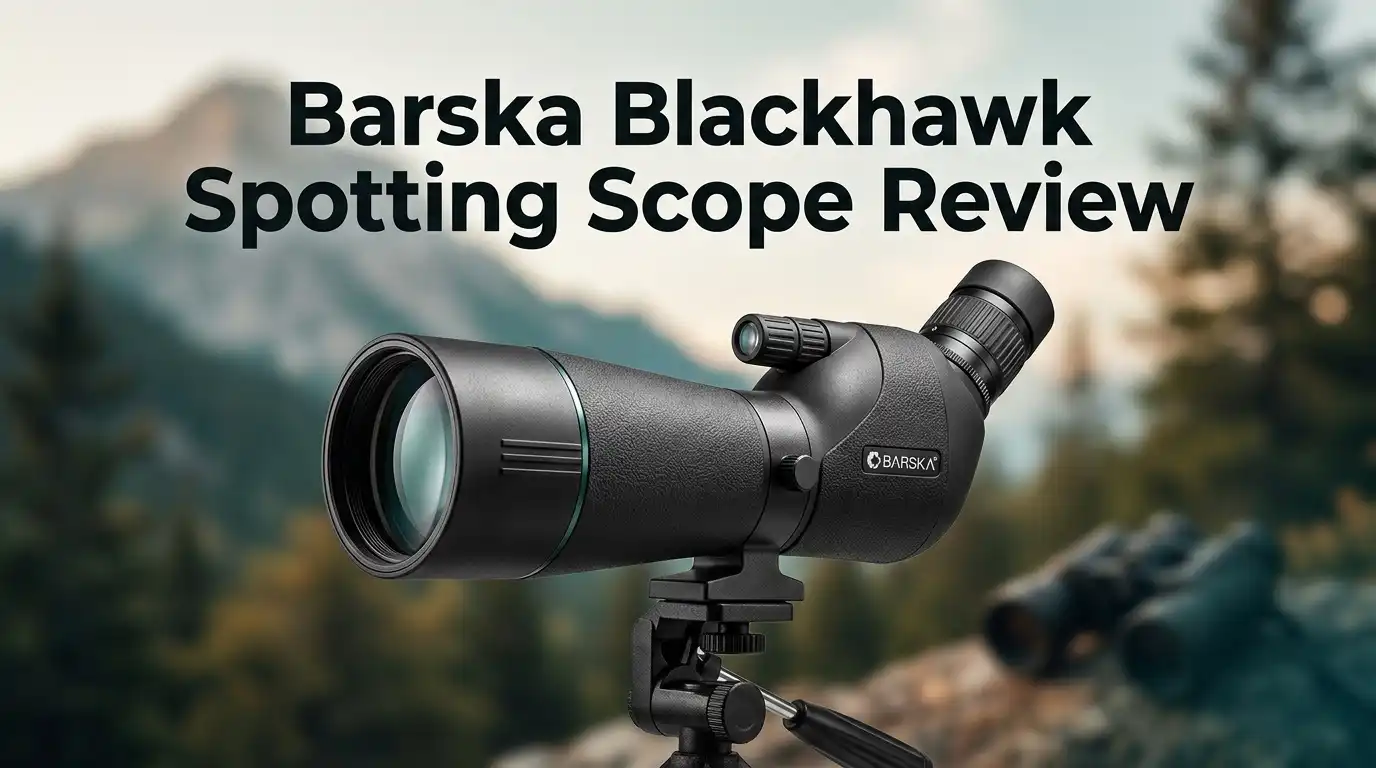
Barska Blackhawk Spotting Scope Review 2026: Still Worth It?
Spotting scopes used to cost a small fortune. Today you can grab a full kit for the price of a decent pair of boots. The Barska Blackhawk sits right in that sweet spot, and it has been quietly selling for well over a decade.
But cheap optics carry a reputation. Some deliver honest value. Others fall apart after two range trips. So where does the Blackhawk land in 2026?
I spent time with this scope at the range, in the backyard, and on a few early morning walks. I looked at the glass, the tripod, the armor, and the complaints buyers keep repeating online. This review covers all of it, including the parts Barska would rather you skip.
In a Nutshell:
- The price is the main selling point. The Barska Blackhawk 20-60×60 usually lands between $90 and $150 depending on the retailer. That price includes the scope, a tripod, a hard case, and a soft case. Very few competitors bundle that much gear at this level.
- Image quality is good at low power and soft at high power. Expect clear, usable views from 20x to roughly 35x. Past 40x the image loses contrast and brightness. This is normal behavior for a 60mm objective lens, not a defect.
- The scope body is genuinely weatherproof. It is sealed, nitrogen filled, fog proof, and wrapped in shock absorbing rubber armor. Rain and humidity will not kill it.
- The included tripod is the weakest part of the kit. It works for casual bench use and nothing more. Budget an extra $40 for a better tripod and the whole experience improves dramatically.
- Quality control is inconsistent. Some units arrive with misaligned objective lenses or cracked plastic retaining rings. The limited lifetime warranty covers this, but returns take time.
- Best for target shooting inside 300 yards, casual birding, and daytime glassing. It is not a low light hunting tool and it is not a digiscoping rig.
What Is the Barska Blackhawk Spotting Scope?

- Angled spotting scope with 20-60x magnification and 60mm objective lens
- Multicoated optics deliver crisp, clear views even in low light conditions

Last update on 2026-09-23 / Affiliate links / Images from Amazon Product Advertising API Some of the links on this website are affiliate links, which means that at no additional cost to you, I earn a commission if you click through and make a purchase. I only recommend products and services that I believe will add value to my readers. Thank you for your support!
The Barska Blackhawk is a line of entry level spotting scopes built around porro prism optics and multi coated glass. Barska has sold this family since the mid 2000s, and the design has barely changed.
The lineup includes several sizes. You can buy an 18x to 36x model with a 50mm objective, a 20x to 60x model with a 60mm objective, a 70mm version, and a large 25x to 75x model with a 100mm lens. There are straight and angled versions of most sizes.
The 20-60×60 angled model is the volume seller, and that is the one most people mean when they say “Barska Blackhawk.” It ships as a complete kit rather than a bare scope.
Barska positions this as a general purpose optic. Think range work, backyard wildlife, scenic viewing, and light hunting duty. It competes directly with Gosky, Emarth, and Landove in the budget bracket. It does not compete with Vortex Diamondback or Celestron Regal, and Barska never pretended otherwise.
Unboxing the Barska Blackhawk
The box arrives smaller and heavier than you expect. Mine showed up in plain retail packaging with a printed sleeve and a molded foam insert.
Inside the foam you find the hard carrying case first. It is a rigid shell with a zipper and a handle, and honestly it feels sturdier than the tripod. The scope sits inside the hard case wrapped in a thin plastic sleeve.
Pull it out and the rubber armor is the first thing you notice. It has real grip and a slightly tacky texture. The body feels dense in the hand, close to three pounds, which surprised me for a budget optic.
The soft nylon carry case comes folded underneath. It has a shoulder strap and cutouts so you can glass while the scope stays in the case. The compact tripod sits in its own sleeve alongside a lens cloth and a short manual.
My first impression was positive. The presentation punches above the price tag. Then I extended the tripod legs, and enthusiasm cooled slightly.
Optical Performance and Image Clarity
Here is where honesty matters. The Blackhawk uses multi coated optics, not fully multi coated glass. That distinction is real. Multi coated means some surfaces get multiple coating layers. Fully multi coated means every air to glass surface gets them.
At 20x the image is bright and pleasingly sharp across most of the field. Colors look natural. Edge softness exists but stays mild. Reading a target at 100 yards is easy work.
Push to 30x and things hold together well. This range is the honest performance window for the scope. Detail stays readable and the view remains comfortable.
At 45x and above the image dims noticeably. Contrast drops. You will see chromatic aberration as purple or green fringing on high contrast edges like branches against bright sky.
Atmospheric heat shimmer also becomes a factor past 40x on warm days, which affects every scope regardless of price. Do not judge the glass on a hot afternoon at maximum zoom. Judge it at 25x in decent light, where it genuinely performs.
Magnification, Field of View, and Close Focus
The numbers tell you a lot about how this scope behaves in practice. Field of view runs roughly 91 feet at 1,000 yards at 20x, narrowing to about 45 feet at 1,000 yards at 60x.
That wide end is generous. Finding a target at 20x takes seconds. Zooming in after you acquire the subject is the correct workflow here, and the single focus knob makes the transition quick.
Close focus sits at 23 feet. That is decent for a scope of this size. You can watch a feeder across the yard without the image collapsing into blur.
Eye relief measures 18mm at 20x and drops to 15mm at 60x. The exit pupil starts at 3mm and shrinks to 1mm at full zoom. That 1mm exit pupil explains the dim high power view more than anything else does.
Focus travel is smooth on a good copy. Some users report gritty or stiff knobs out of the box, which usually loosens after a week of use but occasionally does not.
Top 3 Alternatives for Barska Blackhawk Spotting Scope

- Gosky Updated Newest 20-60x80 Spotting Scope - Variable 20x to 60x magnification and dynamic lens focusing system brings better optics, more stable images and easier focusing power. It’s the best choice for target shooting, archery, hunting, bird watching, wildlife watching, hiking, camping, scenery, outdoor sporting, astronomical observation etc
Last update on 2026-09-13 / Affiliate links / Images from Amazon Product Advertising API Some of the links on this website are affiliate links, which means that at no additional cost to you, I earn a commission if you click through and make a purchase. I only recommend products and services that I believe will add value to my readers. Thank you for your support!
Gosky Updated 20-60×80 Spotting Scope

- ULTIMA ANGLED ZOOM SPOTTING SCOPE: This versatile all-around spotting scope with an 80mm objective lens, 20-60x zoom, and a 45° viewing angle is the ideal choice for any outdoor enthusiast. It's perfect for observing nature and long-distance viewing.
- INCLUDES ESSENTIALS FOR BETTER VIEWING: The Celestron Ultima 80 comes complete with a soft carrying case, an extended tripod mounting plate, a zoom eyepiece with an integrated T-adapter for digiscoping, an eyepiece pouch, a lens cloth, and more.
Last update on 2026-09-13 / Affiliate links / Images from Amazon Product Advertising API Some of the links on this website are affiliate links, which means that at no additional cost to you, I earn a commission if you click through and make a purchase. I only recommend products and services that I believe will add value to my readers. Thank you for your support!
Celestron Ultima 20-60×80 Angled Spotting Scope

- 20-60x60 HD Optics: Designed for target shooting and outdoor observation with high-definition optical performance
- Ultra-Light Spotting Scope Kit for Effortless Travel: Weighing just 1.31lbs, this spotting scope with tripod comes with a soft shoulder-strap carrying case, easy to sling over your shoulder or compact storage in a backpack without taking space.
Last update on 2026-09-17 / Affiliate links / Images from Amazon Product Advertising API Some of the links on this website are affiliate links, which means that at no additional cost to you, I earn a commission if you click through and make a purchase. I only recommend products and services that I believe will add value to my readers. Thank you for your support!
Emarth 20-60×60 Angled Spotting Scope
Build Quality, Waterproofing, and Durability
The Blackhawk body is properly sealed. Barska rates it waterproof and fog proof, and the nitrogen purge does its job. I left mine out in steady rain for twenty minutes with the caps off the eyepiece end. No internal fogging appeared.
The shock absorbing rubber armor covers nearly the entire chassis. It protects against bench knocks, truck bed rattles, and the occasional drop from tripod height onto grass. It will not survive concrete.
Now the concern. Multiple owners report a plastic retaining assembly behind the objective lens that can crack or allow the lens to shift. When that happens, the image goes permanently blurry or doubles.
This is the single most common failure point reported for the Blackhawk line. It does not affect most units, but it affects enough of them that you should test your scope thoroughly within the return window.
Check for a sharp, single, centered image at 20x on day one. If it looks wrong, send it back immediately rather than filing a warranty claim later.
The Included Tripod Is the Weak Link
Every owner review mentions this, and every owner review is correct. The bundled tripod is a lightweight tabletop or low bench unit with thin aluminum legs and plastic locks.
It holds the scope. That is the extent of its achievement. Any wind, any bumped table, any adjustment at 50x produces visible shake that takes several seconds to settle.
For bench shooting at a covered range it is adequate. You set the scope down, you look through it, you do not touch it again. That scenario works.
For field use it fails. The legs are too short for standing observation and too flimsy for uneven ground. Birders will find it frustrating within one outing.
My honest recommendation is to treat the tripod as packaging rather than equipment. A basic full size photo tripod with a fluid pan head transforms this scope. Suddenly the 40x view looks twice as good, because half of what you blamed on the glass was actually vibration.
Eye Relief and Comfort Behind the Glass
Eye relief is the distance your eye can sit from the eyepiece while still seeing the full image. The Blackhawk offers 18mm at low power and 15mm at high power.
On paper that is workable for eyeglass wearers. In practice, reviews are mixed and some users describe the eye relief as poor. The rubber eyecup is fairly shallow and does not fold or twist down on all versions.
If you wear glasses, expect to press close and possibly lose some field of view at the edges. Contact lens wearers will have no complaints.
The angled eyepiece design helps enormously with neck comfort. Looking down into the scope beats craning sideways, especially during long sessions at the bench or when sharing the scope with someone shorter.
The eyepiece rotates within the body collar, so you can position the zoom ring wherever your hand naturally falls. It is a small touch that budget scopes often skip, and it genuinely improves daily use.
Low Light Performance at Dawn and Dusk
Let us be direct. The Barska Blackhawk is a daytime optic. Barska markets the 60mm objective as a light gatherer, and that claim needs context.
A 60mm lens at 20x produces a 3mm exit pupil. Your pupil dilates to around 5mm or more in dim conditions. So at low power the scope already limits how much light reaches your eye.
At 60x the exit pupil shrinks to roughly 1mm. In the last thirty minutes of legal shooting light, that view turns dark and muddy.
Hunters who glass at first light and last light should look elsewhere. An 80mm scope with fully multi coated optics will serve you far better, even at a similar price from another brand.
For daylight hours the picture changes completely. From an hour after sunrise to an hour before sunset, the Blackhawk delivers a bright and perfectly usable image. Match the tool to the time of day and it stops being a weakness.
Barska Blackhawk ED: The Upgrade Worth Considering

- Precision Optics: The spotter features powerful and versatile 20-60x magnification that allows easy targeting and then zoom in for a closer and detailed look.
- Quality Optics: The spotting scope comes with fully multi-coated optics, ED glass, and large 60mm objective lenses, bringing you bright and crystal clear views.
Last update on 2026-09-24 / Affiliate links / Images from Amazon Product Advertising API Some of the links on this website are affiliate links, which means that at no additional cost to you, I earn a commission if you click through and make a purchase. I only recommend products and services that I believe will add value to my readers. Thank you for your support!
Barska also makes an ED version of the 20-60×60 Blackhawk, and it deserves a mention because it solves the standard model’s biggest optical complaint.
ED stands for extra low dispersion glass. This glass type reduces the color fringing you see around high contrast edges at high magnification. The ED Blackhawk also uses fully multi coated optics rather than simply multi coated.
The practical difference shows up past 40x. Edges look cleaner. Whites look whiter instead of faintly purple. Contrast improves enough that the top of the zoom range becomes genuinely useful rather than merely available.
The catch is price. The ED model typically costs two to three times the standard version, which pushes it into territory where Vortex and Celestron compete hard.
My take is simple. If your budget caps at $150, buy the standard Blackhawk and a better tripod. If you can stretch further, compare the ED model directly against an 80mm competitor before deciding.
Best Uses for the Barska Blackhawk
This scope has a clear lane, and it performs well inside it. Target shooting is the strongest use case. From 25 to 200 yards on paper targets, you will see bullet holes clearly at 20x to 30x.
Past 200 yards, switch to splatter targets or shoot and see paper. Standard black holes on white paper become guesswork at that distance with 60mm glass.
Casual birding works nicely during daylight. Backyard feeders, shoreline waders, and raptors on power lines all resolve well. Serious birders chasing warblers in dense canopy will want more light and sharper glass.
Hunting has limits. You can count points on a buck or confirm an animal’s sex at 400 to 600 yards in good light. You cannot do that at dusk.
Other solid uses include scenic viewing from overlooks, watching boats and aircraft, monitoring wildlife at a cabin window, and basic lunar observation. The moon actually looks impressive through this scope at 30x on a clear night.
What the Barska Blackhawk Does Not Do Well
Authentic reviews name the failures, so here they are without cushioning.
It does not perform at 60x. The top third of the zoom range exists more as a specification than a practical setting. Most users settle around 25x to 35x and stay there.
It does not handle low light. Dawn and dusk glassing produces dim, low contrast images that frustrate hunters.
It does not come with a usable field tripod. The included unit is bench only, and even there it wobbles.
It does not have consistent quality control. Reports of misaligned objective lenses, cracked plastic internals, and stiff focus knobs appear regularly across retailers.
It does not support digiscoping properly. No phone adapter is included and no standard threading is provided on most versions.
It does not offer a long, comfortable eye relief experience for eyeglass wearers. Several owners describe the eye relief as effectively nonexistent with glasses on.
Knowing these limits before purchase prevents disappointment. None of them are dealbreakers at this price. All of them are real.
Pros and Cons of the Barska Blackhawk
Pros
- Excellent value for the money, with a complete kit including scope, tripod, hard case, and soft case in one box
- Genuinely waterproof, fog proof, and nitrogen sealed body that survives rain and humidity without internal fogging
- Shock absorbing rubber armor provides real protection against bumps, drops onto soft ground, and vehicle transport
- Sharp, bright, and pleasant image quality across the 20x to 35x range in good daylight
- Angled eyepiece with a rotating collar reduces neck strain during long viewing sessions
- Generous 91 foot field of view at 20x makes finding and tracking subjects fast and easy
- Extendable sunshade cuts glare and helps protect the objective lens from light rain
- Limited lifetime warranty from Barska covers manufacturing defects for the original owner
Cons
- Image softens, dims, and loses contrast significantly above 40x magnification
- The included tripod is too flimsy for field use and shakes at higher magnifications
- Poor low light performance due to the small 1mm exit pupil at maximum zoom
- Noticeable chromatic aberration on high contrast edges in the standard non ED model
- Inconsistent quality control, with recurring reports of misaligned lenses and cracked plastic components
- Eye relief is tight and uncomfortable for many eyeglass wearers
- No digiscoping adapter or smartphone mount included in the package
Warranty, Support, and Long Term Value
Barska backs the Blackhawk with a limited lifetime warranty for the original owner. The warranty covers defects in materials and workmanship, not accidental damage or normal wear.
Filing a claim requires proof of purchase and shipping the scope to Barska at your own cost. Turnaround times vary, and owners report anywhere from two weeks to two months.
The practical advice is to lean on the retailer first. Amazon and OpticsPlanet returns move faster than a warranty claim, and both give you a straightforward exchange window.
Long term value depends heavily on how you treat the scope. Owners who store it in the hard case, keep the caps on, and avoid extreme drops report years of reliable service.
Owners who toss it loose in a truck bed report cracked internals. The rubber armor protects the outside, not the lens alignment inside.
At roughly $100, a scope that lasts five seasons of weekend range trips has paid for itself several times over. That math still works in 2026.
Who Should Buy the Barska Blackhawk in 2026?
Buy this scope if you are new to spotting scopes and want to learn what magnification, exit pupil, and field of view actually mean in practice. It is an outstanding first scope precisely because it teaches you what you do and do not need next.
Buy it if you shoot paper at 100 to 200 yards and are tired of walking downrange. It will pay for itself in saved time immediately.
Buy it if you want a backyard wildlife scope that lives on a windowsill and gets used by kids, guests, and neighbors. A cheap scope you use often beats an expensive scope you protect.
Skip it if you hunt at first and last light. Skip it if you want to photograph wildlife through your phone. Skip it if you need reliable resolution past 400 yards.
Also skip it if arriving defects would genuinely ruin your trip. Buy from a retailer with easy returns and test the scope at home well before you need it.
Final Verdict
The Barska Blackhawk earns a solid recommendation with clear conditions attached. It is an honest budget optic that delivers real performance inside a narrow window and struggles outside it.
The glass is good at 20x to 35x. The body is tough and genuinely weatherproof. The kit contents beat almost everything at this price. Those three facts carry the scope.
The tripod is poor, the high power view disappoints, low light use is off the table, and quality control is a coin flip. Those four facts keep it out of the top tier.
My rating sits around 3.8 out of 5 for value and 3 out of 5 for pure optical performance. Combined, that makes it a smart buy for the right person.
Spend the extra $40 on a real tripod. Test your unit within the return window. Use it at 30x in daylight and enjoy what it does well. Do that, and the Blackhawk will not let you down.
Frequently Asked Questions
How far can you see with the Barska Blackhawk 20-60×60?
You can identify large animals at 400 to 600 yards in good daylight. Bullet holes on paper targets stay visible to roughly 200 yards. Past that, use splatter targets. Distance also depends on light, heat shimmer, and tripod stability more than magnification alone.
Is the Barska Blackhawk waterproof?
Yes. The scope is nitrogen purged, fully sealed, and rated waterproof and fog proof. It handles rain, snow, and humidity without internal condensation. The included cases are not waterproof, so dry the scope before storing it to prevent surface corrosion on the tripod fittings.
Can I attach my phone to the Barska Blackhawk?
Not out of the box. No smartphone adapter is included. Universal clamp style adapters from third party brands will fit the eyepiece, but results are mediocre because the exit pupil is small at high magnification. Digiscoping is not a strength of this scope.
Should I choose the angled or straight version?
Choose angled for shared viewing, bench shooting, and comfortable long sessions. Choose straight if you glass mostly from a vehicle window or need faster target acquisition. Angled models suit most buyers because they reduce neck strain and allow a lower, more stable tripod setup.
Is the Barska Blackhawk good for birdwatching?
It works well for daylight backyard and open habitat birding. Feeders, shorebirds, and raptors resolve clearly at 25x to 30x. Serious birders in low light or dense forest will find the image too dim and will prefer an 80mm scope with fully multi coated optics.
What is the difference between the Blackhawk and the Blackhawk ED?
The ED model uses extra low dispersion glass and fully multi coated optics. It shows noticeably less color fringing and better contrast above 40x. It also costs two to three times more. The standard model is the better value for casual daytime use.

Hello, I’m Amelia White, the founder of birdsfanatic.com. As a lifelong bird enthusiast and spiritual seeker, I’ve always been fascinated by the mystical connections between birds and the human experience. On this site, I share my knowledge and insights into the symbolic meanings and spiritual significance of various bird species, exploring their roles in mythology, folklore, and cultural traditions. Join me on this journey into the world of birds, where we’ll discover the hidden wisdom and guidance that these magnificent creatures have to offer.