Alpen 20×50 Spotting Scope Review 2026: Worth Buying?
The Alpen 20×50 spotting scope is one of those small optics that keeps showing up in forum threads years after it left store shelves. Birders praise its pocket size. Target shooters keep one in the range bag. Hikers slip it into a jacket pocket and forget it is there. Yet the model is now hard to find new, and the specs look modest next to modern zoom scopes.
So does this tiny green scope still earn a spot in your kit in 2026? I spent time with the unit, checked it against current competitors, and read through years of owner feedback.
This review covers the glass, the build, the tripod, the honest weak points, and the alternatives worth your money today. Read on before you spend a dollar.
In A Nutshell:
- Size is the headline feature. The Alpen 20×50 measures about 7.5 inches long and weighs roughly 10 ounces. It fits in a large coat pocket, a glove box, or a daypack lid. Almost no real spotting scope is this small.
- Fixed 20x power keeps things simple. There is no zoom ring to fiddle with. You get one magnification, a steady image, and a wide enough view to find birds quickly.
- The optics are decent, not premium. BK7 multicoated glass delivers bright daylight images. Color fidelity and edge sharpness fall behind BAK4 scopes in the same price bracket.
- Weatherproofing is genuine. Nitrogen purging, sealed housing, and rubber armor mean rain and dust do not end your session. Owners report zero internal fogging after years of use.
- The included tripod is the weak link. The little tabletop tripod wobbles. Plan on a field tripod or a window mount for serious glassing.
- Availability is the real problem in 2026. Alpen discontinued this model, so most listings are used or old stock. Price varies wildly between sellers.
Alpen Optics 20×50 Compact Waterproof Spotting Scope

- Mini spotting scope with 20x magnification and 50mm objective lens
- BK7 multicoated optics for superior brightness, resolution, and edge clarity
Last update on 2026-09-23 / Affiliate links / Images from Amazon Product Advertising API Some of the links on this website are affiliate links, which means that at no additional cost to you, I earn a commission if you click through and make a purchase. I only recommend products and services that I believe will add value to my readers. Thank you for your support!
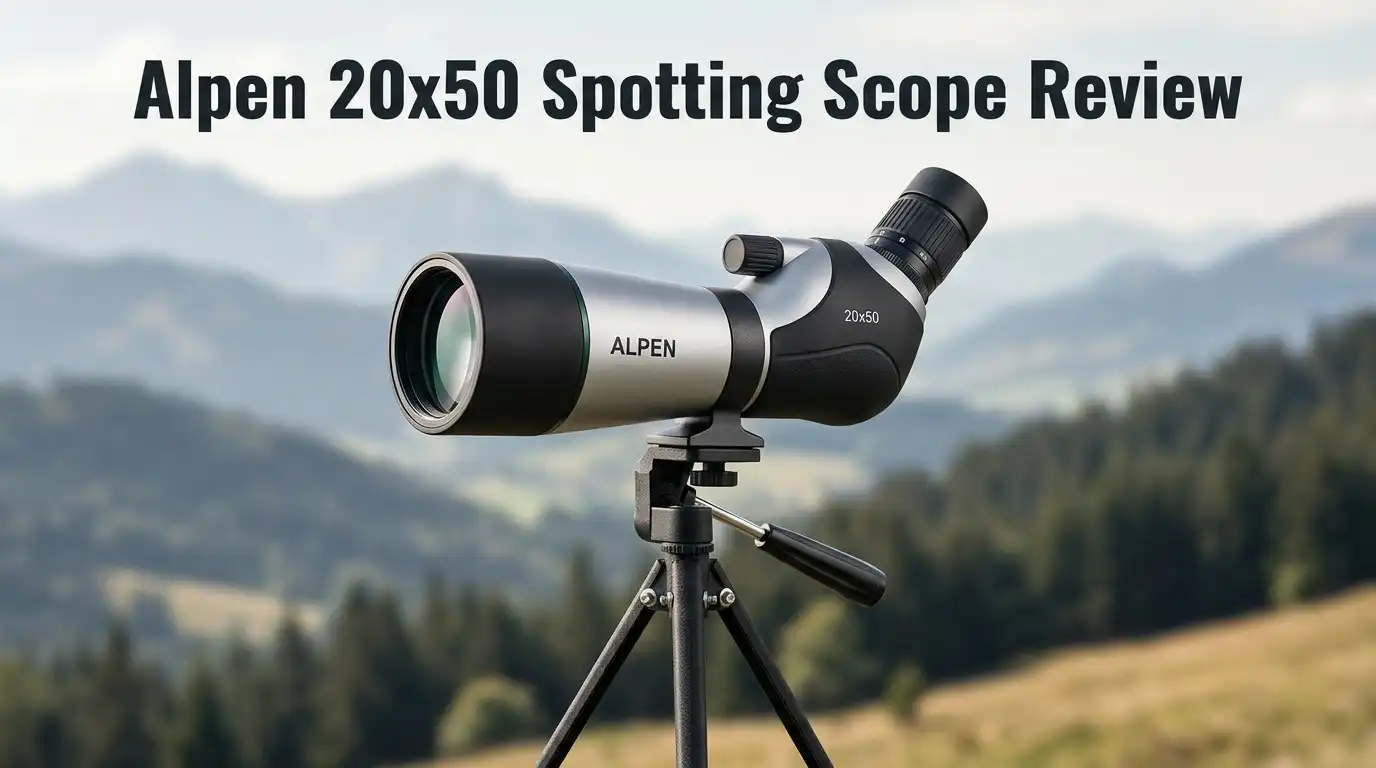
The Alpen 20×50 sits in a category most brands ignore. It is a mini spotting scope, not a monocular and not a full size birding scope. The body holds a 50mm objective lens and a fixed 20x eyepiece in a straight through porro prism layout.
Alpen finished the housing in a green rubber armor that grips well in cold hands. The nitrogen filled tube blocks moisture and dust. A retractable sunshade slides forward over the objective to cut glare from side lighting.
The focus wheel sits on top of the barrel near the eyepiece. It turns smoothly with one finger. Close focus lands around 20 feet, which is fine for hawks and steel targets but limiting for butterflies.
Amazon listings show a 3.9 star average across roughly 151 ratings. That score tells the story well. Owners love the portability. A minority complain about sharpness and the flimsy tripod. Both groups are correct.
The Unboxing Experience
The box arrives smaller than you expect. Mine measured barely longer than a paperback novel. Alpen used a plain cardboard sleeve with a product photo on the front and specifications printed on the side panel. There is nothing flashy here.
Inside you find the scope wrapped in a thin foam sleeve. A black nylon carrying case sits beside it. The tabletop tripod comes folded in its own small bag. A short instruction sheet and a lens cloth round out the contents.
First impression: this thing is tiny. Lifting it out feels like picking up a can of soda. The rubber armor feels grippy rather than tacky. The focus wheel already turns smoothly out of the box with no gritty spots.
The nylon case surprised me in a good way. It is padded, closes with a zipper, and includes a belt loop plus a shoulder strap. Many scopes twice the price ship with a soft bag that offers no protection at all.
Build Quality And Weather Sealing
Alpen built this scope to survive a pack. The rubber armor covers the entire barrel, including the section around the eyepiece. Drop it on grass or gravel and it shrugs the impact off. I would not test it on concrete.
The eyecup is a soft fold down rubber design. Eyeglass wearers can roll it back and still see most of the field. Users without glasses get comfortable eye placement with the cup extended.
The waterproofing is the strongest part of the build. Nitrogen purging stops internal condensation when you move from a warm truck into freezing air. Owners on birding forums report a decade of use with no fogging inside the tube.
The sunshade deserves a mention. It pulls out with light friction and stays where you put it. On bright mornings, it visibly lifts contrast when the sun sits low and off to one side.
The tripod mount is a standard quarter inch thread on the underside. That means any photo tripod or window clamp will hold it.
Top 3 Alternative for Alpen 20×50 Spotting Scope

- Gosky Updated Newest 20-60x80 Spotting Scope - Variable 20x to 60x magnification and dynamic lens focusing system brings better optics, more stable images and easier focusing power. It’s the best choice for target shooting, archery, hunting, bird watching, wildlife watching, hiking, camping, scenery, outdoor sporting, astronomical observation etc
- Fully multi-coated 80mm green film objective lens provides a field of view at 82.9-48ft/1000yards. The quality BAK4 Porro prism optics increases light transmission and make your view brighter, clearer and delivers crisp images
Last update on 2026-09-18 / Affiliate links / Images from Amazon Product Advertising API Some of the links on this website are affiliate links, which means that at no additional cost to you, I earn a commission if you click through and make a purchase. I only recommend products and services that I believe will add value to my readers. Thank you for your support!
Gosky Updated 20 to 60×80 HD Spotting Scope

- This birding scope features military-grade HD optical glass, a BAK4 prism, and fully multi-coated lenses—delivering sharp, bright views. Ideal for birders, hunters, and anyone seeking the best spotting scope for the money.
- Our handcrafted angled spotting scope has a non-slip armored body, molded grip, and a smooth-glide focus ring. Designed for outdoor use, it's a perfect spotter scope for shooting range or nature observation.
Last update on 2026-09-23 / Affiliate links / Images from Amazon Product Advertising API Some of the links on this website are affiliate links, which means that at no additional cost to you, I earn a commission if you click through and make a purchase. I only recommend products and services that I believe will add value to my readers. Thank you for your support!
Roxant Blackbird Compact Spotting Scope

- ULTIMA ANGLED ZOOM SPOTTING SCOPE: This versatile all-around spotting scope with a 65mm objective lens, 18-55x zoom, and a 45° viewing angle is the ideal choice for any outdoor enthusiast. It's perfect for observing nature and long-distance viewing.
- INCLUDES ESSENTIALS FOR BETTER VIEWING: The Celestron Ultima 65 comes complete with a soft carrying case, an extended tripod mounting plate, a zoom eyepiece with an integrated T-adapter for digiscoping, an eyepiece pouch, a lens cloth, and more.

Last update on 2026-09-17 / Affiliate links / Images from Amazon Product Advertising API Some of the links on this website are affiliate links, which means that at no additional cost to you, I earn a commission if you click through and make a purchase. I only recommend products and services that I believe will add value to my readers. Thank you for your support!
Celestron Ultima 18 to 55×65 Angled Spotting Scope
Optical Performance In Daylight
Daylight is where this scope earns its keep. Point it at a treeline on a clear morning and the image looks bright, flat, and easy on the eye. The 50mm objective gathers enough light for comfortable viewing from sunrise through sunset.
Center sharpness is good. I could read license plates well past 100 yards and count feather groups on a perched red tail hawk. Detail holds steady because the fixed 20x power avoids the softness that creeps into cheap zoom eyepieces at high settings.
Edge performance is where the price shows. The outer fifteen percent of the field goes soft. Straight lines near the edge bow slightly. Most users stop noticing this after a week because your eye lives in the center anyway.
Color rendering leans slightly warm. Greens look a touch muted next to a BAK4 scope. Chromatic aberration shows as a faint purple fringe on high contrast edges, such as a dark branch against white sky.
For casual glassing, none of this ruins the experience.
Low Light And Dawn Performance
Low light exposes the limits of a 50mm objective. The exit pupil works out to 2.5mm, which is small. Your eye pupil opens wider than that at dusk, so the image dims faster than it would through a 65mm or 80mm scope.
Practical translation: you lose useful viewing roughly 20 minutes before a bigger scope does. During my dusk tests, deer at 300 yards turned into gray shapes while the outline stayed visible but antler detail disappeared.
Dawn behaves better than dusk because your eyes are already adjusted to darkness and the sky brightens quickly. Early morning birding worked fine from about fifteen minutes before sunrise onward.
The BK7 prism glass contributes here too. BK7 produces slight vignetting at the edges of the exit pupil, which shows up as faint gray corners in dim conditions. BAK4 prisms avoid this.
If you glass mostly at first and last light, buy a larger scope. If you glass in daylight, this limitation will never bother you.
The Included Tabletop Tripod
Let me be blunt. The bundled tripod is the weakest item in the box. It stands about six inches tall, uses thin aluminum legs, and holds the scope with a simple thumb screw.
On a picnic table with no wind, it works. You can rest your elbows, settle in, and get a stable 20x image. The moment a breeze picks up or you bump the table, the image jumps around.
The head has no panning arm. You aim by loosening the screw, moving the scope, and tightening again. That workflow frustrates anyone tracking a moving animal.
My advice is simple. Treat the tripod as a bonus, not a tool. A basic photo tripod costing thirty dollars transforms the scope. A window mount works even better for road birding and range use.
The good news is that the scope weighs so little that almost any support holds it steady. You do not need a heavy carbon fiber setup.
Real World Uses That Suit This Scope
This scope shines in specific situations. Understanding them saves you disappointment.
Backpacking and hiking top the list. Ten ounces disappears in a pack. You carry real magnification without the weight penalty of a full size scope and heavy tripod.
Rifle range use is the second strong fit. At 100 and 200 yards, 20x resolves most centerfire holes on a white target under good light. Shooters can check groups without walking downrange.
Casual birding works well too. The wide field at 20x helps you locate birds fast, which beginners struggle with on 60x zoom scopes. Shorebirds, raptors, and waterfowl all look good.
Boat and kayak use makes sense because of the waterproofing. Spray will not hurt it.
Basic astronomy is a stretch but possible. You will see lunar craters and the four Galilean moons of Jupiter. Saturn shows as an oval rather than a ringed planet.
What The Alpen 20×50 Does Not Do Well
Honest reviews list failures, so here they are without sugar coating.
It cannot compete at long range. Twenty power is simply not enough to judge antler inches at 600 yards or score a target at 300. Serious hunters and competition shooters need 40x or more.
It struggles with fine bird identification. Separating similar sparrows or reading a gull leg band requires more magnification and better glass resolution than this scope offers.
The fixed power gives you no flexibility. You cannot zoom out for a wider search view or zoom in for a detail check.
Eye relief feels tight for eyeglass wearers. You lose noticeable field of view with glasses on.
Close focus around 20 feet rules out insect and flower viewing.
Finally, parts and service are a problem. The model is discontinued. If the focus mechanism fails, you will not find replacement parts easily.
Pros And Cons
Here is the balanced summary.
Pros
- Extremely compact at roughly 7.5 inches long and 10 ounces, so it travels anywhere without effort
- Genuine waterproof and fogproof sealing thanks to nitrogen purging and a rubber armored body
- Bright, usable daylight images with solid center sharpness at 20x magnification
- Fixed power means fast setup with no zoom ring to adjust and no image degradation at high settings
- Wide field of view makes finding and tracking subjects much easier than on high power zoom scopes
- Padded nylon case with belt loop and shoulder strap included at no extra cost
- Retractable sunshade genuinely improves contrast in side lighting conditions
- Standard quarter inch tripod thread fits any photo tripod or window mount
Cons
- The included tabletop tripod wobbles badly and offers no panning control
- BK7 prisms produce softer edges and mild gray corners compared to BAK4 glass
- Low light performance fades early because the 50mm objective yields a small exit pupil
- No zoom range, so you are locked at 20x for every situation
- Eye relief feels short for people who wear eyeglasses
- Close focus near 20 feet blocks insect and flower viewing
- Discontinued status makes new units scarce and pricing inconsistent
Alpen 20×50 Versus Modern Compact Scopes
The competitive picture changed a lot since this scope launched. Budget zoom scopes now dominate the entry level shelf.
The Roxant Blackbird gives you 12x to 36x in a compact body with BAK4 prisms. It costs about the same on the used market and offers more reach. It is bigger and heavier though, and the zoom softens noticeably at maximum power.
The Gosky 20 to 60×80 sits in a different class entirely. The 80mm objective pulls in far more light and the 60x top end resolves details the Alpen cannot touch. You pay for that with size, weight, and the need for a real tripod.
The Celestron Ultima 65 delivers better glass and an angled eyepiece that reduces neck strain during long sessions.
Where the Alpen still wins is pure portability. None of these alternatives fits in a coat pocket. If weight drives your decision, the Alpen holds its ground.
Digiscoping With Your Phone
Plenty of buyers ask about phone photography through this scope. The honest answer is mixed.
No phone adapter ships in the box. You need a universal clamp adapter, which costs around twenty dollars separately. Generic models fit the eyepiece barrel fine.
Once mounted, the fixed 20x power actually helps. You are not fighting the vignetting and dimness that plague 60x zoom eyepieces. Images come out reasonably bright.
Sharpness is the limit. Phone sensors reveal every optical flaw, so chromatic fringing and edge softness show clearly in photos. Center crops look acceptable for social media. They will not print well.
Video suffers most because the flimsy included tripod transmits every vibration. Use a proper tripod and a remote shutter or timer.
My realistic take: this setup captures documentation shots of a bird you want identified later. It is not a wildlife photography solution.
Price And Availability In 2026
This section matters more than the optics. Alpen discontinued the 20×50 model, and the Amazon listing currently shows the item as unavailable.
That leaves three buying paths. Used listings on auction sites appear regularly, usually between forty and eighty dollars depending on condition. Old retail stock occasionally surfaces at optics specialty shops. Third party Amazon sellers sometimes list units at inflated prices.
Check the warranty situation before buying used. Alpen offered a strong warranty historically, but coverage on secondhand units purchased from private sellers is unlikely.
Inspect photos carefully for lens scratches, missing eyecups, and a functioning sunshade. Ask the seller whether the tripod and case are included, because many listings omit them.
Here is my pricing advice. Pay under sixty dollars for a clean used unit with accessories. Above that figure, a new Roxant Blackbird or Emarth compact scope makes better financial sense with a fresh warranty.
Care And Maintenance Tips
Good habits keep this scope working for decades. Owners report units still performing after fifteen years.
Never wipe dry lenses with a shirt. Grit on the glass turns into permanent scratches. Blow dust off first with a bulb blower, then use a lens pen or microfiber cloth.
Store the scope with caps on and the sunshade retracted. Keeping the sunshade extended during storage stresses the sliding mechanism over time.
Avoid leaving it in a hot car for long stretches. Extreme heat can degrade the rubber armor and stress the internal seals that protect the nitrogen fill.
If the focus wheel feels stiff in cold weather, that behavior is normal. Do not force it. Warm the scope in your hands for a minute.
Dry the exterior after rain before packing it away. The scope handles water fine, but the nylon case holds moisture and can develop mildew.
Final Verdict: Should You Buy It?
The Alpen 20×50 solves one problem exceptionally well. It puts real spotting scope magnification in your pocket with almost no weight penalty.
Buy it if you hike, backpack, kayak, or travel and want optics you will actually carry. Buy it if you shoot at 100 and 200 yards and want a quick group checker. Buy it if you find a clean used unit under sixty dollars.
Skip it if you need long range detail, dusk performance, zoom flexibility, or bird identification at species level. Skip it if you want a fresh warranty and easy parts support.
My overall rating lands at 3.9 out of 5, matching the owner consensus. That score reflects a good tool with clear boundaries rather than a compromised product.
The Alpen 20×50 never tried to be a big scope. It tried to be the scope you bring along. On that measure, it still succeeds in 2026.
Frequently Asked Questions
Is the Alpen 20×50 spotting scope waterproof?
Yes. The housing is nitrogen filled and sealed, which makes it waterproof, dustproof, and fogproof. Rain and splashes will not damage it. Owners report no internal condensation even after years of use in cold and humid conditions. Dry the exterior before storing it in the nylon case.
What magnification does the Alpen 20×50 offer?
It offers a fixed 20x magnification with a 50mm objective lens. There is no zoom range. The fixed design keeps the image quality consistent and makes setup faster, but it removes the flexibility that zoom scopes provide.
Can I use the Alpen 20×50 for hunting?
It works for short and medium range scouting up to roughly 300 yards in good light. Serious western hunters judging animals at long distance need higher magnification and a bigger objective lens. Use it as a lightweight backup rather than your primary glassing tool.
Does the Alpen 20×50 come with a tripod?
Yes, a small tabletop tripod ships in the box. It is the weakest accessory in the package and wobbles in wind. A standard photo tripod or window mount improves stability dramatically and costs very little.
Is the Alpen 20×50 still available in 2026?
Alpen discontinued the model, so new units are scarce. Most available scopes come from used listings, auction sites, or leftover retail stock. Check condition carefully and expect prices between forty and eighty dollars for a complete used set.
How does it compare to a 20×50 monocular?
The Alpen offers better optical quality, a sturdier body, and a tripod mount compared to most cheap monoculars. Monoculars are smaller and cheaper. If you want handheld convenience only, a monocular works. If you want tripod mounted stability, the Alpen is the better choice.

Hello, I’m Amelia White, the founder of birdsfanatic.com. As a lifelong bird enthusiast and spiritual seeker, I’ve always been fascinated by the mystical connections between birds and the human experience. On this site, I share my knowledge and insights into the symbolic meanings and spiritual significance of various bird species, exploring their roles in mythology, folklore, and cultural traditions. Join me on this journey into the world of birds, where we’ll discover the hidden wisdom and guidance that these magnificent creatures have to offer.