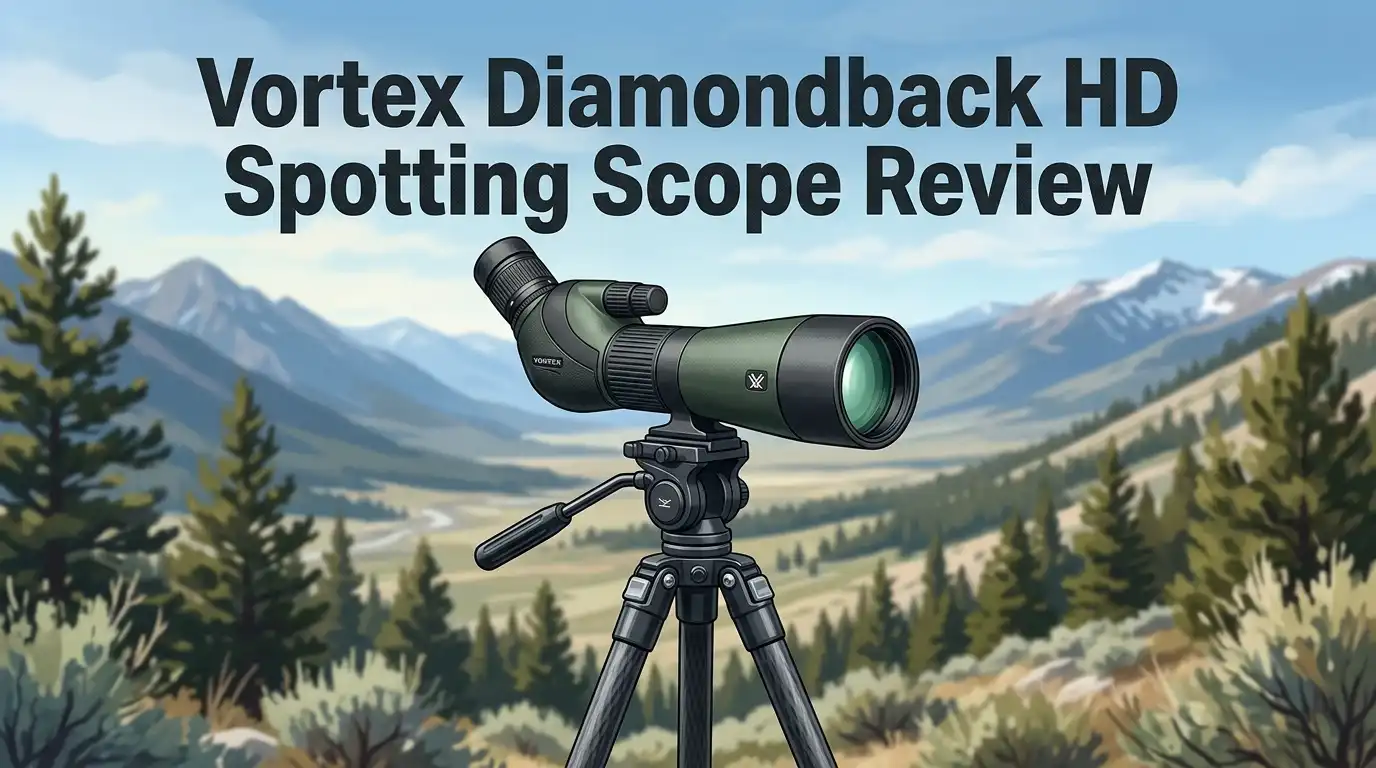
Vortex Diamondback HD Spotting Scope Review 2026: Still Worth It?
Spotting scopes confuse a lot of buyers. You see big numbers, big price tags, and big promises. The Vortex Diamondback HD sits in a tricky spot.
It costs far less than premium glass, yet it carries the same lifetime warranty as scopes that cost triple. I spent weeks glassing ridges, ranges, and backyard bird feeders with this optic.
This review covers what impressed me, what annoyed me, and who should actually buy it. No fluff. No marketing language. Just field notes from real use in 2026.
In a Nutshell:
- The Diamondback HD delivers strong value under $700. You get HD glass elements, argon purging, and Arca Swiss compatibility at a price that undercuts most rivals with similar aperture.
- Two sizes exist. The 85mm model reaches 60x and weighs 60.9 oz. The 65mm model reaches 48x and weighs 49.8 oz. Your pack weight decides which one fits your life.
- Image quality stays sharp through roughly 40x. Past that point, you will notice color fringing and dimming. This is normal physics at this price, but honest buyers should know it.
- The helical focus collar splits opinion. It feels smooth and snag free. It also forces you to grip the barrel, which shakes cheap tripods.
- Low light performance beats expectations for the money. The 85mm objective pulls in enough light for legal shooting hours, though it fades before true premium glass does.
- The warranty removes most buying risk. Vortex repairs or replaces the scope with no receipt and no registration, forever.
What Is the Vortex Diamondback HD Spotting Scope?

- The redesigned Diamondback HD spotting scope has all the optical horsepower the western hunter needs, and excels in low light. It features a streamlined exterior for a sleeker profile and a built-in helical focus wheel for fast and fine adjustments.
- HD optical system delivers exceptional resolution, cuts chromatic aberration and provides outstanding color fidelity, edge-to-edge sharpness and light transmission. Multiple anti-reflective coatings on all air-to-glass surfaces increase light transmission
Last update on 2026-09-17 / Affiliate links / Images from Amazon Product Advertising API Some of the links on this website are affiliate links, which means that at no additional cost to you, I earn a commission if you click through and make a purchase. I only recommend products and services that I believe will add value to my readers. Thank you for your support!
The Diamondback HD is Vortex’s entry level spotting scope line. Vortex redesigned it a few years back, and the update changed the product completely. The older Diamondback used an 80mm objective and a traditional focus knob. The new HD version uses an 85mm objective and a helical focus collar wrapped around the barrel.
Vortex sells the line in four versions. You pick 16x to 48x with a 65mm lens, or 20x to 60x with an 85mm lens. Each size comes in angled or straight body styles. Angled bodies suit tripod glassing and shared viewing. Straight bodies suit window mounts and quick target acquisition.
The core promise is simple. Vortex wants to give hunters usable long range glass without a four figure invoice. The HD label refers to select glass elements that reduce chromatic aberration. Vortex does not publish the exact glass formula, which is worth noting. The results speak clearly enough in the field.
Unboxing Experience: What Actually Arrives
The box arrives plain and sturdy. Vortex does not chase an Apple style presentation, and that is fine. Inside you find the scope wrapped in a fitted neoprene cover that stays on during use. The cover surprised me. It feels thick, grips well, and includes zippered openings for the objective and eyepiece.
You also get tethered lens caps on both ends and a lens cloth. That is the full accessory list. There is no tripod, no hard case, and no phone adapter in the standard Vortex packaging. Some Amazon bundles add those items, so read the listing carefully before you buy.
Lifting the 85mm model out of the box teaches you something immediately. This scope is heavy. At nearly four pounds, it feels dense and serious in your hands. The rubber armor grips your palm. The sunshade slides out with light friction. Nothing rattles. Nothing feels hollow. First impressions land well, and the build quality reads far above the price bracket.
Full Specifications Explained Simply
Numbers matter, so here they are in plain language. The 20x to 60x 85mm angled model measures 16 inches long and weighs 60.9 oz. Eye relief runs from 18.3mm to 20.3mm. Field of view spans 108 feet at low power down to 60 feet at high power, measured at 1000 yards. Close focus sits at 24.6 feet.
The 16x to 48x 65mm model measures 14.25 inches and weighs 49.8 oz. It shares the same eye relief range, which is good news for eyeglass wearers.
Both models use fully multi coated lenses, ArmorTek exterior coatings, and argon gas purging inside an O ring sealed chassis. The argon fill matters more than most buyers realize. It resists internal fogging better than nitrogen across wide temperature swings. Both bodies also accept Arca Swiss clamps directly, which saves you from buying an adapter plate. Standard quarter inch threading works too.
Top 3 Alternatives for the Vortex Diamondback HD Spotting Scope

- The Viper HD 20-60x85 Angled spotter is packed with features for incredible glassing and high end optical performance. A multi-position eyecup provides proper eye relief while a locking collar allows the scope to rotate into different viewing positions.
- The HD optical system comprised of premium components generates vivid high-definition images. XR anti-reflective coatings on exterior surfaces help obtain brighter views in low-light situations.
Last update on 2026-09-20 / Affiliate links / Images from Amazon Product Advertising API Some of the links on this website are affiliate links, which means that at no additional cost to you, I earn a commission if you click through and make a purchase. I only recommend products and services that I believe will add value to my readers. Thank you for your support!
Vortex Viper HD 20-60×85 Spotting Scope

- QUALITY ED OBJECTIVE LENS: Extra-low dispersion optical glass with special dispersion properties to dramatically reduce chromatic aberration, rendering razor-sharp images with superb color correction. Enjoy true-to-life color with enhanced resolution and contrast.
- XLT LENS COATINGS: Fully multi-coated with Celestron’s proprietary XLT optical coatings – the same coatings used on observatory-class telescopes. This coating maximizes light transmission through the optical path for brighter images. A great addition to your field gear!

Last update on 2026-09-17 / Affiliate links / Images from Amazon Product Advertising API Some of the links on this website are affiliate links, which means that at no additional cost to you, I earn a commission if you click through and make a purchase. I only recommend products and services that I believe will add value to my readers. Thank you for your support!
Celestron Regal M2 65ED Spotting Scope

- Nitrogen Purging uses the inertia gas to purge moisture out of the tube giving you better waterproofing and thermal stability
- Fully Multi-Coated lenses gives you great light transmission and bring bright images to your eyes
Last update on 2026-09-17 / Affiliate links / Images from Amazon Product Advertising API Some of the links on this website are affiliate links, which means that at no additional cost to you, I earn a commission if you click through and make a purchase. I only recommend products and services that I believe will add value to my readers. Thank you for your support!
Athlon Optics Talos 20-60×80 Spotting Scope
Optical Performance in Bright Daylight
Daylight is where this scope earns its keep. At 20x, the image looks clean, bright, and neutral in color. Edge sharpness holds well across most of the view, softening only near the outer rim. I read .30 caliber holes at 400 yards on a white target without strain. That result alone justifies the purchase for many range shooters.
Push the magnification higher and the picture changes. Around 45x, contrast starts dropping. By 60x, the image gets noticeably dimmer and purple fringing appears on high contrast edges like dark branches against sky.
This is not a defect. It is the honest limit of glass at this price. Premium ED triplet scopes hold their image to maximum power because they cost two to three times more.
My practical advice is straightforward. Treat 40x as your working ceiling and treat 60x as an emergency zoom. You will enjoy the scope far more that way.
Low Light Performance at Dawn and Dusk
Hunters buy spotting scopes for the first and last thirty minutes of legal light. The Diamondback HD handles those minutes better than I expected from a budget optic. The 85mm objective gathers serious light, and the fully multi coated lenses transmit most of it.
At 20x during morning twilight, I picked out deer shapes in shadowed timber roughly ten minutes before my 10×42 binoculars resolved the same animals. That is a meaningful advantage.
The weakness shows when you zoom in low light. Exit pupil shrinks as magnification climbs, and the image goes gray quickly past 35x in dim conditions. Keep the power low when light fades and the scope rewards you.
The 65mm model gives up ground here. Less aperture means less light. It still works, but it surrenders a few minutes at each end of the day compared to the larger body.
The Helical Focus Collar: Love It or Hate It
Vortex removed the traditional focus knob and replaced it with a collar that rings the barrel. You rotate the whole band to focus. This design has real benefits. Nothing sticks out to snag on pack straps. The body looks clean. The travel feels smooth and evenly weighted.
Now the honest downside. You must grip the scope body to focus it. That grip transmits vibration straight into your tripod. On a light travel tripod at 50x, the image wobbles for a second or two after every adjustment. On a solid tripod head, the problem mostly vanishes.
Birders often prefer knobs because they need instant focus changes on moving subjects. Target shooters rarely care, since the target never moves.
Focus throw feels a bit long too. Going from close range to infinity takes more than a quarter turn. You adapt quickly, but the first week feels slower than a knob system.
Build Quality and Weather Resistance
This is the strongest part of the package. The chassis feels overbuilt for the price. Rubber armor covers the metal body and absorbs bumps without peeling at the seams. The twist up eyecup clicks into position and holds. The sliding sunshade stays where you leave it.
Argon purging and O ring seals make the scope waterproof and fogproof. I left mine on a tripod through a two hour rainstorm and through a freezing morning that went from 20 degrees to 55 degrees. No internal fogging appeared either time. Water beaded off the ArmorTek coated objective and wiped away cleanly.
The rotating tripod collar deserves praise too. You loosen one ring and rotate the body to any angle, which helps enormously when glassing steep terrain or sharing views with a partner.
If you want a scope that survives truck beds, horse panniers, and careless friends, this one qualifies. Durability is not the compromise here.
Which Model Should You Buy: 65mm or 85mm?

- The redesigned Diamondback HD spotting scope has all the optical horsepower the western hunter needs, and excels in low light. It features a streamlined exterior for a sleeker profile and a built-in helical focus wheel for fast and fine adjustments.
- HD optical system delivers exceptional resolution, cuts chromatic aberration and provides outstanding color fidelity, edge-to-edge sharpness and light transmission. Multiple anti-reflective coatings on all air-to-glass surfaces increase light transmission
Last update on 2026-06-10 / Affiliate links / Images from Amazon Product Advertising API Some of the links on this website are affiliate links, which means that at no additional cost to you, I earn a commission if you click through and make a purchase. I only recommend products and services that I believe will add value to my readers. Thank you for your support!
Choose by how far you walk. The 85mm model wins on optical performance. More aperture means brighter images, more magnification, and better low light reach. It also weighs nearly four pounds and stretches 16 inches long. That size demands a real tripod and a real backpack.
The 65mm model weighs 49.8 oz and shortens to 14.25 inches. It slips into a daypack without dominating the space. Its wider low end field of view at 16x makes finding animals easier. For backcountry hunters counting ounces, this is the smarter tool.
Angled versus straight matters too. Angled bodies reduce neck strain during long glassing sessions and let short and tall people share one tripod height. Straight bodies point faster and work better on car window mounts.
My recommendation splits cleanly. Range shooters and truck hunters should take the 85mm angled. Hikers and mountain hunters should take the 65mm angled.
What the Diamondback HD Does Not Do Well
Every honest review needs this section. Here are the genuine weaknesses.
Maximum magnification disappoints. The top end of the zoom range exists more for the spec sheet than for daily use. Image degradation at 60x is real and visible.
Chromatic aberration shows up on high contrast subjects. Birders scanning dark wings against bright sky will see color fringing. Nature photographers will find it distracting.
Weight punishes hikers. The 85mm model is one of the heavier scopes in its class because of the aperture upgrade.
The focus collar shakes light tripods, which forces you to spend more on support gear than you planned.
Digiscoping results stay mediocre. The glass does not resolve enough fine detail for serious phone photography at high power. Casual snapshots work fine. Publication quality images do not.
No tripod or case ships in the box. Budget another $150 minimum for a tripod that actually holds this scope steady.
Pros and Cons of the Vortex Diamondback HD
Pros
- Excellent image quality from 20x through roughly 40x for the price
- Large 85mm objective gathers impressive light at dawn and dusk
- Arca Swiss compatible foot removes the need for adapter plates
- Argon purged and fully waterproof with proven field reliability
- Long eye relief between 18.3mm and 20.3mm suits eyeglass wearers
- Included neoprene cover and tethered caps add real protection
- Unlimited lifetime warranty with no receipt or registration required
- Snag free helical focus keeps the profile clean in a pack
Cons
- Image softens and dims noticeably above 45x magnification
- Visible chromatic aberration on high contrast edges
- The 85mm model weighs a hefty 60.9 oz
- Focus collar transmits shake into lightweight tripods
- No tripod, case, or phone adapter included in the box
- Vortex does not disclose the specific glass type used
- Close focus of 24.6 feet limits backyard insect viewing
Price, Warranty, and Value in 2026
The 85mm models carry a $699.99 list price, and street prices often land lower. The 65mm models sit a few hundred dollars below that. Those numbers put the Diamondback HD in direct competition with scopes that offer weaker warranties and thinner build quality.
The warranty deserves its own discussion. Vortex calls it the VIP warranty. It is unlimited, unconditional, and transferable. You do not need the receipt. You do not need to register. If you drop the scope off a cliff, Vortex repairs or replaces it. Reports from users consistently describe fast turnaround and zero argument.
That coverage changes the value math. A cheaper scope with a one year warranty becomes garbage after an accident. This one does not.
Value verdict? Strong, provided you match your expectations to the price. You are buying durable, honest, mid tier glass with excellent support. You are not buying alpha optics.
Who Should Buy It and Who Should Skip It
Buy the Diamondback HD if you shoot at a range and need to see bullet holes past 300 yards. Buy it if you hunt from trucks, blinds, or short hikes and need to judge antlers at distance. Buy it if you want your first real spotting scope and dislike spending $1500 to find out whether you enjoy the hobby.
Buy it especially if you are hard on gear. The warranty and the build make it nearly unkillable.
Skip it if you are a serious birder who studies plumage detail. Chromatic aberration will frustrate you, and a 65mm ED scope serves you better. Skip it if you count every ounce on multi day backcountry trips. Skip it if you want publication quality digiscoping images.
The honest line is this. The Diamondback HD is a working tool, not a showpiece. It performs its job well and asks a fair price.
Final Verdict
After extended field time, my conclusion is clear. The Vortex Diamondback HD earns a solid recommendation for hunters and range shooters on a working budget. Image quality through the usable magnification range looks genuinely good. Build quality feels excellent. The warranty removes the risk that usually comes with buying optics.
The scope is not perfect, and Vortex never claimed it was. High magnification performance falls short, weight runs high on the 85mm model, and the focus collar requires a stable tripod. Those flaws are predictable at this price point.
What you get is a reliable optic that shows you what you need to see, survives weather and abuse, and gets replaced free if it ever fails. For most buyers spending under $700, that combination is hard to beat.
Rating: 4.3 out of 5. Pair it with a sturdy tripod and it will serve you for many seasons.
Frequently Asked Questions
Is the Vortex Diamondback HD good for bird watching?
It works, but it is not ideal. The wide field of view at low power helps you find birds quickly. Color fringing on high contrast edges bothers dedicated birders who study fine plumage detail. For casual backyard and wetland viewing, most users stay happy.
Does the Diamondback HD come with a tripod?
No. The standard Vortex package includes only a neoprene cover, tethered lens caps, and a lens cloth. Some third party Amazon bundles add a tripod and phone adapter. Plan to spend at least $150 on quality support for the 85mm model.
What is the real usable magnification?
Roughly 40x in good light and about 30x to 35x in low light. The scope reaches 60x, but image brightness and contrast drop enough that most users settle lower. Atmospheric heat shimmer also limits high power viewing on warm days regardless of glass quality.
Is the Viper HD worth the upgrade over the Diamondback HD?
If you frequently glass at maximum power or hunt heavily in low light, yes. The Viper HD holds contrast better at high magnification and shows less color fringing. For range shooting and general hunting use, the Diamondback HD delivers most of the performance for much less money.
How does the lifetime warranty work?
Vortex calls it the VIP warranty. It is unlimited, unconditional, and fully transferable. No receipt, no registration, and no proof of purchase is required. You contact Vortex, ship the scope in, and they repair or replace it regardless of the cause of damage.
Should I choose angled or straight?
Choose angled for tripod glassing, steep terrain, and sharing with people of different heights. Choose straight for car window mounts, faster target acquisition, and scanning while standing. Angled bodies suit most hunters and observers, which is why they outsell straight versions.

Hello, I’m Amelia White, the founder of birdsfanatic.com. As a lifelong bird enthusiast and spiritual seeker, I’ve always been fascinated by the mystical connections between birds and the human experience. On this site, I share my knowledge and insights into the symbolic meanings and spiritual significance of various bird species, exploring their roles in mythology, folklore, and cultural traditions. Join me on this journey into the world of birds, where we’ll discover the hidden wisdom and guidance that these magnificent creatures have to offer.