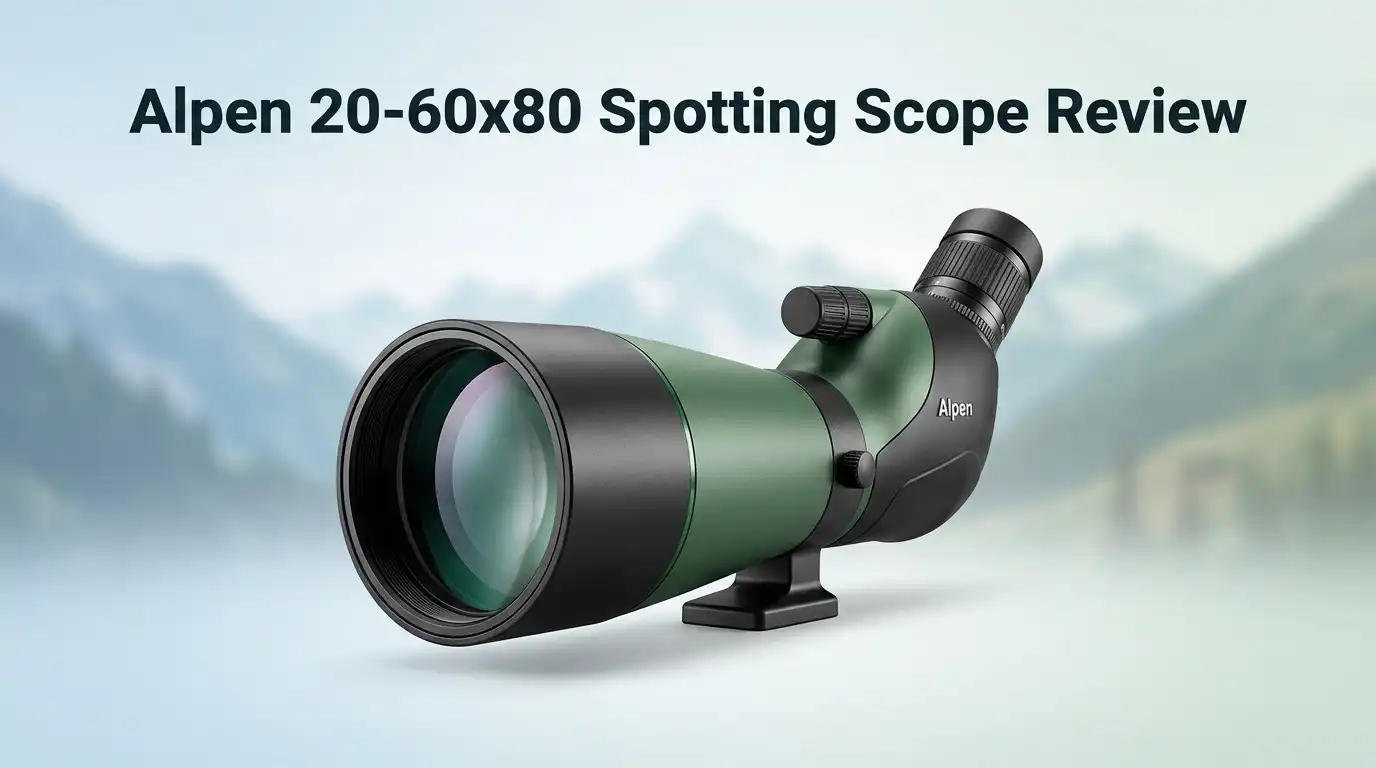
Alpen 20-60×80 Spotting Scope Review 2026: Still Worth It?
Spotting scopes promise a lot. Most of them quietly disappoint. You buy one, set it up on a cold morning, and realize the image looks like a watercolor painting left in the rain.
The Alpen 20-60×80 has been around long enough to build a reputation. Birders argue about it. Target shooters swear by it. Some people love it and some people sell it after one season.
This review covers the real experience. The unboxing, the glass, the focus wheel, the tripod, and the flaws nobody mentions in the product listing. You will get honest details, not recycled marketing copy.
In a Nutshell:
- The 80mm objective is the main selling point. It gathers far more light than a 60mm scope. Dawn and dusk viewing improves noticeably. You see detail on distant birds that smaller scopes simply cannot resolve.
- Optical quality is good, not elite. The BAK4 porro prism and fully multi coated lenses produce a bright, sharp image at low and middle power. Image quality softens above 45x, which is normal for scopes in this price bracket.
- Purple fringing is the biggest complaint. This scope has no ED glass. Bright water, snow, and white feathers against gray sky will show visible color fringing. This is the single most common criticism from long term owners.
- Build quality earns real praise. Nitrogen filled, waterproof to roughly 3.3 feet, rubber armored, and backed by a limited lifetime warranty. It survives rain, trucks, and blinds.
- The included tabletop tripod is weak. Treat it as a bonus, not a solution. Budget for a proper tripod immediately.
- Price sits near $399.99 direct from Alpen in 2026, with street prices often lower. Value depends heavily on the deal you find.
Alpen 20-60×80 Spotting Scope: The Overview

Last update on 2026-09-22 / Affiliate links / Images from Amazon Product Advertising API Some of the links on this website are affiliate links, which means that at no additional cost to you, I earn a commission if you click through and make a purchase. I only recommend products and services that I believe will add value to my readers. Thank you for your support!
The Alpen 20-60×80 carries the model number 788 in angled form and 786 in straight form. Alpen now markets it under the Shasta Ridge name. Both versions share the same optical core.
The scope uses an 80mm objective lens paired with a 20x to 60x zoom eyepiece. The prism is BAK4 porro glass. All air to glass surfaces receive full multi coating.
Field of view measures 113 feet at 1000 yards at 20x. That drops to 55 feet at 1000 yards at 60x. Eye relief runs 19mm at low power and 18mm at high power.
The body weighs 56 ounces, or 3.5 pounds. That is heavy enough to demand a serious tripod but light enough for short hikes.
Alpen includes a carrying case and a tabletop tripod. The housing is nitrogen purged and O ring sealed. The limited lifetime warranty adds real long term value for a scope at this price.
Unboxing Experience: What Arrival Feels Like
The box arrives plain. Brown cardboard, a printed label, nothing flashy. Alpen spends money on glass instead of packaging, which feels honest.
Inside, foam inserts hold the scope body firmly. The soft carrying case sits beside it. You will find a lens cloth, the tabletop tripod, and a short manual.
The first thing you notice is weight. Lifting the scope out with one hand feels reassuring. It does not feel hollow or plasticky.
The rubber armor has a slightly grippy texture. Cold hands hold it well. The eyepiece collar rotates with a firm click stop, and the sunshade slides out smoothly.
The included tripod, however, breaks the mood. It feels light and thin in the hand. You can flex the legs with almost no effort.
Mounting the scope on a real tripod takes about thirty seconds. First light through the eyepiece is genuinely impressive, especially if you are stepping up from binoculars.
Optical Performance in Bright Daylight
Daylight is where this scope looks best. Point it at a fence post 400 yards away at 20x and the image snaps into place with good contrast.
Colors look natural. Greens stay green rather than shifting yellow. The center of the field stays sharp across most of the zoom range.
At 20x to 35x, the view is genuinely enjoyable. You can read large text, count fence wires, and identify waterfowl species with confidence.
Push to 45x and the image stays usable. Detail starts thinning out, but nothing collapses.
At 60x, the picture gets noticeably softer. Contrast drops. Heat shimmer becomes your enemy on warm afternoons.
Edge sharpness falls off in the outer twenty percent of the field. This is normal for porro prism zoom scopes at this price.
Most owners settle into the 20x to 40x range for daily use. The top end exists for occasional bullet hole checking, not for extended viewing sessions.
Top 3 Alternatives for Alpen 20-60×80 Spotting Scope

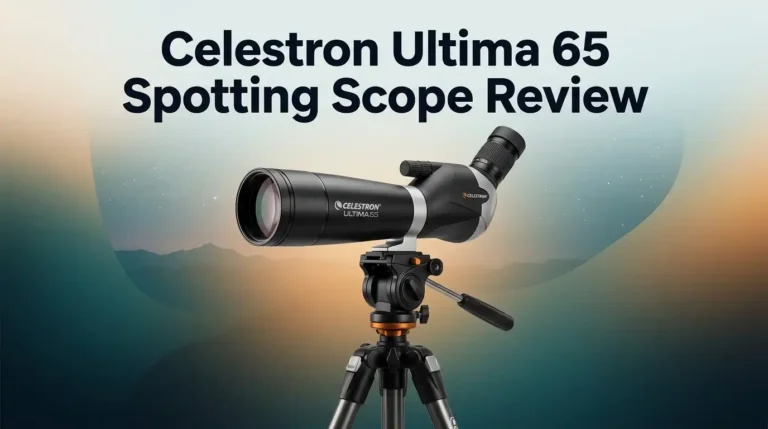
- ULTIMA ANGLED ZOOM SPOTTING SCOPE: This versatile all-around spotting scope with an 80mm objective lens, 20-60x zoom, and a 45° viewing angle is the ideal choice for any outdoor enthusiast. It's perfect for observing nature and long-distance viewing.
- INCLUDES ESSENTIALS FOR BETTER VIEWING: The Celestron Ultima 80 comes complete with a soft carrying case, an extended tripod mounting plate, a zoom eyepiece with an integrated T-adapter for digiscoping, an eyepiece pouch, a lens cloth, and more.

Last update on 2026-09-13 / Affiliate links / Images from Amazon Product Advertising API Some of the links on this website are affiliate links, which means that at no additional cost to you, I earn a commission if you click through and make a purchase. I only recommend products and services that I believe will add value to my readers. Thank you for your support!
Celestron Ultima 20-60×80 Angled Spotting Scope

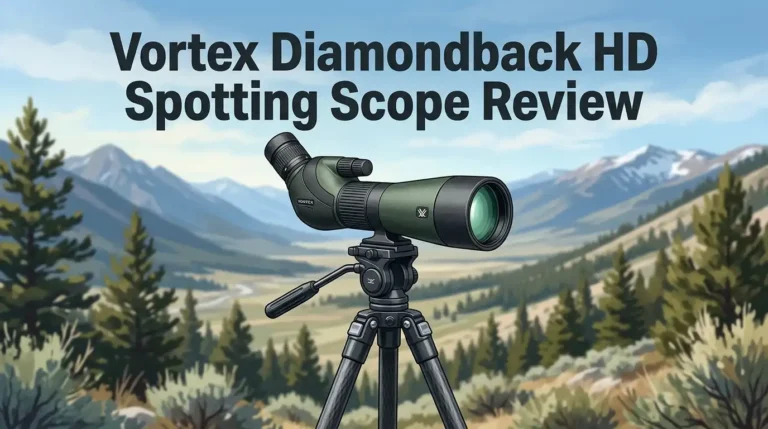
- The redesigned Diamondback HD spotting scope has all the optical horsepower the western hunter needs, and excels in low light. It features a streamlined exterior for a sleeker profile and a built-in helical focus wheel for fast and fine adjustments.
- HD optical system delivers exceptional resolution, cuts chromatic aberration and provides outstanding color fidelity, edge-to-edge sharpness and light transmission. Multiple anti-reflective coatings on all air-to-glass surfaces increase light transmission
Last update on 2026-09-17 / Affiliate links / Images from Amazon Product Advertising API Some of the links on this website are affiliate links, which means that at no additional cost to you, I earn a commission if you click through and make a purchase. I only recommend products and services that I believe will add value to my readers. Thank you for your support!
Vortex Optics Diamondback HD 20-60×85 Angled Spotting Scope

- Gosky Updated Newest 20-60x80 Spotting Scope - Variable 20x to 60x magnification and dynamic lens focusing system brings better optics, more stable images and easier focusing power. It’s the best choice for target shooting, archery, hunting, bird watching, wildlife watching, hiking, camping, scenery, outdoor sporting, astronomical observation etc
Last update on 2026-09-13 / Affiliate links / Images from Amazon Product Advertising API Some of the links on this website are affiliate links, which means that at no additional cost to you, I earn a commission if you click through and make a purchase. I only recommend products and services that I believe will add value to my readers. Thank you for your support!
Gosky Updated 20-60×80 Spotting Scope with Tripod and Phone Adapter
Low Light and Dawn Performance
The 80mm objective earns its keep at sunrise. Exit pupil measures 4mm at 20x, which matches a dilated eye well in dim conditions.
Set up thirty minutes before legal light and you can still identify shapes and movement. A 60mm scope struggles badly in that same window.
Compared side by side with a 60mm scope, the Alpen gathers roughly 78 percent more light. That difference is visible, not theoretical.
The practical limit arrives fast at high power. At 60x the exit pupil shrinks to 1.33mm, and the image dims sharply.
Low light viewing works best between 20x and 30x. Stay in that range and the scope performs above its price class.
Deep dusk viewing still shows some image noise and reduced contrast. This is a good low light scope, not a night vision replacement.
Hunters glassing final light hillsides will appreciate the extra minutes it buys them.
Build Quality and Weather Resistance
Alpen built this scope for field abuse. The housing is nitrogen filled, which blocks internal fogging when temperatures swing.
O ring seals keep water out. The rated depth is around 3.3 feet, far beyond what rain requires.
Rubber armor covers the barrel. It absorbs knocks and provides grip in wet weather.
Owners report using this scope in rain, snow, and coastal salt spray without failures. Internal fogging complaints are rare, which speaks well of the sealing.
The extendable sunshade slides out and holds position. It cuts flare when the sun sits low and off axis.
The tripod collar rotates smoothly and locks firmly. You can shift the eyepiece angle without moving the tripod head.
The limited lifetime warranty matters here. Alpen has supported repairs and replacements for years, which lowers the risk of buying a non premium optic.
The finish scuffs over time, but nothing structural loosens.
Focus System and Everyday Handling
The Alpen uses a top mounted single speed focus knob. Your finger falls on it naturally while your eye stays at the eyepiece.
The knob turns with moderate resistance. It feels damped rather than gritty.
Single speed focus has one drawback. Fine focusing at 60x requires a delicate touch, since small movements produce large changes.
A dual speed focuser would help at high magnification, but very few scopes under $500 offer one.
The zoom ring sits on the eyepiece. It rotates with slightly more friction than the focus knob, which prevents accidental changes.
Close focus is around 24 feet at 20x. Butterfly watchers and backyard users may find that limiting.
The twist up eyecup adjusts in firm steps. It holds position under pressure.
Overall handling feels straightforward. New users figure out the controls in a few minutes without reading the manual.
Eye Relief and Comfort for Eyeglass Wearers
Alpen lists eye relief at 19mm at 20x and 18mm at 60x. On paper, that sounds friendly to eyeglass wearers.
Real world results are mixed. Several owners describe high power eye relief as tight.
With glasses on and the eyecup twisted down, you can see most of the field at 20x. Some blackout occurs at the edges.
At 50x and above, holding the full field with glasses becomes harder. You will find yourself hunting for the sweet spot.
Without glasses, comfort improves significantly. Twist the eyecup up and your eye settles naturally.
Long viewing sessions can cause some eye fatigue. Taking short breaks helps.
Contact lens wearers will have the easiest time with this scope. Eyeglass wearers with strong prescriptions should test before committing.
The eyecup itself is well made and does not collapse under pressure.
Chromatic Aberration: The Honest Weakness
This section deserves full honesty. The Alpen 20-60×80 does not use ED glass.
Chromatic aberration shows up as purple or violet fringing on high contrast edges. You will see it on dark branches against bright sky.
Water is the worst trigger. Bright, overcast water behind a duck produces heavy purple edges that some owners find genuinely distracting.
One long term owner on a major birding forum described the fringing as annoying enough to retire the scope after buying an ED alternative.
Fringing worsens as magnification increases. At 20x it is mild. At 60x it becomes obvious.
Center field fringing is less severe than edge fringing. Keeping your target centered reduces the effect.
If you regularly glass waterbirds on gray days, this flaw will bother you. If you glass deer on brown hillsides or check targets at the range, you may barely notice it.
Birding Performance in the Field
Birders form the toughest audience for any spotting scope. Their standards are high because identification depends on fine detail.
The Alpen performs well for shorebird scanning at moderate power. Leg color, bill shape, and wing bars show clearly at 25x to 35x.
Raptor watching at distance works fine. You can separate a red tailed hawk from a rough legged hawk at several hundred yards.
The wide 113 foot field at 20x helps you find birds quickly. Locating a moving target is easier with this scope than with narrow field designs.
Problems appear with backlit subjects. Purple fringing softens the edge detail birders rely on.
Close focus at 24 feet rules out nearby feeder watching.
This scope suits general birders and casual listers well. Serious competitive birders chasing rarities will eventually want ED or HD glass.
Hunting and Target Shooting Use
Hunters get excellent value from this scope. Field conditions favor its strengths and hide its weaknesses.
Glassing hillsides for game animals happens mostly at 20x to 30x. Image quality shines in that range.
The 80mm objective helps during the legal shooting light windows at dawn and dusk. You gain useful minutes at both ends of the day.
Waterproofing handles rain, snow, and truck bed travel without complaint. Durability is a genuine strength here.
Target shooters use the top end more. You can spot .30 caliber holes at 200 yards under good conditions.
At 300 yards and beyond, .22 caliber holes get difficult. Mirage often becomes the limiting factor rather than the glass.
The angled 45 degree eyepiece works well from a prone or bench position. Straight body fans can choose the 786 model instead.
Weight of 3.5 pounds suits truck hunting better than long backcountry packing.
Digiscoping with a Smartphone
Phone photography through a spotting scope has become standard practice. The Alpen handles it adequately.
You will need a separate phone adapter, since Alpen does not include one. Universal clamp style adapters fit the eyepiece.
Results at 20x to 25x look respectable. Images come out bright with usable detail for identification records.
Push the magnification higher and image quality degrades quickly. Vignetting increases and sharpness drops.
Purple fringing becomes more obvious in photos than through the eyepiece. Editing software can reduce it partially.
Stability matters enormously. The included tabletop tripod produces shaky images and wasted shots.
A sturdy tripod with a fluid head transforms digiscoping results. This upgrade costs money but changes everything.
Video recording works at low power. Expect casual documentation quality, not publishable wildlife photography.
The Included Tripod: Manage Your Expectations
This part needs plain speaking. The included tabletop tripod is the weakest item in the box.
It is light, short, and flexible. Owners have complained about plastic construction for years.
Placing a 3.5 pound scope on it creates visible vibration. Every touch of the focus knob shakes the image.
The tripod works for occasional bench use on a solid table. It does not work for field glassing.
A proper aluminum or carbon fiber tripod with a fluid pan head solves the problem completely. Budget somewhere between $100 and $250.
Image quality appears to improve dramatically after this upgrade. In reality, you are simply seeing what the glass could always do.
Treat the included tripod as a free extra, not a feature. Factor a real tripod into your total purchase cost from the beginning.
Window mounts also work well for vehicle based viewing.
Alpen 20-60×80 vs Celestron Ultima 80
These two scopes compete directly. Both use 80mm objectives and 20x to 60x zoom eyepieces.
The Celestron Ultima 80 typically sells for less, often near $269.99. The Alpen lists higher at $399.99, though street prices vary.
Optically, the two sit close at low power. Both produce bright, pleasing images at 20x to 30x.
The Celestron is lighter, at around 3.7 pounds including its case, and slightly more compact.
Owners who have used both often prefer the Alpen body and warranty. The Alpen feels more solid in hand.
Celestron includes a soft case but also a basic tripod experience.
Neither scope uses ED glass in the standard version. Both show purple fringing under harsh contrast.
Choose the Celestron for budget and portability. Choose the Alpen for build quality and the limited lifetime warranty.
Step up to the Vortex Diamondback HD for genuinely better glass at a higher price.
Pros and Cons of the Alpen 20-60×80
Here is the balanced summary based on specifications and owner feedback.
Pros
- Large 80mm objective gathers substantially more light than 60mm competitors, which improves dawn and dusk viewing
- Fully multi coated optics with BAK4 porro prisms deliver bright, contrasty images through the low and middle zoom range
- Waterproof and nitrogen filled housing resists rain, fog, and temperature swings reliably
- Wide 113 foot field of view at 20x makes finding and tracking subjects easy
- Limited lifetime warranty from Alpen reduces long term ownership risk
- Rubber armored body provides grip and impact protection in rough field conditions
- Angled 45 degree eyepiece stays comfortable during long sessions and shared viewing
- Extendable sunshade cuts glare when the sun sits low
Cons
- Noticeable purple fringing on high contrast edges because the scope lacks ED glass
- Image softens above 45x, limiting the practical usefulness of the top magnification
- Included tabletop tripod is too flimsy for serious field use
- Eye relief feels tight at high power for many eyeglass wearers
- Close focus of 24 feet blocks nearby subject viewing
- Weight of 3.5 pounds makes long distance backpacking less comfortable
- Single speed focus requires patience at maximum magnification
Price, Value, and Who Should Buy It
Alpen lists the Shasta Ridge 20-60×80 at $399.99 in 2026. Retailers frequently discount it, and used examples appear regularly.
At full price, competition gets tough. The Vortex Diamondback HD 20-60×85 offers better glass for a modest premium.
At a discounted price near $250 or below, this scope becomes a strong buy. Few 80mm scopes match its build quality at that level.
You should buy it if you hunt, shoot at a range, or watch wildlife casually in mixed conditions.
You should also buy it if durability and warranty support rank high on your list.
You should skip it if you photograph birds seriously or glass bright water frequently.
Beginners get the most satisfaction from this scope. It teaches you what you want from your next one.
Experienced birders with ED glass experience will find the fringing hard to ignore.
Final Verdict: Should You Buy It in 2026?
Last update on 2026-09-22 / Affiliate links / Images from Amazon Product Advertising API Some of the links on this website are affiliate links, which means that at no additional cost to you, I earn a commission if you click through and make a purchase. I only recommend products and services that I believe will add value to my readers. Thank you for your support!
The Alpen 20-60×80 remains a solid working scope in 2026. It is not a premium optic and it never pretended to be.
Its strengths are real. Bright low light performance, tough weatherproof construction, a comfortable angled eyepiece, and a warranty that outlasts most competitors.
Its weakness is equally real. Purple fringing on high contrast subjects will frustrate detail oriented viewers.
The scope rewards moderate magnification and punishes maximum magnification. Learn that lesson early and you will enjoy it far more.
Pair it with a quality tripod. That single upgrade matters more than any other accessory decision.
For hunters, range shooters, and general nature watchers, this scope delivers honest performance for the money.
Serious birders should save longer and buy ED glass instead. The difference in fringing control is significant.
Buy it on sale, mount it properly, and it will serve you for many seasons.
Frequently Asked Questions
Is the Alpen 20-60×80 good for bird watching?
Yes, for general birding. Identification at moderate power works well thanks to the bright 80mm objective and wide field of view. Purple fringing on backlit subjects is the main limitation, and dedicated birders often prefer ED glass models.
What is the difference between the Alpen 786 and 788?
The 786 is the straight body version and the 788 is the 45 degree angled version. Both share identical optics, coatings, and build quality. Angled models suit tripod sharing and upward viewing, while straight models suit vehicle window mounts.
Does the Alpen 20-60×80 have ED glass?
No. The standard Shasta Ridge 20-60×80 uses BAK4 porro prisms with fully multi coated lenses but no extra low dispersion glass. Alpen offers ED glass in its higher tier Apex XP line.
Can you see bullet holes at 300 yards?
You can see .30 caliber holes at 300 yards under good light and low mirage conditions. Smaller .22 caliber holes become difficult at that distance. Mirage usually limits performance more than the optics do.
Is the included tripod usable?
Only for casual tabletop viewing. The tabletop tripod flexes under the 3.5 pound scope and transmits vibration. A full size tripod with a fluid pan head is strongly recommended for field use.
How heavy is the Alpen 20-60×80?
The scope body weighs 56 ounces, or roughly 3.5 pounds. That weight suits vehicle based and short hike use. Long backcountry trips favor lighter 65mm scopes.
Is it waterproof in heavy rain?
Yes. The housing is nitrogen filled and O ring sealed to roughly 3.3 feet of water. Heavy rain, snow, and humidity pose no risk to internal optics.
What warranty does Alpen offer?
Alpen provides a limited lifetime warranty on this scope. That coverage adds meaningful long term value and remains one of the strongest reasons to choose Alpen over similarly priced competitors.

Hello, I’m Amelia White, the founder of birdsfanatic.com. As a lifelong bird enthusiast and spiritual seeker, I’ve always been fascinated by the mystical connections between birds and the human experience. On this site, I share my knowledge and insights into the symbolic meanings and spiritual significance of various bird species, exploring their roles in mythology, folklore, and cultural traditions. Join me on this journey into the world of birds, where we’ll discover the hidden wisdom and guidance that these magnificent creatures have to offer.