Why Should Bird Houses Not Contain Perches?
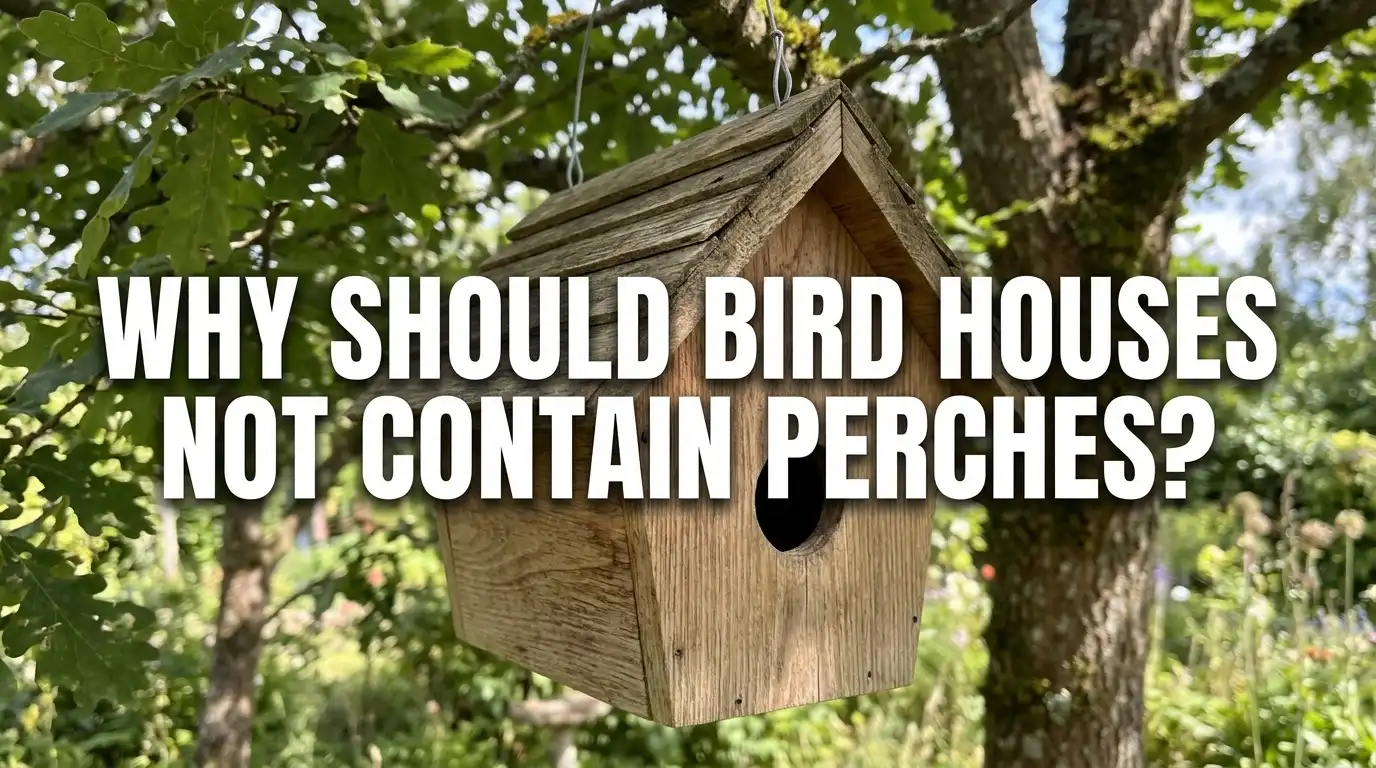
That little wooden dowel sticking out below the entrance hole looks charming. It makes a birdhouse look like a birdhouse. It also happens to be one of the most harmful design features you can hang in your yard.
Cavity nesting birds never asked for a perch. They cling, they grip, they slip straight inside a hole in a tree trunk. Nothing in their biology needs a landing stick. Predators and aggressive competitors, on the other hand, love that stick very much.
If you already own a birdhouse with a perch, you have not ruined anything. You can fix it in about ten minutes with tools you probably already own. This guide walks you through why perches cause trouble, how to remove them safely, and what to add instead so your nest box actually protects the family living inside.
Key Takeaways
- Cavity nesting birds do not use perches. Bluebirds, chickadees, wrens, titmice, nuthatches, and swallows all nest inside tree holes in the wild. They land directly on the entrance hole edge and pull themselves in. A perch adds zero benefit to the species you want to attract.
- A perch is a handle for predators. Raccoons, cats, snakes, squirrels, and chipmunks gain a stable grip they would not otherwise have. It lets a raccoon steady itself while reaching an arm inside, and it gives a climbing snake a resting point right at the door.
- House Sparrows and European Starlings benefit most. These non native species perch outside a box for long periods, harass the residents, and drive them off. Native cavity nesters rarely linger outside the hole, so the perch mostly serves the birds you least want.
- Removal is simple and reversible. Unscrew it, cut it flush, or snap it off with pliers, then sand the stub smooth. Never leave a rough stub or a protruding screw that could injure an adult bird’s chest or wing.
- Replace the perch with real protection. A correctly sized entrance hole, a pole mounted box, a stovepipe or cone baffle, and a sloped overhanging roof do far more for nest survival than any decorative feature.
- Good boxes share a checklist. Untreated wood, walls at least three quarters of an inch thick, ventilation holes, drainage holes, a hinged side for cleaning, rough interior walls, and no outside perch.
What a Perch Actually Does on a Birdhouse
A perch is a small dowel, peg, or ledge fixed just below the entrance hole. Manufacturers add it because shoppers expect it. It sells birdhouses. It does not help birds.
Think about what a perch provides. It offers a stable place to stand and a place to grip. Now ask which animal in your yard benefits from standing outside a nest box for a long stretch of time.
It is never the nesting pair. Parent birds want to enter fast and leave fast. Every extra second spent outside the hole advertises the nest location to anything watching.
The perch instead becomes a small platform for whatever wants to investigate. A birdhouse should be difficult to loiter on. Smooth, featureless walls around the entrance are a safety feature, not an oversight.
Wildlife organizations that publish nest box plans, including major bird conservation programs, list “no outside perches” as a standard requirement. That advice is not aesthetic preference. It comes from decades of nest monitoring data.
The Real Reason Birds Do Not Need a Perch
Every bird that uses a nest box is a cavity nester. In nature these birds raise young inside woodpecker holes, rotted knots, hollow limbs, and split trunks. None of those cavities come with a stick attached.
Their bodies are built for this. Cavity nesters have strong feet and sharp claws that grip bark and raw wood edges without effort. Chickadees and nuthatches can hang upside down on a twig, so a flat hole rim is easy for them.
Watch a bluebird approach a box. It flies in, catches the lip of the hole with its feet, and slides inside in one motion. The whole movement takes less than a second.
Woodpeckers, wrens, and swallows do the same thing. Tree Swallows often shoot straight through the hole without pausing at all.
A perch does not speed this up. It simply sits there, unused by the tenant, while making the front of the box more accessible to everything else. Removing it costs the birds nothing.
How Perches Give Predators a Better Grip
This is the core safety problem. Nest boxes are more exposed than natural cavities. A hollow limb is hidden and hard to reach, while a mounted box sits in the open where every animal in the neighborhood can see it.
Raccoons are the biggest threat in most yards. A raccoon needs leverage to reach an arm through an entrance hole. A perch gives it a foot brace directly under the opening. Without one, the raccoon must balance awkwardly on a sloped roof or a narrow front panel.
Cats jump to the top of boxes and reach down. A perch offers a second contact point that steadies the swipe.
Snakes climb poles and tree trunks with ease. A dowel gives a rat snake or racer a place to coil and push upward into the hole.
Squirrels and chipmunks use perches to sit and chew, and chewing enlarges the entrance hole. Once the hole widens, larger predators can enter completely.
Pros of keeping a perch: it looks traditional and it makes photography easier. Cons: it raises predation risk, encourages hole chewing, and invites nest takeovers. The cons win by a wide margin.
How House Sparrows and Starlings Exploit Perches
House Sparrows and European Starlings are introduced species in North America and are not protected. They are also serious threats to native cavity nesters. Sparrows will kill adult bluebirds inside a box and build a nest on top of the bodies.
Both species behave differently from native birds outside a nest box. They perch, sing, and guard. A male House Sparrow will sit at a cavity entrance for long stretches, claiming it and driving other birds away.
That behavior needs a place to stand. A perch supplies exactly that. Native birds, who enter and exit quickly, gain nothing from the same feature.
Experienced bluebird trail monitors treat perches as an unfair advantage handed to sparrows. Where House Sparrows are common, a perched box is often the first box lost.
Removing the perch will not eliminate sparrow pressure on its own. It does remove one small edge you were giving them for free. Combine it with a correctly sized hole and active monitoring for the best result.
Step by Step: Removing a Perch From an Existing Birdhouse
Do this outside the nesting season, ideally in late fall or winter, so you never disturb an active nest. Check the box first and make sure it is empty.
Step one: Take the box down or work with it steady on a bench. Loose boxes wobble and cause slips.
Step two: Identify the attachment. Look for a screw head on the inside of the front panel, or a glued dowel pushed into a drilled hole.
Step three: If a screw holds it, unscrew from the inside and pull the dowel free. This is the cleanest method.
Step four: If it is glued, grip it with pliers and twist while pulling. Many dowels break loose with steady pressure.
Step five: If it will not budge, cut it flush with a fine tooth saw or a flush cut saw. Multi tools with a cutting blade also work well.
Step six: Sand the remaining stub and the hole rim smooth with medium then fine sandpaper. Rough splinters can injure a bird’s breast feathers.
Step seven: Fill any leftover hole with untreated wood filler or a wooden plug, then sand again. Skip paint and sealants near the entrance.
What to Do When the Perch Is Part of the Front Panel
Some birdhouses have a molded ledge, a small porch, or a decorative shelf built into the front board. You cannot simply unscrew these. You have three practical options.
Option one: cut the ledge away. Use a saw or oscillating tool and trim it flush with the front face. Sand smooth afterward.
Pros: keeps the original box and costs nothing. Cons: takes tools and patience, and cuts can look rough on painted boxes.
Option two: replace the front panel. Cut a new board from untreated pine or cedar, drill the correct hole size, and screw it on.
Pros: you get a fresh, correctly sized entrance and a clean face. Cons: requires basic woodworking and a drill bit or hole saw in the right diameter.
Option três… option three: retire the box to decoration. Hang it on a shed wall or a fence as garden art and seal the entrance hole shut.
Pros: no tools, no waste, and no risk to birds. Cons: you lose a nesting site and need a replacement box.
Choose based on your comfort with tools. Any of the three is better than leaving the ledge in place.
Check for Other Footholds You Might Have Missed
The perch is the obvious offender, but boxes often hide other handholds. Walk around each birdhouse and look at it the way a raccoon would.
Look for decorative trim, shutters, tiny fences, chimneys, and mounting brackets near the entrance. Anything that offers grip within reach of the hole works like a perch. Remove or relocate it.
Check the roof overhang. A roof that extends two to four inches past the front makes reaching down into the hole much harder. Short or flat roofs make it easy.
Look at protruding screws, nail heads, and rough butt joints on the front panel. Sand or countersink them.
Check the hole rim itself. If squirrels have chewed it wider, fit a metal hole reducer plate over the entrance. A widened hole undoes all your other precautions.
Finally, look at what surrounds the box. Overhanging branches, nearby fence rails, trellises, and brush piles all give predators a launch point.
Pick the Right Entrance Hole Size Instead
Hole size is your strongest defense, and it costs nothing to get right. The entrance controls exactly who can enter, which no perch ever will.
For Eastern Bluebirds, use a hole of 1.5 inches. Western and Mountain Bluebirds need 1 and 9/16 inches. Chickadees do well with 1 and 1/8 inches, and House Wrens with about 1 inch to 1.25 inches.
Tufted Titmice and White breasted Nuthatches take roughly 1.25 to 1.5 inches. Tree Swallows use 1 and 3/8 to 1.5 inches.
Two numbers matter most. European Starlings cannot fit through anything smaller than 1 and 9/16 inches. House Sparrows cannot fit through anything smaller than 1.25 inches.
Pros of a small hole: it excludes intruders automatically and needs no maintenance. Cons: a hole under 1.25 inches also excludes bluebirds, so match the size to your target species rather than shrinking everything.
Drill cleanly and sand the rim. A ragged hole snags feathers.
Add Predator Guards That Actually Work
Once the perch is gone, add real protection. Three guard types have long track records with nest box monitors.
Cone baffle. A metal cone roughly three feet in diameter mounted on the pole below the box.
Pros: simple, cheap to build, and effective against raccoons and cats. Cons: wind can rattle it, and very large snakes occasionally get past.
Stovepipe baffle. A metal cylinder about eight inches wide and 24 to 36 inches long, hung loosely under the box.
Pros: widely considered the most effective option against climbing mammals and snakes. Cons: bulkier to build and slightly more expensive.
Noel guard. A wire mesh tunnel attached over the entrance, extending outward about five inches.
Pros: blocks reaching arms and works on boxes mounted to trees. Cons: it should be paired with a pole baffle, and a few birds hesitate at first.
Install baffles before nesting season begins. Adding one mid season can cause a pair to abandon the nest.
Mount the Box on a Smooth Metal Pole
Where you put the box matters as much as how you build it. A perfect nest box on a tree trunk is still an easy climb for a raccoon.
Use a smooth metal pole, such as electrical conduit or a galvanized pipe. Smooth metal is hard to climb and pairs perfectly with a baffle. Wooden posts and fence rails give claws something to grip.
Keep the box away from overhanging branches. Cats and squirrels jump surprising distances, so leave at least eight to ten feet of clear space around and above the box.
Mount at the height your target species prefers. Bluebirds accept four to six feet. Chickadees and wrens like five to ten feet.
Face the entrance away from prevailing wind and driving rain. In much of North America that means facing east or northeast.
Avoid mounting near bird feeders. Heavy feeder traffic attracts sparrows and stresses nesting pairs.
Improve the Inside So Fledglings Can Climb Out
People sometimes add a perch because they worry the young birds cannot get out. That worry is real, but the solution belongs inside the box, not outside.
Roughen the interior front wall below the entrance hole. Coarse sandpaper does the job on smooth boards. Rough wood gives tiny claws something to grip.
Better yet, cut a series of shallow horizontal grooves like a small ladder. Swallows especially need this help, and bluebirds use it too.
For deep boxes such as duck boxes, staple a strip of quarter inch hardware cloth from the floor to the entrance. Make sure no sharp wire ends stick out.
Pros of interior grooves: they solve the exit problem without helping predators at all. Cons: they take a few extra minutes during construction, and they wear smooth over many seasons, so check them each year.
This single change replaces every supposed benefit a perch was meant to provide.
Decorative Birdhouses With Perches: Safe Choices
Maybe you own a painted cottage birdhouse from a craft fair, or one a family member made years ago. You do not have to throw it away.
Option one: modify it. Remove the perch, verify the hole size, drill drainage and ventilation holes, and add a hinged side for cleaning.
Pros: keeps something sentimental in service. Cons: many decorative boxes have thin walls that overheat in sun.
Option two: display it indoors or under cover. Put it on a porch shelf or a potting bench where no bird can nest in it.
Pros: zero risk and it still looks lovely. Cons: it stops being habitat.
Option three: seal the entrance and hang it as yard art. Glue a wooden disc over the hole.
Pros: fast and permanent. Cons: some birds may still probe at it in spring.
Never leave a poor quality box open and unmonitored. An unsafe box in the yard is worse than no box, because it draws a pair away from safer sites.
Build a Simple Seasonal Maintenance Routine
A safe birdhouse stays safe only with a little attention. The routine takes about fifteen minutes per box across a whole year.
Late winter: Open the box, remove old nesting material, and scrape the interior. Rinse with plain water or a very weak bleach solution, then dry fully in sun. Check the hole rim, hinges, and baffle.
Early spring: Confirm the perch is gone, the drainage holes are clear, and the roof still overhangs the front.
Nesting season: Check the box about once a week for a minute or two, midmorning, in fair weather. Never open a box after young are about twelve or thirteen days old, because they may fledge too early.
Late summer: Clean out finished nests so a second brood can start fresh.
Fall: Tighten screws, sand any splinters, and reapply nothing to the interior.
Keeping simple notes on which species used which box helps you fine tune placement next year.
Frequently Asked Questions
Do any birds actually use a perch on a birdhouse?
Native cavity nesters do not need one. House Sparrows and European Starlings use them often, which is exactly the problem. If you want to give birds somewhere to rest in your yard, plant a shrub or leave a bare branch several feet away from the box instead.
Will removing the perch make birds avoid my birdhouse?
No. Birds choose a box based on cavity size, hole diameter, location, height, and safety. A missing perch has never been shown to reduce occupancy. Many monitors report better success after removal because fewer intruders bother the box.
Can I just leave the perch if I add a predator guard?
You can, but you are keeping an unnecessary risk. Guards are not perfect, and a perch quietly makes every attempt easier. Removal takes ten minutes and improves the odds for free, so there is little reason to keep it.
What if a perch is already glued in and I have no saw?
Try pliers and steady twisting first, since many dowels break loose. If that fails, a sharp utility knife can score and snap a thin dowel. Sand the stub flat afterward and check that no sharp edge remains near the entrance.
Is a small landing ledge under the hole different from a perch?
It is the same problem in a different shape. Any surface that lets an animal stand or brace near the entrance works against the nest. Keep the front of the box flat and featureless below the hole.
When is the best time to remove a perch?
Late fall or winter, when boxes are empty. If you discover a perch during nesting season, wait until the young fledge and the nest is finished. Disturbing an active nest causes more harm than the perch will in a single season.
A birdhouse is not decoration first and shelter second. Take the stick off, size the hole right, mount it on a smooth pole, and add a baffle. Those four steps turn a pretty box into a place where a family of birds actually survives the summer.

Hello, I’m Amelia White, the founder of birdsfanatic.com. As a lifelong bird enthusiast and spiritual seeker, I’ve always been fascinated by the mystical connections between birds and the human experience. On this site, I share my knowledge and insights into the symbolic meanings and spiritual significance of various bird species, exploring their roles in mythology, folklore, and cultural traditions. Join me on this journey into the world of birds, where we’ll discover the hidden wisdom and guidance that these magnificent creatures have to offer.


