
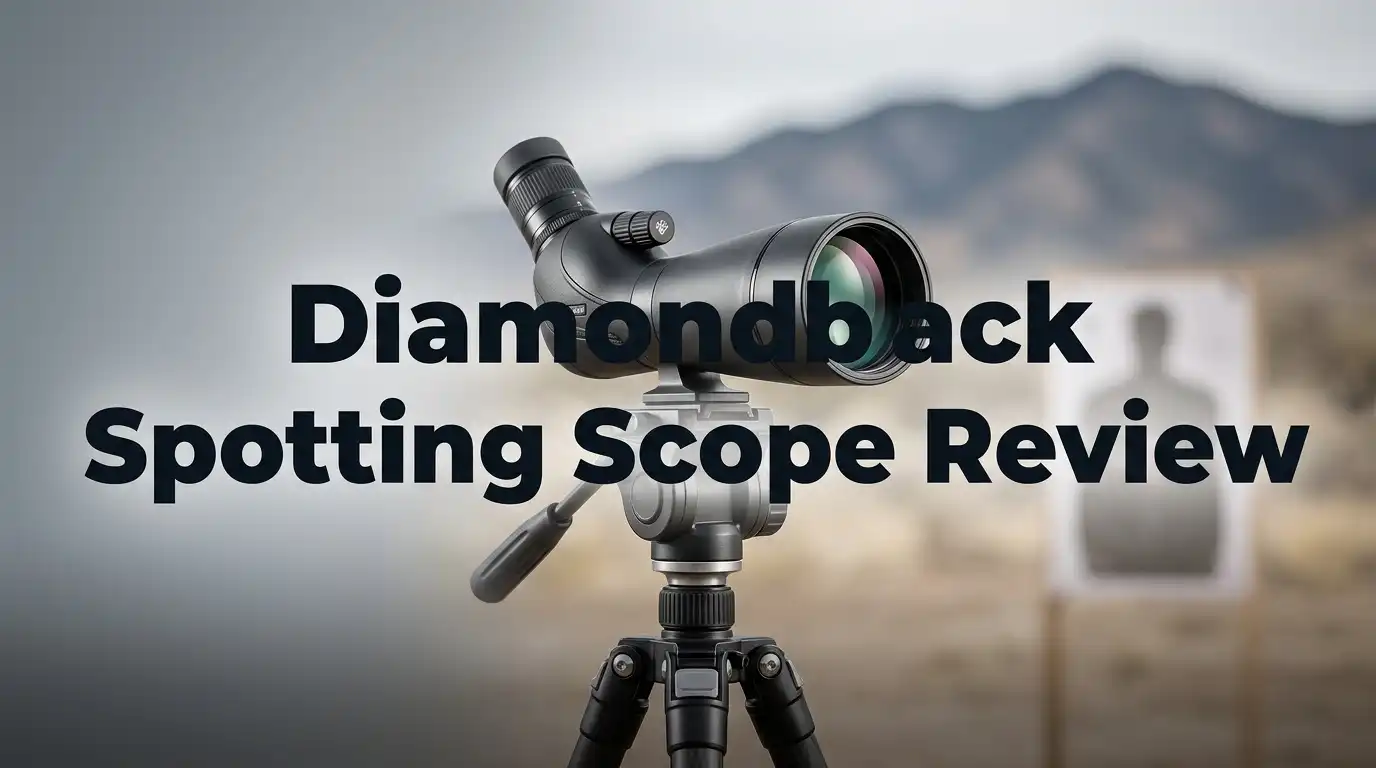
Diamondback Spotting Scope Review 2026: Still Worth It?
Buying a spotting scope feels like a big decision. You want sharp glass, a body that survives bad weather, and a price that does not wreck your budget. The Vortex Diamondback HD sits right in that sweet spot, and it has become one of the most recommended entry level spotters on the market.
I spent months glassing ridgelines, watching shorebirds, and checking bullet holes at 300 yards with this scope. This review covers what the Diamondback HD does well, where it falls short, and who should skip it entirely. No marketing fluff. Just field notes, honest flaws, and clear answers.
In a Nutshell:
- The Diamondback HD is a value buy, not a glass champion. You get genuinely good daylight images for the money, but the top end of the zoom range softens noticeably. Expect strong performance from 20x to about 40x, then a visible drop.
- The 85mm model weighs 60.9 ounces. That is almost four pounds. It is not a backpack hunting scope. The smaller 65mm version weighs 49.8 ounces and packs much better for long hikes.
- The helical focus collar divides people. Some users love the snag free design. Others find it slower than a traditional knob, especially birders tracking fast moving subjects.
- Chromatic aberration shows up at high power. You will see purple or green fringing on high contrast edges. This is normal for spotters under $1,000, but it still matters if you digiscope.
- The Vortex VIP warranty is the quiet hero here. Unlimited, unconditional, and transferable. Break it, flood it, drop it off a cliff, and Vortex fixes or replaces it.
- Best fit: target shooters, casual hunters, backyard wildlife watchers, and first time spotting scope buyers who want reliable gear without spending four figures.
Vortex Diamondback HD 20 to 60×85 Angled Spotting Scope

- The redesigned Diamondback HD spotting scope has all the optical horsepower the western hunter needs, and excels in low light. It features a streamlined exterior for a sleeker profile and a built-in helical focus wheel for fast and fine adjustments.
- HD optical system delivers exceptional resolution, cuts chromatic aberration and provides outstanding color fidelity, edge-to-edge sharpness and light transmission. Multiple anti-reflective coatings on all air-to-glass surfaces increase light transmission
Last update on 2026-09-17 / Affiliate links / Images from Amazon Product Advertising API Some of the links on this website are affiliate links, which means that at no additional cost to you, I earn a commission if you click through and make a purchase. I only recommend products and services that I believe will add value to my readers. Thank you for your support!
This is the full size model and the one most people mean when they say “Diamondback spotter.” It carries an 85mm objective lens, a 20x to 60x zoom range, and a 16 inch body. Vortex lists it at $699.99 MSRP, though street prices often land lower.
The angled eyepiece makes group glassing easier. You can leave the tripod low and let a shorter person look through without adjusting anything. The 85mm front lens pulls in serious light, which pays off during those last twenty minutes of shooting light.
Eye relief runs 18.3mm to 20.3mm. That works fine with glasses. Field of view measures 108 feet at 1,000 yards on the low end and drops to 60 feet at full zoom. Close focus sits at 24.6 feet, which is a bit long for insect watching but perfectly fine for everything else.
Unboxing Experience and First Impressions
The box is plain cardboard with a product photo. Nothing fancy. Inside you get the scope wrapped in a neoprene cover that stays on permanently, tethered objective and ocular lens caps, and a lens cloth. There is no hard case and no tripod included. That stings a little at this price.
My first reaction was weight. Lifting it out of the foam, the 85mm model feels like a small dumbbell. The rubber armor has a grippy texture that feels secure in cold hands. The helical focus collar turned smoothly out of the box with a light amount of play.
The twist up eyecup clicks into three positions. The extendable sunshade slides out with mild resistance. Everything felt properly assembled, which is more than I can say for some competing budget spotters I have handled.
Vortex Diamondback HD 16 to 48×65 Angled Spotting Scope

- The redesigned Diamondback HD spotting scope has all the optical horsepower the western hunter needs, and excels in low light. It features a streamlined exterior for a sleeker profile and a built-in helical focus wheel for fast and fine adjustments.
- HD optical system delivers exceptional resolution, cuts chromatic aberration and provides outstanding color fidelity, edge-to-edge sharpness and light transmission. Multiple anti-reflective coatings on all air-to-glass surfaces.increase light transmission
Last update on 2026-10-01 / Affiliate links / Images from Amazon Product Advertising API Some of the links on this website are affiliate links, which means that at no additional cost to you, I earn a commission if you click through and make a purchase. I only recommend products and services that I believe will add value to my readers. Thank you for your support!
This is the compact sibling, and honestly it is the smarter buy for a lot of people. The 65mm objective lens and 16x to 48x zoom range keep the body down to 14.25 inches and 49.8 ounces. That is roughly 11 ounces lighter than the 85mm version.
The lower starting magnification gives you a wider field of view, which makes finding animals much faster. Anyone who has lost a moving elk inside a 60x tunnel will understand why that matters.
You give up some light gathering. At dusk the 85mm model clearly pulls ahead. But during daylight hours the gap is smaller than the spec sheet suggests. For hikers, backcountry hunters, and anyone carrying gear more than a mile, the 65mm model makes a lot more sense. It also costs less, which never hurts.
Top 3 Alternative for Vortex Diamondback HD Spotting Scope

- QUALITY ED OBJECTIVE LENS: Extra-low dispersion optical glass with special dispersion properties to dramatically reduce chromatic aberration, rendering razor-sharp images with superb color correction. Enjoy true-to-life color with enhanced resolution and contrast.
- XLT LENS COATINGS: Fully multi-coated with Celestron’s proprietary XLT optical coatings – the same coatings used on observatory-class telescopes. This coating maximizes light transmission through the optical path for brighter images. A great addition to your field gear!

Last update on 2026-09-17 / Affiliate links / Images from Amazon Product Advertising API Some of the links on this website are affiliate links, which means that at no additional cost to you, I earn a commission if you click through and make a purchase. I only recommend products and services that I believe will add value to my readers. Thank you for your support!
Celestron Regal M2 80ED Spotting Scope

- Nitrogen Purging uses the inertia gas to purge moisture out of the tube giving you better waterproofing and thermal stability
- Fully Multi-Coated lenses gives you great light transmission and bring bright images to your eyes
Last update on 2026-09-17 / Affiliate links / Images from Amazon Product Advertising API Some of the links on this website are affiliate links, which means that at no additional cost to you, I earn a commission if you click through and make a purchase. I only recommend products and services that I believe will add value to my readers. Thank you for your support!
Athlon Optics Talos 20 to 60×80 Spotting Scope

- The Viper HD 15-45x65 Straight spotter is packed with features for incredible glassing and high end optical performance. A multi-position eyecup provides proper eye relief while a locking collar allows the scope to rotate into different viewing positions.
- The HD optical system comprised of premium components generates vivid high-definition images. XR anti-reflective coatings on exterior surfaces help obtain brighter views in low-light situations.
Last update on 2026-10-01 / Affiliate links / Images from Amazon Product Advertising API Some of the links on this website are affiliate links, which means that at no additional cost to you, I earn a commission if you click through and make a purchase. I only recommend products and services that I believe will add value to my readers. Thank you for your support!
Vortex Viper HD 15 to 45×65 Spotting Scope
Key Specifications at a Glance
Numbers tell a story, so here are the ones that matter. The 85mm model runs 20x to 60x magnification with an 85mm objective. It measures 16 inches long and weighs 60.9 ounces. Angular field of view spans 2.1 degrees down to 1.1 degrees.
The 65mm model runs 16x to 48x with a 65mm objective, measures 14.25 inches, and weighs 49.8 ounces. Both share the same eye relief range of 18.3mm to 20.3mm.
Both bodies are argon gas purged and O ring sealed. That means fully waterproof and fogproof. ArmorTek coating protects the exterior lenses from scratches, oil, and dirt. Both models accept standard quarter inch tripod threads and mount directly to Arca Swiss plates.
The Arca Swiss compatibility is a genuinely useful detail. Most budget spotters force you to buy an adapter plate separately.
Optical Performance in Daylight
In good light, the Diamondback HD performs well above its price class at lower magnifications. At 20x the image is bright, contrast is solid, and colors look natural rather than washed out or oddly warm.
I counted antler points on a mule deer at 600 yards without strain. Reading .22 caliber holes at 100 yards was easy. Reading them at 200 yards required good light and patience.
Sharpness holds up nicely from 20x to around 40x. Past that, the image softens and brightness drops. By 60x you are looking at a dimmer, mushier picture that works for confirming a shape but not for picking out fine detail.
Edge sharpness is average. The center of the image is clean, but the outer 20 percent gets noticeably soft. Premium glass fixes this. Budget glass usually does not.
Low Light Performance at Dawn and Dusk
This is where the 85mm objective earns its weight. During the final half hour before dark, the big front lens keeps the image usable longer than smaller spotters manage.
I glassed a treeline at 500 yards roughly 25 minutes after sunset and could still separate a bedded animal from brush at 25x. The 65mm model lost that same detail about ten minutes earlier.
Keep the magnification low in dim conditions. Dropping to 20x or 25x maximizes exit pupil and brightness. Cranking to 60x at dusk turns the image into gray soup.
The Diamondback HD will not match a Viper or Razor in twilight. The difference is real and visible side by side. But compared to generic sub $300 spotters, the gap in low light is dramatic and favors the Vortex heavily.
The Helical Focus System Explained
Vortex dropped the traditional focus knob on this line and replaced it with a helical collar. You grip the barrel and rotate it to focus. The design is snag free, which means it slides into a pack without catching on straps.
The collar handles both coarse and fine focus in one motion. Once you learn the feel, it becomes fast and intuitive. Gloved hands work fine with it.
Now the honest part. Some users report play or slop in the collar, where a small amount of rotation produces no change before the focus engages. Mine had a slight amount. Vortex support has acknowledged this on demo units.
Birders used to knob focus often dislike the helical system. Tracking a warbler that moves between branches demands instant adjustment, and the collar can feel slower in that scenario.
Build Quality and Weather Resistance
The chassis feels solid. Rubber armor wraps the body and absorbs bumps well. I have knocked mine against rock, dropped it from waist height onto packed dirt, and left it out in steady rain for two hours.
No fogging, no water intrusion, no loosened parts. Argon purging works better than nitrogen for long term seal stability, and Vortex uses argon here.
The rotating tripod ring lets you shift from horizontal to angled viewing without remounting. The detent clicks are firm enough to hold position.
The weak points are the lens caps. The tethered objective cap flops around and occasionally swings into the field of view in wind. Several users eventually cut the tethers off. The neoprene cover protects the body but traps moisture if you store it wet.
Tripod Mounting and Arca Swiss Compatibility
A spotting scope is only as stable as whatever holds it up. Do not pair this scope with a cheap aluminum camera tripod. At 60x, the slightest vibration makes the image dance.
The Diamondback HD mounts directly to Arca Swiss clamps thanks to a machined foot. That saves you money and removes one failure point. It also accepts standard quarter inch threading for traditional heads and car window mounts.
I used a carbon fiber tripod with a fluid head weighing about four pounds. That combination handled the 85mm body without wobble.
Budget around $150 to $300 for a tripod that actually does this scope justice. Spending $699 on glass and $40 on legs is a mistake people make constantly, and it produces disappointing results that get blamed on the scope.
Digiscoping With a Phone
Phone photography through a spotting scope is popular, and the Diamondback HD handles it acceptably. Third party adapters from Phone Skope and Ollin fit both models.
Expect usable results at lower magnifications only. At 20x to 30x you can capture sharp, shareable images of wildlife. Push past 40x and chromatic aberration becomes obvious in photos, showing up as purple halos around branches and antler tips.
Video shows the same pattern. Steady footage at 25x looks good. Footage at 60x looks soft and heat shimmer dominates anyway.
This is not a digiscoping specialist. If photography is your primary goal, the Viper or Razor lines produce visibly cleaner files. The Diamondback HD works for documentation shots and social media, not for printed wildlife photography.
What the Diamondback HD Does Not Do Well
Honest reviews name the flaws, so here they are without softening.
The top third of the zoom range is largely marketing. Between 45x and 60x the image loses brightness, contrast, and resolution. You will rarely use 60x in real conditions because atmospheric heat shimmer ruins it anyway.
Chromatic aberration is present and visible. High contrast edges show color fringing at medium and high power.
Edge to edge sharpness is mediocre. The sweet spot is the center of the image.
The 85mm model is heavy enough that packing it more than two miles becomes genuinely unpleasant.
No carrying case is included, which feels cheap at this price point. The neoprene cover is not a substitute for real storage protection.
Pros and Cons
Pros
- Excellent value with HD glass, ArmorTek coating, and argon purging at an entry level price point
- The unlimited lifetime VIP warranty covers accidents, requires no receipt, and transfers to new owners
- Arca Swiss compatible foot removes the need for extra adapter plates
- Generous eye relief of 18.3mm to 20.3mm works comfortably with eyeglasses
- Bright, sharp images through the lower and middle magnification range
- Fully waterproof and fogproof construction that handles real weather
Cons
- Image quality degrades noticeably above 45x magnification
- Visible chromatic aberration on high contrast edges
- The 85mm model weighs nearly four pounds, limiting backcountry use
- Helical focus collar can feel slow for birding and may show slight play
- Soft image edges compared to premium glass
- No hard case or tripod included in the box
Diamondback HD vs Viper HD: Which Should You Buy?
This is the question that stops most buyers. The Viper HD costs roughly $150 to $300 more depending on configuration and sale timing.
The Viper delivers a wider sweet spot, better edge sharpness, and cleaner color control. Side by side on a tripod, the difference is obvious to anyone who looks carefully. The Viper also holds detail better at high magnification.
Is it worth the jump? If you glass for hours every week, yes. If you use a spotter a few times per season, probably not.
The Diamondback HD gives you about 80 percent of the Viper experience for roughly 60 percent of the price. That ratio favors most casual users. Serious Western hunters who spend entire days behind glass should stretch for the Viper and avoid eye fatigue.
Who Should Buy This Spotting Scope?
The Diamondback HD fits specific people very well. Target shooters benefit most, since range work happens in good light at fixed distances with a stable bench.
First time spotting scope buyers get a safe entry point. The warranty removes financial risk, and the optical quality teaches you what to look for in future upgrades.
Casual hunters and backyard wildlife watchers will find it more scope than they need in most situations.
Who should skip it? Dedicated birders who need instant focus response. Backcountry hunters counting ounces, unless they choose the 65mm model. Wildlife photographers who plan to digiscope seriously.
Anyone with a budget above $1,000 should simply look at the Viper or Razor lines instead.
Price, Warranty, and Value in 2026
The 85mm model carries a $699.99 MSRP, with the 65mm model sitting lower. Street prices fluctuate, and both models frequently appear at discounts during hunting season and major sales events.
The VIP warranty changes the value calculation entirely. Vortex repairs or replaces the scope regardless of fault, with no registration, no receipt, and no time limit. If you sell the scope in ten years, the warranty follows it.
That coverage effectively protects your purchase forever. Competing brands at this price offer limited warranties with exclusions and proof of purchase requirements.
Resale value stays strong for the same reason. Used Diamondback HD spotters hold roughly 70 percent of retail price, which is unusually high for optics. The real cost of ownership is lower than the sticker suggests.
Frequently Asked Questions
Is the Vortex Diamondback HD good for bird watching?
It works, but it is not ideal. The glass quality is fine for identifying birds at distance. The helical focus collar is the problem, since birders need rapid focus changes and the collar is slower than a knob. The 65mm model suits birding better because of its wider field of view and lighter weight.
What is the maximum usable distance?
In good conditions you can identify large animals out to roughly 1,000 yards. Reading rifle targets works reliably to 200 yards for small calibers and further for larger holes. Heat shimmer limits real world performance more than the glass does.
Does it come with a tripod?
No. The box includes a neoprene cover, tethered lens caps, and a lens cloth only. You need to buy a tripod separately, and a quality one matters significantly at high magnification.
Angled or straight: which should I choose?
Choose angled for tripod use, group viewing, and glassing uphill. Choose straight for car window mounts, scanning from a vehicle, and quicker target acquisition. Most hunters prefer angled once they adjust to it.
How does it compare to cheaper spotting scopes?
The gap is large. Generic sub $300 spotters show heavy color fringing, dim images, and poor build sealing. The Diamondback HD delivers noticeably better clarity, real weatherproofing, and a warranty that actually protects you.
Can I use it with eyeglasses?
Yes. Eye relief of 18.3mm to 20.3mm is generous, and the twist down eyecups accommodate glasses comfortably. This is one area where the Diamondback HD beats more expensive scopes like the Razor, which offers tighter eye relief.

Hello, I’m Amelia White, the founder of birdsfanatic.com. As a lifelong bird enthusiast and spiritual seeker, I’ve always been fascinated by the mystical connections between birds and the human experience. On this site, I share my knowledge and insights into the symbolic meanings and spiritual significance of various bird species, exploring their roles in mythology, folklore, and cultural traditions. Join me on this journey into the world of birds, where we’ll discover the hidden wisdom and guidance that these magnificent creatures have to offer.