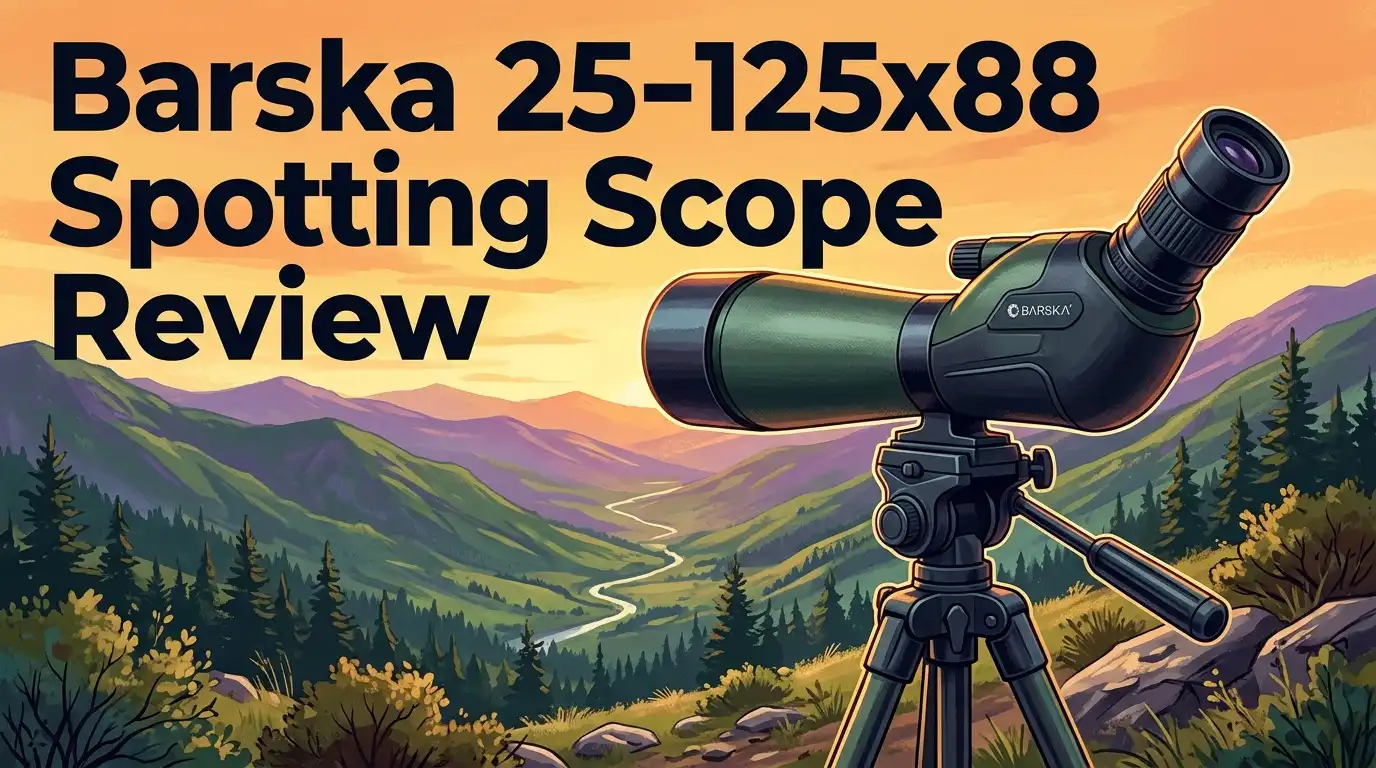
Barska 25-125×88 Spotting Scope Review 2026: Worth Buying?
Long range viewing gear can confuse anyone. Prices swing from fifty dollars to three thousand dollars. Numbers on the box promise the moon. The Barska 25-125×88 sits in a strange spot. It carries a huge 88mm objective lens and a wild 125x top magnification, yet it costs less than many entry level scopes from premium brands.
So what is the catch? There is always a catch with budget optics. I spent time with this scope at the range, in the backyard, and on a windy hillside. I looked at paper targets, deer, rooftops, and the moon. This review shares exactly what I saw, including the parts that disappointed me.
You will get the full picture here. Real performance numbers, the honest weak spots, the unboxing, and three solid alternatives. By the end you will know if this scope belongs in your truck or if your money belongs somewhere else.
Key Takeaways:
- The 88mm objective lens is the real star. It gathers plenty of light and gives bright views at low and medium power. Brightness at 25x through 50x is genuinely impressive for the price.
- The 125x number is mostly marketing. Useful images stop somewhere near 60x to 80x on a clear, calm day. Push past that and you get a dim, soft, shaky picture. Treat this as a 25x to 70x scope and you will stay happy.
- Build quality feels solid and outdoor ready. Rubber armor, nitrogen purging, and full waterproof sealing come standard. The body weighs about 1.78 pounds, which is light for an 88mm spotter.
- The included tripod is not good enough. The small tabletop tripod wobbles badly above 40x. Budget another forty to eighty dollars for a proper tripod, or the scope will frustrate you.
- Focus happens at the objective, not at the eyepiece. This Dynamic Focusing System takes practice. Some users love it. Others find it slow compared to a standard focus wheel.
- Best value target buyer: the casual shooter, the backyard sky watcher, and the hunter who wants reach without spending rifle money. Serious birders should look elsewhere.
Barska 25-125×88 Spotting Scope: Quick Overview

- The spotter features powerful and versatile 25-125x magnification that allows easy targeting and then zoom in for a closer and detailed look.
- The spotting scope comes with fully-coated optics and large 88mm objective lenses, bringing you bright and crystal clear views.

Last update on 2026-09-23 / Affiliate links / Images from Amazon Product Advertising API Some of the links on this website are affiliate links, which means that at no additional cost to you, I earn a commission if you click through and make a purchase. I only recommend products and services that I believe will add value to my readers. Thank you for your support!
The Barska Benchmark 25-125×88 is a straight body spotting scope built around a large 88mm front lens. Barska sells it under model number AD11182. The scope belongs to the Benchmark DES family, which uses a porro prism layout with BK7 prism glass.
Key numbers matter here. Magnification runs from 25x to 125x. Close focus sits at 18 feet. Eye relief measures 13.3mm at 25x and drops to 7.6mm at 125x. Field of view starts at 54 feet per 1000 yards and shrinks to 24 feet at full zoom. Exit pupil falls from 3.2mm down to a tiny 0.64mm.
Those last two figures explain most of this scope’s behavior. A 0.64mm exit pupil is far below what a human eye uses comfortably, so top magnification looks dark. The body measures 13.2 inches long and weighs 1.78 pounds. Barska backs it with a limited lifetime warranty, which adds real peace of mind at this price level.
Unboxing Experience: What Actually Arrives
The box arrives heavier than expected. Inside sits a rigid hard case with a zipper, and that case protects the scope during shipping and storage. Opening it feels satisfying. The scope rests in shaped foam with the accessories tucked around it.
You get more gear than most budget spotters include. The kit holds the scope itself, a hard carrying case, a soft padded case with a shoulder strap, a small tabletop tripod with a pan head, the Accu Grip handheld mount, a lens cleaning cloth, and lens covers for both ends.
First impressions are good. The green rubber armor feels grippy and thick. The zoom collar turns with firm resistance. The objective housing rotates smoothly for focusing. Nothing rattles.
Then reality lands. The tabletop tripod feels flimsy the moment you lift it. The legs are thin. The pan head has noticeable play. It works for a quick look from a picnic table, and that is honestly the limit of it.
Build Quality and Body Design
The Barska feels tougher than its price suggests. Rubber armor wraps the entire tube, which guards against knocks, scratches, and cold metal in winter. The armor also quiets any noise if the scope bumps a truck door or a shooting bench.
Barska seals the body with O rings and purges it with nitrogen. That makes the scope fully waterproof and fogproof. Rain will not harm it. Moving from a warm cabin into freezing air will not fog the internals. This sealing is the single most underrated feature on the whole product.
Weight sits at 1.78 pounds, which is light for an 88mm scope. Many rivals in this size range hit three pounds or more. The tradeoff shows in the housing material, which is polycarbonate rather than magnesium alloy.
The straight body suits ground level viewing and bench shooting. Straight bodies point faster at targets. Angled bodies work better for sky watching and for sharing with people of different heights. Pick based on your main use.
Optical Performance in Real Daylight
This is where honesty matters. At 25x the image looks bright, wide, and pleasing. Colors stay natural. Center sharpness is good enough to read range flags, count antler points, and spot .22 holes at 50 yards.
Push to 40x and the view still holds up well. This range is the sweet spot. Light stays strong because the exit pupil remains above 2mm. Detail on a deer at 400 yards reads clearly on a bright afternoon.
At 60x things soften. The image dims slightly. Edge sharpness falls off, and some purple fringing appears on high contrast lines like dark branches against bright sky. It remains usable.
Beyond 80x the picture degrades fast. Contrast drops, brightness drops, and heat shimmer takes over. You see a bigger blur, not more detail.
The optics are fully coated rather than fully multi coated. That single word gap costs real light transmission compared to pricier glass. Expect roughly seventy percent transmission instead of the ninety percent premium scopes deliver.
Top 3 Alternative for Barska 25-125×88 Spotting Scope

- ULTIMA ANGLED ZOOM SPOTTING SCOPE: This versatile all-around spotting scope with an 80mm objective lens, 20-60x zoom, and a 45° viewing angle is the ideal choice for any outdoor enthusiast. It's perfect for observing nature and long-distance viewing.
- INCLUDES ESSENTIALS FOR BETTER VIEWING: The Celestron Ultima 80 comes complete with a soft carrying case, an extended tripod mounting plate, a zoom eyepiece with an integrated T-adapter for digiscoping, an eyepiece pouch, a lens cloth, and more.
Last update on 2026-09-13 / Affiliate links / Images from Amazon Product Advertising API Some of the links on this website are affiliate links, which means that at no additional cost to you, I earn a commission if you click through and make a purchase. I only recommend products and services that I believe will add value to my readers. Thank you for your support!
Celestron Ultima 80 Angled Spotting Scope

- Gosky Updated Newest 20-60x80 Spotting Scope - Variable 20x to 60x magnification and dynamic lens focusing system brings better optics, more stable images and easier focusing power. It’s the best choice for target shooting, archery, hunting, bird watching, wildlife watching, hiking, camping, scenery, outdoor sporting, astronomical observation etc
Last update on 2026-09-13 / Affiliate links / Images from Amazon Product Advertising API Some of the links on this website are affiliate links, which means that at no additional cost to you, I earn a commission if you click through and make a purchase. I only recommend products and services that I believe will add value to my readers. Thank you for your support!
Gosky Updated 20-60×80 Spotting Scope

- 20-60x60 HD Optics: Designed for target shooting and outdoor observation with high-definition optical performance
- Ultra-Light Spotting Scope Kit for Effortless Travel: Weighing just 1.31lbs, this spotting scope with tripod comes with a soft shoulder-strap carrying case, easy to sling over your shoulder or compact storage in a backpack without taking space.
Last update on 2026-09-17 / Affiliate links / Images from Amazon Product Advertising API Some of the links on this website are affiliate links, which means that at no additional cost to you, I earn a commission if you click through and make a purchase. I only recommend products and services that I believe will add value to my readers. Thank you for your support!
Emarth 20-60×60 Angled Spotting Scope
How the 125x Magnification Really Performs
Let us settle the big question. Does 125x work? Rarely. Almost never in daylight.
Three things block high magnification. First, air. Heat shimmer and atmospheric turbulence blur distant objects long before the glass gives out. On most days the air limits any scope to about 60x. Second, the exit pupil. At 125x the exit pupil measures 0.64mm, far smaller than your pupil, so the view looks dark and grainy. Third, shake. Every tiny vibration multiplies with magnification.
I found the practical ceiling to be around 70x on a cool, still morning. Late evening and midday were worse.
Does that make the scope useless? No. A useful 25x to 70x zoom for this price is still a fair deal. Just ignore the top of the dial.
There is one exception. The moon at night looks genuinely striking near 80x to 100x. Cool night air is steady, and the moon is bright enough to feed that tiny exit pupil.
The Dynamic Focusing System Explained
Barska calls it the Dynamic Focusing System. In plain words, you focus by rotating the objective lens housing at the front of the scope, not with a wheel near the eyepiece.
The design has real benefits. It keeps the body fully sealed. It reduces moving parts. It gives a long, fine focus throw that helps at high power.
The downside shows in daily use. You must reach forward to the front of the tube, which shifts your hand position and can nudge the scope on a weak tripod. Fast target acquisition suffers. A birder tracking a moving warbler will feel this immediately.
Focus travel is also long. Going from 18 feet to infinity takes several full rotations. That is great for precision and annoying for speed.
My advice: mount the scope on a firm tripod and the focusing system stops being a problem. On the included tabletop tripod, every focus adjustment shakes the image for two seconds afterward.
The Included Tripod and Accu Grip Mount
Barska includes two support options. Both deserve honest words.
The tabletop tripod stands roughly seven inches tall with a simple pan head. It works fine at 25x on a solid table. At 40x you will see shake from your own breathing. At 80x the image bounces with any breeze. This tripod is a bonus item, not a real solution.
The Accu Grip is more interesting. It is a handheld pistol style grip that screws into the tripod socket. You hold it like a camera and brace your elbows. For quick scanning at 25x it genuinely helps. Hunters glassing a hillside from a sitting position will use it.
My honest recommendation stays simple. Buy a full size tripod with a fluid pan head rated for at least five pounds. Something in the fifty to one hundred dollar range transforms this scope. The optics were never the main limit at high power. The support was.
Waterproof and Fogproof Protection in the Field
This feature works exactly as promised, and it surprised me at this price.
The body uses O ring seals at every joint. Barska then purges the interior with nitrogen, which removes moisture from the inside air. Two benefits follow. Rain and splashes cannot enter. Internal fogging cannot happen during temperature swings.
I tested the temperature swing directly. I carried the scope from a heated room into 30 degree air and used it within a minute. No internal fog appeared. The exterior lens surfaces fogged briefly, as any glass does, and wiped clear instantly.
Rain testing was mild but positive. Steady drizzle for twenty minutes caused no issues.
This sealing is why the Barska outlasts cheaper scopes. Most budget optics fail from internal moisture, not from broken glass. Fungus grows on damp internal lenses, and that ruins a scope permanently. Nitrogen purging blocks that path entirely.
One care note stays important. The seals protect against rain and splashes, not against full submersion at depth.
Best Uses for This Spotting Scope
Certain activities suit this scope well. Others do not.
Target shooting ranks first. At 100 to 300 yards, the 88mm lens and 40x setting let you see bullet holes in paper clearly on bright days. The straight body lines up naturally from a bench.
Backyard astronomy ranks a close second. Moon craters look sharp. Jupiter shows as a disc with its four bright moons. Saturn shows its ring shape near 80x. This is a genuinely fun night sky tool.
Hunting and general wildlife watching work well at moderate power. Glassing a field at 25x to 40x for deer or elk is exactly what the scope handles best.
Landscape and marine viewing work fine too. Watching ships, distant ridges, or wind turbines is easy at low power.
Serious birding is the weak match. Birders need fast focus, crisp color, and sharp detail on small, moving subjects. This scope gives none of those three at a high level.
What This Scope Does Not Do Well
An honest review lists failures plainly. Here are the real ones.
The advertised 125x is not usable. Calling this a 125x scope stretches the truth. Plan around 70x maximum.
Color accuracy is average. Chromatic aberration shows as purple or green edges on high contrast subjects above 50x. Birders and photographers will notice.
Edge sharpness drops noticeably. The outer twenty percent of the view is softer than the center at all magnifications.
Field of view is narrow. Just 54 feet at 1000 yards at 25x is tight. Finding a subject takes patience, and following a moving animal is difficult.
Eye relief at high power is poor. At 7.6mm, eyeglass wearers cannot see the full field at 125x. Even at 25x the 13.3mm figure is merely adequate.
Sample variation exists. Some units perform clearly better than others. Test yours quickly and return it if the view looks noticeably soft at 30x.
BK7 prisms cost light. BAK4 prism glass performs better, and rivals in this price bracket offer it.
Pros and Cons
Here is the summary in plain bullets.
Pros
- Large 88mm objective lens gathers strong light for bright views at low and medium power
- Fully waterproof and fogproof with O ring seals and nitrogen purging, which protects against internal fungus
- Light weight at 1.78 pounds makes it easier to pack than most 80mm class spotters
- Generous accessory kit includes a hard case, a soft case, a tripod, the Accu Grip mount, and a cleaning cloth
- Thick rubber armor absorbs bumps and gives a secure grip in cold or wet conditions
- Limited lifetime warranty from Barska adds long term security
- Excellent value under 250 dollars for casual range and backyard use
Cons
- 125x magnification is not practically usable in daylight conditions
- Included tabletop tripod is too weak for anything above 40x
- Fully coated optics only, not fully multi coated, so light transmission lags behind rivals
- BK7 prisms instead of the better BAK4 glass
- Narrow field of view makes target finding slow
- Short eye relief at high power troubles eyeglass wearers
- Objective focusing is slower than a standard focus wheel
Barska 25-125×88 Versus Popular Competitors
Context helps. Here is how the Barska compares.
Against the Celestron Ultima 80, the Barska loses on optical quality. The Celestron uses multi coated optics and BAK4 prisms, giving a brighter and sharper image at every power. The Celestron caps at 60x, which is honest. The Barska wins on price and on objective size.
Against the Gosky 20-60×80, the match is close. Both target budget buyers. Gosky includes a phone adapter and an angled option. The Barska offers a bigger lens and a straight body.
Against the Vortex Diamondback HD 20-60×85, the Barska loses badly on glass and wins hugely on price. The Vortex costs roughly four times more and delivers far better color, contrast, and edge sharpness.
The honest conclusion: if your budget reaches 350 dollars or more, buy better glass with a lower maximum power. If your budget sits near 200 dollars, the Barska delivers a lot of hardware for the money.
Who Should Buy the Barska 25-125×88
- The spotter features powerful and versatile 25-125x magnification that allows easy targeting and then zoom in for a closer and detailed look.
- The spotting scope comes with fully-coated optics and large 88mm objective lenses, bringing you bright and crystal clear views.
Last update on 2026-09-23 / Affiliate links / Images from Amazon Product Advertising API Some of the links on this website are affiliate links, which means that at no additional cost to you, I earn a commission if you click through and make a purchase. I only recommend products and services that I believe will add value to my readers. Thank you for your support!
This scope fits specific buyers well.
Buy it if you shoot at a range regularly. Confirming shot placement at 100 to 300 yards is exactly what it does best, and the price leaves money for ammunition.
Buy it if you want a first astronomy tool. Moon detail alone justifies the cost for many families, and the waterproof body survives dewy nights.
Buy it if you need reach on a tight budget. An 88mm lens for under 250 dollars is uncommon.
Buy it if you want a rugged knockabout scope for a truck, boat, or cabin where an expensive optic would worry you.
Skip it if you are a dedicated birder. Fast focus and true color matter too much in that hobby.
Skip it if you wear glasses full time. The short eye relief will frustrate you.
Skip it if you expect premium image quality. Manage your expectations and this scope satisfies. Expect magic and it will disappoint.
Tips to Get the Best Image From This Scope
Small changes make a large difference with budget optics.
Buy a real tripod first. This is the single biggest upgrade available. A sturdy tripod with a fluid pan head doubles the usable magnification instantly.
Start at 25x and zoom in slowly. Find your subject at the widest setting, center it, then increase power. Searching at high magnification wastes time.
View in the early morning. Cool, still air gives the steadiest image. Midday heat shimmer ruins detail at any power.
Stop at the point where detail stops improving. Zoom until the image stops getting better, then back off slightly. That is your true maximum for the day.
Keep the lenses clean but handle them gently. Blow dust off first, then use the included cloth with light pressure.
Shade the objective lens. Pull out the built in lens shade or use your hand to block side light. Contrast improves noticeably.
Let the scope cool outdoors for ten minutes before serious viewing in winter.
Price and Value in 2026
Pricing on this model moves a lot. List price sits around 440 dollars, which nobody pays. Street prices commonly land between 180 and 260 dollars depending on the retailer and the season.
At 180 dollars, this scope is a strong buy for casual users. At 260 dollars, the value weakens because the Celestron Ultima 80 and similar options come into range with better glass.
Watch for sales. Spring and autumn hunting seasons bring the best discounts. Prices also dip around major shopping events.
Consider the total cost honestly. Add a proper tripod at fifty to eighty dollars. Your real investment reaches roughly 250 to 330 dollars for a setup that works well. Factor that in before comparing against other scopes that include better support gear.
Long term value looks fine. The lifetime warranty and the sealed body mean this scope should last many years with basic care. Budget optics that survive a decade represent good value, even when the image never wows anyone.
Final Verdict
The Barska 25-125×88 is a good scope wearing a misleading label. The 88mm lens, the waterproof sealing, the rubber armor, and the accessory kit all deliver honest value at this price. The 125x claim does not.
Judge it as a 25x to 70x spotting scope with a big, bright objective lens, and it earns a solid recommendation for range shooters, casual wildlife watchers, and backyard astronomers.
My rating: 3.7 out of 5. It loses points for the marketing number, the weak tripod, and the average coatings. It gains points for durability, brightness at usable powers, and genuine value.
Buy a real tripod with it. That one purchase changes everything.
Frequently Asked Questions
Is the Barska 25-125×88 good for birding?
Not really. Birding needs fast focusing, wide field of view, and accurate color. This scope has a slow objective focusing system, a narrow 54 foot field of view, and noticeable color fringing above 50x. A dedicated birding scope with multi coated optics serves you far better. For casual backyard bird watching at a feeder, it works fine.
Can you actually use 125x magnification?
Rarely. Atmospheric conditions, the tiny 0.64mm exit pupil, and vibration all limit real performance. Practical daylight maximum sits near 60x to 70x. The exception is night viewing of the moon, where steady cool air and a bright subject allow 80x to 100x to look impressive.
Does it come with a tripod?
Yes. A small tabletop tripod with a pan head is included, plus the Accu Grip handheld mount. The tabletop tripod handles low magnification on a stable surface. For anything above 40x you need a full size tripod. Budget fifty to eighty dollars for that upgrade.
Is this scope waterproof?
Yes. The body uses O ring seals and nitrogen purging, which makes it fully waterproof and fogproof. Rain and temperature swings will not cause internal fogging. Do not submerge it deliberately.
Can I attach a smartphone for photos?
Not with included parts. Barska does not supply a phone adapter with this kit. Universal digiscoping adapters exist and fit the eyepiece housing. Photo quality will be modest because of the fully coated optics and the small exit pupil at high power.
Is it good for astronomy?
Yes, for casual use. Moon craters look sharp and detailed. Jupiter shows as a disc with visible moons. Saturn shows its ring shape near 80x. Deep sky objects stay out of reach. A stable tripod is essential for any night viewing.
Straight or angled, which should I pick?
This model is straight only. Straight bodies point at targets faster and suit bench shooting and ground level viewing. Angled bodies work better for sky watching, for sharing among people of different heights, and for viewing from a lower tripod position.
How does it compare to the Celestron Ultima 80?
The Celestron delivers better image quality thanks to multi coated optics and BAK4 prisms, but caps at 60x. The Barska offers a larger 88mm lens and usually costs less. Choose the Celestron for image quality and the Barska for value and light gathering.

Hello, I’m Amelia White, the founder of birdsfanatic.com. As a lifelong bird enthusiast and spiritual seeker, I’ve always been fascinated by the mystical connections between birds and the human experience. On this site, I share my knowledge and insights into the symbolic meanings and spiritual significance of various bird species, exploring their roles in mythology, folklore, and cultural traditions. Join me on this journey into the world of birds, where we’ll discover the hidden wisdom and guidance that these magnificent creatures have to offer.