
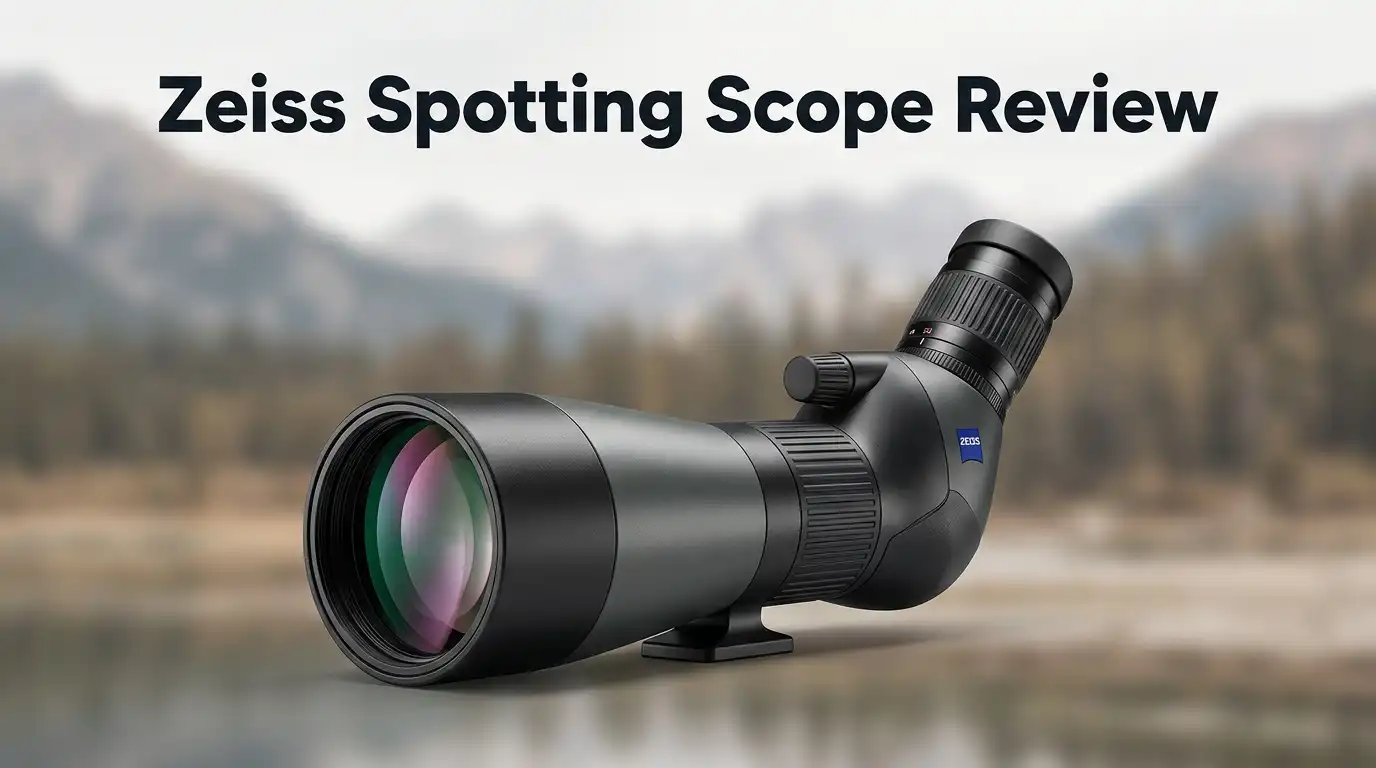
Zeiss Spotting Scope Review 2026: Worth It?
Zeiss builds some of the most respected glass on the planet, but spotting scopes are where the brand gets tested hardest. You are glassing a ridge at 800 yards, counting antler points, or trying to identify a shorebird in flat gray light.
Cheap glass falls apart in those moments. Good glass earns its keep. In 2026 Zeiss sells four spotters that matter, and they sit at very different price points with very different personalities. This review walks through each one in plain language.
You will learn what the glass actually shows you, how the controls feel in cold hands, what the boxes contain, and where each scope disappoints. No marketing fluff. Just the details you need before you spend between 1,500 and 5,000 dollars on an optic you plan to keep for a decade.
In a Nutshell:
- The Zeiss Conquest Apia 65 is the headline product of 2026. It costs about 1,499 dollars, weighs 47.6 ounces, and delivers roughly 87 percent light transmission. It won a spot in several major optics roundups this year. It is also the first premium Zeiss spotter built outside Germany, which surprised a lot of longtime fans.
- The Conquest Gavia 85 remains the value pick for hunters. It gives you an 85mm objective at around 60 ounces and near 2,000 dollars. That combination stayed competitive for almost a decade.
- The Victory Harpia 95 is the flagship and the beast. A 3x wide angle zoom, 23x to 70x magnification, and a dual focus system put it in the same conversation as Swarovski. The price and weight put it out of reach for most buyers.
- The Dialyt 65 is the odd one out. A straight body monobloc design at 42 ounces, aimed at alpine hunters who count every gram.
- Zeiss glass is excellent, but no Zeiss spotter is perfect. Close focus is weak on the Gavia, the Apia gets grainy past roughly 42x, and the Harpia demands an expensive tripod and a separate eyepiece purchase.
- Buy based on objective size and weight first, brand second. A 65mm scope you actually carry beats a 95mm scope you leave in the truck.
Why Zeiss Spotting Scopes Still Matter in 2026

- COMPACT AND LIGHTWEIGHT – Engineered for maximum compactness at 11.7 in. with minimal weight making it easy to pack and carry for long hikes, birdwatching, or outdoor excursions.
- IMMERSIVE VIEWING EXPERIENCE - Experience edge-edge image sharpness with ZEISS FieldFlattener Technology and an ideal zoom range from 20x to 50x. The Apia eyepiece with long eye relief allows easier viewing even over long time periods.
Last update on 2026-09-22 / Affiliate links / Images from Amazon Product Advertising API Some of the links on this website are affiliate links, which means that at no additional cost to you, I earn a commission if you click through and make a purchase. I only recommend products and services that I believe will add value to my readers. Thank you for your support!
Zeiss has an unusual position in the optics market. Swarovski owns the ultra premium tier. Vortex owns the value tier with an unbeatable warranty. Zeiss sits in between and refuses to pick a side. The company sells a 4,000 dollar flagship and a 1,500 dollar workhorse from the same catalog.
That matters because spotting scope prices climbed hard over the past three years. A top tier European spotter now runs between 3,000 and 5,000 dollars. Zeiss answered by building the Conquest Apia in Asia and pricing it under 1,500 dollars.
The optical engineering is still the real draw. Zeiss developed the T* coating decades ago. LotuTec, the hydrophobic exterior coating, sheds water and dust better than most competitors. Field flattener lenses now appear in the mid tier lineup, not only the flagship.
The result is a brand you can trust across three very different budgets. That flexibility is rare.
Zeiss Conquest Apia 65 Review
The Conquest Apia 65 is the scope most readers came here for. Zeiss launched it as a compact spotter with a 65mm objective and a 20x to 50x zoom range. It measures 11.7 inches long and weighs 47.6 ounces.
The body is magnesium alloy. The controls are oversized and heavily textured, which means you can work them with gloves on without fumbling. The eyepiece is removable and locks flush to the body with a tight bayonet mount, similar to a camera lens.
Image quality is the surprise here. Zeiss claims 87 percent light transmission. Testers reported a bright, vibrant view with no edge distortion, no flaring, and no visible color fringing. That is unusual at this price.
The magnification throw lever is a smart touch. You can swing from 20x to 50x in one motion while your eye stays on the target. The integrated Arca Swiss foot mounts directly to most tripod heads with no adapter plate needed.
Pros
- Excellent glass with no detectable edge distortion or color fringing
- Field flattener lenses at a mid tier price
- Integrated Arca Swiss foot saves you an adapter
- Removable eyepiece with a tight bayonet mount
- Magnification throw lever works fast in the field
- Priced under 1,500 dollars against rivals costing double
Cons
- At 47.6 ounces it is heavy for a 65mm scope
- The image turns grainy above roughly 42x
- The focus wheel is tight out of the box
- Made in China, which bothers some Zeiss purists
- The digiscoping adapter costs around 200 dollars extra
Unboxing the Conquest Apia 65
The box is standard Zeiss. Dark blue, understated, no dramatic reveal. Inside you find the scope body wrapped in a soft cloth sleeve, the eyepiece packed separately in its own foam cutout, lens caps for both ends, and a stay on carrying case.
The first thing you notice is the weight. Lift it out and the nearly 3 pound mass registers immediately. This does not feel like a compact scope. It feels dense and solid in a reassuring way.
Mounting the eyepiece takes about four seconds. Line up the dot, push, twist a quarter turn. It clicks and seats flush. No threaded collar to cross thread and no grit trap.
The focus wheel is noticeably stiff on a new unit. It loosens with use but never becomes loose. Turning it feels like adjusting a precision instrument, which is either satisfying or annoying depending on your patience.
The eyecup twists out smoothly with clear stops. Eyeglass wearers will find the eye relief comfortable at every magnification setting.
Zeiss Conquest Gavia 85 Review

- LIGHTWEIGHT - The magnesium body and compact dimensions make the ZEISS Conquest Gavia a lightweight and handy companion wherever you go.
- ERGONOMIC - The large focusing ring enables precise handling and easy focusing of the viewing image.
Last update on 2026-09-22 / Affiliate links / Images from Amazon Product Advertising API Some of the links on this website are affiliate links, which means that at no additional cost to you, I earn a commission if you click through and make a purchase. I only recommend products and services that I believe will add value to my readers. Thank you for your support!
The Gavia 85 has been in the Zeiss lineup since 2017, and it earned a loyal following among western hunters. The formula is simple. Take an 85mm objective, a 30x to 60x zoom eyepiece, and squeeze it all into a body that weighs 60 ounces.
That weight is the headline. Most 85mm spotters run 63 to 70 ounces. The Gavia is one of the lightest full size 85mm scopes ever built, and the magnesium body is a big reason why.
Field of view runs 99 feet at 30x down to 69 feet at 60x, measured at 1,000 yards. Internal baffling is genuinely effective, so glare and stray light rarely wash out the image.
The optical weakness is close focus performance. Image quality at minimum focus distance is poor. If you want to study butterflies or feeder birds at 15 feet, this is the wrong scope. For glassing across canyons, it performs beautifully.
Reviewers consistently rated its resolution within a whisker of the Vortex Razor HD while praising the Gavia for a brighter view in fading light.
Top 3 Alternatives for Zeiss Conquest Apia 65

- All round performer: excellent optical performance even in challenging light conditions, a 21–65x zoom range for maximum flexibility, and a lightweight yet rugged construction weighing just 53.3 oz. Its lightweight, perfectly balanced design delivers comfortable all-day carry in the field.
- Incredible detail recognition: The 75 mm objective lens diameter provides exceptional light gathering capability, enabling detailed observations under challenging lighting conditions. The HD optics provide outstanding image clarity with natural color fidelity, high contrast, and crisp detail. Even at high magnifications, the finest details remain razor sharp and rich in contrast.
Last update on 2026-09-22 / Affiliate links / Images from Amazon Product Advertising API Some of the links on this website are affiliate links, which means that at no additional cost to you, I earn a commission if you click through and make a purchase. I only recommend products and services that I believe will add value to my readers. Thank you for your support!
Swarovski AT Endura 21x to 65×75

- The Viper HD 20-60x85 Angled spotter is packed with features for incredible glassing and high end optical performance. A multi-position eyecup provides proper eye relief while a locking collar allows the scope to rotate into different viewing positions.
- The HD optical system comprised of premium components generates vivid high-definition images. XR anti-reflective coatings on exterior surfaces help obtain brighter views in low-light situations.
Last update on 2026-09-20 / Affiliate links / Images from Amazon Product Advertising API Some of the links on this website are affiliate links, which means that at no additional cost to you, I earn a commission if you click through and make a purchase. I only recommend products and services that I believe will add value to my readers. Thank you for your support!
Vortex Viper HD 20x to 60×85 Angled

- PREMIUM ED OPTICS FOR EXCEPTIONAL CLARITY - Extra-Low Dispersion (ED) glass and lanthanum ocular elements deliver outstanding sharpness, true color accuracy, and edge-to-edge clarity for detailed viewing at any distance.
- 15-35X ZOOM WITH SUPER WIDE FIELD OF VIEW - Smooth zoom magnification provides the versatility to scan wide areas at 15x or zoom in for detailed observation at 35x, with an impressive 210–110 ft field of view at 1000 yards.
Last update on 2026-09-22 / Affiliate links / Images from Amazon Product Advertising API Some of the links on this website are affiliate links, which means that at no additional cost to you, I earn a commission if you click through and make a purchase. I only recommend products and services that I believe will add value to my readers. Thank you for your support!
Hawke Frontier ED X 15x to 35×56
Zeiss Victory Harpia 95 Review
The Harpia 95 is Zeiss at full stretch. It uses FL fluorite glass, delivers a 3x wide angle zoom from 23x to 70x, and shows a 72 degree apparent field of view. The body alone sells for around 4,199 dollars. The eyepiece adds roughly 800 dollars on top.
The dual focus system defines this scope. Zeiss placed both the zoom and the focus controls on the body itself, stacked coaxially. Your hand never leaves the same spot. You zoom with one ring, focus with the other, and your eye stays locked on the bird.
The wide field across the entire zoom range is what separates the Harpia from everything else. Most spotters pinch the view as magnification climbs. The Harpia holds a usable field at 70x.
The trade off is mass. This scope is heavy, and the review consensus is blunt about it. You need a serious tripod and a fluid head. A lightweight travel tripod will shudder and ruin the image.
Pros
- FL fluorite glass with outstanding color fidelity at maximum power
- Wide field of view maintained across the full 23x to 70x range
- Long eye relief at every magnification setting
- Dual focus controls mounted together on the body
- Genuine competitor to the Swarovski flagship scopes
Cons
- Very heavy, even before you add the eyepiece
- The body and eyepiece are sold separately
- Requires a heavy duty tripod and fluid head
- Total cost approaches 5,000 dollars
- Overkill for target shooting or casual wildlife viewing
Zeiss Dialyt 65 for Backcountry Hunters
The Dialyt 18x to 45×65 is the quiet member of the family. It uses a straight body monobloc construction with no removable eyepiece, which means fewer entry points for dust and moisture.
It weighs 42 ounces and measures 15.5 inches. Price sits near 1,599 dollars. Zeiss markets it for deerstalking and alpine hunting, and that is exactly who buys it.
Sharpness holds up remarkably well at 45x. Field reviewers noted edge to edge clarity and strong contrast even at maximum magnification, which is the opposite of what most budget scopes deliver.
The straight body divides opinion. Straight scopes acquire targets faster and work better when you glass downhill from above. Angled scopes are more comfortable for extended sitting and for sharing with a partner.
The Dialyt is an older design now, and the Conquest Apia has arguably replaced it on optical merit. It survives because of that low weight and the simplicity of a sealed one piece body.
Glass, Coatings and Light Transmission Compared
Light transmission numbers tell you how much light reaches your eye. Zeiss quotes about 87 percent for the Conquest Apia. The Harpia sits higher thanks to its fluorite glass. Swarovski claims 88 to 90 percent on its current scopes.
Those differences are small on paper and noticeable in the last ten minutes of legal shooting light. That is when a two percent gap becomes the difference between identifying an animal and guessing.
The T* coating is applied to every air to glass surface and cuts internal reflections. LotuTec coats the exterior lenses and repels water and fingerprints. Rain beads up and rolls off instead of smearing across your view.
Field flattener lenses in the Apia correct the curvature that makes the outer portion of an image go soft. On cheaper scopes you refocus constantly as you pan. On the Apia the whole frame stays sharp.
Coatings matter more than objective diameter for image quality. A well coated 65mm scope routinely outperforms a poorly coated 85mm scope.
Field of View and Eye Relief
Field of view controls how much landscape you see at once. The Conquest Apia shows 144 feet at 20x and 81 feet at 50x, measured at 1,000 yards. The Gavia 85 shows 99 feet at 30x. The Harpia is the widest performer in the family.
Wide fields make you faster. You find the animal quicker, you track it more easily, and you scan a hillside with fewer sweeps.
Eye relief is the distance your eye sits from the ocular lens while still seeing the full image. Eyeglass wearers need at least 16mm or they lose the edges of the picture. Every current Zeiss spotter handles glasses well, and the Harpia is generous at every setting.
The twist out eyecups have firm detents so they hold position. Close focus varies a lot. The Apia focuses down to 11.5 feet, which is genuinely useful for insects and garden birds. The Gavia technically focuses close but the image quality collapses there.
Digiscoping With a Zeiss Spotting Scope
Digiscoping means shooting photos and video through your spotter with a phone. Zeiss sells a magnetic adapter system that connects almost any modern phone to the eyepiece.
The adapter costs roughly 200 dollars including the magnetic eyepiece receiver. That stings on top of a 1,500 dollar scope, but the execution is good. The magnet snaps your phone into alignment instantly instead of making you fiddle with clamps.
Results depend on magnification. Shoot between 20x and 35x and the images look sharp and well saturated. Push past 45x and you get soft, grainy files.
Video is where digiscoping shines. A stabilized clip of a feeding bull elk at 600 yards is something a normal telephoto lens cannot match without spending thousands.
One honest caveat. Digiscoping requires a stable tripod, patience, and practice. Your first fifty photos will be disappointing. The learning curve is real.
Weight, Size and Tripod Requirements
This is the section buyers skip and later regret. A spotting scope is only half of the system. The tripod is the other half, and a weak tripod ruins good glass.
The Conquest Apia at 47.6 ounces works on a mid weight carbon tripod. The Gavia 85 at 60 ounces needs something sturdier. The Harpia 95 demands a full size tripod with a proper fluid head, and that combination adds four to six pounds to your pack.
Budget accordingly. A tripod and head capable of holding a Harpia steady costs between 500 and 1,200 dollars.
Length matters for packing. The Apia at 11.7 inches slides into a side pocket. The Dialyt at 15.5 inches and the Gavia at around 14 inches need to go inside the pack or strap to the outside.
Integrated Arca Swiss feet on the newer Zeiss scopes save weight and time. You clamp the scope straight to the head with no plate to lose.
What Zeiss Spotting Scopes Do Not Do Well
Honest reviews list failures, so here they are. Zeiss spotters are heavier than their objective sizes suggest. The Apia weighs almost 3 pounds for a 65mm scope. Competitors hit similar performance at lower weight.
Zeiss also does not compete below 1,000 dollars. If your budget is 400 dollars, the brand has nothing for you and Vortex or Kite will serve you better.
The upper end of every zoom range disappoints. The Apia gets grainy around 42x despite advertising 50x. This is physics rather than a Zeiss flaw, but the marketing rarely mentions it.
Close focus on the Gavia 85 is genuinely poor. Butterfly watchers and garden birders should look elsewhere.
The Harpia sells the body and eyepiece separately, which feels unfriendly at a 4,000 dollar price point. And Zeiss warranty service, while solid, does not match the no questions asked replacement policy Vortex offers.
Zeiss Versus Swarovski Versus Vortex
Swarovski holds the optical crown. The AT Endura at 2,899 dollars and the stabilized ST Balance at 3,849 dollars both deliver images that testers rank at the very top. You pay roughly double the Zeiss price for a visible but modest improvement.
Vortex attacks from below. The Viper HD 85mm sells well under 1,000 dollars and the Razor HD competes directly with the Gavia. Side by side testing found the Gavia and the Razor nearly identical in resolution, with the Zeiss slightly brighter.
Vortex also offers the best warranty in the industry, fully transferable and unconditional. That has real value if you hunt hard.
Zeiss wins on price to performance ratio in the middle of the market. The Conquest Apia performs close to scopes costing twice as much and beats everything in its own price bracket on coatings and edge sharpness.
Choose Swarovski for absolute best image, Vortex for warranty and value, Zeiss for the balance between the two.
Which Zeiss Spotting Scope Should You Buy
Match the scope to your actual use, not your aspirations. Most buyers should choose the Conquest Apia 65. It is the newest design, the sharpest value, and compact enough to carry. At under 1,500 dollars it represents the best Zeiss deal available in 2026.
Pick the Conquest Gavia 85 if you glass in poor light and want the extra aperture. An 85mm objective gathers roughly 70 percent more light than a 65mm objective. That matters at dawn and dusk.
Pick the Dialyt 65 only if you want a straight body and the lightest possible package for mountain hunting.
Pick the Victory Harpia 95 if you are a serious birder who spends hours behind glass and already owns a heavy tripod. It is the best Zeiss spotter made, and the price reflects that.
Skip Zeiss entirely if your budget sits under 1,000 dollars. Buy a Vortex and put the savings into a good tripod.
Frequently Asked Questions
Is the Zeiss Conquest Apia made in Germany?
No. The Conquest Apia is manufactured in China and it is the first premium Zeiss optic neither designed nor built in Germany. Zeiss engineered it specifically for the North American market. The build quality and the optical coatings remain genuine Zeiss standards, and testers found the performance nearly equal to scopes costing twice as much.
How much does a good Zeiss spotting scope cost in 2026?
Expect to pay about 1,499 dollars for the Conquest Apia 65, around 1,599 dollars for the Dialyt 65, roughly 1,999 dollars for the Conquest Gavia 85, and about 4,199 dollars for the Victory Harpia 95 body. The Harpia eyepiece costs an additional 800 dollars.
Do I need a 65mm or an 85mm spotting scope?
Choose 65mm if you carry your scope on foot and glass mostly in daylight. Choose 85mm if you observe in low light or need maximum magnification. The larger objective gathers more light and holds detail better at high power, but it adds weight and demands a stronger tripod.
Are Zeiss spotting scopes waterproof?
Yes. Every current Zeiss spotter is nitrogen filled, sealed against water, and fog proof. The LotuTec exterior coating repels rain and dirt so water beads and rolls off the lens surface rather than smearing.
Can I attach my phone to a Zeiss spotting scope?
Yes. Zeiss sells a magnetic digiscoping adapter that fits most modern phones and costs around 200 dollars with the eyepiece receiver. Image quality is strong between 20x and 35x and softens noticeably at higher magnifications.
Is a Zeiss spotting scope better than a Swarovski?
Swarovski currently holds a slight optical edge at the top of the market, particularly with its stabilized models. Zeiss offers better price to performance in the middle tier. For most buyers the Conquest Apia delivers about 90 percent of the Swarovski experience at roughly half the cost.
Which Zeiss scope works best for target shooting?
The Conquest Apia 65 suits range use very well. It resolves bullet holes cleanly at 300 yards, packs down small, and mounts directly to Arca Swiss tripod heads. The Gavia 85 gives you more reach if you shoot past 600 yards.

Hello, I’m Amelia White, the founder of birdsfanatic.com. As a lifelong bird enthusiast and spiritual seeker, I’ve always been fascinated by the mystical connections between birds and the human experience. On this site, I share my knowledge and insights into the symbolic meanings and spiritual significance of various bird species, exploring their roles in mythology, folklore, and cultural traditions. Join me on this journey into the world of birds, where we’ll discover the hidden wisdom and guidance that these magnificent creatures have to offer.