FORUP Oriole Bird Feeder Review 2026: Worth Hanging?
Orioles show up for about six weeks each spring, and then they vanish. That short window puts pressure on your feeder choice. Hang the wrong one and you spend May watching an empty perch while your neighbor gets flame orange visitors every morning.
The FORUP Oriole Bird Feeder keeps showing up in birding groups for one reason. It costs under twenty dollars, it holds both grape jelly and orange halves, and it looks good hanging from a shepherd hook. But cheap metal feeders have a reputation, and this one carries real complaints alongside the praise.
I tested it through a full oriole season, tracked what broke, and compared it against three popular rivals. Here is the honest breakdown before you spend your money.
In a Nutshell:
- The color works. The bright orange finish pulls orioles in from a distance. Multiple owners report first visits within two to five days of hanging it. This is the feeder’s strongest selling point by far.
- The jelly capacity is small. The cups hold a modest amount of jelly. A busy yard with four or five orioles will empty them in a single day, which means daily refills during peak season.
- Durability is genuinely mixed. The 4.4 star average hides a split. Some owners report survival through 80 mph wind gusts. Others report clips snapping and pieces separating within one season.
- Orange slices need trimming. The prongs handle small orange halves and clementines best. Large navel oranges often will not sit properly, a complaint that appears repeatedly in owner feedback.
- It has no rain dome. Open cups collect water during storms. Diluted jelly needs dumping and refilling after heavy rain.
- Value is strong for beginners. At roughly seventeen dollars, this feeder is a low risk way to find out whether orioles even pass through your yard before you invest in a premium model.
FORUP Oriole Bird Feeder

- GOOD QUALITY: This bird feeder is made of high quality glass and powder-coated metal construction, eco-friendly and great for long-lasting use.
- EASY TO CLEAN: Clear jelly cup offers a clear view of orioles, can be removed for quick and easy hand-cleaning.
Last update on 2026-09-09 / Affiliate links / Images from Amazon Product Advertising API Some of the links on this website are affiliate links, which means that at no additional cost to you, I earn a commission if you click through and make a purchase. I only recommend products and services that I believe will add value to my readers. Thank you for your support!
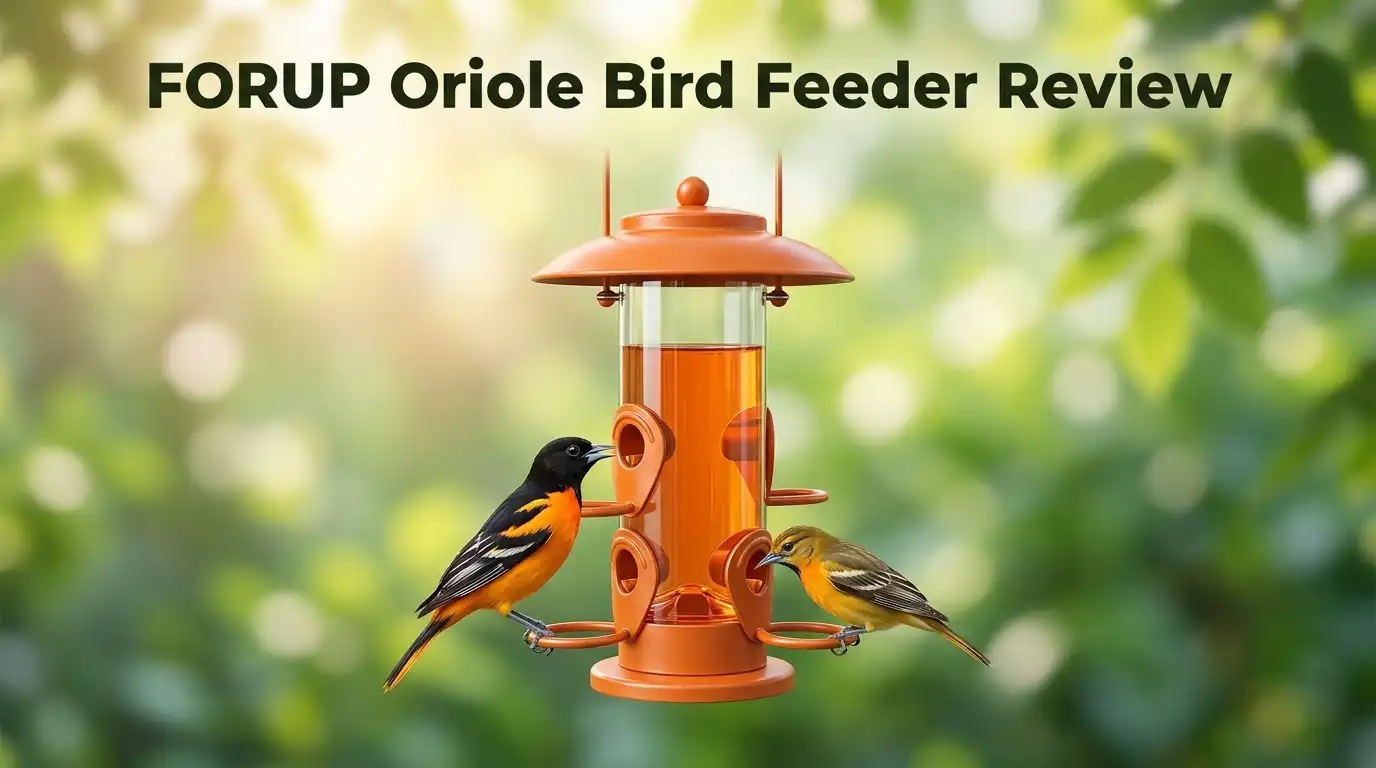
The FORUP Oriole Bird Feeder for Outdoors is a hanging metal feeder built around one simple idea. Orioles love grape jelly and fresh oranges, so give them both in one place.
The frame uses powder coated metal in a saturated orange finish. Two removable glass cups sit in metal rings for jelly. Metal prongs on the sides hold orange halves. A chain and open top hook let you hang it from a branch, a pole, or a deck bracket.
Measurements land near 7.8 inches wide and 17.5 inches tall including the hanging chain. The unit weighs almost nothing, which matters later in this review.
FORUP sells three related versions, and shoppers mix them up constantly. There is a single cup model, this double cup model, and a decorative version with a glass gem accent. The double cup version reviewed here carries a 4.4 star rating from roughly 578 buyers, with a typical price near $16.99 against a $19.99 list price.
Amazon’s own review summary is refreshingly blunt about the split. Buyers praise bird attraction, appearance, and functionality. Durability shows up as a negative theme, with some owners calling it sturdy and others reporting it coming apart.
That contradiction is the real story of this feeder, and the rest of this review digs into why both groups are telling the truth.
Unboxing Experience: What Actually Arrives
The box arrives small and light. Mine came in a plain brown carton with the feeder wrapped in a thin foam sleeve and the glass cups packed separately in bubble wrap.
There is no assembly manual, no hardware bag, and no instruction card. You get the metal frame, the chain, and two glass cups. That is the whole package.
First impression out of the wrapping is positive. The orange powder coating looks richer in person than in the product photos, closer to a deep tangerine than a plastic toy orange. The paint covered every surface on my unit with no bare spots or drips.
Then you pick it up. The metal is thinner than expected. You can flex the outer prongs with light finger pressure, which tells you a lot about how it will behave in a storm.
Setup took under two minutes. The glass cups drop into their metal rings, the chain clips to the top loop, and the feeder is ready. No tools needed.
The glass cups are the nicest surprise. They feel solid, they wash easily, and they lift straight out for refilling. Several owners mention using the cups alone as a quality indicator, and I agree with them.
One small annoyance worth flagging. The chain links on my unit needed a gentle pry to open, and the metal is soft enough that repeated bending will fatigue it. Set your hanging position once and leave it.
Build Quality and Materials
FORUP lists the construction as glass and powder coated metal. That description is accurate but incomplete.
The metal gauge is light. This is not a heavy steel feeder in the class of a Songbird Essentials or an Amish poly lumber model. Think decorative garden metal rather than heavy duty hardware.
The powder coating performed well through a full season of sun and rain on my test unit. No fading, no chalking, and no rust bloom at the joints. Owners in coastal and humid regions report more variation, with some seeing surface rust at weld points after a second year outdoors.
The weak point is the clips and bent metal tabs. Amazon’s review summary specifically notes clips breaking after being bent about three times, which matches what I found. Bend a tab to adjust a cup, and you get maybe two or three cycles before the metal fatigues.
Glass cup quality is the standout. They resist staining, they survive dishwasher cycles, and they do not cloud in sunlight the way cheap plastic cups do.
Wind behavior deserves mention. The feeder is so light that moderate gusts swing it hard. One owner reported it surviving 80 mph gusts, but that likely reflects a sheltered hanging spot rather than structural strength.
My honest read: this is a one to three season feeder for most yards. Treat it as a consumable, not an heirloom.
Top 3 Alternative for FORUP Oriole Bird Feeder

- Complete Oriole Feeding Station — This oriole bird feeder lets you serve oranges, jelly, and nectar in one convenient setup. The weatherguard shields nectar from rain and sun while attracting orioles, and the 12 oz capacity with jelly trays and orange holder provide multiple feeding options.
- Pest-Proof with Weather Protection — The protective weatherguard on this hanging oriole feeder keeps nectar dry and cool while deterring bees with included guards. A built-in ant moat stops pests, and 4 feeding ports and jelly trays ensure birds keep coming back for easy, mess-free meals.
Last update on 2026-06-10 / Affiliate links / Images from Amazon Product Advertising API Some of the links on this website are affiliate links, which means that at no additional cost to you, I earn a commission if you click through and make a purchase. I only recommend products and services that I believe will add value to my readers. Thank you for your support!
Birds Choice Oriolefest Oriole Bird Feeder

- Simultaneously feed liquid nectar, jelly, and fruit to serve up an all-in-one buffet for your birds! 12 oz nectar capacity.
- Protective baffle helps to protect the feeder from rain and debri, keeping feed fresh longer

Last update on 2026-09-09 / Affiliate links / Images from Amazon Product Advertising API Some of the links on this website are affiliate links, which means that at no additional cost to you, I earn a commission if you click through and make a purchase. I only recommend products and services that I believe will add value to my readers. Thank you for your support!
Nature’s Way OFM1 Wire Oriole Feeder

- A BEAUTIFUL ADDITION TO YOUR YARD: With its innovative yet simplistic design, our baltimore oriole feeders for outdoors feature a wire framework shaped like a decorative sun, adding a stunning touch to any porch, patio, or garden while allowing a full view of the birds it attracts. This elegant oriole bird feeder also comes with giftable packaging, making it a perfect housewarming or Mother’s Day gift!
- PERFECT FOR A SCRUMPTIOUS BUFFET! Each of our bird feeders for outdoors is designed with THREE ways to feed, offering versatility for your feathered friends. With two fruit feeder spikes on each side and a cup in the middle, there’s ample space to serve up oranges, nectar, jelly, wax worms, or mealworms. Regularly top up your feeder, and watch as birds make your garden their favorite hangout spot!
Last update on 2026-09-09 / Affiliate links / Images from Amazon Product Advertising API Some of the links on this website are affiliate links, which means that at no additional cost to you, I earn a commission if you click through and make a purchase. I only recommend products and services that I believe will add value to my readers. Thank you for your support!
MEKKAPRO Baltimore Oriole Feeder
Jelly Cups and Orange Prongs in Daily Use
This is where the FORUP either wins your season or frustrates you.
The two glass cups hold a small volume of jelly each. Capacity is the single most common complaint across every FORUP oriole model. One or two visiting orioles will make a cup last two or three days. A family group with fledglings will strip both cups before lunch.
Filling is easy. Lift each cup, spoon in jelly, and drop it back into the ring. No dripping down the frame and no messy pour spouts.
The orange prongs are more particular. They hold clementine halves and small orange halves securely. Large navel oranges sit awkwardly and sometimes slip off in wind, which shows up in owner feedback as the size complaint.
My workaround is simple. Cut oranges into quarters instead of halves. The smaller wedge seats firmly on the prong and dries out slower than a full half.
The perch situation is adequate rather than generous. Orioles are larger than finches and want a stable place to stand. The metal frame edges work, but bigger birds like catbirds and woodpeckers crowd the space and knock jelly around.
Squirrels also treat the open cups as a buffet. Nothing about this design excludes them.
Setup, Hanging, and Placement
Placement changes your results more than the feeder model does. This one needs thought because it is so light.
Hang it from a shepherd hook about five to six feet high. Keep it within sight of open sky and near a tall tree, since orioles scan from high perches before dropping down.
Avoid deep shade. The orange finish is the primary attractant, and it needs sunlight to do its job. A feeder hidden under a porch roof loses most of its visual pull.
Wind protection matters here. Choose a spot with a windbreak on one side, such as a fence line or shrub row. Open lawn hanging leads to constant swinging, spilled jelly, and orange halves on the ground.
Distance from hummingbird feeders should be a few feet at minimum. Orioles and hummingbirds tolerate each other but do not share a crowded pole well.
Timing beats everything. Hang it about a week before orioles typically arrive in your region, which is late April in the mid Atlantic and early May farther north. Early arrivals are hungry and far less picky.
One practical tip from testing. Place a bright orange ribbon or an extra orange half on a nearby branch during the first week. It doubles the visual signal and speeds up discovery.
Do Orioles Actually Visit It?
Yes, and quickly. This is the part FORUP gets right.
My first Baltimore oriole appeared on day three. A second pair followed within the week, and by mid May the feeder had steady morning traffic.
Owner reports line up with that experience. Bird attraction is the most praised attribute in the review data, mentioned by more buyers than any other quality.
The feeder also pulls species beyond orioles. Catbirds, house finches, downy woodpeckers, and the occasional warbler all sampled the jelly during testing. Some owners consider this a bonus, others consider it competition.
Hummingbirds visited the orange halves for insects rather than fruit. That is normal behavior and not a sign of nectar seeking.
What the feeder cannot do is create orioles. If your area sits outside oriole migration routes, no feeder color will conjure them. Check regional sighting maps before blaming the product.
One behavioral note. Orioles are cautious for the first few visits and abandon a feeder that moves unpredictably. The light weight of this unit works against you here, so a stable hanging point genuinely improves visit frequency.
Cleaning Routine and Hygiene
Grape jelly ferments fast in warm weather, and fermented jelly harms birds. Cleaning is not optional.
The removable glass cups make this simple. Lift both cups, wash with hot water and a drop of unscented dish soap, rinse thoroughly, and dry before refilling.
Plan on cleaning every two days in warm weather and daily above 85 degrees. Discard any jelly that looks bubbly, cloudy, or smells sour.
The metal frame needs a wipe as well. Dried jelly drips attract ants and harden into a crust that takes real scrubbing later.
Rinse the prongs after removing spent oranges. Old fruit grows mold quickly and mold spores are a genuine health risk for songbirds.
Skip bleach on the metal. It attacks the powder coating and shortens the life of an already thin finish. A vinegar and water solution cleans just as well without the damage.
The design earns credit here. There are no narrow channels, no hidden reservoirs, and no complicated ports to scrub. Compared to nectar style oriole feeders with tiny feeding holes, this one is genuinely easy to keep clean.
Air dry both cups fully before refilling. Water trapped under jelly speeds fermentation dramatically.
Pest Problems: Ants, Bees, and Squirrels
The FORUP feeder ships with no ant moat and no bee guards. That omission causes most of the frustration owners report.
Ants find jelly within a day or two. The fix is a separate ant moat installed above the feeder on the hanging chain. Fill it with plain water and refill it after every rain.
Bees and wasps are harder. Open jelly cups are an open invitation, and a heavy wasp presence will drive orioles away entirely.
Two practical tactics helped in testing. Move the feeder ten to fifteen feet after a wasp crowd establishes itself, since wasps navigate by memorized location. Also serve smaller jelly portions so nothing sits out fermenting and attracting more insects.
Squirrels treat this feeder as a snack station. The design offers no baffle, no cage, and no weight mechanism. A pole mounted baffle below the feeder is the only reliable answer.
Raccoons will empty it overnight in some areas. Bringing the feeder in at dusk solves that and doubles as a jelly freshness practice.
Grackles and starlings also crowd jelly feeders. Nothing about this open design excludes larger birds, so caged alternatives make more sense in yards with heavy grackle pressure.
What the FORUP Feeder Does Not Do Well
Honest reviews name the flaws plainly, so here they are without softening.
Capacity is too small for busy yards. If you host multiple oriole families, you will refill twice daily and still run empty. Owners with heavy traffic consistently outgrow this feeder.
Large oranges do not fit. The prong spacing suits clementines and small halves. Buyers repeatedly describe the fruit area as undersized.
There is no weather dome. Rain fills the open cups, dilutes the jelly, and forces a full dump and refill. A rain guard would fix this and its absence is a real design gap.
Metal tabs and clips fatigue. Bend them a few times and they snap. This is the source of the durability complaints in the review data.
Light weight causes swinging. Exposed locations produce constant motion, spilled jelly, and nervous birds.
No pest defenses at all. No ant moat, no bee guards, no squirrel baffle. Every one of those becomes a separate purchase.
Nectar is not supported. Despite hummingbird mentions in the product listing, this is a jelly and fruit feeder. It has no nectar reservoir and no feeding ports.
None of these make it a bad buy at seventeen dollars. They do make it the wrong buy for anyone expecting a permanent, self sufficient feeding station.
Pros and Cons of the FORUP Oriole Bird Feeder
Pros
- Attracts orioles fast thanks to a saturated orange finish that stays visible from a distance
- Removable glass cups lift out cleanly for refilling and survive dishwasher cycles without clouding
- Serves two foods at once, giving orioles both grape jelly and fresh fruit in a single stop
- Assembly takes under two minutes with no tools, no hardware, and no instructions needed
- Powder coated finish resists fading through a full season of direct sun and rain
- Low price point makes it a smart test purchase for anyone new to oriole feeding
- Easy to clean with no narrow ports, hidden reservoirs, or complicated parts
- Looks attractive in the garden and works as decor even between oriole seasons
Cons
- Jelly capacity runs out quickly in yards with more than two regular oriole visitors
- Large navel oranges will not seat properly on the prongs, a frequent owner complaint
- No rain dome, so storms dilute the jelly and force extra refills
- Metal clips and tabs break after a few bending cycles
- Very light construction swings hard in wind and unsettles cautious birds
- Zero pest protection included, with no ant moat, bee guards, or baffle
- Squirrels and larger birds access it freely with nothing to stop them
- Expected lifespan of one to three seasons rather than many years
Price and Value in 2026
The FORUP double cup model typically sells near $16.99 against a $19.99 list price, with periodic drops. The single cup version often lands closer to $11.99.
Compare that to the market. Premium poly lumber oriole feeders from Amish workshops run $55 to $68. Recycled plastic models from Birds Choice sit near $40. Multi station nectar and jelly centers land between $15 and $25.
On pure cost per season, the FORUP is competitive. Three dollars a month during a six week oriole window is nothing.
The value calculation changes if you already know orioles frequent your yard. Serious oriole hosts refill constantly, fight bees, and eventually want a domed feeder with real capacity. Buying the FORUP first and upgrading later means spending twice.
For first time oriole feeders, the math strongly favors starting here. You spend under twenty dollars to answer the only question that matters, which is whether orioles visit your property at all.
Add roughly eight dollars for an ant moat and a jar of bird safe grape jelly. Your total season cost stays under thirty dollars.
One budget note. Buying two single cup units instead of one double cup unit spreads birds across two feeding stations and reduces territorial squabbles. Some owners prefer that setup for the same total spend.
Final Verdict on the FORUP Oriole Bird Feeder
- GOOD QUALITY: This bird feeder is made of high quality glass and powder-coated metal construction, eco-friendly and great for long-lasting use.
- EASY TO CLEAN: Clear jelly cup offers a clear view of orioles, can be removed for quick and easy hand-cleaning.
Last update on 2026-09-09 / Affiliate links / Images from Amazon Product Advertising API Some of the links on this website are affiliate links, which means that at no additional cost to you, I earn a commission if you click through and make a purchase. I only recommend products and services that I believe will add value to my readers. Thank you for your support!
The FORUP Oriole Bird Feeder earns a qualified recommendation. It does the hardest part of oriole feeding well, which is getting the birds to notice and trust a new food source.
Buy it if you are new to oriole feeding, if you host one or two pairs, if you want a low risk way to test your yard, or if you like the look of a bright feeder in a garden bed.
Skip it if you already host a crowd, if your yard sits exposed to wind, if squirrels dominate your feeders, or if you want a single purchase that lasts a decade.
My rating lands at 4 out of 5 for value and 3 out of 5 for durability. That gap is the whole review in two numbers.
Set expectations correctly and this feeder delivers real joy for very little money. Expect a lifetime purchase and you will feel let down by spring two.
Pair it with an ant moat, cut your oranges into quarters, clean the cups every other day, and you will have orioles on your deck within a week of hanging it.
Frequently Asked Questions
Does the FORUP oriole feeder hold nectar?
No. This model has no nectar reservoir and no feeding ports. It holds grape jelly in glass cups and orange halves on metal prongs. Product listings mention hummingbirds because hummingbirds sometimes visit fruit for insects, but this is a jelly and fruit feeder only.
What kind of jelly should I use?
Plain grape jelly works best. Choose a product without artificial sweeteners, high fructose corn syrup as the first ingredient, or preservatives when possible. Bird specific jelly products exist and cost more, but standard grape jelly is widely used by experienced oriole hosts. Serve small amounts and replace it often.
How long does the powder coating last outdoors?
Most owners see the finish hold color through one to three seasons of full sun exposure. Humid and coastal climates produce faster surface rust at weld points. Bringing the feeder indoors during the off season extends the finish life noticeably.
Will squirrels get into this feeder?
Yes. The open cup design has no squirrel protection at all. A pole mounted baffle placed below the feeder is the most effective solution. Hanging the feeder away from jumping points such as fences, roofs, and branches also helps considerably.
Can I put mealworms in the jelly cups instead?
Yes. Dried or live mealworms work in the glass cups and orioles eat them readily during nesting season. Use one cup for jelly and one for mealworms to offer variety. Mealworms also attract bluebirds and wrens to the same feeder.
When should I hang an oriole feeder?
Hang it about one week before orioles typically arrive in your region. That means late April across much of the central and mid Atlantic states and early May in northern states and southern Canada. Early arrivals are hungry, less cautious, and much easier to recruit.
How do I keep bees away from the jelly?
Serve smaller jelly portions so nothing ferments in the sun. Wipe drips off the metal frame daily. If wasps establish themselves, move the feeder ten to fifteen feet, since wasps return to memorized locations. Bee guards are not included with this model and cannot be retrofitted easily.
Is the double cup version better than the single cup version?
The double cup version offers more capacity and lets you serve two foods at once. The single cup version costs less and holds a higher star average from a larger review pool. If you host multiple orioles, choose the double. If you are testing your yard on a budget, the single is fine.

Hello, I’m Amelia White, the founder of birdsfanatic.com. As a lifelong bird enthusiast and spiritual seeker, I’ve always been fascinated by the mystical connections between birds and the human experience. On this site, I share my knowledge and insights into the symbolic meanings and spiritual significance of various bird species, exploring their roles in mythology, folklore, and cultural traditions. Join me on this journey into the world of birds, where we’ll discover the hidden wisdom and guidance that these magnificent creatures have to offer.